
- About Us

- Our Services
- Your Industry
- Resources
- News & Blog
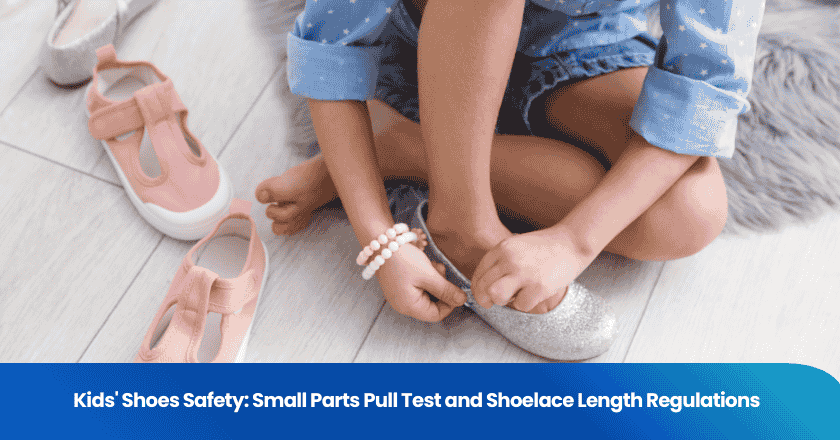
The structural integrity and mechanical safety of children's footwear are governed by a complex framework of international standards designed to mitigate lethal risks such as choking, aspiration, and entanglement. For Softline Products intended for infants and toddlers, the technical validation of every component—from decorative appliques to functional shoelaces—is a non-negotiable prerequisite for market entry. Ensuring that a rivet can withstand the kinetic force of a child's grip or that a lace does not present a tripping hazard requires rigorous adherence to metrological protocols like the Small Parts Pull Test and standardized length inspections. This guide provides an in-depth technical analysis of global regulatory requirements (CPSIA, EN 71) and the industrial methodologies used to certify pediatric footwear safety.
Key Takeaways
- Small parts validation (16 CFR 1501) utilizes a truncated cylinder to identify choking hazards for children under 36 months.
- Tension tests apply a constant 90-Newton force for 10 seconds to verify component attachment strength.
- Maximum shoelace length is restricted to 20cm to prevent playground entanglement and mechanical tripping.
- ASTM F963 and EN 71-1 provide the definitive benchmarks for mechanical and physical properties of footwear trims.
- Chemical bio-safety audits are mandatory for detecting restricted lead (Pb) and phthalates in pigments and adhesives.
- Professional quality control audits prevent 'Safety Fade' in mass-produced pediatric shoes.
The Physics of Choking Hazards: The Small Parts Cylinder
Technical evaluation of choking risks in pediatric footwear relies on the "Small Parts Cylinder" defined under 16 CFR 1501. This metrological tool simulates the dimensions of a small child's airway. Any component—such as a plastic jewel, metal rivet, or aglet—that detaches and fits entirely within the cylinder is classified as a Critical Hazard. For infants under 3 years of age, the aspiration risk is significant because their cognitive development does not yet include a robust "spit" reflex for non-food objects.
Metrological Dimensions of the Choke Tube
Industrial inspectors utilize stainless steel cylinders with a precise internal diameter of 31.7mm (1.25 inches). If an applique or a detached pull-tab fits into this space without compression, it fails the safety check. This standard is harmonized globally, ensuring that a shoe certified for the North American market also meets the fundamental safety logic of the European Union's EN 71-1.
| Feature | Technical Specification | Safety Objective |
|---|---|---|
| Cylinder Diameter | 31.7 mm (1.25 inches) | Simulate a child's throat opening |
| Test Environment | 21'C +/- 5'C; 65% RH | Ensure material elasticity is standardized |
| Pass Criteria | Zero parts in cylinder | Absolute choking mitigation |
Mechanical Detachment Resistance: The Pull Test Protocol
Detachable components are the primary source of small-part failures. To verify the security of these items, technicians utilize a Universal Testing Machine (UTM) or a handheld digital force gauge. The pull test measures the "Attachment Strength" of buttons, bows, and snap-fasteners. According to the **90-Newton Rule**, any component must withstand a pull force of 90N (approx. 20 lbs) for 10 seconds without detaching or fracturing.
Component-Specific Tension Analysis
During apparel and footwear quality inspections, different attachments require specialized clamping. For example, a metal rivet on a toddler's boot requires a "three-point claw" clamp to apply force evenly. Failure is often caused by the substrate (the leather or fabric) tearing before the metal part detaches, indicating that the material density itself is insufficient to support the safety trim.
| Attachment Type | Force (N) | Duration | Common Failure Mode |
|---|---|---|---|
| Rivets and Snaps | 90 N | 10 Seconds | Substrate blowout (fabric tear) |
| Decorative Appliques | 70 N | 10 Seconds | Adhesive delamination |
| Pull Tabs / Loops | 90 N | 10 Seconds | Seam rupture at attachment point |
| Eyelets | 90 N | 10 Seconds | Mechanical deformation of the ring |
Technical Standard: For products intended for infants under 18 months, many high-end brands tighten the requirement to 120N for 15 seconds, recognizing that these wearers are more likely to subject footwear to high-frequency biting and gnawing.
Shoelace Length and Entanglement Physics
In pediatric safety, shoelaces are categorized as "Functional Cords." Long laces represent a significant risk of "Mechanical Entanglement"—where the lace catches on a bicycle chain, an escalator comb, or a playground slide. This can result in serious orthopedic injury or accidental strangulation. Most global safety standards mandate that the free length of a shoelace must not exceed 20cm when the shoe is fully laced and tightened.
Measurement and Volumetric Control
During a professional footwear inspection, inspectors measure the lace from the exit point of the top eyelet to the tip of the aglet. The lace must not be stretched during measurement. If the lace is too long, the manufacturer must provide a "Lace Management System" (such as a velcro shroud) or shorten the lace. Furthermore, "Cord Locks" or "Stopper" components must also pass the small parts cylinder check to ensure they do not become a secondary hazard if they fall off.
Chemical Bio-Safety: CPSIA and REACH Requirements
Beyond mechanical failure, children's footwear must be chemically inert. The **Consumer Product Safety Improvement Act (CPSIA)** in the United States restricts the presence of Lead (Pb) in any accessible part of a child's shoe to 100ppm. Phthalates, used to soften PVC in midsoles and uppers, are also strictly regulated. Verification requires "Total Content" testing via ICP-OES (Inductively Coupled Plasma Optical Emission Spectroscopy) to detect heavy metals in pigments and surface coatings.
For global markets, manufacturers must ensure their supply chain adheres to the **ZDHC (Zero Discharge of Hazardous Chemicals)** framework. This involves auditing the dyeing and tanning houses to ensure that "Forbidden Azo Dyes" are not used in the lining fabric, as these can release carcinogenic aromatic amines when in contact with a child's sweaty foot.
The Importance of Zero Tolerance in Batch Audits
In standard quality control, a batch may pass if it contains a small percentage of minor defects. However, in safety-critical pediatric inspections, a single failure of a small parts pull test triggers a **Zero-Tolerance Failure**. This means the entire shipment is rejected for 100% rework. This high level of scrutiny is essential for protecting the brand from "Consumer Product Recalls," which can cost millions of dollars and cause irreparable damage to public trust.
Effective safety risk prevention requires that factories implement a "Broken Needle Policy." Every sewing station must log needle breakages and account for every fragment. If a fragment is missing, the garment must be passed through a conveyorized metal detector (calibrated to 0.8mm ferrous sensitivity) to ensure no sharp points remain embedded in the shoe's lining.
Ready to ensure your kids' shoes meet safety requirements and regulatory standards before shipment?
As your third-party inspection, testing & certification partner in China, TradeAider supports brands and sourcing teams across the entire production process—helping you identify potential safety risks such as small parts hazards and non-compliant shoelace lengths, ensure compliance with applicable regulations, and strengthen your quality control capabilities before shipment. Book an Inspection or Testing Service with TradeAider today, or for tailored solutions and expert guidance, contact us at services@tradeaider.com or click the button below.

Frequently Asked Questions (FAQ)
What is the "Sharp Point" and "Sharp Edge" test?
Governed by 16 CFR 1500.48 and 1500.49, these tests use specialized instruments to determine if a component has edges or points sharp enough to pierce or cut a child's skin. Any decorative buckle or zipper teeth must be "de-burred" to pass this technical validation.
Why are toddlers' shoes often made without shoelaces?
Technically, velcro (hook-and-loop) or elastic closures are superior for toddlers. They eliminate the entanglement risks associated with cords and support independent "donning and doffing." If laces are used, they are often "mock laces" that are sewn down to prevent them from becoming loose.
Does a "BPA-Free" label mean the shoe is safe?
Not necessarily. BPA is only one of many chemical risks. A technically safe shoe must also be "Lead-Free" and "Phthalate-Free." A comprehensive footwear lab report should confirm compliance with all restricted substance lists (RSL).
How can I verify if a shoe component is a "Small Part"?
You can perform a field check using a standardized "Choke Tube." However, for legal compliance, you must use a calibrated Small Parts Cylinder that meets the exact specifications of 16 CFR 1501. If the part can be oriented in any way to fit inside, it is a fail.
How often should a factory calibrate its pull-test force gauge?
For industrial quality control, the gauge should be verified daily using calibration weights and professionally calibrated by an ISO 17025 accredited laboratory every 6 to 12 months to ensure the 90N reading is accurate and legally defensible.
Related Articles

Grow your business with TradeAider Service
Click the button below to directly enter the TradeAider Service System. The simple steps from booking and payment to receiving reports are easy to operate.

