
- About Us

- Our Services
- Your Industry
- Resources
- News & Blog
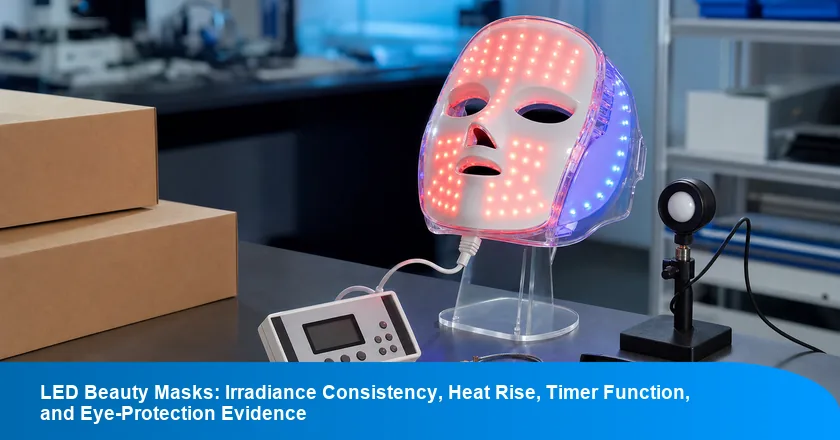
A production-lot LED beauty mask needs one evidence packet that links optical output, heat and timer behavior, eye protection, claims, instructions, and cartons to the same current build. It gives the buyer a single traceable basis for deciding whether the named lot can move, must be held, or needs to be separated from an unchanged subset.
For an LED beauty mask quality inspection, the practical question is not whether a sample lights up. It is whether the production build being packed has the same recorded optical output, programmed behavior, protective components, instructions, and carton identity as the evidence the buyer is relying on. The workflow below helps a Product Compliance Manager turn that question into a bounded production-lot release decision; it is not a certification, a conformity assessment, or legal advice.
What a Production-Lot LED Beauty Mask Release Must Prove
A release population means the identifiable masks and cartons covered by one buyer decision. That population should match a defined production build and a complete set of records. It should not use a pleasant cosmetic appearance, an LED count, or one supplier report as a shortcut. A usable packet ties the mask, controller, firmware, operating mode, optical map, eye-protection components, instructions, findings, and carton list together before the buyer decides whether to release, hold, or separate a subset.
- Evidence boundary: Each record identifies the same mask configuration, not merely the same product name.
- Operating check: The chosen mode completes a documented full programmed session, including its timer end state.
- Release rule: An unmatched controller, firmware, document version, or carton population is a reason to hold or segregate the affected subset until records align.
The buyer’s acceptance criteria still control the decision. Write them before the visit: the relevant SKU and revision, sample selection, named modes, measurement setup, duration, ambient condition, observable checks, document versions, defect classifications, and the record that connects sampled masks to packed cartons. This makes the inspection brief useful to the supplier, inspector, buyer, and logistics team without implying that inspection alone establishes product safety or market access.
Use the Four-Route Evidence Handoff Before Release
Use four separate routes to decide whether a lot is ready: build identity, optical output, operating behavior, and user-protection/claim documentation. The Four-Route Evidence Handoff means a buyer decision rule joining four records for one current production build. It makes a missing or mismatched route visible instead of allowing a strong document in one area to stand in for evidence from another. Set the route owners and handoff fields before production reaches final packing.
The Four-Route Evidence Handoff keeps optical, heat/timer, eye-protection, and claim/instruction evidence from being substituted for one another. It asks each route to identify the same current build and makes a gap visible before a buyer mistakenly lets a document from another configuration close it.
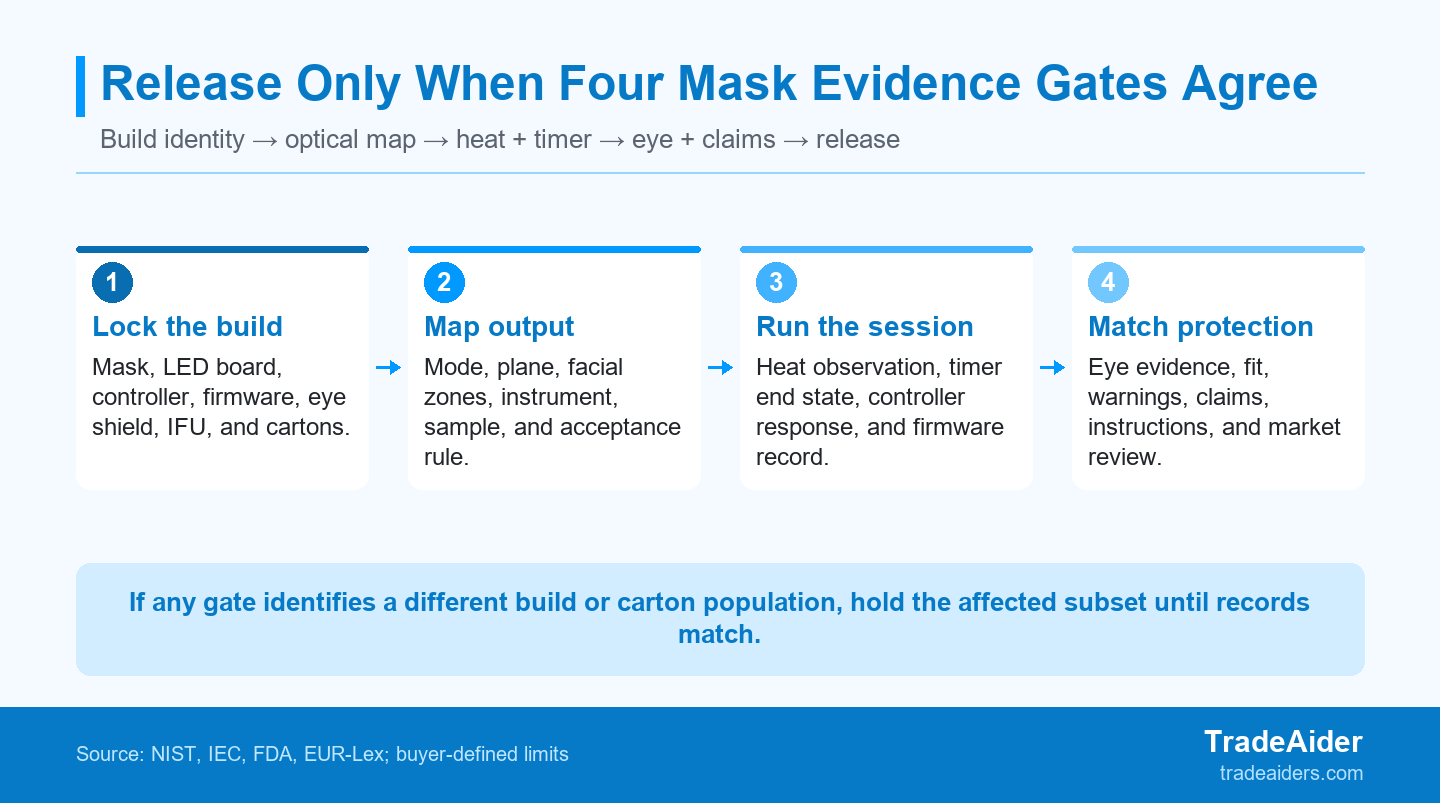
Use the four gates to confirm that every record and carton describes the same LED beauty-mask configuration before release.
Route one freezes identity: SKU, mask shell, LED board, controller revision, firmware version, eye shield, cable, instructions for use, retail box, and export-carton markings. Route two asks whether the stated output is mapped at named face zones. Route three observes the complete programmed session. Route four checks whether eye-protection records, warnings, claims, and instructions belong to the same build and intended-market review. Your inspection standard guidance can then name the buyer-defined criteria and evidence expected for each route.
Give every route one matching identifier. A simple configuration code can combine the SKU, controller/firmware revision, instructions revision, and carton range. If a supplier changes one of those elements, do not overwrite the old identifier. Open a new line in the release packet and decide whether the changed masks are a separate population. TradeAider can work from this buyer-created packet to scope production observations and flag technical or compliance questions for escalation. This is a control method for procurement evidence, not a claim that every change triggers a universal regulatory outcome.
Start With the Product Configuration, Not the LED Count
An LED count does not identify the wavelength, output distribution, diffuser, driver, firmware, face distance, or assembly that a release record must represent. Treat it as a marketing descriptor only, then record the component and document revisions that let a reviewer distinguish one actual build from another.
Start the brief with the configuration that will actually be inspected. Record the model and colorway, LED board drawing or revision, nominal wavelengths and modes supplied by the buyer, diffuser or lens arrangement, controller label, firmware version, cable and charging arrangement, eye-shield revision, instructions revision, retail-box artwork, and carton marks. Photograph or retain the identifiers used for traceability. A supplier’s output sheet is useful only when its device, setup, and controller match this definition. The result is a disciplined comparison point rather than a generic promise about all masks that share a marketing name.
Validate Irradiance at Defined Face Zones
An irradiance result is decision-ready only when it identifies the measurement plane, the operating mode, the face zones, the instrument or method reference, the sample, and the acceptance boundary chosen by the buyer. For this brief, the term test condition covers the selected mode, fixture setup, session length, ambient environment, sample, and acceptance boundary. Ask for a zoned irradiance map rather than a single headline number, then confirm that the mapped configuration is the one being packed.
Irradiance is radiant power received per unit area, so an LED mask report must state where and how the value was measured. The measurement position, distance or contact geometry, and selected mode belong beside the result; otherwise, a figure cannot be compared reliably across samples or revisions. See NIST’s radiometry overview.
For each selected mode, specify the face distance or mask contact geometry, measurement plane, positioning fixture, sensor orientation, sample identifier, ambient condition, warm-up state, and whether the value is an individual zone reading or a calculated summary. Retain the raw map or a clear zone-by-zone record alongside the buyer’s tolerance. A single average can conceal low-output areas near a contour or a configuration that no longer matches the tested unit. When the question needs specialist optical, thermal, or documented safety work beyond observable inspection, scope it through a product testing service rather than treating a factory-floor observation as a substitute.
Map the Eye Contour, Cheeks, Chin, and Other Named Zones
PISÉO describes mapping radiation uniformity across facial areas such as the eye contour, cheeks, nasolabial folds, and chin. Such named locations turn a vague request for even output into a map the buyer can compare with its own acceptance rule, without implying that the cited page sets that rule. See its LED-therapy-mask testing overview.
Name the zones on the map before looking at the result: left and right eye contour, upper cheek, lower cheek, nasolabial area, chin, forehead, and any other area relevant to the product’s fit and intended mode. The purpose is not to declare a universal “good” value. It is to make variation readable against the buyer’s stated acceptance rule and to ensure the reading location can be reproduced. Mark zones that cannot be measured under the defined setup and explain why; a blank zone is not evidence of uniformity. Result: the buyer can see whether a named location is verified, unresolved, or outside the agreed method, rather than misreading an average as proof for the whole face. Keep the map, sample ID, and configuration code together in the optical route.
Check Heat Rise, Timer Function, and Firmware as One Operating System
Check heat observation, timer behavior, controller response, and firmware identity during the same full programmed session. A functional spot check at switch-on cannot show what happens near automatic shutoff or after a controller has operated for the intended duration. Establish the buyer’s observable checks and acceptance limits in advance, record the ambient condition and starting state, and treat an unrecorded firmware revision as a configuration mismatch rather than a minor paperwork gap.
FDA notes that carefully controlled light-based energy can heat tissue and that light-based energy procedures can injure the eyes within its body-contouring discussion. The cited material concerns body-contouring technology and supplies background for controlled observation, rather than a numerical criterion for an LED beauty mask. See the FDA’s body-contouring safety discussion.
For the production build, document the selected mode, start time, full programmed duration, sample location or points for the buyer-defined thermal observation, controller label, firmware version, and shutdown or end-of-session state. A during-production inspection service can be scoped when a controller, assembly, or firmware change needs containment before final packing removes practical options.
Run the Full Programmed Session and Record Its End State
One FDA device record lists a 70 mW/cm² irradiance figure and automatic shutdown when the treatment time ends for that model. Its product-specific pairing shows why an output number and timer behavior should remain associated with the named device rather than becoming a generic target. See the FDA device record.
Those values and functions apply only to the cited model; they do not set a target for another mask. For the lot under review, run the buyer-defined complete session on a traceable unit. Record start mode, controller and firmware identifier, elapsed time, any display or indicator behavior, observed heat data under the defined method, automatic shutdown or other programmed end state, and whether the unit can be restarted only as described in the current instructions. Capture exceptions precisely. “Timer works” is too vague to explain whether the tested behavior belongs to the cartons waiting for release.
Treat Eye Shields as One Part of the Eye-Protection Evidence
An eye shield is an important physical component, but it does not independently answer the eye-protection question. The release packet needs to show which shield, fit arrangement, optical configuration, warnings, and instructions belong to the tested build, while the applicable optical-risk evidence is handled through the appropriate technical route. Inspectors can verify presence, fit, markings, and configuration identity; they should not turn those observations into a safety classification or a claim of suitability for every user or market.
IEC 62471 gives a reference measurement technique and classification scheme for photobiological hazards from LEDs and other non-laser optical sources. This supports retaining an applicable optical-risk route alongside, rather than inside, a simple component-presence check. See the IEC 62471 publication page.
An FDA record describes a mask configuration with eye shield, controller, cable, straps, and automatic shutdown. The cited component list is product-specific, which is why a buyer should capture the exact protective component and controller revisions that travel with the reviewed configuration. See that product-specific FDA record.
The standard reference and device record illustrate why evidence must remain configuration-specific; neither establishes a result for the mask in your cartons. Check that the eye shield is the correct revision, seats as the buyer’s configuration specifies, is present in the required quantity, and matches the instructions, accessories list, packaging, and warnings. Escalate questions about photobiological evaluation, claimed protection, or market applicability to the responsible technical or compliance route. Do not use a shield-only observation to approve a claim, waive an evaluation, or create a universal safety conclusion.
Keep Claims and Instructions Aligned With the Tested Build
Review the current labels, instructions, warnings, sales copy, and intended-market materials beside the exact device configuration, not as a late artwork task. A change to output mode, automatic timing, eye-shield design, charging instructions, or controller behavior may also make an old document set a poor match for the production lot. The release packet should identify the document versions reviewed and clearly route unresolved compliance questions to the qualified owner rather than treating a visual document check as a regulatory decision.
EU MDR defines intended purpose through manufacturer-supplied label, instructions for use, promotional or sales materials, and clinical evaluation. That definition explains why the document set should be reviewed as part of the build record rather than only after finished goods have been counted. See the official EU MDR text.
IEC 60601-2-57 applies to non-laser optical-radiation equipment for therapeutic, diagnostic, monitoring, cosmetic, and aesthetic uses. Its publication page describes equipment with one or more optical-radiation sources in the 200 nm to 3 000 nm range. Whether it applies to one product depends on the product facts and market requirements, so an inspection brief should record its own boundary and escalate that determination. See IEC 60601-2-57’s publication page.
These sources describe regulatory and equipment-scope context, not a determination for a particular LED beauty mask. In the inspection brief, use plain document controls: approved version, language set, controller/firmware association, warnings linked to actual modes, accessories shown as packed, and a responsible person for market-specific review. If the production build changes after the documents were approved, preserve the old and revised versions, identify affected cartons, and do not assume that a prior report automatically covers the new combination.
Worked Scenario: A Timer Firmware Change Creates a Split-Release Decision
The following illustrative scenario shows why traceability can produce a more useful outcome than treating all cartons as one undifferentiated lot. It uses 1,800 masks in 60 cartons and a late controller change, but its quantities do not create a universal release rule. The decision logic is simple: separate what can be identified, hold what lacks matched evidence, and avoid applying an old record to a changed configuration merely because the exterior carton looks similar.
A traceable revised-controller subset should stay on hold when its full-session evidence and instructions do not yet match the changed masks. In this illustration, that bounded hold prevents an older controller record from being silently applied to cartons that can be identified as revised.
Situation, Problem, Action, and Result
The illustrative firmware-change scenario requires carton segregation, matched full-session verification, document review, and a rebuilt record before the changed cartons can be reconsidered. The path limits the decision to the affected subset and preserves an auditable reason for the hold while corrective work is completed.
A private-label consumer brand is preparing an LED beauty mask with a flexible mask body, LED board, removable eye shields, rechargeable controller, USB charging cable, retail box, instructions, and export cartons. The illustrative order contains 1,800 masks in 60 export cartons. The buyer has an approved optical report and a controller specification, but the supplier introduced a revised timer firmware after the optical report was issued.
Twelve cartons, containing 360 masks, carry a traceable controller revision code while the remaining 48 cartons retain the original documented controller code. The revised-controller packet identifies the firmware version but does not show a matched full-session timer check, a heat observation, or confirmation that the current instructions and warnings match the changed behavior. This is a late-change split-release question: the unchanged and changed populations can be considered separately only if carton and controller records preserve the boundary.
Keep the 12 traceable revised-controller cartons on hold and treat the 48 original-code cartons as a separate population pending the buyer's release decision and record review. The supplier identifies the revised masks, runs the buyer-defined programmed-session check on the revised configuration, records the controller and firmware version, verifies the relevant instructions and warnings, and updates the carton map.
The held subset can be reconsidered only when the revised controller, test condition, observed timer and heat behavior, instructions, and carton population all point to the same masks. The quantities and change are illustrative. They do not establish a universal heat limit, timer duration, safety classification, claim approval, or legal release decision.
Result: the buyer gains a clearer decision boundary, not an automatic release for the 48 cartons. Original-code cartons can be reviewed as one documented population and revised-controller cartons as another, rather than becoming an untraceable mixed lot. For the held subset, the new evidence must show the complete operating sequence, the exact revision, the applicable document set, and the cartons it covers. If any link remains unknown, the packet should report that fact and preserve the hold.
Build a Release Packet That Survives the Final Handoff
A final handoff should let a new reviewer understand what was built, what was observed, which records were consulted, which cartons are in scope, and how any exception was disposed. Build the packet before the inspection date so the supplier knows which identifiers and documents must be available. Then update it with actual observations rather than replacing it with a generic pass/fail note. The output is a traceable buyer record, not a substitute for applicable testing, certification, or compliance review.
A release packet should identify the build, optical map, heat/timer record, eye-protection evidence, claims/instructions version, findings, disposition, and carton population. This buyer-designed index helps a later reviewer follow one decision across supplier, inspector, buyer, and logistics handoffs without pretending that one universal format fits every market.
For the final production lot, a Pre-Shipment Inspection service can be scoped around the agreed packet and the identifiable cartons actually presented. Include the configuration code; unit and carton identifiers; optical-map reference and test condition; full-session record; eye-shield/accessory observations; current document and artwork versions; sampling and findings; photos where useful; exception ownership; corrective evidence; release/hold/segregation disposition; and a carton map. Keep buyer-defined acceptance limits distinct from observations and supplier explanations.
Use a short handoff checklist when the lot moves from factory to inspection to buyer approval. First, compare the controller and firmware ID on sampled masks with the packet. Next, compare the instructions, warnings, accessories, and retail-box version with the approved configuration. Then make sure the optical and operating records name the same build. Finally, reconcile the carton list to the population that the buyer is actually deciding on. This sequence makes it harder for a late change to disappear inside a finished-goods count.
Before a request is sent, compare the supplier’s final packing list with the carton map and make sure the packet records which units or cartons were sampled. Ask the supplier to preserve the controller and firmware identifiers for any changed configuration, even when labels and cartons appear otherwise identical. If a report, instructions, or photo cannot be linked to the actual goods, list it as an unresolved gap rather than adding it to the release packet. That small discipline keeps later buyer approval focused on matched evidence rather than on a pile of attachments.
For a scoped request, send your LED mask evidence brief.
Who Is TradeAider?
TradeAider is a quality inspection, testing, and certification service provider in China. For LED beauty masks, a useful request starts with the buyer’s product configuration, selected modes, expected documents, sampling timing, and acceptance criteria. This lets the inspection scope distinguish observable production facts from questions that call for specialist optical testing, technical review, or market-specific compliance judgment. The buyer remains responsible for the final release decision and for any applicable legal or technical determination.
Its coverage includes Guangdong, Zhejiang, Jiangsu, Shandong and Fujian, with project coordination built around the buyer’s approved configuration, sample needs, schedule, and handoff record. For Inspection & QA Services, the stated rate is $199/man-day all-inclusive. Scope, travel availability, and specialist work should be confirmed for the actual product and factory location. TradeAider reports client-identified outcomes including an 18% reduction in defect rates and a 23% faster inspection process; these are client-reported results, not a promised outcome for a future lot. For a time-sensitive visit, the buyer should state known changes, the retail and export cartons in scope, how existing records are named, and who will make the final hold or release decision. This keeps factory preparation, sampling, and reporting connected to one product population.
TradeAider can use a buyer's configuration packet to scope production-lot inspection observations and clearly identify testing or compliance questions that need escalation. For an LED beauty mask, the most useful handoff is a clear build definition, named acceptance checks, and an explicit escalation path for unresolved issues. Its profile identifies it as an Amazon Service Provider Network (SPN) partner.
FAQs
Is a supplier irradiance report enough for production release?
No, a supplier irradiance report is enough only when its sample, mode, measurement plane, and build identity match the masks being released. Check that the report names the current controller and firmware where relevant, shows the zones and test condition, and connects to the carton population. If a build element has changed, keep the changed subset separate until the buyer has matching evidence and a documented disposition.
Should an LED beauty mask be checked while charging?
Check charging behavior against the approved instructions, because a charging condition or prohibited use mode must not be silently substituted during a functional test. State whether the selected session is run on battery, while connected, or under another approved condition. Record what was done and treat a contradiction between observed behavior and the current instructions as a document/configuration question to resolve, not as an undocumented assumption.
Can an eye shield replace optical safety evidence?
No, an eye shield is a physical component and cannot replace the applicable optical-safety evaluation, fit evidence, warnings, and instructions for the specific device configuration. Inspecting presence and fit helps confirm that the packed configuration matches the packet. It does not classify photobiological risk, approve a protective claim, or decide which technical evidence applies to a product in a particular market.
When should a changed firmware lot be held?
Hold a changed firmware lot when the change affects mode, timer, output, warnings, or records and the buyer cannot trace matching verification to the affected masks. Preserve the original and revised identifiers, map cartons to the appropriate version, and define the required full-session, document, and configuration checks. Reconsider only the subset whose evidence, instructions, and cartons now describe the same released build.
Related Articles

Grow your business with TradeAider Service
Click the button below to directly enter the TradeAider Service System. The simple steps from booking and payment to receiving reports are easy to operate.

