
- About Us

- Our Services
- Your Industry
- Resources
- News & Blog
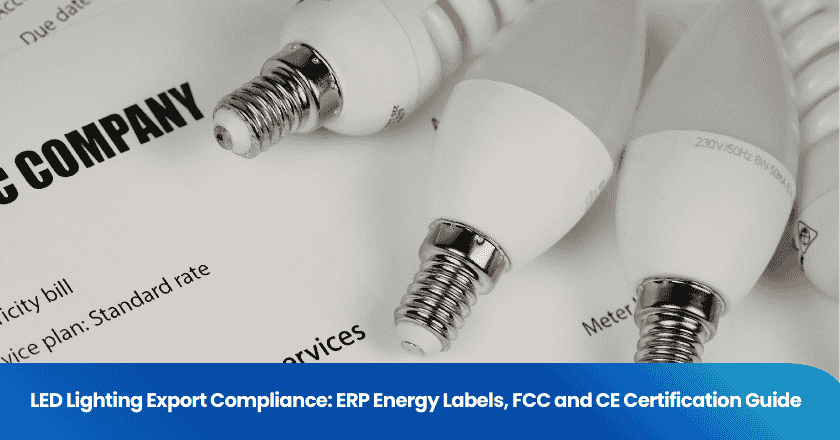
LED lighting export compliance is a multi-layered requirement that covers energy labeling, electromagnetic compatibility, electrical safety, and restricted substances. Exporters targeting the EU must satisfy ERP energy label requirements and obtain CE certification. Those targeting the US market need FCC certification. Missing or incorrect documentation leads to customs rejection, market withdrawal, or legal liability. This guide explains what each requirement covers, how inspections verify compliance, and what exporters can do to avoid common pitfalls.
Key Takeaways
- EU exporters must register LED products in the EPREL database and display an ERP energy label on product, packaging, and website.
- CE certification covers the Low Voltage Directive, EMC Directive, and RoHS -- all three are mandatory for EU market access.
- FCC Part 15 certification is required for LED products sold in the US; Class B (residential) carries stricter emission limits than Class A.
- Accurate labeling and matching test results prevent compliance failures that cause costly shipment delays.
- Real-time inspection reporting enables on-site correction of issues before products leave the factory.
ERP Energy Labels for LED Lighting Export Compliance
ERP Energy Label Overview
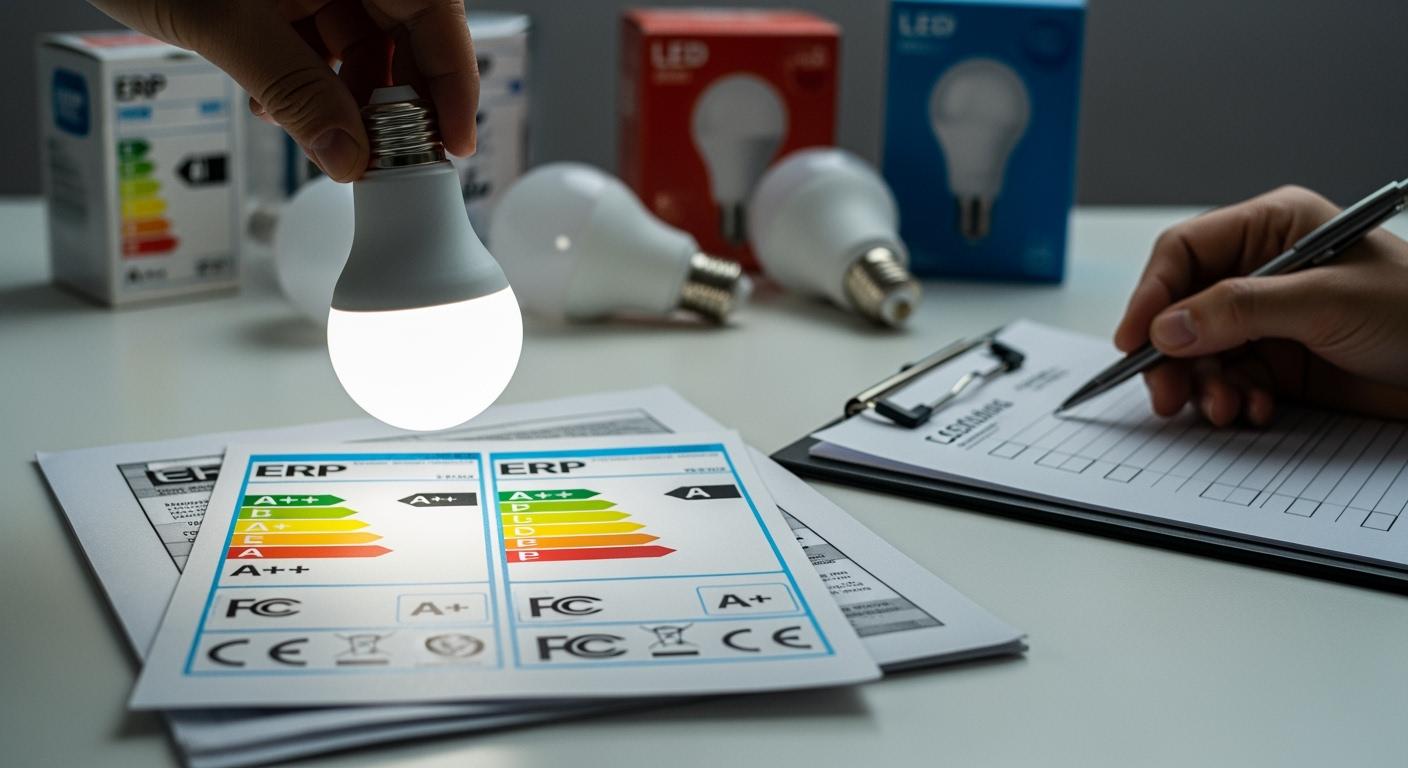
The Energy-related Products (ErP) Directive governs all LED lighting sold in the European Union. Regulations EU 2019/2020 expanded the scope to include LED products embedded in household appliances and furniture, introduced a new A-to-G energy efficiency scale replacing the old A++ to E system, and added new flicker test requirements. All products must be registered in the European Product Registry for Energy Labelling (EPREL) before sale.
| Aspect | New Regulations (EU 2019/2020) | Previous Requirements |
|---|---|---|
| Scope | Includes appliances, furniture lighting | Limited scope |
| Efficiency Calculation | Pon Max replaces EEI index | EEI index |
| Energy Class Scale | A-G | A++ to E |
| Flicker Testing | SVM and Pst parameters required | Not specified |
| Endurance Test | 3,600 hours with lumen maintenance requirements | Not specified |
| Test Sample Count | Reduced to 10 units | Higher count required |
The energy label must display the supplier name, product model, energy efficiency class, power loss, and an energy efficiency QR code. It must appear on the product itself, the outer packaging, and the manufacturer's website. Technical documentation supporting all label claims must be maintained and available to regulators on request.
Energy Efficiency Testing for LED Lighting
Testing is central to ERP certification. Inspectors use standardized methods to measure luminous flux, power consumption, color maintenance, and flicker performance:
| Standard | Scope |
|---|---|
| EN 62612 + amendments | General performance requirements for self-ballasted LED lamps |
| IEC 62722-1:2014 | General requirements for LED luminaires |
| IES LM-79-19 | Electrical and photometric measurement methods |
| ANSI/IES LM-80-15 | Luminous flux and color maintenance of LED packages |
TradeAider's on-site inspectors verify that technical claims on the energy label match actual measured performance. Standby power, total power draw, and efficiency class are confirmed against test data. If measurements do not match label claims, the issue is reported immediately so corrections can be made before export.
Common Label Compliance Issues
The most frequent compliance failures include missing or outdated label information (particularly after the 2021 scale change), mismatched technical claims between the label and test report, and failure to register in EPREL before market entry. Exporters must also note that EU and US standards differ: the EU mandates EPREL registration and detailed technical files; the US relies more on voluntary programs and self-declaration. Products should be assessed against the specific requirements of each destination market.
Tip: Accurate labeling and thorough testing help LED lighting products pass compliance checks and enter international markets without delays.
FCC and CE Certification for LED Lighting

CE Certification Requirements
CE marking is mandatory for all LED lighting products entering the EU. It demonstrates conformity with applicable directives. The process involves identifying applicable directives, testing to harmonized standards, compiling a technical file, signing a Declaration of Conformity, and affixing the CE mark.
The three primary directives for LED lighting are:
- Low Voltage Directive (LVD) 2014/35/EU: electrical safety for equipment operating within specified voltage ranges.
- Electromagnetic Compatibility (EMC) Directive 2014/30/EU: limits on electromagnetic emissions and immunity requirements.
- RoHS Directive 2011/65/EU: restricts lead, mercury, cadmium, hexavalent chromium, PBB, and PBDE in electrical products.
| CE Certification Step | Description |
|---|---|
| 1 | Identify applicable EU directives and regulations |
| 2 | Identify harmonized standards for each directive |
| 3 | Perform accredited laboratory testing |
| 4 | Compile the technical file |
| 5 | Sign the Declaration of Conformity |
| 6 | Affix the CE mark to product, packaging, and documentation |
FCC Certification and Testing
FCC certification under Part 15 is mandatory for LED products exported to the US. LEDs that use switching power supplies or wireless control modules must demonstrate that their emissions do not cause harmful interference. The regulation distinguishes between Class A (commercial) and Class B (residential) devices:
| Requirement | Class A (Commercial) | Class B (Residential) |
|---|---|---|
| Emission Limits | Less stringent | More stringent (proximity to sensitive equipment) |
| Testing | Required at accredited lab | Required at accredited lab |
| FCC Logo | Not required (recommended) | Compliance statement required on packaging or manual |
| Declaration | Supplier's Declaration of Conformity | Supplier's Declaration of Conformity |
FCC testing includes conducted spurious emissions, radiated spurious emissions, conducted emissions band-edge compliance, maximum peak conducted output power, and antenna performance. All tests must be performed at an FCC-recognized testing facility.
Avoiding Compliance Pitfalls
Missing certifications are the most common cause of customs rejection. Failure to meet LVD or EMC requirements creates legal liability and potential product recalls. Non-compliance incurs storage fees, re-testing costs, and lost sales windows. To avoid these outcomes, exporters should work with accredited labs from the product design stage, maintain up-to-date technical documentation, and monitor regulatory changes in each target market.
Additional certifications that support compliance and market access:
| Certification | Market | Purpose |
|---|---|---|
| ETL | US and Canada | Safety compliance recognized by North American authorities |
| UL | Global | Electrical and fire safety; widely recognized by buyers |
| Energy Star | US | Energy efficiency program; improves market acceptance |
| RoHS | EU and global | Hazardous substance restrictions; required for EU and many other markets |
Tip: Early planning and thorough testing help manufacturers avoid compliance issues and succeed in global markets.
LED Lighting Export Compliance Inspection Checklist
Essential Documents
Every LED lighting export shipment should be accompanied by the following documentation:
| Document | Purpose |
|---|---|
| FCC Supplier's Declaration of Conformity | Confirms FCC Part 15 compliance for US market |
| CE Declaration of Conformity + Technical File | Confirms LVD, EMC, and RoHS compliance for EU market |
| RoHS Test Report | Demonstrates restricted substance compliance |
| ERP Energy Label + EPREL Registration | Required for EU energy labeling compliance |
| LM-79 / LM-80 Photometric Reports | Supports lumen, efficacy, and depreciation claims |
Inspection Procedures and Best Practices
On-site inspectors check electrical safety, insulation integrity, grounding, and labeling against test reports. They verify that restricted substance compliance certificates are current and that energy label information matches the measured performance data. Key regulations covered during inspection:
| Regulation | What Inspectors Check |
|---|---|
| RoHS Directive | Lead, mercury, cadmium, hexavalent chromium, PBB, PBDE, DEHP, BBP, DBP, DIBP |
| Low Voltage Directive | Electrical safety: insulation, creepage, clearance, earthing |
| EMC Directive | Conducted and radiated emissions; immunity to interference |
| GPSD | General product safety; instructions for safe use |
Real-Time Reporting and Quality Control
TradeAider's inspection system captures data digitally, enabling immediate reporting of non-conformances. If an inspector identifies a label mismatch or missing certificate, the client is notified in real time and can authorize on-site correction before the shipment leaves the factory. Official reports with photographic evidence are delivered within 24 hours, providing full traceability for compliance records.
Tip: Real-time reporting and on-site rectification help exporters avoid delays and maintain compliance with all regulations.
Successful LED lighting export requires aligning ERP energy labels, CE certification, FCC certification, and RoHS compliance before any product leaves the factory. Third-party inspection provides the independent verification that buyers, customs authorities, and regulators require. Ongoing compliance monitoring -- tracking regulatory updates and maintaining current documentation -- protects market access and reduces the risk of costly non-conformance events.
Ready to secure your LED Lighting quality before shipment?
As your third-party inspection, testing & certification partner in China, TradeAider supports brands and sourcing teams across the entire production process, helping you identify quality risks early, ensure compliance, and strengthen your team’s capabilities before shipment.
Book an Inspection or Testing Service with TradeAider today, or for tailored solutions and expert guidance, contact us at services@tradeaider.com.
FAQ
What is the main purpose of ERP energy labels for LED lighting?
ERP energy labels show buyers the energy efficiency class, power consumption, and key performance data for LED products. They are mandatory for EU market entry and support informed purchasing decisions. Products must be registered in the EPREL database before the label can be applied.
Why do LED lighting products need CE and FCC certification?
CE certification confirms compliance with EU safety, EMC, and environmental directives. FCC certification confirms that the product's emissions do not cause harmful interference in the US. Both are legally required to sell in their respective markets.
What documents are required for LED lighting export compliance?
Exporters need CE and FCC Declarations of Conformity, RoHS test reports, ERP energy label documentation with EPREL registration number, and LM-79/LM-80 photometric test reports. A complete technical file must be maintained and available to regulators.
How does real-time reporting improve LED lighting inspections?
Real-time reporting lets clients see inspection findings as they occur. Non-conformances can be corrected on-site before shipment, reducing rework costs, avoiding customs delays, and maintaining full documentation traceability.
What are common mistakes in LED lighting export compliance?
The most common errors are missing or outdated certifications, energy label information that does not match test data, and failure to update documentation after product changes. These mistakes cause shipment delays, customs rejections, and potential legal penalties. Systematic pre-shipment inspection and accurate record-keeping prevent most of these issues.
Related Articles


Grow your business with TradeAider Service
Click the button below to directly enter the TradeAider Service System. The simple steps from booking and payment to receiving reports are easy to operate.

