
- About Us

- Our Services
- Your Industry
- Resources
- News & Blog
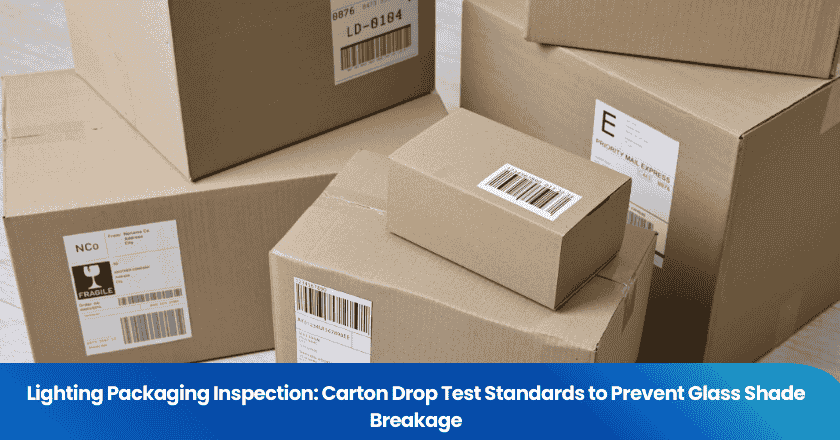
Glass shade breakage on packing lines is classified as an extreme hazard in food and beverage packaging environments, and similar logic applies to lighting export: a single glass breakage during transit can contaminate or destroy multiple products in a master carton, halt incoming goods inspection, and trigger costly returns. Carton drop testing simulates the real-world impacts packaging experiences during loading, transport, and unloading, providing objective evidence before shipment that the packaging design can protect fragile components. This guide covers the standards, procedures, and defect classification framework inspectors use for lighting packaging quality assurance.
Key Takeaways
- Carton drop tests provide objective evidence that packaging will protect glass shades during real-world shipping impacts. Visual assessment of packaging alone is insufficient for fragile lighting products.
- ASTM and ISTA standards serve different purposes: ASTM (D5276, D4169) provides flexible engineering data for R&D; ISTA (1A, 3A, 6-Amazon) provides rigid pass/fail criteria for retailer certification.
- Under ANSI/ASQ Z1.4-2008, any glass breakage constitutes a critical defect with 0% tolerance — one failure in the sample results in batch rejection.
- Conditioning packages at 23 degrees Celsius +/-2 and 50% +/-5% relative humidity for 24 hours before testing is mandatory for reproducible results under international standards.
- Real-time inspection reporting allows buyers to request packaging redesign while the inspection is still in progress, before shipment is authorised.
Why Glass Shade Breakage Occurs During Shipping
Glass shades fail during shipping through three main mechanisms. Edge damage accounts for most in-transit breakage: glass edges are inherently weaker than the surface due to micro-fractures introduced during cutting. When a carton falls on a corner or edge during forklift loading or drop from a conveyor, the glass edge experiences concentrated impact force that propagates into a crack. Thermal stress causes breakage when containers experience large temperature swings — a common occurrence in air-sea combinations or extended cold-chain storage — causing the glass to expand and contract differentially. Spontaneous breakage occurs much less frequently and traces to internal inclusions (nickel sulphide, alumina particles) in the glass that change phase over time, creating localised stress fields.
The business impact extends beyond replacing broken units. Production line delays occur when teams must halt incoming goods inspection to clean glass fragments. Customer return processing, freight costs, and reputational damage compound the direct product cost. One pallet of damaged chandeliers at a European distributor can generate returns, replacement shipping, and customer service costs many times the value of the original order margin.
Drop Test Standards: ISTA, ASTM, and ISO
ASTM vs. ISTA: Choosing the Right Standard
The two most widely referenced frameworks for drop testing are ASTM International and the International Safe Transit Association (ISTA). They are designed for different purposes and should not be treated as interchangeable.
| Feature | ASTM (D5276, D4169) | ISTA (1A, 3A, 6-Amazon) |
|---|---|---|
| Core Focus | Test method and physics: precise drop angle, surface, velocity | Shipping scenario: simulates a specific distribution channel |
| Flexibility | High: adjustable height and intensity for engineering data | Low: rigid pass/fail criteria without deviation allowed |
| Primary Use | R&D, cushioning material comparison, regulatory compliance | Final package validation, retailer certification (Amazon, Walmart) |
| Key Benefit | Statistically significant repeatable engineering data | Real-world simulation proving readiness for distribution |
| Certification Output | Engineering report; no direct certification | ISTA certificate valid for retailer submission |
ISO 2248 provides another international drop test methodology that specifies test surface hardness, conditioning requirements, and result documentation format. Buyers shipping to multiple markets should confirm which standard their retail or distribution partners require before specifying the test protocol.
Defect Classification Under ANSI/ASQ Z1.4-2008
Sampling and defect classification follow ANSI/ASQ Z1.4-2008 for most pre-shipment packaging inspections. The defect severity levels and their acceptance thresholds are:
| Defect Type | Description | Acceptance Level (AQL) |
|---|---|---|
| Critical | Violates safety regulations or poses direct risk to user (e.g., broken glass, exposed live parts) | 0% - one occurrence causes batch rejection |
| Major | Likely to cause product returns; does not create safety risk (e.g., cosmetic glass chips, deformed shade) | 2.5% |
| Minor | Below acceptable quality in quantity but unlikely to cause returns individually (e.g., minor carton crush with product intact) | 4.0% |
For glass lighting products, any breakage of glass shades is automatically classified as a critical defect. One broken shade in the tested sample triggers batch rejection and requires corrective action — typically redesign of cushioning or carton configuration — before re-inspection.
Drop Test Procedure: Step-by-Step
Sample Selection and Conditioning
Inspectors select cartons randomly from throughout the production batch to avoid sampling bias. Cartons from the beginning and end of the packing run, and from different positions in the pallet stack, are included in the sample. Before testing, cartons are conditioned at 23 degrees Celsius +/-2 and 50% +/-5% relative humidity for a minimum of 24 hours. This conditioning period standardises the moisture content of the corrugated board, which significantly affects its cushioning performance. Cartons tested immediately after packing — before conditioning — will consistently show better drop performance than conditioned cartons because the fresh board retains moisture-driven stiffness that diminishes during storage and transit.
Inspectors photograph each carton before conditioning and record gross weight. Drop height in most standards is determined by gross package weight. Heavier cartons are dropped from lower heights because they carry more kinetic energy at impact; the height-weight relationship is designed to produce equivalent impact forces across different package sizes.
Drop Sequence
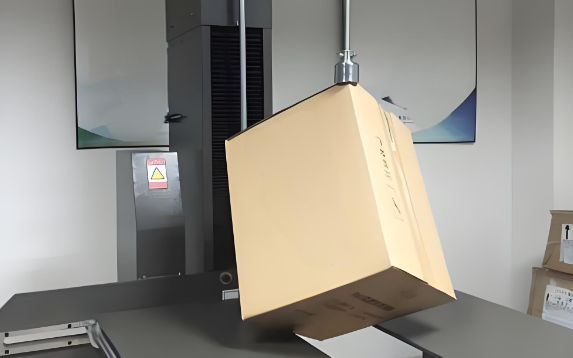
The standard drop sequence tests all vulnerable orientations of the carton. The complete sequence begins with the most fragile corner (if unknown, inspectors use the 2-3-5 corner convention), followed by the three edges radiating from that corner in order from shortest to longest, then all six faces in order from smallest to largest. Drops are free-fall — the carton is released from the specified height and falls onto a rigid steel or concrete surface. The sequence simulates the range of impacts a carton experiences during manual handling, conveyor transitions, and vehicle transport.
- Drop on the most fragile corner (or 2-3-5 corner if fragile corner is unknown).
- Drop on the shortest edge radiating from that corner.
- Drop on the next longest edge radiating from that corner.
- Drop on the longest edge radiating from that corner.
- Drop flat on the smallest face.
- Drop flat on the opposite smallest face.
- Drop flat on a medium face.
- Drop flat on the opposite medium face.
- Drop flat on the largest face.
- Drop flat on the opposite largest face.
Post-Drop Inspection and Defect Handling
After completing the full drop sequence, inspectors open each carton and examine all contents under adequate lighting. For glass shade products, they inspect for complete breakage, chips at edges or contact points, hairline cracks (which may not be immediately visible; rotating the shade in angled light reveals them), and any loosening of the shade's mounting point that could cause breakage in subsequent handling. The outer carton is assessed for severe deformation that would compromise the remaining cushioning function for subsequent cartons in a stacked pallet.
All findings are documented in a structured report that records the test standard applied, carton configuration, gross weight, drop height, drop sequence, and detailed description with photographs of each defect found. If inspectors cannot complete the sequence or if the report does not accurately reflect the actual test, they flag this for retest. An incomplete or inaccurate drop test report is not a passing result — it is a documentation failure that requires resolution before the batch can be cleared.
Tip: Real-time reporting during the drop test allows buyers to observe test results as they occur and request packaging design changes before the production batch is authorised for shipment. This is significantly less costly than rejecting a completed batch.
Best Practices for Packaging Glass Lighting Products
Internal Cushioning Design
The most effective packaging for glass shades combines multiple cushioning elements that address different impact scenarios. Expanded polyethylene (EPE) foam inserts moulded to the shade's exact profile distribute impact forces across the entire surface rather than concentrating them at contact points. The shade must be immobilised within the inner box — it should not shift under any combination of the drop orientations tested. A shade that can shift even 5 millimetres during a corner drop will experience contact stress at the point of impact that a correctly fitted insert would have absorbed.
For master cartons containing multiple inner boxes, the space between inner boxes must also be filled. Corrugated dividers, EPE sheet layers between inner box rows, and tight packing that prevents vertical shifting of inner boxes all contribute to protecting contents. Inspectors verify that the actual packing method matches the approved specification: padding dimensions, material grade, and number of layers must all be confirmed, not assumed.
Sealing requirements matter for maintaining the carton's structural integrity through multiple handling impacts. Inner boxes use 2-inch transparent tape along all seams; outer cartons use 3-inch tape. For heavy or high-value products, H-taping (tape across all box seams in an H pattern) provides better burst resistance than centre seam taping alone.
Continuous Improvement and Factory Cooperation
Packaging quality improves when factories receive specific, documented feedback after each inspection rather than only a pass/fail result. Inspectors provide photographs of exactly where breakage or deformation occurred, which enables the packaging engineer to identify the specific failure mode. A shade broken at the rim after a corner drop indicates insufficient rim protection in the EPE insert; a shade broken across the dome after a flat face drop indicates the insert is not supporting the shade profile correctly at that orientation.
Buyers improve factory cooperation by providing inspection requirements in the purchase order rather than communicating them only when the inspector arrives. Sending the quality control checklist before production begins allows the factory to prepare the correct packing materials and brief their packing team. Clear definition of who authorises shipment when inspection results are borderline, and what process applies when the factory disputes an inspection finding, prevents delays and misunderstandings that erode commercial relationships.
| Communication Practice | Benefit |
|---|---|
| Include inspection requirements in purchase order | Factory prepares materials and staff; no surprises on inspection day |
| Send QC checklist before production | Factory briefs packing team on specific requirements |
| Specify defect classification in advance | Eliminates disputes about severity classification after inspection |
| Define shipment hold/release authority clearly | Prevents unauthorised shipment of uninspected or failed batches |
| Provide specific feedback with photos after each inspection | Enables targeted corrective actions rather than generic improvement requests |
FAQ
What is a carton drop test?
A carton drop test is a standardised procedure that assesses whether packaging can protect its contents through the impacts that occur during normal shipping and handling. Inspectors drop a packed carton from a specified height onto a rigid surface and evaluate both the carton structure and the product inside for damage. The drop height is determined by the carton's gross weight.
Why do lighting products with glass shades require special packaging tests?
Glass shades are highly sensitive to edge impacts and thermal stress. Standard visual assessment of packaging cannot predict how the interior cushioning will perform under the dynamic loads of shipping. Drop testing provides objective, reproducible evidence that the packaging design protects the specific fragile component under realistic transit conditions.
How do inspectors select cartons for drop testing?
Cartons are selected randomly from throughout the production batch using the ANSI/ASQ Z1.4-2008 sampling plan. The sample includes cartons from different positions in the pallet and different times during the packing run. This approach ensures the sample represents the overall batch quality rather than only the most recently packed cartons.
What happens if a carton fails the drop test?
Any glass shade breakage constitutes a critical defect with 0% tolerance under ANSI/ASQ Z1.4-2008. The batch fails inspection and cannot be shipped until the packaging is redesigned and retested. The inspector documents the failure mode in detail — where the glass broke, which drop in the sequence caused it, and what packaging element failed to absorb the impact — to enable targeted corrective action by the packaging engineer.
Related Articles
Grow your business with TradeAider Service
Click the button below to directly enter the TradeAider Service System. The simple steps from booking and payment to receiving reports are easy to operate.

