
- About Us

- Our Services
- Your Industry
- Resources
- News & Blog
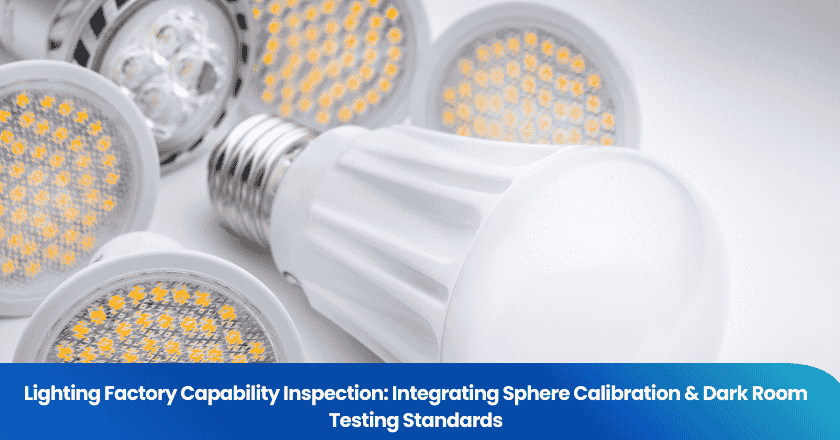
A lighting factory that cannot accurately measure its own LED products cannot consistently produce them to specification. Factory capability inspection addresses this gap by evaluating whether a facility possesses the equipment, calibration records, and controlled environment needed to generate trustworthy LED test data. This guide covers how inspectors evaluate integrating sphere equipment, verify dark room setup and controls, interpret key photometric parameters, and review the documentation that confirms a factory's testing credibility.
Key Takeaways
- A lighting factory capability inspection verifies the equipment and testing environment, not just the products. A factory using an uncalibrated integrating sphere can produce LED bulbs that consistently fail photometric claims without anyone at the factory detecting the gap.
- Integrating sphere calibration must be traceable to national standards and documented with current calibration certificates. Calibration intervals should not exceed 12 months for production environments.
- Dark room conditions — light-tight construction, temperature and humidity control, non-reflective surfaces — are prerequisites for accurate goniophotometer and integrating sphere measurements.
- Real-time reporting during factory audits allows buyers to request corrective actions before committing to a production order.
- Buyers can tailor inspection requirements to include comparative tests between approved gold samples and bulk production output, providing direct evidence of manufacturing consistency.
Why Factory Testing Capability Matters
If a factory's integrating sphere is miscalibrated or its dark room admits ambient light, every luminous flux and colour temperature measurement it produces is systematically wrong. Products certified to emit 1000 lumens might actually produce 850. Colour temperature stated as 4000K might be 4400K. These gaps are not caught by visual inspection and will only surface in end-user environments or during third-party testing — at which point the cost is product recalls, re-testing fees, and damaged buyer relationships.
Inaccurate photometric data also creates compliance risk. Building codes and lighting standards specify minimum illuminance levels for workplaces, roads, and public spaces. A factory supplying products with inflated lumen claims undermines the lighting designer's calculations, potentially resulting in non-compliant installations. The consequences can include legal liability and the cost of complete re-luminaire installations.
Integrating Sphere: Function and Calibration Requirements
How an Integrating Sphere Measures LED Output
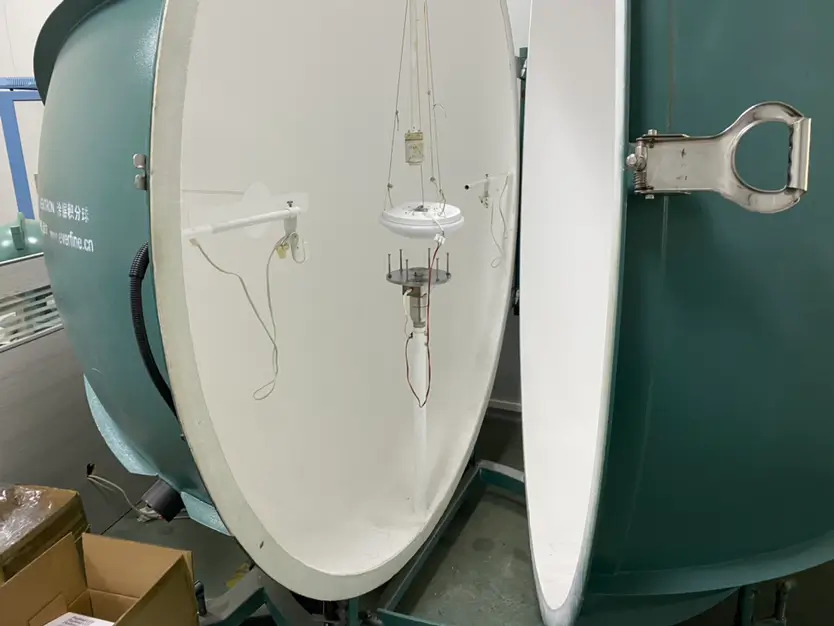
An integrating sphere captures all light emitted by a source regardless of direction, enabling accurate total luminous flux measurement. The sphere's interior is coated with highly reflective barium sulfate or optically diffuse plastic. Light entering through the sample port reflects diffusely off the sphere wall multiple times before reaching the measurement detector, creating a uniform average of all emitted light. This diffuse uniformity means the measurement is independent of the LED's spatial distribution, which is critical because LEDs with identical lumen output but different beam angles would produce different readings in directional measurement systems.
For LED testing specifically, the sphere must be appropriately sized relative to the LED package. As a general rule, sphere diameter should be at least 10 times the maximum dimension of the LED emitter. A sphere too small for the LED product introduces measurement errors through the "self-absorption" effect, where the sample occupies an excessive fraction of the sphere volume and absorbs diffusely reflected light.
Calibration Standards and Certificate Verification
Inspectors verify calibration by reviewing current calibration certificates from an accredited facility. The certificate must specify the calibration date, the next recalibration due date, the calibrated parameters (luminous flux scale, spectral responsivity of the detector), the measurement uncertainty at each calibration point, and a traceable reference to national or international measurement standards (such as NIST in the US or PTB in Germany). Certificates older than 12 months, or certificates from non-accredited facilities, are treated as a critical gap in factory readiness.
| Calibration Parameter | Requirement |
|---|---|
| Coating Type | Barium sulfate or optically diffuse plastic; must maintain reflectance above 95% |
| Uniformity (Detector Port) | Less than +/-0.7% over 90% of port opening area |
| Angular Uniformity | Less than +/-5% within +/-40 degrees of normal |
| Calibration Interval | Maximum 12 months for production use environments |
| Traceability | Certified calibration source traceable to national measurement standards |
Key Photometric Parameters Measured
A fully equipped factory with a calibrated integrating sphere and spectroradiometer measures four primary parameters for every LED product:
- Luminous Flux (lm): Total light output of the LED; the primary basis for lumen claims on packaging. Must match the specification within the manufacturer's stated tolerance, typically +/-10%.
- Colour Temperature (K): The colour appearance of the light. Buyers specify tolerance ranges (e.g., 4000K +/-200K). Colour consistency across a production batch is often more commercially important than hitting the exact nominal value.
- Colour Rendering Index (CRI): A measure of how accurately the light source renders colours compared to a reference illuminant. Minimum CRI 80 is standard for most commercial applications; CRI 90+ is required for retail, healthcare, and quality inspection environments.
- Luminous Efficacy (lm/W): The ratio of luminous flux to input power. This parameter directly affects energy efficiency claims and compliance with energy efficiency labels and regulations such as EU Ecodesign.
| Parameter | Unit | Typical Acceptance Tolerance |
|---|---|---|
| Luminous Flux | lm | Within -10% / +15% of nominal |
| Colour Temperature | K | Within +/-200K of nominal, within ANSI bin |
| CRI (Ra) | - | Minimum Ra as specified; typically 80 or 90 |
| Luminous Efficacy | lm/W | Within -5% of specified value |
Dark Room Setup and Environmental Controls
Light-Tight Construction Requirements
A dark room used for LED testing must achieve complete exclusion of ambient light. Any light entering from outside the controlled environment adds to the measured flux, causing artificially high readings. Inspectors verify light-tightness by entering the room after a 5-minute dark adaptation period (allowing the eyes to adjust) and checking for any visible light leakage around door seals, cable entry points, ventilation ducts, and observation windows. Even a narrow gap under a door can admit enough daylight to measurably affect integrating sphere readings.
Walls and ceiling must have non-reflective finishes — typically flat black paint — to prevent stray reflections from confounding goniophotometer angular distribution measurements. The floor may have a different treatment depending on the test setup, but any reflective surface in the light path is problematic.
Temperature and Humidity Control
LED photometric output is sensitive to junction temperature, which is influenced by ambient temperature. A 10-degree Celsius increase in ambient temperature can reduce LED lumen output by 5-8% depending on the LED package. For test results to be reproducible and comparable across different factories or test dates, the dark room must maintain stable temperature and humidity conditions. The standard test conditions per IEC 62612 and LM-79 require 25 degrees Celsius ambient temperature with +/-1 degree tolerance. Inspectors verify this with a calibrated temperature data logger operating during the test period, not just a spot reading at the start.
Testing Methods Within the Dark Room
| Testing Method | Parameter Measured | Application |
|---|---|---|
| Integrating Sphere | Total luminous flux, spectral power distribution, CRI, CCT | Production-line testing of all LED products |
| Goniophotometer | Angular light distribution, beam angle, zonal flux | Directional products: PAR lamps, spotlights, road lighting |
| Handheld Light Meter | Illuminance (lux) at a point | Quick compliance checks on production floor |
| Spectroradiometer | Full spectral power distribution, colour coordinates | Detailed colour quality analysis; required for CRI and TM-30 metrics |
On-Site Audit Procedure
Equipment and Environment Verification
Factory capability audits begin with a physical walkthrough of the testing area. Inspectors map all measurement equipment, note equipment serial numbers and calibration certificate dates, and check for physical damage that could affect measurement accuracy (bent detector baffles inside integrating spheres, discoloured or scratched interior coatings, cracked spectroradiometer input optics). They check that the dark room maintains consistent temperature throughout the day by reviewing temperature logging records, not just the reading at the time of inspection.
Inspectors also run a comparative test: they measure an approved gold sample (a previously certified reference luminaire supplied by the buyer) on the factory's integrating sphere and compare the result against the gold sample's certified performance values. Agreement within +/-5% for luminous flux and within +/-150K for colour temperature indicates the factory's measurement system is performing correctly. Deviations beyond this range suggest calibration issues requiring resolution before production testing results can be trusted.
Tip: Always bring a certified gold sample when conducting factory capability audits. Measuring a known reference is the most direct way to assess whether a factory's test system is producing accurate results.
Documentation Review Checklist
Inspectors review the following documentation categories during a lighting factory capability audit. Missing or outdated documents in the critical categories represent significant audit findings:
- Integrating sphere and spectroradiometer calibration certificates (must be current, from accredited facility)
- Temperature and humidity data logger records for the dark room (last 3 months)
- LM-79 or equivalent test reports for current product lines
- Assembly instructions and technical drawings for products under audit
- Technical data sheets with specified photometric values
- Type plate images and circuit diagrams for registered products
- Certificates for critical components (LED chips, drivers, lenses)
- List of approved component suppliers and approved component substitution records
- Existing third-party test reports and certification documents
- Manufacturing site quality plan and control charts for photometric parameters
Tailored Inspection Requirements
Buyers with specific product requirements can request additional checks beyond the standard capability audit. Common tailored requirements include: comparative testing of randomly selected bulk production samples against the gold sample standard; verification of ANSI colour bin compliance for products where colour consistency between units is commercially important; and specific compliance checks for target market certifications such as Energy Star, DLC (DesignLights Consortium), or EU Ecodesign requirements. These tailored checks are incorporated into the inspection plan before the audit begins, ensuring the factory prepares the required samples and documentation in advance.
| Inspection Type | Timing | Primary Purpose |
|---|---|---|
| Initial Production Check (IPC) | First 20% of production run | Catch tooling or material issues before full production |
| During Production Inspection (DUPRO) | Mid-production | Identify drift in assembly quality or component substitution |
| Final Random Inspection (FRI) | Pre-shipment | Verify finished goods meet specification before release |
| Factory Capability Audit | Before placing initial orders | Confirm factory has equipment, process, and documentation to produce consistently |
| Lab Testing and Certification | New product introduction | Confirm product safety and performance claims through accredited testing |
FAQ
What does an integrating sphere measure in LED testing?
An integrating sphere measures total luminous flux (lm), spectral power distribution, colour temperature (CCT in Kelvin), colour rendering index (CRI), and luminous efficacy (lm/W). It is the primary tool for verifying whether an LED product's lumen output and colour quality match its specification.
Why is a dark room necessary for accurate LED photometric testing?
Ambient light from outside the controlled environment adds to the measured signal, causing artificially inflated readings. Additionally, any stray reflections from walls or equipment alter the spatial distribution measurements in goniophotometer testing. A properly constructed dark room with light-tight seals and non-reflective surfaces eliminates these sources of error.
How often should factories calibrate their integrating sphere?
In a production testing environment, calibration intervals should not exceed 12 months. Factories conducting high volumes of testing, or where the sphere coating may degrade faster due to exposure to different LED spectra, should consider 6-month intervals. Recalibration is also required any time the sphere is physically moved, the interior coating is cleaned or repaired, or test results show systematic deviation from known reference samples.
What documents should buyers review during a lighting factory audit?
The most critical documents are the integrating sphere calibration certificate (current and from an accredited facility), temperature and humidity logs for the dark room, LM-79 test reports, certificates for critical components (especially LED chips and drivers), and any existing third-party certification documents. These provide traceable evidence that the factory's test results are reliable.
Can buyers specify custom inspection requirements for LED factories?
Yes. Buyers can request comparative testing between certified gold samples and bulk production samples, ANSI colour bin compliance verification, or checks against specific energy efficiency certification requirements such as Energy Star or DLC. These tailored checks are specified in the inspection agreement before the audit begins to ensure the factory prepares the appropriate samples and documentation.

Related Articles


Grow your business with TradeAider Service
Click the button below to directly enter the TradeAider Service System. The simple steps from booking and payment to receiving reports are easy to operate.

