
- About Us

- Our Services
- Your Industry
- Resources
- News & Blog
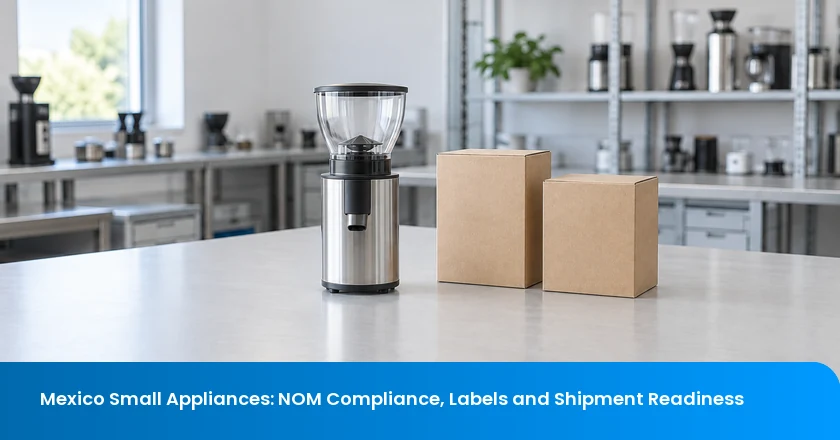
Before shipping small appliances to Mexico, confirm the applicable safety evidence, approve the Spanish consumer information, and agree the import route with the Mexican importer. Then inspect the actual goods against those confirmed references. NOM stands for Norma Oficial Mexicana, a mandatory Mexican technical regulation. It does not describe one universal certificate that settles every question about a shipment. A supplier can reproduce an approved carton perfectly while still using importer details that are no longer correct.
Three Checks Before a Mexico Shipment
Safety evidence, consumer information and import arrangements answer different shipment questions.
- Product safety: Does the accepted evidence cover this appliance and configuration?
- Consumer information: Do the labels, instructions and relevant warranty information describe the product and responsible business correctly?
- Shipment execution: Do the packed goods match current references, and has the importer settled the applicable entry requirements?
Assign an owner to each answer before the final inspection. The certification body addresses its conformity scope; the importer approves local business information and works with its customs representative; the factory implements the accepted pack specification. Inspection provides observations about that implementation. These responsibilities may interact, but a clean workmanship result cannot answer an unresolved regulatory question. The official references below were checked in September 2026; confirm their application to the exact product and transaction.
Confirm NOM Safety and Consumer-Information Requirements
The Mexican Ministry of Economy lists NOM-003-SCFI-2014 as an active electrical-product safety standard.
Begin with a technical description rather than a catalog category. A household coffee grinder, a professional machine, and a device whose principal function is electronic may require different scope decisions. Send the intended use, power supply, model variants and principal functions to the responsible conformity body. Ask which safety standard applies and what evidence is needed for the configuration being purchased. Do not infer the answer from another customer’s shipment history.
The official safety standard contains a household-appliance section referring to general and applicable particular Mexican standards. It also distinguishes products covered by specific safety NOMs. Consequently, a report bearing a familiar international standard number is a starting document for review, not a buyer’s authority to declare the Mexican requirements satisfied.
For purchasing, record the agreed scope beside the exact order model. Keep the accepted technical reference, issuing organization, covered variants and any unresolved questions together. If the supplier changes the motor, heater, power cord, control system or other specified construction, return the change to the technical owner. The buyer should not decide that a substitution is harmless merely because the appearance and advertised function remain the same.
Verify Who Issued the Conformity Evidence
The Ministry of Economy provides a directory of accredited and, where applicable, approved conformity assessment bodies.
Search by the relevant standard and distinguish a testing laboratory, certification body and inspection unit. The directory explains their different categories; finding an organization’s name is not enough to establish that its scope covers the service your supplier is claiming. For the applicable safety procedure, verify the required accreditation and approval with the responsible body. Ask it to confirm the certificate’s identity and status using its own verification channel.
Request the complete certificate and its model schedule or annexes, rather than a cropped logo or cover page. Compare the holder, manufacturer, factory details where relevant, model identification and technical references with the transaction. A trading company may legitimately be involved, but unexplained differences should be resolved before the buyer treats the evidence as applicable. Record the explanation from the appropriate party rather than asking the factory to rewrite a certificate.
Keep this review separate from selecting a factory inspection provider. TradeAider’s role in the planned visit is to examine the order against agreed checks and report observations; Mexican NOM certification remains a separate responsibility. To review the inspection provider’s identity and background, use TradeAider’s company background.
Approve Spanish Packaging and Consumer Information
The Ministry of Economy lists NOM-024-SCFI-2013 as active for commercial information on packaging, instructions and warranties.
For covered packaging, the required Spanish information includes product identification, the domestic manufacturer or importer’s name and address, origin, and applicable manufacturer-defined electrical ratings. Confirm the detailed requirements for the product rather than treating this short list as a complete label approval.
Give the importer a readable proof showing every panel, not only the attractive front face. Ask it to approve the business details and the version intended for this order. The factory can check whether the printed text matches a file, but it cannot determine from a purchase order alone which local entity should be named. A distribution agreement, importer change or address update can make an old proof unsuitable without changing the appliance itself.
Keep a dated approval with an identifiable artwork revision. State which earlier revision is superseded and where remaining stock may be used, if anywhere. At the packing station, inspect a physical pack for legibility, placement and consistency with that revision. An approved PDF does not show whether a sticker covers another required statement, whether small text survives printing, or whether the wrong label roll was loaded. Photograph the finished consumer pack, including information that disappears when cartons are stacked.
Check Instructions Against the Appliance in the Box
NOM-024 requires instructions and warnings in understandable, legible Spanish, while allowing additional languages.
The rule generally requires the necessary instructions to accompany the product or appear on its packaging. A limited provision permits printed quick-start instructions with electronic detailed instructions for specified electronic and computing categories; do not extend it automatically to household appliances. Where a warranty is offered, have the importer confirm its Spanish terms and the relevant Mexican service information.
For the factory check, open the manual alongside the actual appliance. Follow its ordinary assembly and operating sequence using the agreed safe procedure. Compare the controls, supplied accessories, connection instructions and cleaning guidance with what is physically present. A translation can read fluently while describing a different switch layout or an accessory omitted from this purchase. Flag that mismatch with photographs and the relevant manual page rather than marking the whole document simply “Spanish: yes.”
Use a manual revision identifier in the packing specification and retain a reference copy. If several appliances share one booklet, make sure readers can identify the instructions that apply to their model. Check that diagrams and language labels agree, and that the correct booklet is inside the retail pack. Ask a qualified language reviewer to resolve ambiguous warnings; the existence of Spanish text alone is not a judgment on its accuracy. These are practical inspection controls, not a substitute for the responsible party’s review of the document requirements.
Compare the Model, Nameplate, Pack and Test Records
A document match is useful only when the reference itself is correct for the order.
Separate approval of the reference from comparison of the goods. First, the importer and technical owners confirm the current model, business details and accepted files. Then the inspection compares the order with that reference set. Reversing the sequence creates false confidence: identical cartons show consistent printing, but they cannot prove that the printed information is still correct. Apply this distinction to packaging approval as carefully as to the appliance specification.
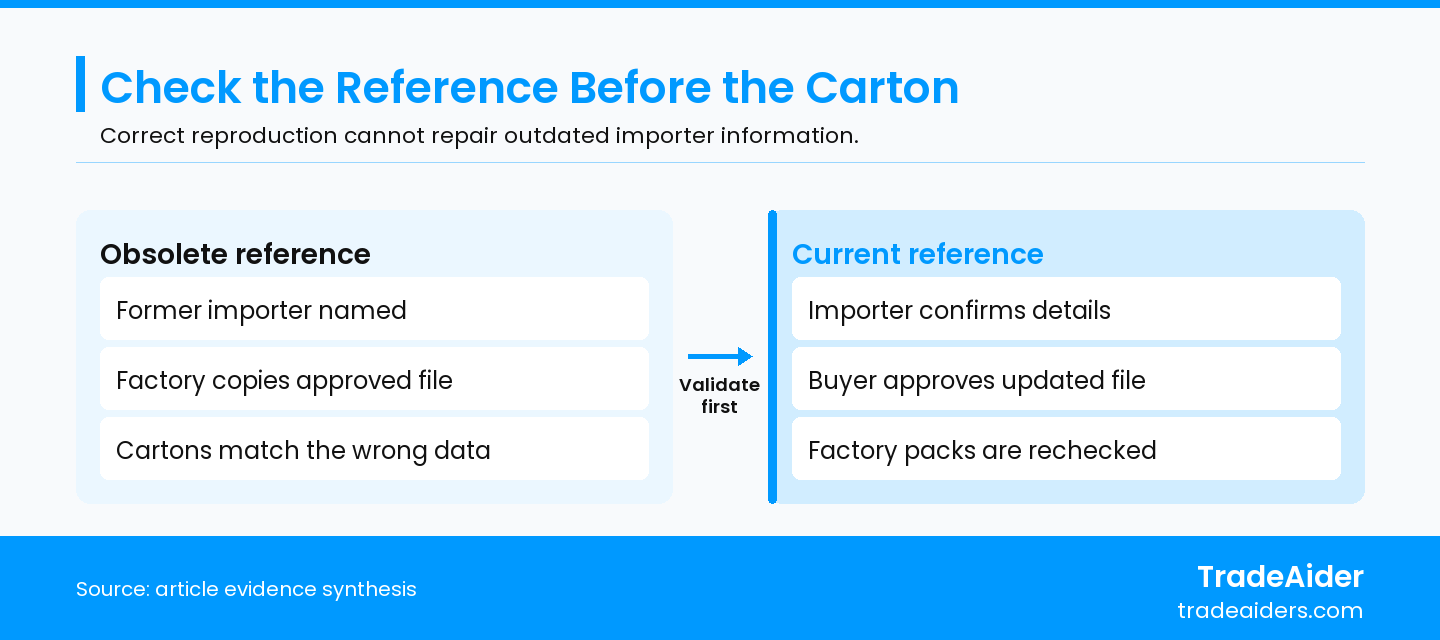
A factory match is meaningful only after the reference is confirmed for the current order.
Use the following checklist to connect evidence that is often reviewed in separate email threads. It describes purchasing checks; the precise required markings and test methods still come from the applicable product rules and accepted technical documents.
| Item | Compare with | Record at inspection | Escalate when |
|---|---|---|---|
| Model identity | Accepted model list and conformity scope | Actual model and variant photographs | A model or suffix lacks an accepted mapping |
| Nameplate | Approved electrical specification | Legible ratings and unit identification | Ratings or construction references disagree |
| Retail packaging | Current importer-approved artwork | All relevant panels and label revision | Business details or origin text differ |
| Instructions | Approved manual and supplied appliance | Revision, language and operating diagrams | The booklet describes different controls |
| Test records | Accepted model, procedure and test scope | Report identity and available factory records | A report concerns another configuration |
For each discrepancy, record both sides of the comparison. “Wrong label” is less useful than a photograph of the label, the approved revision and a clear statement of the difference. Keep observations separate from pending interpretations. The inspector may establish that two model codes differ, while the certification body must determine whether the documented scope accepts that relationship.
Specify which checks apply to every ordered variant and which can use an agreed sampling plan. Do not allow a readily accessible model to stand in for all other models without a stated basis. Organize the approved checks and defect descriptions before the visit using TradeAider’s inspection-standard guidance.
Confirm the Import and Labeling Route Before Dispatch
SNICE, Mexico’s foreign-trade information service, explains that Annex 2.4.1 lists NOM requirements enforced at the point of entry.
The applicable entry requirement therefore needs a transaction-specific check alongside the product’s regulatory scope. Have the Mexican importer and customs representative confirm the tariff classification, product description and current rule for the planned operation. Obtain their confirmation of classification and any claimed exemption before dispatch. A retail-information requirement should not be converted into an assumed border procedure without checking the relevant rule.
SNICE’s labeling compliance guidance describes labeling at origin and conditional arrangements in Mexican territory. Domestic alternatives involve eligibility, documentation and inspection-unit arrangements. They are not a general permission to ship unfinished labels and resolve the paperwork later. Confirm the applicable route and available inspection unit before relying on a destination-labeling plan.
Write the chosen route into the shipping instructions. If labeling will be completed at origin, the release review should assess the completed packs against current approved artwork. If a permitted domestic route is used, identify the remaining work, its responsible party and the evidence needed for that arrangement. The factory inspection report should accurately describe the goods’ current condition rather than call them retail-ready while that work remains open.
Reconfirm the plan when the importer, destination facility or consignment arrangement changes. A logistics booking does not validate a regulatory assumption. Keep the importer’s route confirmation with the order records so the factory, inspection coordinator and shipping team are acting on the same decision.
Set a Factory Inspection Scope That Can Be Verified
Arrange the visit around goods that can be opened and checked in their intended packing configuration. Confirm access to the agreed models, the current reference files and any equipment required by the inspection scope before setting the appointment.
TradeAider describes pre-shipment inspection service readiness as 100% of the order complete and at least 80% packed.
The packing threshold allows inspection of goods in their export configuration; it does not mean production may be unfinished. When arranging the visit, provide the quantity by model, packing status, accepted references and any known information changes. Agree access to representative goods and retail packs across the order, including variants that are not conveniently positioned near the packing entrance.
Include workmanship, dimensions where relevant, accessories, packaging and agreed functional checks. Define electrical checks through an accepted procedure, appropriate equipment and competent personnel. A brief power-on observation cannot demonstrate every safety requirement. If certification testing or technical assessment remains outstanding, keep that question with the responsible body and describe it separately from the inspection findings.
Ask for photographs that connect the observed model to its nameplate and retail pack, together with the reference revision used. Record unavailable documents and checks that could not be performed. This makes the report useful for a release decision without implying that an unobserved feature passed. The buyer can then distinguish a physical discrepancy, an inaccessible check and an unresolved approval instead of merging them into a single unexplained result.
Illustrative Example: Every Carton Matches an Outdated Label
Consider an illustrative order of 900 household coffee grinders in 900 retail cartons for Mexico. The importer selected labeling at origin. Production and packing are complete, and the model and technical references have been accepted. At inspection, the cartons still name the former importing business. The factory’s print records show that all 900 cartons came from the same outdated artwork. The importing business changed after approval of that file; the appliance design did not change.
In this illustrative example, the buyer pauses dispatch of the whole order because every carton uses the same outdated importer artwork. The issue is the validity of the approved reference, not inconsistent reproduction by the factory. Inspecting additional cartons against that same obsolete file would not resolve it. The current importer must approve the correct information and check whether its separate conformity arrangements need attention; the label finding alone does not establish that a safety certificate is invalid.
The factory replaces the obsolete artwork and corrects all 900 retail cartons under the new approval. The buyer also reconciles documents that name the importer, so changing the outer label does not leave contradictory information elsewhere. The correction record identifies the superseded file, the replacement revision and the order quantities covered.
Before dispatch resumes, the physical packs are checked against the current reference and the importer confirms that its separate documentation questions are settled. This illustrative example concerns a shared artwork problem, not a measured electrical failure rate. Keep it distinct from isolated workmanship defects when planning an acceptance quality limit (AQL) sampling approach with the AQL calculator.
Send TradeAider the References and Open Questions
An inspection request should distinguish approved references from issues still awaiting importer or conformity-body decisions.
Send the model list, accepted technical evidence, current Spanish artwork and manual revisions, and the importer-confirmed labeling route. Add the order quantity, packing status, factory location and planned dispatch date. Identify any change since the last approval, including a new importing business, revised pack or substituted component. A folder full of conflicting drafts makes a reliable comparison harder; mark the current files and retain superseded versions separately.
For each open point, name the decision owner and state what the visit can usefully observe. For example, the importer may still be confirming a business address while the factory can already provide photographs of the printed panels. Ask for those observations without presenting the address as approved. If a reference is missing, say so before the visit so the scope can reflect what can actually be checked.
TradeAider can use the supplied material to confirm feasible factory checks and the visit scope. The intended deliverable is inspection findings and photographs connected to the sampled products and packaging. Keep the request focused on that evidence: the report should help you compare the finished order, while the Mexican importer and responsible conformity body resolve their own outstanding requirements.
Before booking, list the decisions the report must support: whether the correct manual is packed, whether the current label revision has been applied, or whether an observed model matches the accepted reference. This gives the coordinator a concrete basis for agreeing access, sample coverage and reporting detail. Include any relevant rework history so newly corrected packs are identifiable during the visit. Name an available factory contact who can retrieve current files and open the agreed cartons while the inspector is on site.
With the references and remaining questions identified, Contact TradeAider to plan the visit.
Frequently Asked Questions
Does a CE mark establish Mexican NOM compliance?
A CE mark alone does not establish compliance with the applicable Mexican NOM requirements. Give the Mexican conformity body the foreign certificates and test reports and ask whether, and on what basis, they can be used in the required assessment. Do not relabel an appliance as compliant simply because similar goods were sold in another market. Resolve the acceptance route before treating foreign evidence as sufficient.
When should the online product listing be checked against the shipment?
Review the listing whenever the approved product or packaging information changes. Compare online descriptions and images with the version that customers will receive, especially model identity, included accessories and electrical characteristics. Ask the importer or seller to resolve inaccurate content before relying on an old listing. This is a separate review from checking physical cartons; an accurate factory pack cannot correct an obsolete product page.
Should a replacement accessory use the same retail information as a complete appliance?
Classify the accessory and its sales context before copying the complete appliance’s pack requirements. An item sold separately to a consumer can differ from a part supplied for warranty replacement, and an electrically powered accessory can raise additional safety questions. Give the importer the item’s function, packaging and intended supply channel. Ask it to confirm the applicable information and warnings instead of treating every spare part as a complete appliance.
What if the order ships in separate consignments?
Keep each consignment identifiable and verify that its documents and pack revisions match the goods actually dispatched. Record which models and quantities leave in each shipment and which remain at the factory. If a later consignment uses revised artwork or changed goods, check those differences before relying on an earlier inspection. Have the importer confirm that its accepted import arrangements remain appropriate for each transaction.
Related Articles
Grow your business with TradeAider Service
Click the button below to directly enter the TradeAider Service System. The simple steps from booking and payment to receiving reports are easy to operate.

