
- About Us

- Our Services
- Your Industry
- Resources
- News & Blog
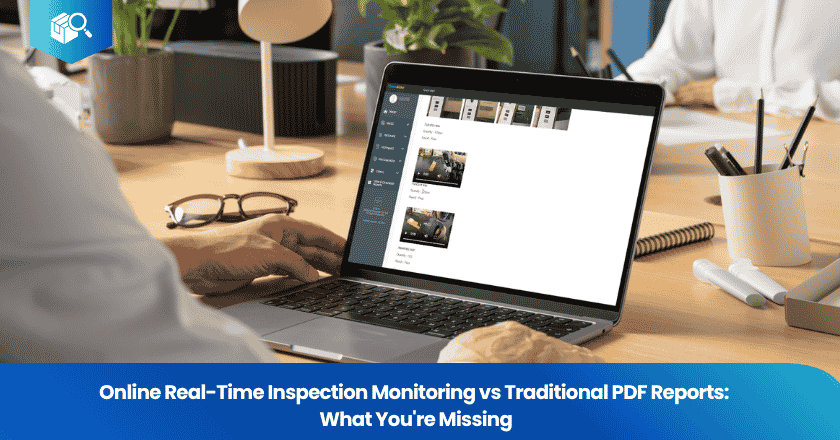
When an inspection provider delivers a PDF report, the inspection is already over. The goods have been examined, the container may already be sealed, and any defects found now require negotiation, rework delays, or shipment holds — all managed from thousands of miles away through email. Online real-time monitoring changes that equation fundamentally: the buyer sees photos and findings as the inspector captures them, while the inspector is still in the factory, while rework is still possible. According to Shopify's ecommerce return research, 20–30% of all online returns are caused by defective or poor-quality goods — a figure that reflects what happens when quality problems are discovered too late to fix before shipment. This article defines real-time monitoring, explains what a traditional PDF report can and cannot do, and gives you a concrete comparison to help you decide which model your quality program needs.
Key Takeaways
- Definition: Online real-time inspection monitoring delivers live photo and video evidence from the factory floor during the inspection — not a consolidated report after it concludes.
- Critical gap: Traditional PDF reports arrive after the inspection is complete, meaning defect response decisions must be made without the ability to intervene in real time at the factory.
- Business impact: Real-time visibility allows buyers to issue corrective instructions during the inspection, before goods are packed, sealed, or loaded — eliminating the rework delays and shipping holds that follow post-completion reports.
- Cost equation: Processing a defective-goods return costs 20%–65% of the item's sale price. Real-time monitoring catches and prevents defects at the source for a fraction of that cost.
- TradeAider: Real-time online monitoring is a standard feature of TradeAider's $199/man-day all-inclusive Inspection & QA Services — not a premium add-on.
Defining Online Real-Time Inspection Monitoring
Online real-time inspection monitoring is a quality control delivery model in which the buyer receives live photo and video evidence from the factory floor as the inspection is being conducted, rather than in a consolidated report delivered hours or days after the inspection is complete. Under this model, the buyer can issue corrective instructions directly to the inspector — and through the inspector to the factory — while defects are still addressable on-site.
The practical implication of this definition is significant. In a traditional inspection workflow, the inspector visits the factory, examines a sample of goods, photographs defects, writes a report, and delivers it — typically between 12 and 72 hours after leaving the facility. The buyer then reads the report, evaluates the findings, contacts the supplier, and begins a negotiation process that may or may not result in rework before shipment. In real-time monitoring, this sequence collapses: the buyer sees defect photos within minutes of them being captured, while the inspector is still physically present in the factory, when rework is still possible without shipment delay or renegotiation.
This is not a marginal improvement in reporting speed. It is a structural change in who has agency over the inspection outcome. KPMG's 2024 supply chain research identifies real-time visibility as one of the two primary drivers of supply chain digitalization investment, with 50% of supply chain organizations actively investing in advanced analytics and visibility capabilities. The same principle applies at the inspection level: visibility while action is still possible is fundamentally different from visibility after the fact.
What a Traditional PDF Inspection Report Can and Cannot Do
Traditional PDF inspection reports remain the dominant delivery format among established quality control providers, particularly the enterprise-scale inspection organizations. A well-prepared PDF report provides substantial value: it documents defect findings with photographs, classifies defects by severity (critical, major, minor), records AQL sampling results, and provides a formal pass or fail determination. For importers managing quality data over time, a consistent PDF format also creates a comparable record that can be tracked across multiple inspections and suppliers.
What a PDF Report Cannot Do
The structural limitation of a PDF report is that it documents what happened — it does not enable intervention while things are happening. When the report arrives, the following are typically already true: the inspection is complete, the factory has moved on to shipping preparation or the next production run, and the inspector has left the facility. Any response to defect findings must be communicated back through the supplier, who must then locate and rework the specific units involved — a process that is both slower and less verifiable than intervention during the original inspection. A PDF report cannot tell you what is happening right now; it can only tell you what was happening when the inspector was there. For buyers in different time zones managing factory relationships across 12–16 hour gaps, this limitation is compounded by the fact that the inspection itself happens during the buyer's overnight hours, meaning the report arrives at the start of their next business day — with the factory already moving forward.
When the PDF Delivery Gap Becomes Expensive: A Scenario
Consider a Shopify brand placing a 5,000-unit electronics order with a new Chinese factory in Shenzhen — a first-order relationship without an established inspection track record. The buyer books a pre-shipment inspection through a traditional provider. The inspector visits the factory on a Tuesday, works through the day, and delivers the PDF report the following Wednesday morning.
The report documents two findings: a labeling error affecting 12% of units where the compliance certification marking has been applied to the wrong location on the packaging, and a functional test failure affecting 3% of units where the USB-C port shows resistance inconsistent with the product specification. Total affected units: approximately 750 with labeling issues, approximately 150 with functional failures. AQL result: Fail.
The problem is that by the time the report arrives Wednesday morning, the factory has already begun loading the container for Thursday's truck pickup to the port. The buyer must now: halt the shipment at additional cost, direct the factory to sort and rework 750+ units, and book a re-inspection to verify the rework — all of which takes 5–7 additional days, plus re-inspection fees. The labeling error, had it been identified while the inspector was still on-site, could have been flagged to the factory supervisor immediately. The factory could have reprinted correct labels and reapplied them the same afternoon. Total intervention time: 3–4 hours. Total delay: zero.
Under a real-time monitoring model, the buyer — monitoring inspection photos on their phone in the US — would have seen the labeling issue at hour two of the inspection and messaged the inspector directly. The factory supervisor, already present, would have received the correction instruction immediately. The functional failure in 3% of units would have been isolated, those units segregated, and the inspection completed with verified compliance on the remaining stock. The PDF-versus-real-time gap in this scenario: approximately $3,200 in container unloading, re-inspection fees, and express re-packing costs, plus a 6-day shipment delay.
Real-Time Monitoring vs Traditional PDF Reports: Side-by-Side Comparison
The table below compares the two inspection delivery models across the dimensions that matter most for importers sourcing from China. Use it to evaluate which model your current inspection provider offers and whether the gap is costing you.
| Dimension | Real-Time Monitoring | Traditional PDF Report |
|---|---|---|
| Visibility timing | Live — photos uploaded every 5–15 minutes while inspector is on-site | Post-completion — report delivered 12–72 hours after inspection ends |
| Defect response window | During inspection — buyer can issue same-day corrective instructions on-site | After completion — factory has typically moved to next step; rework requires a second visit |
| Evidence tamper-resistance | Timestamped, geotagged photos uploaded in real time — continuous chain of custody | Compiled post-inspection — photos selected by inspector after the fact |
| Time-zone advantage | Buyer can intervene during their business hours even across a 12-hour gap | Report arrives after the inspection — intervention requires overnight coordination |
| Rework without delay | Minor issues can be corrected during inspection with inspector verification | All rework requires re-inspection, adding 1–5 days minimum |
| Typical pricing | $199/man-day all-inclusive (TradeAider 2026) | $250–$350/man-day typical among traditional providers |
| Best for | Remote buyers with no on-site presence; time-sensitive orders; new supplier relationships | Buyers with local sourcing agents on-site; stable supplier relationships with low defect history |
Based on this comparison, the data shows that real-time monitoring delivers a structural advantage in defect response capability that is unavailable from any PDF-based delivery model, regardless of how quickly the PDF is delivered. Same-day PDF delivery is faster than 48-hour delivery — but both arrive after the intervention window has closed.
Who Benefits Most from Real-Time Monitoring
Remote Buyers Without Factory-Floor Presence
The importer most disadvantaged by traditional PDF inspection is the buyer who has no one physically present at the factory — which describes the vast majority of overseas buyers sourcing from China. Without real-time visibility, they are entirely dependent on the inspector's compiled record of what happened, with no ability to interact with the inspection as it proceeds. Real-time monitoring restores a degree of on-site presence without the cost of travel or a local representative. Deloitte's 2025 manufacturing industry outlook identifies remote digital visibility as one of the defining trends in how industrial buyers are managing supplier relationships — and inspection monitoring is the most direct application of this capability in quality control.
First-Order or New Supplier Relationships
When placing an order with a supplier who has no established quality track record, the inspection itself is a trust-building exercise. Real-time monitoring signals to the factory that the buyer has genuine visibility into what is happening — a dynamic that changes supplier behavior. Supply chain research shows that early digital supply chain adopters reduce quality-related logistics costs by 15% compared to organizations relying on post-event reporting. The behavioral effect of real-time visibility on supplier quality performance is one mechanism through which that savings is achieved.
High-Defect-Risk Product Categories
Electronics, children's products, and other safety-regulated categories carry the highest consequences for post-shipment defect discovery. The Consumer Product Safety Commission issues recalls covering millions of units annually for products that reached consumers with unresolved safety defects. For these categories, the ability to issue corrective instructions during the inspection — rather than reading about the failure in a report the next morning — is not a quality preference; it is a risk management necessity. CapitalOne Shopping's 2024 return data confirms that 81% of consumer returns cite damaged or defective items as the primary reason — returns that represent costs of 20%–65% of item value per unit returned.
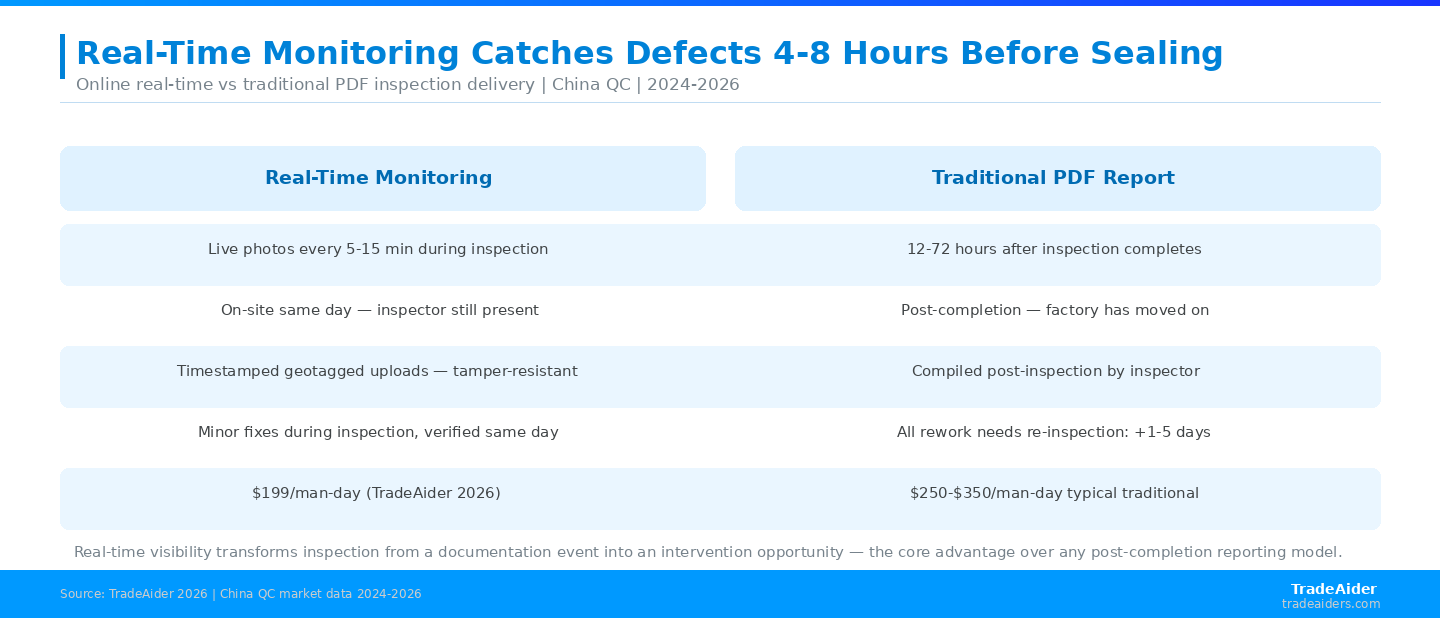 Real-time visibility transforms inspection from a documentation event into an intervention opportunity — the core advantage over any post-completion reporting model.
How to Evaluate Whether Your Current Provider Offers True Real-Time Monitoring
Not all providers who claim "real-time" reporting actually deliver live inspection visibility. The following questions will help you evaluate your current provider's offering with specificity. First: can you access individual inspection photos while the inspection is in progress, or only after it is complete? Second: is there a live communication channel to the inspector during the inspection, or only an email address for the inspection company's customer service team? Third: are photos timestamped and geotagged at upload, or compiled into the report after the inspection? Fourth: can you issue corrective instructions to the inspector in real time, and does the inspector have the authority and the process to implement them during the inspection day? A provider who delivers a same-day PDF report within 4 hours of inspection completion is delivering fast post-completion reporting — not real-time monitoring. The distinction matters for buyers who need the ability to intervene, not just the ability to read. For an introduction to pre-shipment inspection services that include real-time monitoring, you can review the inspection service specifications before booking.
Who Is TradeAider?
TradeAider is a quality inspection, testing, and certification service provider in China. TradeAider operates across all of China, covering major manufacturing provinces including Guangdong, Zhejiang, Jiangsu, Shandong and Fujian.
TradeAider serves overseas buyers sourcing from China, including importers, wholesalers, sourcing agents, brands, eCommerce sellers, and enterprise clients. Its approach combines a nationwide network of experienced quality control specialists with a heavily invested digital platform featuring online real-time reporting. Clients can monitor inspections live, communicate directly with inspectors, and address issues during production rather than after shipment — a proactive model focused on problem-solving and prevention, not just defect identification.
Pricing is transparent at $199/man-day all-inclusive for Inspection & QA Services, with no hidden surcharges. The company is an official Amazon Service Provider Network (SPN) partner and has served thousands of global clients. Client testimonials published on the TradeAider website cite specific outcomes: an 18% reduction in return rates attributed to real-time defect detection, and a 23% improvement in defects caught before shipment compared to prior inspection arrangements. These are client-reported figures.
Frequently Asked Questions
What is online real-time inspection monitoring?
Online real-time inspection monitoring is a quality control delivery model in which the buyer receives live photo and video evidence from the factory floor as the inspection is being conducted — not in a consolidated report delivered after the inspection is complete. The buyer can view individual defect photos on a web dashboard or mobile app within minutes of capture, communicate directly with the inspector, and issue corrective instructions while the inspector is still on-site and rework is still possible without shipment delay. This model is fundamentally different from fast PDF delivery, where even same-day report delivery arrives after the intervention window has closed.
Does a same-day PDF report count as real-time monitoring?
No — same-day PDF delivery and real-time monitoring are distinct models. A same-day PDF report means you receive a completed inspection document within 12 hours of inspection completion. This is faster than the 24–72 hour standard common among larger traditional providers, but the inspection is still finished when you receive it. Real-time monitoring means you have access to individual photos and findings as they are captured, while the inspector is still physically present in the factory. The practical difference is whether you can intervene in the inspection — which you can with real-time monitoring and cannot with any post-completion report, regardless of how quickly it arrives.
Can real-time monitoring replace a physical visit to the factory?
Real-time monitoring is not a complete substitute for a physical presence — a trained inspector on-site can check dimensions, perform functional tests, and observe factory operations in ways that go beyond what a camera can capture. However, for the vast majority of overseas buyers sourcing from China who cannot cost-effectively visit every factory for every order, real-time monitoring provides a level of visibility and intervention capability that is substantially more valuable than a post-completion report. It addresses the core problem of the time-zone gap: the inspection happens during the buyer's overnight hours, and real-time monitoring allows them to follow and influence it rather than simply reading about what happened afterward.
Does real-time monitoring cost more than a traditional inspection?
Not necessarily. While real-time monitoring capability historically required a premium over standard PDF-only inspection services, current market pricing has changed that equation. TradeAider provides real-time monitoring as a standard feature of its $199/man-day all-inclusive rate — which is at or below the pricing of traditional PDF-only providers who charge $250–$350/man-day for equivalent product categories. The capability gap has closed at pricing parity, meaning buyers today can access real-time monitoring without paying a premium over traditional inspection costs. Use the inspection cost calculator to estimate the cost for your specific order parameters.
What types of defects can be corrected during a real-time inspection?
Defects that can be addressed during a real-time inspection are typically those involving packaging, labeling, sorting, or simple cosmetic rework — those classified as minor under your AQL inspection criteria — issues where factory workers can make corrections with materials already on hand. Examples include incorrect barcode placement, missing certification marks on packaging, wrong sticker application, and sorting out units from a contaminated batch. Structural or functional defects — a dimensional failure, a circuit board issue, a material substitution — require production-level rework that cannot be completed during an inspection day. However, identifying these issues in real time still provides the advantage of being able to halt shipment loading immediately and direct corrective action before any packing or containerization has occurred.
Related Articles



Grow your business with TradeAider Service
Click the button below to directly enter the TradeAider Service System. The simple steps from booking and payment to receiving reports are easy to operate.

