
- About Us

- Our Services
- Your Industry
- Resources
- News & Blog

When a pre-shipment inspection report comes back with a "Fail" result, you face an immediate decision under time pressure: demand rework followed by re-inspection, or accept the shipment and negotiate a discount to compensate for the quality shortfall. According to Shopify's ecommerce returns research, 20–30% of online returns stem from defective or poor-quality goods — meaning the choice you make at this moment has direct consequences for your return rate, your platform health metrics, and ultimately your brand reputation. This guide gives you a concrete decision framework to navigate that choice without guesswork.
Key Takeaways
- Decision: Re-inspection is the right call when major or critical defects are found, when products are safety-regulated, or when you're working with a new supplier for the first time.
- Accept-and-Discount: Accepting with a negotiated price reduction makes sense only for minor cosmetic defects with no functional impact and no safety implications.
- Cost reality: Processing a return costs 20%–65% of the item's original value — far exceeding the cost of a re-inspection in most scenarios.
- Framework: The 5-Factor Defect Response Framework — severity, timeline, defect rate, supplier leverage, and downstream risk — gives you a structured path to the right decision every time.
- Pricing: TradeAider charges $199/man-day all-inclusive for re-inspection and all Inspection & QA Services, with same-day or ≤24-hour report delivery.
Understanding Your Two Core Options After a Failed Inspection
When inspection results show that defect levels exceed your agreed AQL threshold, you have two primary paths forward, each with distinct cost and risk profiles. Choosing between them without a framework leads to costly mistakes in both directions — delaying shipments unnecessarily on minor issues, or releasing defective goods that generate downstream returns and account flags.
What Is a Re-Inspection?
A re-inspection is a second formal quality check conducted after the supplier has reworked or sorted the defective goods from the original failed batch. The process typically unfolds as follows: the buyer issues a rework instruction to the factory, the factory sorts defective units and either repairs them or removes them from the shipment, and then an independent third-party inspector returns to verify the result. In a well-structured supplier contract, re-inspection costs are charged back to the supplier when the original inspection failed due to quality issues that were the factory's responsibility. A re-inspection gives you a documented, defensible quality verification before goods leave China — the only moment when you still have meaningful leverage over the outcome. For pre-shipment inspection services that include real-time monitoring, inspectors can also observe the rework process directly.
What Does Accept-and-Discount Mean?
Accepting with a discount means releasing the shipment as-is and negotiating a price reduction with the supplier to offset the quality shortfall. The discount is intended to compensate you for the defective units you will encounter once the goods arrive, and to cover the cost of sorting, reworking, or disposing of those units on your end. This approach avoids shipment delays but transfers all the uncertainty and handling cost to your operation. According to CapitalOne Shopping's 2024 retail return data, 81% of consumer returns cite damaged or defective items as the primary reason — confirming that defects you accept and ship ultimately translate directly into return volume and customer complaints.
The 5-Factor Defect Response Framework
The 5-Factor Defect Response Framework is the structured decision tool that separates disciplined quality management from reactive improvisation. Applying it to every failed inspection result ensures you never make a decision based on deadline pressure alone, and never leave risk unquantified. Each of the five factors shifts the decision weight toward re-inspection or acceptance, and their combined signal tells you which path is appropriate for your specific situation.
Factor 1 — Defect Severity: Critical, Major, or Minor
Defect severity is the single most decisive factor in the 5-Factor Defect Response Framework. Critical defects — those that pose a safety risk to the end user or violate mandatory regulations — are never acceptable grounds for a discount negotiation. The US Consumer Product Safety Commission issues hundreds of recall notices each year for products that reached consumers with unresolved critical defects. The liability exposure and reputational damage from a recall dwarfs any discount a supplier could offer. Major defects — those that render a product unacceptable to the typical consumer — warrant re-inspection after rework in the vast majority of cases. Minor cosmetic defects are the only category where accept-and-discount can be a proportionate response, provided they do not compound into a functional problem once in the field.
Factor 2 — Timeline Pressure and Shipment Urgency
Timeline pressure is the factor most frequently used to justify accepting a failing shipment — and the factor most frequently misapplied. A genuine peak-season deadline with no alternative inventory is a legitimate constraint. A self-imposed "urgency" based on reluctance to confront the supplier is not. Before applying timeline weight in the 5-Factor Defect Response Framework, quantify the actual delay: re-inspection in China's major manufacturing hubs typically takes 1–3 days from booking to report delivery. If the only consequence of that delay is a two-week shift in your restocking schedule and the defects found are major, the timeline argument rarely outweighs the quality risk. The calculation changes only when the delay would breach a contractual delivery obligation with downstream consequences — retailer chargebacks, platform penalties, or seasonal sell-through windows.
Factor 3 — Defect Rate Relative to Your AQL Threshold
The numerical defect rate tells you how far outside your AQL the shipment sits. A batch that fails at 3.2% major defects against an AQL 2.5 threshold is meaningfully different from one that fails at 8.7%. A borderline failure — where the defect rate is only marginally above the acceptance number — may indicate a sampling anomaly or a concentrated defect cluster rather than systemic production failure. In that scenario, a partial sort-and-discount can be proportionate. A shipment that fails by a wide margin signals a systemic production problem that a discount cannot fix. Shipping it means the defects are distributed throughout your entire inventory, not concentrated in a known subset. Your AQL calculator can help you translate inspection findings into the expected defect proportion across your full order quantity.
Factor 4 — Supplier Relationship and Contractual Leverage
Your leverage over the supplier determines which options are actually available to you. A long-standing supplier relationship with a documented history of passed inspections gives you credibility to demand rework and re-inspection without damaging the partnership. A first-order relationship with a new supplier, by contrast, requires even firmer insistence on re-inspection — new suppliers have no track record to rely on, and accepting defects on a first order establishes a precedent that quality standards are negotiable. Contractual leverage matters too: if your purchase order specifies that re-inspection costs are charged to the supplier upon a quality failure, you have a clear written basis for the demand. Without that clause, re-inspection cost recovery depends entirely on your negotiating position. Quality experts consistently recommend building these provisions into purchase orders before production starts — not after a failure occurs.
Factor 5 — Downstream Cost Risk if Defects Reach Customers
The fifth and most financially decisive factor of the 5-Factor Defect Response Framework is the actual cost of the defects if they reach your customers unresolved. This calculation must account for: return processing costs (20%–65% of item value per return), platform penalty exposure (for Amazon FBA sellers, a defect rate above 1% triggers account health warnings), customer review damage, and the administrative cost of managing returns and supplier disputes after the fact. The ecommerce return rate in 2024 averaged 20.4% across online retail — and products with known quality issues routinely generate return rates well above that baseline. If your expected return cost on the defective units exceeds the re-inspection cost by a factor of 5× or more (a threshold routinely crossed at defect rates above 5%), the financial case for re-inspection is clear regardless of timeline.
Re-Inspection vs Accept-and-Discount: Side-by-Side Comparison
The table below applies the 5-Factor Defect Response Framework to both options across the dimensions that matter most to importers. Use it as a quick reference when you receive a failed inspection report and need to make a decision quickly.
| Dimension | Re-Inspection After Rework | Accept and Negotiate Discount |
|---|---|---|
| Best for defect type | Major or critical defects; any functional failure | Minor cosmetic defects only; no functional impact |
| Timeline impact | 1–5 day delay (rework + re-inspection turnaround) | No delay; goods ship immediately after agreement |
| Cost to buyer | $199/man-day re-inspection fee (often charged back to supplier) | Discount 5–20% offset by downstream return and sorting costs |
| Quality assurance | Verified — third-party confirms rework was completed | None — defect quantity and distribution remain unknown |
| Supplier precedent | Reinforces that standards are non-negotiable | Signals standards are negotiable; may increase future defects |
| Platform/regulatory risk | Eliminated before goods ship | Transferred to destination market — returns, reviews, potential recall |
| New supplier context | Always recommended — no track record to rely on | Rarely appropriate — sets a bad quality expectation from the start |
Based on this comparison, the data shows that accept-and-discount is a structurally weaker option in most real-world scenarios. Its apparent advantage — no shipment delay — comes at the cost of transferring all quality uncertainty to your market. Re-inspection eliminates that uncertainty for a fraction of what downstream returns cost to process.
When to Choose Re-Inspection: Three Decision Scenarios
Scenario 1 — Major or Critical Defects Found
Re-inspection is mandatory when the failed report documents major defects — items that the typical end consumer would find unacceptable — or any critical defect that poses a safety risk. This is non-negotiable when selling into regulated markets. Safety-regulated categories including electronics, children's products, personal care, and food-contact items carry mandatory compliance requirements that a discount cannot address. A supplier discount does not make a non-compliant product compliant. The only path forward is rework that resolves the root cause, followed by third-party verification that the corrective action was effective.
Scenario 2 — First Order from a New Supplier
When you are placing your first order with a supplier who has no inspection track record with you, accepting defects and discounting sends entirely the wrong signal. It establishes from day one that your quality standards are a starting point for negotiation, not a firm requirement. Experienced sourcing advisors consistently identify first-order inspection enforcement as the single biggest determinant of supplier quality over the long term. Re-inspection after rework, even if it delays your first shipment by a few days, creates the precedent that your standards will be consistently enforced.
Scenario 3 — High Defect Rate Well Above AQL Threshold
When the defect rate found in the sample is significantly above your acceptance number — not marginally, but substantially — it indicates a systemic production issue rather than a random statistical cluster. In this scenario, the defects are likely distributed throughout the entire order quantity, not concentrated in the specific units the inspector sampled. Accepting this shipment means accepting an unknown proportion of defective units across your entire inventory. Re-inspection after a documented rework or sort is the only way to get an evidence-based picture of what you are actually receiving.
When Accept-and-Discount Is a Reasonable Choice
Scenario 1 — Minor Cosmetic Defects with No Functional Impact
If the inspection report documents only minor cosmetic defects — a small paint variation, a cosmetic surface mark, an off-specification color shade that does not affect function or compliance — and the defect rate is only marginally above your acceptance number, accepting with a negotiated discount can be proportionate. The key conditions are: no safety implication, no functional degradation, no regulatory compliance risk, and a discount that genuinely reflects the proportion of affected units and the cost to manage them at your end. Document the agreement in writing, referencing the inspection report findings, before releasing final payment.
Scenario 2 — Proven Supplier with Isolated, Identified Issue
A supplier with a documented track record of passed inspections — five or more consecutive passes — who experiences a single isolated issue that is clearly identified and explained (a batch of incorrect labeling, for example, rather than a structural defect) may be an appropriate candidate for accept-and-discount on minor issues. The key distinction is whether the defect has a clear, isolated cause that has been corrected going forward, versus a symptom of broader quality control weakness in the factory.
Scenario 3 — Genuinely Unrecoverable Timeline with Only Minor Issues
When a genuine contractual or commercial deadline makes even a 2-day delay commercially catastrophic — a peak-season retail delivery window, a promotional event with fixed dates — and the defects found are minor with no functional or safety implications, a discount negotiation may be the only viable option. In this case, negotiate specifically: quantify the expected return or sorting cost from the known defect units, and negotiate a discount that covers that cost plus a margin for unknown distribution within the batch. Use your inspection standard as the reference point for what the accepted defect tolerance actually means in practice.
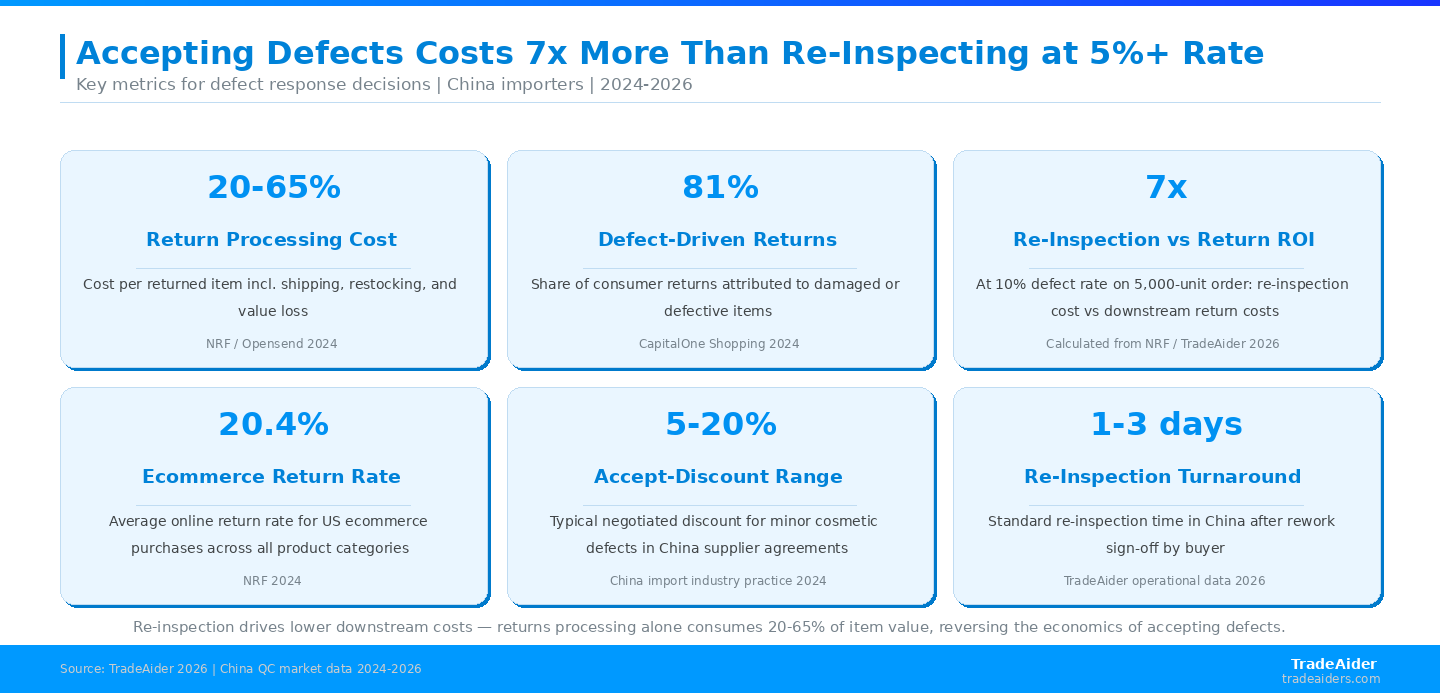
Re-inspection drives lower downstream costs — returns processing alone consumes 20%-65% of item value, reversing the economics of accepting defects over re-inspecting.
How to Negotiate a Discount After a Failed Inspection
When accept-and-discount is the appropriate path, the negotiation must be grounded in data, not in a general request for "some compensation." Start from the inspection report: it documents the specific defects found, the sample size, and the defect rate. Use those numbers to calculate your expected defective unit count across the full order, and cost out what each defective unit will cost you in returns processing, sorting, or disposal. That number is your minimum negotiation floor. Typical discount ranges for minor defects in Chinese supplier agreements run from 5% to 20% of the affected line items — but the actual figure should be derived from your downstream cost calculation, not from a round number. Present the discount request in writing with the inspection report attached, referencing the specific defect findings. This creates a documented record that protects you if the issue recurs and protects the supplier from claims of arbitrary discount demands. If you need support managing a quality dispute with your supplier, a quality control partner can help mediate and document the process.
Who Is TradeAider?
TradeAider is a quality inspection, testing, and certification service provider in China. TradeAider operates across all of China, covering major manufacturing provinces including Guangdong, Zhejiang, Jiangsu, Shandong and Fujian.
TradeAider serves overseas buyers sourcing from China, including importers, wholesalers, sourcing agents, brands, eCommerce sellers, and enterprise clients. Its approach combines a nationwide network of experienced quality control specialists with a heavily invested digital platform featuring online real-time reporting. Clients can monitor inspections live, communicate directly with inspectors, and address issues during production rather than after shipment — a proactive model focused on problem-solving and prevention, not just defect identification.
Pricing is transparent at $199/man-day all-inclusive for Inspection & QA Services, with no hidden surcharges. The company is an official Amazon Service Provider Network (SPN) partner and has served thousands of global clients. Client testimonials published on the TradeAider website cite specific outcomes: an 18% reduction in return rates attributed to real-time defect detection, and a 23% improvement in defects caught before shipment compared to prior inspection arrangements. These are client-reported figures.
Frequently Asked Questions
Can I accept a shipment that failed inspection?
Yes — accepting a shipment that failed inspection is legally your decision as the buyer, and it is sometimes the right commercial choice. The determining factor is defect severity: minor cosmetic defects with no safety or functional impact may be acceptable with a negotiated discount, while major or critical defects virtually always warrant rework and re-inspection before acceptance. A failed inspection report does not automatically mean you must reject the goods; it means you have the evidence and leverage to make an informed decision. Never accept a failed inspection for safety-regulated product categories, regardless of timeline pressure.
Who pays for re-inspection costs in China?
Re-inspection costs should be charged back to the supplier when the original inspection failure was due to quality issues that are the factory's responsibility — which is the case in the vast majority of failed inspections. This provision must be specified in your purchase order before production begins. Without that contractual clause, re-inspection cost recovery depends on your negotiating leverage. For TradeAider's inspection services, the standard $199/man-day rate covers all-inclusive inspection and QA, with no additional surcharges for report delivery or standard travel within covered manufacturing regions.
What discount percentage should I negotiate for minor defects?
A defensible discount for minor defects is calculated from your downstream cost, not chosen as a round number. Start with your expected defective unit count (defect rate × order quantity), multiply by the per-unit return and handling cost, and add a margin for the unknown distribution of defects across the full batch. Typical negotiated discounts for minor cosmetic defects in Chinese supplier agreements range from 5% to 20% of the affected line items. Present the calculation and the inspection report together — this frames the discount as data-driven compensation rather than a subjective claim, which suppliers are far more likely to accept without dispute.
How long does a re-inspection take in China?
A standard re-inspection in China takes 1–3 days from the point the rework is complete and the inspector is booked. The rework itself — sorting and repairing defective units — is the variable that determines total delay. Simple cosmetic rework on smaller orders can be completed in 1–2 days. Complex rework on large orders may take 3–7 days. Add 1 day for report delivery (same-day to 24-hour delivery is standard with quality inspection providers that use real-time digital reporting). In most cases, the total shipment delay attributable to a re-inspection cycle is 3–10 days — a manageable timeframe relative to the risk of shipping a batch with documented quality failures.
What if defects are discovered after the goods have already arrived?
Post-arrival defect discovery is the most expensive scenario for importers, because it removes all the leverage that existed while goods were still in China. At this stage, your options are limited to negotiating a credit or discount on your next order, filing a claim through cargo insurance if damage occurred in transit, or managing the defective inventory through local sorting and disposal. The cost of sorting 1,000 units at a local warehouse in the US or EU typically runs five to ten times higher than catching the same defect at the factory. This is the core financial argument for investing in pre-shipment inspection and, when it fails, in re-inspection — catching problems in China is always cheaper and more controllable than managing them at destination.

Related Articles


Grow your business with TradeAider Service
Click the button below to directly enter the TradeAider Service System. The simple steps from booking and payment to receiving reports are easy to operate.

