
- About Us

- Our Services
- Your Industry
- Resources
- News & Blog
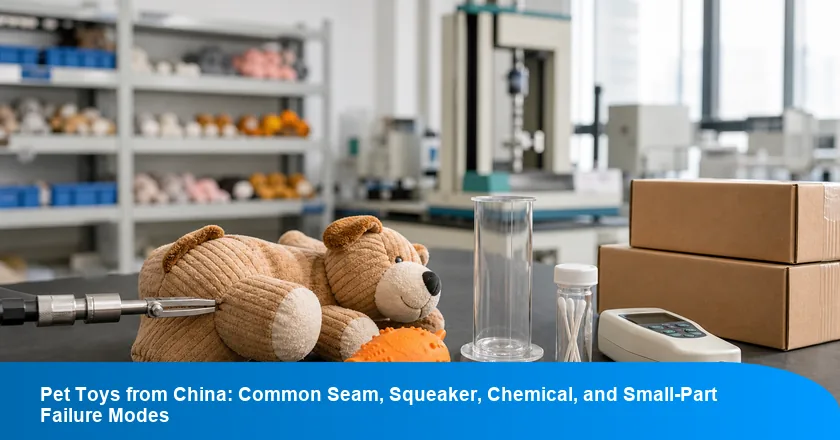
A pet-toy failure mode is a construction or material condition that can make a toy fragment, expose an internal component, or leave its declared material unverified for the intended market. Inspection records seams and containment, a supplier record identifies a material claim, and a laboratory method answers a defined chemical question. None of these alone is a blanket safety approval.
A release decision is only as useful as the evidence attached to each failure mode. A useful buying brief names the vulnerable component, the agreed observation condition, the document or method that supports the finding, and the product population covered by the decision.
How a Failure Mode Changes the Evidence You Need
A pet toy can look finished while still leaving different questions unanswered: will a seam open during the agreed handling check, is the internal squeaker enclosed, can a decoration detach, and does the packed version match the material record? Calling all of these a single quality pass makes a release note too vague to be useful. Whether the buyer uses an in-house team or TradeAider, the better sequence is failure mode, observation, supporting evidence, and the release action that evidence can justify.
- Use construction observations for seams, stuffing, squeakers, and detachable decorations.
- Use controlled supplier records to identify which design and material are being discussed.
- Use a defined laboratory question only when a market requirement or record conflict needs it.
Keeping those routes separate prevents two costly mistakes: treating an inspection photo as a chemical conclusion, or treating a revised declaration as proof that a construction issue is fixed. The rest of the brief should make the handoff between the routes explicit.
Map Pet-Toy Failure Modes Before You Choose a Sample
The ASPCA advises that toys should not fragment into smaller pieces that can be swallowed. For a buyer, that is a practical reason to map the parts of a pet toy that carry stress or can become detached before a sample is selected.
Start with a product-family map: fabric shell, seam line, stuffing, squeaker pouch, rope, embroidery, plastic eye, tag, glued applique, and any hard insert. Mark where a dog can bite, pull, compress, or repeatedly flex the toy in its intended use. The objective is not to predict every animal's behaviour. It is to turn a general concern into a repeatable factory instruction.
Write the observation condition before sampling begins. Specify the seam zone, the agreed handling sequence, what counts as stuffing exposure, and how a detached part will be recorded. A supplier and inspector can work consistently only when the acceptable condition is visible in the brief. An inspection standard for written acceptance criteria helps establish that shared baseline before the lot is selected.
Seams and stuffing: inspect the stress path, not only the surface
Inspect the stress path, not only the visible surface. A smooth outer panel does not show whether the seam allowance, stitch continuity, reinforcement point, or closing seam will stay intact in the zones a pet is likely to mouth.
Focus around limb joins, ears, tails, handles, squeaker pockets, closing seams, and transitions between soft fabric and hard parts. Compare several units from the selected lot rather than relying on a display sample. The report should distinguish a cosmetic loose thread from an opening that exposes stuffing or weakens component containment. Retain photos, product code, character design, and carton reference so a later recheck can identify the affected version.
Squeakers and inserts: treat movement as a containment question
Squeaker retention means whether the internal noise-making component remains enclosed during the agreed handling check.
Movement, exposure, or release should be recorded against the agreed containment condition. Ask the supplier to identify the component location and the construction intended to hold it in place, then record the design, selected unit, handling condition, and visible result.
A squeaker that still makes a sound may nevertheless have shifted into an unprotected zone or become visible through a seam. Where an insert is used across multiple character designs, do not assume one satisfactory unit represents all of them. Different fabric thicknesses, seam paths, or pouch layouts can change the relevant construction risk. A design-level record keeps the corrective action focused on the version that was actually observed.
Loose decorations: do not borrow a child-product conclusion
16 CFR part 1501 identifies articles intended for children under three that present a small-parts choking, aspiration, or ingestion hazard. The published US regulation identifies that child-product scope, while ASPCA pet-use guidance separately highlights size and chewing context.
This is not a shortcut to a pet-toy approval. A pet-toy brief should describe the intended pet size range, how aggressively the item is expected to be chewed, and whether a decoration can become a separate piece during the agreed check. Inspect eyes, bells, rope ends, labels, plastic clips, and glued attachments as components with their own containment condition. If a part is not intended to be removable, the acceptance rule should say so.
Match Each Pet-Toy Observation to the Right Evidence
A visual inspection can record a material identifier, but it cannot determine a formulation from appearance. No chemical-content claim is made without a relevant test method and an identified sample.
A material declaration is a supplier record naming the materials used for the product or component. It can help the buyer compare what was ordered, what is listed on the bill of materials, and what is said to be packed. It is not proof of chemical content by itself. The US EPA's phthalates overview describes phthalates as chemicals used to make plastics more flexible and durable; that source context is why a flexible appearance alone is not a formulation result. If the document and packed version conflict, identify the component, record revision, and destination-market question before choosing an escalation route.
| Failure mode | Factory observation | Supporting record or test | Release consequence |
|---|---|---|---|
| Seam opening | Location, opening, stuffing exposure, design, carton | Approved construction sample and corrective-action record | Rework or hold the identified population pending recheck |
| Squeaker movement | Movement, exposure, or release during the agreed sequence | Design-specific containment instruction and recheck result | Hold the affected design until containment is verified |
| Material-record conflict | Product identifier differs from current declaration or component record | Controlled declaration, design traceability, and targeted laboratory scope when needed | Do not release an unresolved population |
European Commission guidance shows that chemical restrictions and risk-management information can depend on article, material, and legal scope. Its pages on chemical restrictions and the REACH framework provide the source context for that boundary.
Do not request a generic chemical pass. Define the component, intended market, applicable requirement to be checked, sampled design, and result format needed for the decision. That keeps the laboratory question connected to the product rather than to an unverified assumption about a flexible material.
NIST says laboratory accreditation addresses competence and capability within scope, not the specifics of an individual result. NIST's guidance on laboratory accreditation therefore supports a scope check rather than a claim that inspection or accreditation is a product certificate.
A laboratory's accredited scope does not turn an inspection observation into a product certificate. Confirm that the method, sample identity, material or component, and destination-market question match the issue found in the lot. Use product testing for material questions that inspection cannot settle when that defined evidence route is necessary.
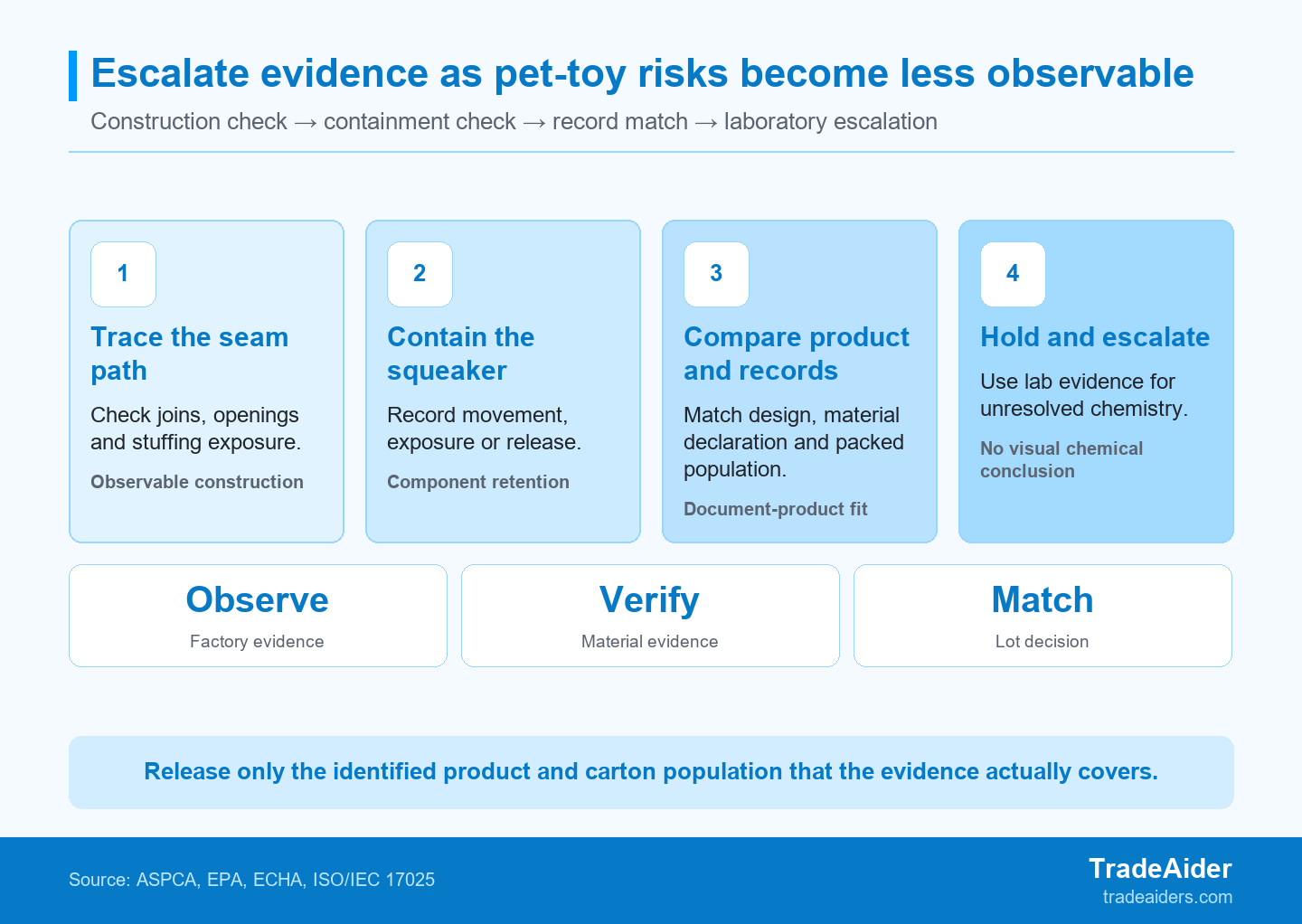
Escalate the evidence as a pet-toy question moves from visible construction to a material-record conflict.
Build the Factory Check Around the Product Family and Chew Use
Use early checks to control construction and final checks to verify the identified shipped population. At an early stage, verify approved material identifiers, insert locations, seam construction, decoration attachment, and the current version of the product specification.
This is the point at which the supplier can still correct a pouch layout, stitch route, or component placement without mixing corrected and uncorrected production in sealed cartons. At final inspection, shift the question from whether the factory can make the design to whether the identified packed population matches the approved version and the evidence on file. Record design name, order quantity, selected cartons, packing status, and the record revision reviewed.
A During Production Inspection for high-risk pet-toy construction can be scoped around the construction features that are still accessible before packing. If the supplier changes fabric, an insert, an adhesive decoration, or a component source after that visit, treat the change as a new evidence question rather than assuming the earlier observation still represents the finished lot.
Keep the sampling instruction and escalation rule in the same brief. State who can hold the lot, which records must be reconciled, when a recheck is required, and what proof is needed before shipment. This avoids the handoff error in which a revised document is treated as if it also repaired a physical construction issue.
Worked Scenario: A Material Declaration Conflicts With the Packed Design
The article's 180-carton illustrative lot remains on hold until the record and product scope match. This is an illustrative decision path, not a sampling rule, client outcome, or statement that a laboratory result already exists.
Why this lot needs a full hold, not a selective release
Do not split a lot without an identified unaffected population. A selective release needs a controlled carton and product boundary, not an assumption that only one version is involved.
An online pet-products brand is preparing a soft dog-toy assortment for a mixed-size dog range. Its brief asks the factory to document seam integrity, internal-component containment, and the material record for each character design before shipment. The illustrative order contains 5,400 units in 180 export cartons across three character designs. The designs were packed together, so the release question concerns the carton population as well as the individual toy versions. All cartons are sealed, but the buyer has not yet issued a release instruction. The factory can provide packing records but cannot point to a controlled carton boundary that separates one design from the other two.
Six of 32 selected units show audible movement of the internal squeaker after the agreed handling sequence. The report records the design code, location of movement, handling sequence, and selected-carton references; it does not create a universal safety threshold. The supplier declaration says TPR outer material, while a current packing component record identifies a flexible PVC input for one design. The inconsistency is a record-to-product concern. It does not identify the polymer in the finished part or determine chemical content from the inspection table. The inspection finding establishes a construction concern and a record conflict, but it does not identify the polymer or determine chemical content. The buyer therefore has two linked gaps: the squeaker construction must be corrected and rechecked, and the material record must be reconciled with the version that was packed.
Place the full 180-carton population on hold because the affected design cannot be reliably separated and the material claim is unresolved. Releasing cartons on the assumption that they contain an unaffected design would create a boundary the records do not support. The supplier isolates the design, provides controlled material records, and submits agreed samples for a targeted laboratory scope if the destination-market requirement makes that evidence necessary. It also corrects the squeaker containment route and identifies the repaired production population for recheck.
Release only after the product record is reconciled, the corrected squeaker construction is rechecked, and the evidence scope matches the packed design. The buyer records which version, cartons, documents, and results the release statement covers. The quantities are illustrative and are not a sampling standard; a laboratory result is not implied by the inspection. A different order may justify a different boundary only when its traceability and evidence identify the unaffected population.
Write a Release Statement That Matches the Evidence
Release only the product version and carton population that the evidence actually identifies. A release boundary is the identified population that the decision covers, including the design, cartons, documents, and checks named in the release statement.
A final release note should identify the purchase order, product code or design, finished quantity or carton population, inspection date, observed construction condition, reviewed record version, outstanding issue, and action required before release. Avoid wording such as all quality and chemical requirements passed unless the buyer holds evidence that genuinely covers that statement. Keep inspection observations, supplier declarations, and laboratory results as distinct fields.
- State the exact product version and cartons covered by the decision.
- Name every hold reason, corrective action, and recheck required to close it.
- Confirm that the destination-market question matches the evidence obtained.
For the finished export population, a Pre-Shipment Inspection for the identified export lot can verify the condition and packing references named in the statement. That check does not retroactively prove an untested material claim. Its role is to document the finished population and provide a traceable basis for the shipping decision.
Coordinate China Inspection and Testing Without Blurring Their Roles
TradeAider is a quality inspection, testing, and certification service provider in China. TradeAider's inspection coverage and service background provide relevant provider context for a category-specific brief.
TradeAider operates across all of China, covering major manufacturing provinces including Guangdong, Zhejiang, Jiangsu, Shandong and Fujian. For a pet-toy buyer, that coverage can support one inspection brief across factory locations, but it is not a pet-toy compliance guarantee. The buyer should still set the product-family scope, construction conditions, destination-market question, and release boundary for the particular order.
Send product photos, material records, design codes, component map, order quantity, factory readiness, packing status, and known seam or insert concerns before booking. That lets the construction check, document review, and any laboratory escalation be scoped as separate evidence routes. It also avoids sending a sample for an undefined chemical question when the real issue is an untracked design change or unresolved squeaker enclosure.
A nationwide network can support factory coordination, while real-time online reports, live monitoring, and direct inspector communication can make the decision trail easier to review. TradeAider lists $199/man-day all-inclusive for Inspection & QA Services and describes itself as an official Amazon SPN partner. Those provider details give service context; they do not change the buyer's responsibility to define the acceptance conditions and decision boundary.
Before booking, request a pet-toy inspection brief from TradeAider with the evidence route you need the report to support.
Frequently Asked Questions
Can a factory inspection certify a pet toy's chemical safety?
No; an inspection can document material identifiers and supplier records, but chemical conclusions require a relevant method, sample, and laboratory scope. Inspection can show which version was observed and whether a record is present. It cannot establish a formulation from appearance. Define the target-market question first, then ensure the selected sample and method address that question.
How should buyers test squeaker retention during inspection?
Buyers should define the construction zones, the handling sequence, and the unacceptable movement or exposure condition before the inspection starts. The report should identify the design, selected unit, squeaker location, and visible outcome. This gives the supplier a condition to correct and the buyer a basis for recheck without inventing a universal force or animal-risk threshold.
Are children's small-parts tests enough for pet toys?
No; children's small-parts rules address a child-use choking hazard, while pet-toy suitability must also consider the animal's size and chewing behaviour. A child-product result can explain its own scope, but it should not be copied into a pet-toy release statement. Describe the component, intended pet-use context, and observable containment condition required in the inspection brief.
When should a pet-toy lot be held before shipment?
Hold the affected lot when a critical component, material record, or packed product cannot be matched to the agreed inspection and evidence scope. Do not create a selective release boundary merely because a supplier says one design was affected. First establish which cartons and versions are genuinely unaffected, correct the issue, reconcile the records, and recheck the evidence for the finished population.

Related Articles
Grow your business with TradeAider Service
Click the button below to directly enter the TradeAider Service System. The simple steps from booking and payment to receiving reports are easy to operate.

