
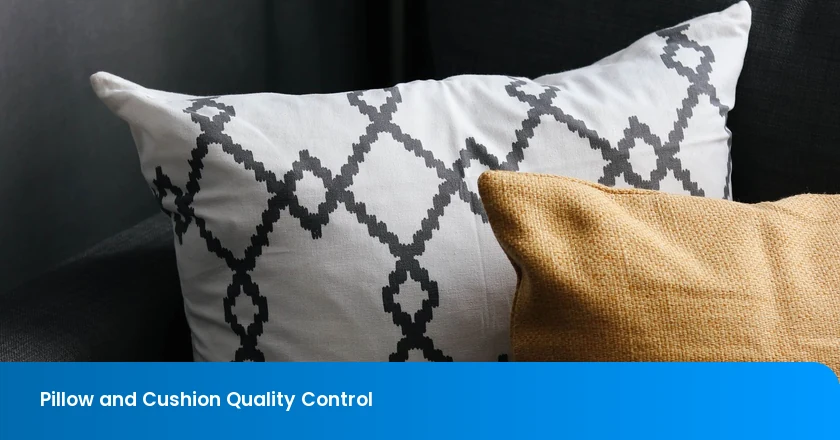
Two pillows can contain the same filling mass yet differ in shape, support and recovery after unpacking. A neat compressed pack can also conceal empty corners, stressed seams or a product that has not regained the specified thickness. Buyers need to assess the recovered pillow or cushion, as well as its filling and packaging. The six checks below cover fill weight, loft recovery, dimensions, odor, seam security and compression packing, using the preparation, measurement conditions and limits agreed for the ordered construction.
Start with These Six Pillow and Cushion Checks
| Check | What to do | How to judge it |
|---|---|---|
| Fill weight | Weigh the filling directly or subtract the actual measured non-fill parts from the sampled product; inspect distribution separately. | Net filling mass meets its tolerance; no unacceptable clumps or empty corners. Total product weight does not establish filling amount. |
| Loft recovery | Record compression history and opening time; follow the agreed preparation, recovery time, thickness points and measuring contact. | Thickness and shape meet their limits at the required checkpoint. Additional hand fluffing or indefinite waiting cannot replace the agreed procedure. |
| Dimensions | Measure the specified cover, insert or complete product at the drawing reference points; check the cover and insert together. | Length, width and relevant depth details meet tolerances; fit and closures work without forcing. |
| Odor | Assess the unpacked product under the agreed sensory conditions and describe any unusual odor, keeping the first observation. | The sensory result meets the criterion. Neither absence nor presence of odor establishes chemical identity or safety. |
| Seam security | Inspect closing seams, corners and closures; conduct only the defined strength check on the agreed specimen. | No unacceptable opening, skipped stitches or filling escape; standardized strength results meet their own criteria. |
| Compression packing | Check bags, seals, packing dates and assortment; assess recovered products after the agreed storage and unpacking sequence. | Packing protects the product and recovered function meets the specification, including after a proposed compression change. |
Define whether the weight requirement concerns filling, the insert or the complete covered product. For thickness and dimensions, also agree when to measure after unpacking and what preparation and measuring contact are permitted. Otherwise, an apparent difference may come from the cover weight or measurement procedure rather than the characteristic the buyer intended to compare.
Three Comparisons That Matter
- Measure filling mass separately from complete product weight
- Compare recovered thickness and dimensions under matched conditions
- Check seams and sensory odor separately from material and chemical claims
Approve the construction and inspection conditions
A pillow or cushion inspection needs a reference construction and a repeatable measurement method. Identify the cover, inner shell where present, filling type, filling quantity, closures, and intended shape. These adult home-product checks do not establish infant sleep safety or substantiate clinical positioning claims.
Provide the specification, approved sample, material declarations, dimension drawing, labels, care instructions, and packing requirements. State whether a quoted weight means filling only, the insert, or the complete covered product. Define the condition in which dimensions and thickness are measured, including unpacking, any permitted preparation, recovery time, and the surface or loading method.
Use the TradeAider inspection standard to align defect descriptions and reporting with the inspection provider. Then add the product-specific limits and methods that a general inspection standard cannot supply. Fiber-filled inserts, loose foam pieces, molded foam cushions, and feather or down constructions should not be treated as interchangeable simply because they share the same finished dimensions.
Verify filling weight and distribution separately
Filling weight establishes how much filling is present under the agreed method. Distribution establishes where that filling sits inside the pillow or cushion. Meeting one requirement does not establish the other: a correctly weighted insert may have empty corners or persistent clumps, while an evenly shaped sample may contain too little filling.
Account for the cover, inner shell, and other components
For a permitted destructive weigh-out, identify the sampled unit and record its complete mass before opening. Measure the emptied cover, inner shell, zipper, piping, and any other non-fill components included in that mass. Net filling mass is complete mass minus the measured non-fill mass, provided filling has not been lost or retained unnoticed during separation. Alternatively, weigh the recovered filling directly under the agreed procedure.
IDFL’s filling-testing options describe net fill weight as the weight of the filling material, recorded in grams and ounces. That quantity excludes the shell and removable cover. The definition does not supply a general tolerance for every pillow; the buyer still needs an agreed weight requirement and a suitable measurement procedure.
Do not subtract a supplier's generic cover weight without verifying that it represents the sampled construction. An altered fabric, zipper, or inner shell can change the subtraction. Keep moisture and conditioning consistent where they affect the agreed comparison, and record the scale resolution. Retain the opened sample separately; destructive checking does not authorize returning it to saleable stock.
Mass does not establish material identity. Compare the declared fiber, foam, feather, or down construction with appropriate supplier evidence and any agreed testing. A visible white filling is not proof of a particular composition or blend. Keep the identity question separate from the measured amount so a weight result cannot silently certify the material claim.
Look for clumps, empty corners, and variation between units
Check the pillow or cushion against the approved reference for filling spread, corner support, and persistent lumps. Follow any agreed preparation step rather than repeatedly shaking or kneading a failing unit until it resembles the sample. Photograph the observed condition and record whether it changes during the permitted preparation.
Acceptance quality limit (AQL) is a parameter used in an attribute acceptance-sampling scheme. Use the AQL calculator when planning that inspection, while separately defining the units allocated to destructive filling checks and recovery tests. Record individual weights and the observed range where applicable. A lot average can conceal variation and does not demonstrate that every product meets its specification.
Measure loft after a controlled recovery procedure
Loft recovery is the return of pillow or cushion thickness and shape after the agreed compression exposure and preparation. Specify the thickness measurement state before comparing units: free-standing thickness and thickness measured under a defined load answer different questions. Use the same method for each comparison and judge the agreed checkpoint, rather than a sample measured immediately after unpacking.
Record how the product was packed, how long it remained compressed, and when it was opened. Follow the agreed conditioning and preparation procedure, then measure thickness at the specified locations and time points. Use the same surface, orientation, and contact method for the approved sample and inspection units. Excessive hand fluffing or a different measuring pressure can hide a real difference.
ASTM D1776/D1776M-20(2024) addresses textile conditioning when a test method calls for it and notes that previous humidity exposure can affect moisture equilibrium, the stable moisture content reached under the specified conditions. Distinguish those conditioning requirements from finished-product unpacking recovery. The public scope does not prescribe a universal pillow recovery time or the buyer’s loft tolerance.
Compare recovery using matched materials, construction, conditioning, and measurement conditions, while documenting any intentional difference in compression exposure. An uncompressed reference and a product unpacked moments ago do not establish a like-for-like result. If the supplier proposes a longer recovery time, treat that as a change to the agreed use or acceptance condition. Do not turn an unresolved result into a pass merely by waiting indefinitely.
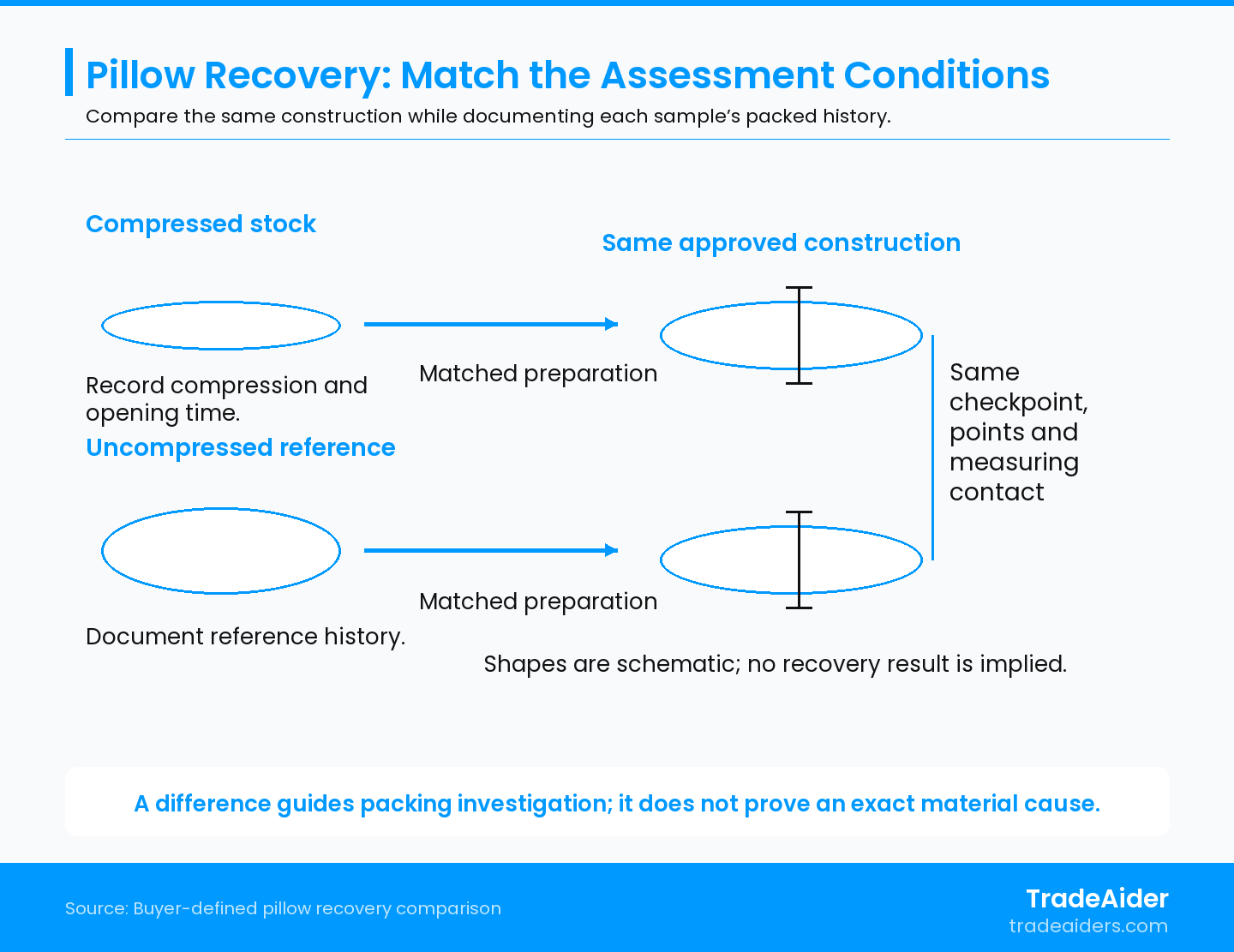
Document the different packed histories, then match the assessment conditions. Pillow shapes are illustrative and do not represent measured recovery.
For a laboratory assessment, identify the material and construction the method actually covers. A test on a foam specimen is not automatically a test of an entire fiber-filled pillow, cover, seam, and packing system. Ask the testing party to explain the specimen, conditioning, measurement, and interpretation, and retain any limits on transferring the result to the finished product.
ASTM D3574-25 applies to flexible polyurethane foams and cautions that results under a particular test may differ from performance in other use environments. Keep that material and test scope intact. A result under this standard does not automatically establish polyester-fiber, down, or latex product durability.
IDFL describes down-and-feather fill power as volume for a prescribed material weight, with shipping treatment, conditioning time, and testing climate affecting variation. Fill power is a laboratory characteristic of that filling material. It is not the finished pillow’s thickness, a foam-recovery result, or a universal acceptance limit.
Measure the intended finished shape against the drawing
Pillow and cushion dimensions should be checked at the drawing's reference points in the specified state. Identify whether the requirement concerns the empty cover, filled insert, or complete assembled product. Measure length, width, gusset or edge details, and thickness where specified. A gusset is a side panel that adds depth to the pillow or cushion. Do not compare an inflated-looking diagonal with a seam-to-seam requirement.
Check cover and insert fit together. Excessive tension, loose corners, twisted seams, and a zipper that closes only under force can reveal a mismatch even when separate length and width readings look acceptable. Compare corresponding units from the sampled stock, not a conveniently selected showroom cover with a different insert.
Record odor without treating a smell check as chemical clearance
An odor check should record a product-specific sensory observation under agreed conditions. Identify when the pillow or cushion was unpacked, the surrounding environment, and any preparation or airing. Compare the observation with the buyer's acceptance criteria and reference sample rather than using “normal smell” as an undefined factory judgment.
Note unusual odor associated with the filling, cover, bag, or another identifiable component where it can be separated safely. Keep the observation descriptive and avoid exposing an inspector to unknown emissions. If the issue is persistent, the buyer can request investigation of materials, processing, contamination, or packing, using a suitable assessment rather than inventing a cause from smell alone.
IDFL Test Method 30 describes odor assessment of filling materials and finished products, including packaging and fabric coverings before laboratory evaluation of filling odor. This is a sensory assessment with its own procedure. It does not identify a chemical, establish toxicology or emissions compliance, or guarantee harmlessness.
No detectable odor does not establish that a pillow or cushion is free of hazardous substances, and a noticeable odor does not by itself identify a chemical or demonstrate toxicity. Chemical restrictions, emissions claims, and material declarations need evidence appropriate to the product and destination market. Keep those questions distinct from the buyer's sensory acceptance decision.
Inspect seam construction and agreed strength checks
Seam security depends on the specified construction and its actual condition. Inspect the closing seam, corners, gussets, zipper attachment, and any areas carrying concentrated stress. Record open seams, skipped stitches, loose thread ends, fabric damage, and filling escape against the approved defect criteria.
Where strength testing is agreed, define the specimen, direction, applied force or method, and acceptance criteria before inspection. Do not report an inspector's hand pull as a standardized seam-strength test. A seam can look continuous yet open under the intended handling; conversely, a destructive test can damage an otherwise saleable unit. Identify tested samples and their agreed disposition.
ASTM D1683/D1683M-22 measures sewn seam strength in woven fabrics using force perpendicular to the seam; its scope does not predict actual wear performance. Confirm that the construction, specimen preparation, and agreed criteria fit the method. An informal hand pull is a different observation.
Validate compression packing with the recovered product
Compression packing should be assessed as a product-and-package system. Check the approved bag, seal, packing orientation, protection of closures, quantity, and carton assortment. Record the compressed size and the packing date where duration is relevant to the agreed recovery assessment. A tight bag is not evidence that the product will recover acceptably after storage.
Evaluate representative packed units after the agreed exposure and unpacking procedure. Compare filling distribution, dimensions, loft, seams, and odor as relevant to the specification. If a packaging test is part of the order, inspect the contents afterward as well as the bag or carton. A seal that remains closed can still conceal a product that has changed under compression.
IKEA’s JÄRNÖRT instructions note that transport-compressed, roll-packed pillows may take a few days to regain shape and fluffiness. That is guidance for the named product. It illustrates delayed unpacking recovery, but does not set a recovery time or pass threshold for another pillow or authorize unapproved heating.
Treat a change in compression level, bag size, packed duration, or carton count as a configuration change to review. Lower transport volume may be valuable, but it is not a reason to assume the previous recovery evidence applies. When a supplier offers an alternative, quality and logistics teams should check the product result and the consequences for carton dimensions, quantities, labels, and transport planning.
Investigate Failed Checks and Proposed Packing Changes
Keep the failing sample, construction, packed history and measurement conditions identifiable. Separate a completed failure from a check that was not performed. If the supplier proposes extra airing, more hand fluffing or a different recovery time, record it as a proposed change and assess it against the intended use and agreed acceptance condition. Retain the original observation alongside any approved retest.
Illustrative example: lower packing volume conflicts with recovery
Consider a hypothetical importer order of 1,600 polyester-fiber pillows. An identifiable group of 800 units has been held in compression packing for 14 days while shipment review is pending. Under the buyer's illustrative 24-hour unpacking and recovery procedure, sampled units from this group do not reach the approved loft. Uncompressed references from the same identified production group meet the reference loft after the same conditioning procedure, while filling-weight checks meet the specified amount.
The observations justify investigating the packed configuration; they do not prove underfilling or identify an exact material defect. The buyer and supplier propose a lower-compression alternative for comparison with the current packing method under matched conditions. Logistics checks the revised carton volume and assortment. The alternative remains subject to the recovery check: a larger pack is useful only if the recovered product meets the agreed requirement and the revised shipment arrangement is acceptable.
Representative units in the alternative packing undergo the agreed storage and recovery sequence before the buyer authorizes the relevant release. The report preserves the original failed configuration and identifies which stock uses the revised one. All quantities and times in this illustrative example are hypothetical buyer assumptions, not TradeAider client results or universal recovery limits. An instant hand-fluffed sample would not verify the proposed change.
Send the Construction, Recovery Method and Packing History
Send the approved construction and sample, net filling requirement, dimension drawing, recovery method, labels and lot details. Include compressed storage duration, packing dates, proposed changes and the checks allocated to destructive samples. Confirm which seam or material tests need laboratory equipment, how specimens will represent the finished construction and whether the recovery schedule extends beyond the factory visit.
Resolve drawing, component, and sample differences before production when possible. TradeAider's Pre-Production Inspection can be discussed for checking agreed materials, components, and initial samples at that stage. Explain which cover-and-insert configuration needs verification and confirm the scope; a routine visit should not be described as validation of an unsupported comfort or medical claim.
TradeAider’s Pre-Shipment Inspection takes place when the finished order is 100% complete and at least 80% packed for export, using randomly selected shipment samples. Confirm the product-specific checks and any separate laboratory or longer recovery assessment before booking.
Contact our team with the pillow or cushion specification and recovery schedule for scope and quote review. Include the intended packing configuration.
Frequently asked questions
Can two pillows have the same weight but different firmness?
Yes; equal filling mass does not establish equal firmness, shape, or recovery for different materials, constructions, and agreed measurement conditions. Compare the approved filling type and distribution as well as its amount. If firmness is an acceptance characteristic, define a suitable method and reference instead of substituting a scale reading. Keep any comfort claim within its actual evidence; inspection does not establish a clinical benefit.
Can a supplier air out stock until an odor complaint disappears?
Airing is acceptable only within the buyer's agreed preparation and assessment conditions; it should not quietly replace the original packed-product requirement. Record the initial observation and the treatment proposed, then assess whether the result remains appropriate after the intended packing and storage sequence. If chemical or emissions claims are involved, use relevant evidence rather than assuming that a weaker smell resolves those claims.
Does changing the removable cover require every test to be repeated?
A cover change needs a scoped review of the characteristics it can affect, rather than an automatic assumption that all previous evidence still applies. Check dimensions, component weight, fit, closures, seams, labels, and any relevant material requirements. Identify the changed stock and compare it with the approved construction. Repeat affected verification under the agreed method; explain why unaffected evidence remains applicable.
Can opened filling-weight samples be repacked into the shipment?
Only if the buyer has approved a disposition that restores and verifies the required saleable condition after the destructive check. Keep opened or altered samples identifiable and separate until that decision is made. Account for lost filling, damaged seams, contamination, closures, and packaging rather than treating a new bag as sufficient repair. A useful test result does not itself authorize returning that particular unit to stock.
Related Articles

Grow your business with TradeAider Service
Click the button below to directly enter the TradeAider Service System. The simple steps from booking and payment to receiving reports are easy to operate.