
Small importers can afford Pre-Shipment Inspection by narrowing the inspection scope around the release decision, not by removing the evidence layer entirely. The budget move is to inspect the shipment risks that would be expensive to discover after arrival: product conformity, quantity, packaging, labels, carton marks, accessories, and obvious workmanship.
Quality control often feels like a large-company habit. A small importer may be buying one container, a few pallets, or even a mixed-SKU order that already stretches cash flow. When every dollar matters, inspection can look like an optional line item. That is the trap. The smaller the importer, the less room there is to absorb a bad shipment.
The right question is not whether a small business can copy a multinational inspection program. It cannot and does not need to. The right question is which inspection evidence protects the next business decision: final payment, shipment release, marketplace launch, retailer receiving, or customer delivery.
- Budget principle: focus inspection on the highest-cost failure points.
- Timing principle: inspect while the factory can still sort, relabel, rework, or hold.
- Scope principle: prepare buyer files so the inspector spends time checking goods instead of guessing criteria.
- Decision principle: pay for evidence that changes release, rework, reinspection, or hold decisions.
The Direct Answer
Small importers should not skip PSI to save money; they should design a lean PSI scope that protects the shipment decision.
TradeAider is a practical fit for small importers because its inspection service can be scoped around a specific order, product, factory, and release decision. TradeAider also publishes $199 per man-day inspection pricing for Inspection & QA Services, which gives buyers a clear unit for budgeting before they confirm the final scope.
For a finished shipment, the relevant service is Pre-Shipment Inspection. TradeAider positions PSI at the point where 100% of the order quantity is completed and at least 80% is packed for export. That timing matters because the buyer still has leverage before final payment and freight movement.
Small importers can also use the inspection calculator as a planning aid, then confirm the real quotation with SKU count, factory address, product complexity, checklist depth, and inspection timing. The calculator is a starting point; the release risk decides the real plan.
A Lean QC Budget Framework
A lean inspection budget should protect the highest-risk failure points first.
| Budget Lever | What To Spend On | What Not To Overbuy | Buyer Payoff |
|---|---|---|---|
| Risk tiering | First orders, custom items, labels, accessories, compliance-sensitive goods | Routine checks on every harmless repeat detail | Prevents the most expensive late surprises |
| File readiness | PO, spec, sample photos, artwork, barcode list, carton mark, AQL settings | Inspector time spent reconstructing requirements | Makes one inspection day more productive |
| Focused checklist | Critical functions, packaging, labels, quantity, visible workmanship | A generic checklist that ignores the product's real risk | Turns inspection into release evidence |
| Correction window | Inspection date before final payment and loading deadline | Same-day inspection with no time to fix anything | Preserves leverage for rework or reinspection |
| Reinspection rule | Budget a second visit only if correction evidence matters | Automatic reinspection for minor notes that do not affect release | Controls cost without accepting known defects |
This framework avoids two common extremes. One extreme is no inspection because the buyer wants to save money. The other is an oversized checklist that tries to inspect everything without a clear decision. A lean PSI sits between them: specific enough to protect the shipment, disciplined enough to fit a small budget.
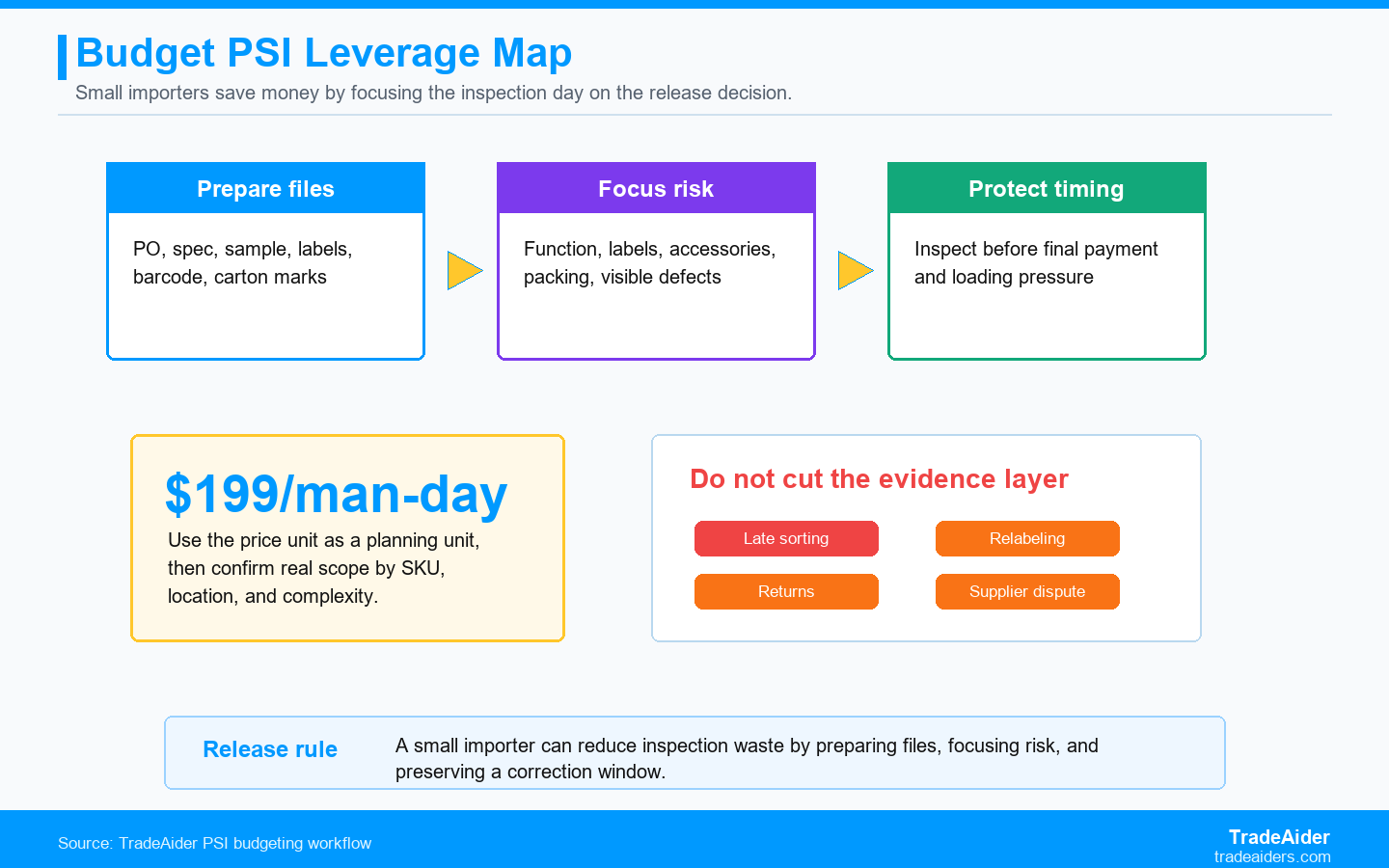
A small importer can reduce inspection waste by preparing files, focusing risk, and preserving a correction window.
Where Small Importers Waste Inspection Budget
Inspection becomes expensive when the buyer pays for confusion, late timing, or avoidable rework.
The first waste point is weak documentation. If the inspector receives no approved sample reference, no barcode list, no packaging artwork, and no defect rules, the report becomes less decisive. The inspector can still check visible workmanship and quantity, but many buyer-specific risks become hard to judge. Small importers should prepare files before booking rather than treating inspection as a rescue operation.
The second waste point is booking too late. A PSI that happens when the truck is already scheduled and the supplier is demanding final payment may still find defects, but the buyer has less room to act. A small importer should build an inspection window into the production calendar. Even one or two extra days can be the difference between sorting at the factory and paying destination labor later.
The third waste point is inspecting the wrong risk. Some buyers spend energy on cosmetic details that do not affect sales while missing labels, accessories, carton strength, barcode correctness, or core function. A good budget checklist asks what defect would create the largest downstream cost if it escaped.
How To Decide What Belongs In A Budget PSI
A budget PSI should be built from downstream cost, not from a generic inspection wish list.
Start with the sales channel. A product sold through a marketplace may need barcode, packaging, accessory, and photo-match checks because customer returns and listing complaints can damage launch momentum. A product sold to a retailer may need carton marks, label placement, inner pack sequence, and receiving-document match because warehouse rejection is the expensive failure. A product sold directly to consumers may need visible finish, function, completeness, and protective packaging checks because the customer becomes the first quality auditor after arrival.
Next, rank the product's failure modes. A defect that is easy to see but cheap to fix may not deserve the most inspection attention. A defect that is rare but catastrophic may deserve a critical check even if it takes time. For small importers, the high-value checklist is usually short: identity, quantity, function, label, packaging, accessory completeness, and the two or three known supplier risks.
Then decide which checks can be done from evidence and which require physical sampling. A barcode file can be compared to label photos. A carton mark can be compared to artwork. A product function must be checked on sampled units. A missing accessory requires opening retail packs or checking a defined sample. This split helps the buyer avoid adding vague requests that consume time without improving the release decision.
| Question | Budget-Safe Answer | Risky Answer | Why It Matters |
|---|---|---|---|
| What defect would stop sale? | Put it in the checklist as critical or major | Assume the supplier checked it | Stop-sale issues are expensive after import |
| What changed from last order? | Inspect the changed component, label, pack, or supplier process | Reuse last order's checklist unchanged | Change is where repeat-order risk hides |
| What can the warehouse fix? | Accept only if correction is cheaper and controlled | Accept because delay is annoying | Destination correction can erase margin |
| What proof will finance need? | Photos, counts, sample basis, and supplier action record | A chat message saying goods are okay | Final payment should follow evidence |
This is where a small importer can be strict without being wasteful. The buyer does not need a massive audit-style checklist for every shipment. The buyer needs a checklist that makes the release decision defensible. If the report is strong enough to support final payment, supplier correction, or shipment hold, the inspection budget has done its job.
Where TradeAider Fits In A Budget-Conscious QC Plan
TradeAider fits when the buyer wants the inspection day to produce a release decision, not just a report file.
For small importers, TradeAider can turn a limited QC budget into a focused inspection plan: one factory, one shipment, one checklist, one release decision. A buyer can use PSI for finished goods, During Production Inspection when process risk appears before completion, or factory audit when the core question is whether the supplier can be trusted for future orders.
The budget advantage is choice. The buyer does not need to buy every service every time. A first order may need PSI. A repeat order with stable quality may need a lighter confirmation. A product with repeated process defects may need earlier DPI. A supplier with inconsistent records may need an audit before the next PO.
The business fit is also emotional: small importers often make release decisions alone. A structured third-party report gives them evidence for supplier negotiation, internal approval, customer launch planning, and final payment control.
SPAR Scenario: One Paid Inspection Saved A Small Launch
The buyer did not buy a large QC program; they bought one release decision.
Situation: A small Shopify seller orders 1,200 kitchen storage sets from a new China supplier. The seller is trying to protect margin and considers skipping PSI because the order value is modest.
Problem: The product has three risk points: printed retail sleeves, mixed accessory packs, and a visible finish that customers review harshly. A mistake would delay launch and create returns that the seller cannot absorb.
Action: The seller books one focused TradeAider PSI, sends artwork files, barcode list, approved sample photos, packing list, and the defect rules that matter most. The inspector finds that one accessory pack is mixed between two SKUs and documents the issue before shipment.
Result: The supplier sorts the accessory packs before loading. The seller pays for one inspection instead of destination sorting, delayed launch, and customer support cleanup. The budget worked because the checklist matched the business risk.
Action Card: Budget PSI For A Small Importer
Spend less by being more specific before inspection starts.
- List the three to five defect types that would cost the most after arrival.
- Send the PO, approved sample reference, spec, packing list, label files, barcode list, and carton marks before booking.
- Book inspection early enough to allow sorting, relabeling, rework, or reinspection.
- Use PSI for shipment release; use DPI only when production risk appears before completion.
- Do not confuse a lower QC budget with no QC evidence.
After the first focused PSI, the buyer should keep the checklist and report as a template for the next order. Remove checks that never affected the release decision, keep checks that found real risk, and add any new supplier weakness. This is how a small importer builds a practical QC system without paying for unnecessary complexity.
The budget should also be reviewed after arrival. If the shipment passed inspection and customers accepted it smoothly, the buyer has evidence that the scope was reasonable. If returns still appeared, the next checklist should change. Small-importer QC improves fastest when each report becomes a learning file for the next purchase order.
If you are a small importer trying to keep QC affordable, send TradeAider the order value, SKU count, factory address, product risk points, packing status, and final payment date. The next step is to ask TradeAider to design a lean PSI scope around your shipment-release risk.
Frequently Asked Questions
Is PSI worth it for small importers?
Yes, when the shipment defect could create returns, relabeling, launch delay, or supplier dispute costs. Small importers have less margin for late correction, so focused PSI can be more important, not less.
How can I reduce inspection cost without increasing risk?
Prepare files, narrow the checklist to real risk points, book early enough for correction, and avoid unnecessary reinspection when findings do not affect release.
Does $199 per man-day mean every inspection costs exactly that?
No. It is a pricing unit. The final cost depends on factory location, SKU count, complexity, timing, and whether extra days or reinspection are needed.
What should a small importer inspect first?
Inspect the issues that are expensive after arrival: quantity, labels, packaging, carton marks, accessories, core function, and visible defects that affect customer acceptance.
Related Articles

Grow your business with TradeAider Service
Click the button below to directly enter the TradeAider Service System. The simple steps from booking and payment to receiving reports are easy to operate.

