
- About Us

- Our Services
- Your Industry
- Resources
- News & Blog
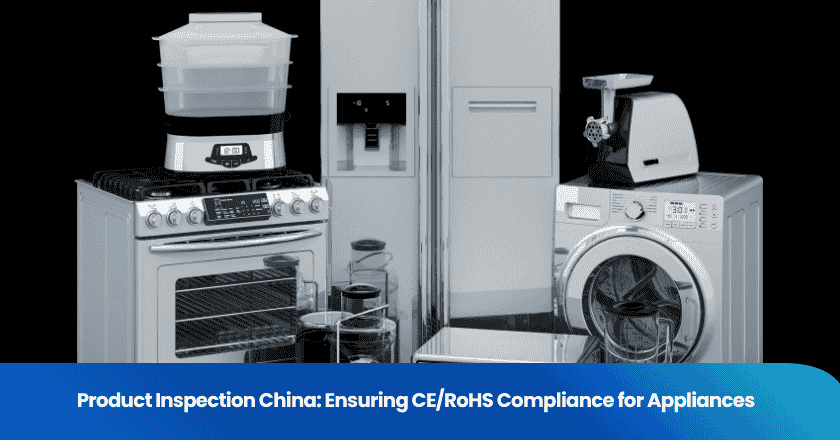
You've sourced a kitchen appliance from a Chinese factory. The supplier has provided a CE certificate, a RoHS test report, and assurances that everything is in order for the EU market. Here's what most importers don't realize: a document that says CE compliance is not the same as a product that is CE compliant. A recent enforcement study found that nearly half of household electronics and appliances don't actually comply with CE requirements — despite having paperwork that claims they do. Product inspection in China is the mechanism that closes this gap between claimed compliance and verified compliance.
Key Takeaways
- CE marking is not a certification — it's a manufacturer's declaration that must be backed by technical documentation and verified substance testing.
- RoHS restricts 10 hazardous substances in electrical and electronic equipment; lead must be below 1,000 ppm, cadmium below 100 ppm, with documentation retained for 10 years.
- Product inspection in China verifies that the physical units on the production line match the documentation submitted for compliance — a critical check because factories sometimes substitute components post-certification.
- As the EU importer, you are legally responsible for compliance — not your Chinese supplier. If a product fails market surveillance, the liability is yours.
CE, RoHS, and REACH: What Each Compliance Actually Requires
Before understanding what product inspection verifies, it's important to understand what the three primary EU compliance frameworks actually require. Many importers conflate them, which leads to expensive gaps in their compliance programs.
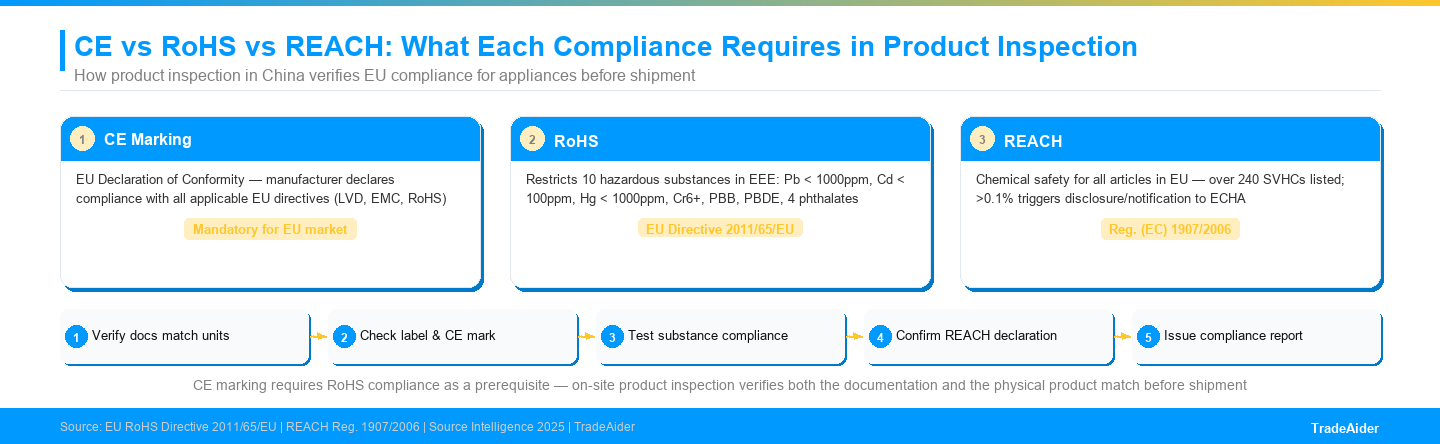
CE marking requires RoHS compliance as a prerequisite — on-site product inspection verifies both the documentation and the physical product match before shipment
CE Marking: A Declaration, Not a Certificate
CE marking is not issued by a testing body or certification authority. It is the manufacturer's declaration that the product meets all applicable EU directives. For household appliances, this typically includes the Low Voltage Directive (LVD 2014/35/EU), the EMC Directive (2014/30/EU), and — for products containing electronic components — the RoHS Directive. The CE marking process requires the manufacturer to complete a Conformity Assessment, prepare technical documentation, issue an EU Declaration of Conformity, and affix the CE marking to the product and packaging.
As an EU importer, it is critical to understand that CE marking is not a quality mark or a certification issued by a third party. It is the manufacturer's declaration. This distinction matters because Chinese factories frequently present a "CE certificate" that is either a test report rather than a Declaration of Conformity, or a declaration prepared for a different product variant. Product inspection in China verifies that the actual units in the batch correspond to the product described in the compliance documentation.
RoHS: Substance Limits in Electrical and Electronic Equipment
The EU RoHS Directive (2011/65/EU, updated by 2015/863/EU) restricts 10 hazardous substances in electrical and electronic equipment. For household appliances, the key concentration limits per Source Intelligence's regulatory analysis are:
| Substance | Maximum Concentration | Common Sources in Appliances |
|---|---|---|
| Lead (Pb) | < 1,000 ppm (0.1%) | Solder, PVC cables, paint |
| Cadmium (Cd) | < 100 ppm (0.01%) | Rechargeable batteries, plating |
| Mercury (Hg) | < 1,000 ppm | Fluorescent lamps, thermostats |
| Hexavalent Chromium (Cr6+) | < 1,000 ppm | Metal plating, corrosion protection |
| PBB / PBDE (flame retardants) | < 1,000 ppm each | Plastic housing, PCB coatings |
| 4 Phthalates (DEHP, BBP, DBP, DIBP) | < 1,000 ppm each | PVC cables, gaskets, seals |
RoHS compliance requires the manufacturer to verify substance concentrations through material declarations, testing per IEC 62321 (the international standard for determining hazardous substances in electrical and electronic products), and maintain a Technical File with documentation retained for 10 years. Critically, RoHS compliance is a prerequisite for CE marking on electrical and electronic appliances — you cannot CE-mark a product that hasn't been verified for RoHS compliance.
REACH: Chemical Safety Beyond Electronics
REACH (Regulation EC 1907/2006) is broader than RoHS — it applies to virtually all articles imported into the EU, not just electronic equipment. For household appliances, REACH's most operationally relevant requirement is the Substances of Very High Concern (SVHC) list, which now contains over 240 substances. If your product contains any SVHC above 0.1% by weight at the article level, you must provide this information upon request to customers and consumers. Importers bringing more than 1 ton per year of articles containing SVHCs must notify the European Chemicals Agency (ECHA).
As Supplier Ally's 2026 compliance guide observes: "Chinese suppliers will send you REACH test reports. Sometimes they're real. Sometimes they're for a different product. We've seen factories pass off reports from one component as proof for an entire product, or use old reports from years ago." This is not hyperbole — it's a documented pattern that on-site product inspection is designed to catch.
What Product Inspection in China Actually Verifies for CE/RoHS Compliance
Understanding what compliance requires is one thing. Understanding what product inspection verifies is another. Here's what a professional inspection covering CE/RoHS compliance actually checks on the factory floor:
1. Document-to-Product Verification
The most critical inspection activity for compliance is verifying that the physical units being produced match the product described in the compliance documentation. Inspectors check:
- Model number and variant on the units match the model covered by the CE Declaration of Conformity
- Components visible during internal inspection match the approved Bill of Materials — this catches post-certification component substitutions
- Certifications marked on the product label (CE mark, WEEE symbol) are correctly formatted and positioned per regulatory requirements
- RoHS test reports reference the specific components used in this production run, not an earlier product version
This document-to-product verification step is frequently where non-compliance is discovered. A factory may have valid compliance documentation for a slightly different product configuration than what they're currently producing — perhaps with a different heating element, a different cable supplier, or an updated plastic formulation. An inspector verifying compliance doesn't just review documents; they compare documents to units.
2. Label and Marking Compliance Check
CE marking requirements are specific. The CE mark itself must be at least 5mm in height, clearly visible, legible, and indelible. It must appear on the product, on the packaging, and on the accompanying documentation. For RoHS-compliant products sold in the EU, the WEEE (Waste Electrical and Electronic Equipment) symbol — the crossed-out wheelie bin — must also appear. Incorrect or missing markings are a compliance failure that can result in customs rejection, even if the product itself passes substance testing.
Inspectors also verify the regulatory label information: rated voltage, rated power, manufacturer's name and address or EU importer's details (required under the EU General Product Safety Regulation effective December 2024), country of origin, and any required safety warnings in the language of the destination market. According to home appliances inspection checklist, label compliance is one of the most frequently cited minor-to-major defect categories in EU-destined appliance inspections.
3. Verification of RoHS Test Report Validity
A qualified inspector reviewing RoHS compliance verifies that:
- The test report was issued by an accredited laboratory (ISO/IEC 17025 accreditation)
- The test report covers the specific product model and its current configuration
- The test date is recent enough to reflect current component sourcing (reports older than 1–2 years raise red flags if the factory has changed suppliers)
- The test results show values below the RoHS concentration limits for all 10 restricted substances
- Testing was conducted per IEC 62321 methodology
If the factory cannot produce a valid RoHS test report for the current production run, this is a compliance gap that must be resolved before shipment — not after customs raises a flag. TradeAider's product testing service can coordinate RoHS testing with accredited laboratories in China to resolve this gap efficiently.
4. REACH SVHC Declaration Review
For importers with regular EU shipments, inspectors can verify whether the factory has prepared or can produce a REACH SVHC declaration for the product's materials. While laboratory REACH testing isn't always conducted on-site, an inspection can flag missing documentation and prompt the importer to request updated material declarations from the factory's component suppliers. According to REACH compliance guide, failure to comply with REACH reporting obligations can result in fines, product recalls, and import bans within the European market.
The Risk of Relying on Factory-Provided Compliance Documents
The pattern documented by compliance consultants working in China is consistent: factories provide compliance documents as a matter of course, but the quality and accuracy of those documents varies enormously. The specific risk factors for CE/RoHS compliance documents from Chinese factories include:
- Component substitution: A factory changes to a cheaper cable supplier after receiving certification. The new cables may contain lead levels above RoHS limits, but the old RoHS test report is still used.
- Scope mismatch: The RoHS test report covers only the PCB, not the full product — but the factory presents it as full product compliance documentation.
- Outdated reports: RoHS test reports are produced once and reused indefinitely, even as components change.
- Incorrect CE Declaration scope: The Declaration of Conformity references directives that don't apply to the product, or omits directives that do.
The legal consequence for EU importers is significant. This means that if market surveillance finds RoHS violations in your product, the fines, recall costs, and legal exposure belong to the importer.
How to Structure Your Compliance-Focused Product Inspection
When booking a product inspection in China with a compliance verification component, your inspection brief should specify:
| Inspection Task | What to Specify in Your Brief |
|---|---|
| CE marking verification | Confirm CE mark present, correctly sized, on product + packaging + documentation |
| Declaration of Conformity review | Verify DoC covers current model number and lists all applicable directives |
| RoHS test report validation | Confirm accredited lab, current model, IEC 62321 methodology, all 10 substances tested |
| Component-to-BOM verification | Internal inspection to confirm components match approved BOM |
| Label compliance check | WEEE symbol, EU importer address, model number, language requirements |
| REACH SVHC documentation | Confirm factory has current material declarations from component suppliers |
For importers with ongoing EU-market sourcing programs, it's also worth considering a factory audit that specifically evaluates the supplier's quality management system for compliance document control — verifying that the factory has a systematic process for maintaining up-to-date compliance documentation, rather than relying on a single test report that was prepared years ago.
TradeAider's Approach to Compliance Verification
TradeAider's inspectors include compliance document verification as a standard component of pre-shipment inspections for EU-destined appliances. The real-time reporting platform means the importer can review compliance documentation findings — photos of the CE declaration, label verification results, component spot-checks — while the inspector is still at the factory, allowing immediate follow-up if gaps are identified.
For products that require formal RoHS or REACH laboratory testing, TradeAider coordinates with accredited testing laboratories in China to provide a full compliance package: on-site inspection plus lab testing, delivered as an integrated service. The transparent $199/man-day inspection pricing is separate from laboratory testing fees, which vary by product and test scope — all communicated in advance with no hidden charges. Contact our team to discuss compliance verification requirements for your next appliance shipment.
Frequently Asked Questions
Is CE marking mandatory for all appliances imported into the EU?
CE marking is mandatory for appliances covered by specific EU directives, including the Low Voltage Directive, EMC Directive, and RoHS Directive. In practice, this covers virtually all household electrical appliances — coffee makers, air fryers, kettles, blenders, rice cookers, and similar products. Products without valid CE marking cannot legally be placed on the EU market and are subject to customs rejection and market surveillance enforcement action.
Who is responsible for CE compliance — the Chinese manufacturer or the EU importer?
The EU importer bears legal responsibility for the compliance of every product they place on the European market. While the Chinese manufacturer produces the technical documentation and conducts the conformity assessment, the importer must verify that this documentation is accurate and complete before placing the product on the market. This is why independent product inspection in China — verifying that physical units match compliance documentation — is the importer's primary tool for managing this legal exposure.
How often do I need to retest for RoHS compliance?
RoHS does not specify a mandatory retesting schedule. However, a RoHS test report should be updated whenever the product design changes, component suppliers change, or manufacturing processes are modified in ways that could affect substance concentrations. Given how frequently Chinese factories change component suppliers (often for cost reasons), importers with ongoing orders should require the factory to notify them of any component changes and trigger a new compliance review. Pre-Production Inspection (PPI) at the start of each new production run is an efficient way to catch component substitutions before they become a compliance problem.
What is the difference between EU RoHS and China RoHS?
EU RoHS (Directive 2011/65/EU) restricts 10 hazardous substances and requires CE marking and a Declaration of Conformity. China RoHS 2 (effective 2019 for listed product categories) restricts 6 substances and requires products to bear either a green environmental compliance mark or an orange Environmental Protection Use Period (EPUP) mark indicating the number of years the product can be safely used. The two systems have different exemptions, marking requirements, and scope — a product compliant with EU RoHS is not automatically compliant with China RoHS, and vice versa. Importers selling in both markets need separate compliance documentation for each.
Can I use a Chinese factory's RoHS test report, or do I need my own?
You can use a factory-provided RoHS test report if it meets all validity criteria: issued by an accredited laboratory, covers your specific product model and current configuration, uses IEC 62321 methodology, and is recent enough to reflect current component sourcing. If any of these criteria aren't met — or if the factory can't produce a valid report — you should commission independent RoHS testing before shipping. Given the compliance risk involved, independent testing through a trusted partner is the safer choice for any significant EU-market appliance order. Get a quote for product testing and inspection combined.
Related Articles


Grow your business with TradeAider Service
Click the button below to directly enter the TradeAider Service System. The simple steps from booking and payment to receiving reports are easy to operate.

