
If a PSI fails, do not choose between delay and acceptance too quickly. First classify the defect severity, legal or safety exposure, customer impact, correction feasibility, shipment urgency, and supplier responsibility. Delay is usually right for critical, systemic, or compliance-related failures; acceptance with renegotiation may be reasonable only for controlled defects that do not damage the buyer's market promise.
A failed pre-shipment inspection creates pressure from every side. The supplier wants to ship. The freight schedule may be tight. The buyer may need inventory. Sales or marketplace launch dates may already be committed. At that moment, a discount can feel tempting. But a discount does not fix a defect that creates returns, safety exposure, retailer rejection, or brand damage.
The correct response depends on the type of failure. A cosmetic issue on a low-risk product is different from a missing warning label, wrong component, failed function test, mixed SKU, or defect pattern that shows the factory did not control production. The buyer needs a decision framework before negotiating.
- Delay shipment: use when the defect is critical, systemic, unsafe, noncompliant, or expensive after arrival.
- Accept and renegotiate: consider only when the defect is bounded, sellable, documented, and cheaper to handle than delay.
- Rework and reinspect: use when correction is feasible and the buyer needs proof before release.
- Reject or hold: use when the supplier cannot show correction, root cause, or reliable containment.
The Direct Answer
A failed PSI should become a structured release decision: classify risk, choose correction path, document supplier responsibility, and reinspect when correction evidence matters.
TradeAider's Pre-Shipment Inspection gives the buyer evidence before goods leave the factory. When the report fails, the value of that evidence is not only the fail verdict. The value is the defect count, photo proof, affected SKUs, packaging notes, and action path that still exists before final release.
If the failure suggests process instability, the next order may need During Production Inspection rather than waiting for PSI. If the failure suggests supplier-system weakness, a factory audit can test whether the factory can prevent recurrence.
The negotiation should follow the evidence. A buyer who asks for a discount without solving containment may simply buy the defect. A buyer who demands rework without defining reinspection may still ship an unverified correction. The failed report should lead to a written decision, not a vague supplier promise.
Failed PSI Decision Matrix
Use severity and correction feasibility before considering commercial urgency.
| Failure Type | Delay Shipment? | Accept And Renegotiate? | Best Next Step |
|---|---|---|---|
| Critical safety or legal issue | Yes | No | Hold shipment, require correction evidence, consider testing or escalation |
| Wrong label, warning, barcode, or carton mark | Usually yes | Only if destination relabeling is controlled and documented | Correct at factory and reinspect affected scope |
| Major function or assembly defect pattern | Yes if systemic | Rarely, unless bounded and customer impact is low | Sort, rework, root-cause note, reinspection |
| Minor cosmetic defects within commercial tolerance | Not always | Possible with concession | Document concession and adjust next-order standard |
| Partial quantity or mixed SKU issue | Usually yes | Only if buyer can split shipment safely | Separate lots, correct packing list, verify before release |
The matrix is deliberately conservative. A discount can be useful, but it should come after the buyer knows that the remaining risk is controlled. Money recovered from the supplier does not automatically recover customer trust, marketplace ranking, retailer compliance, or launch timing.
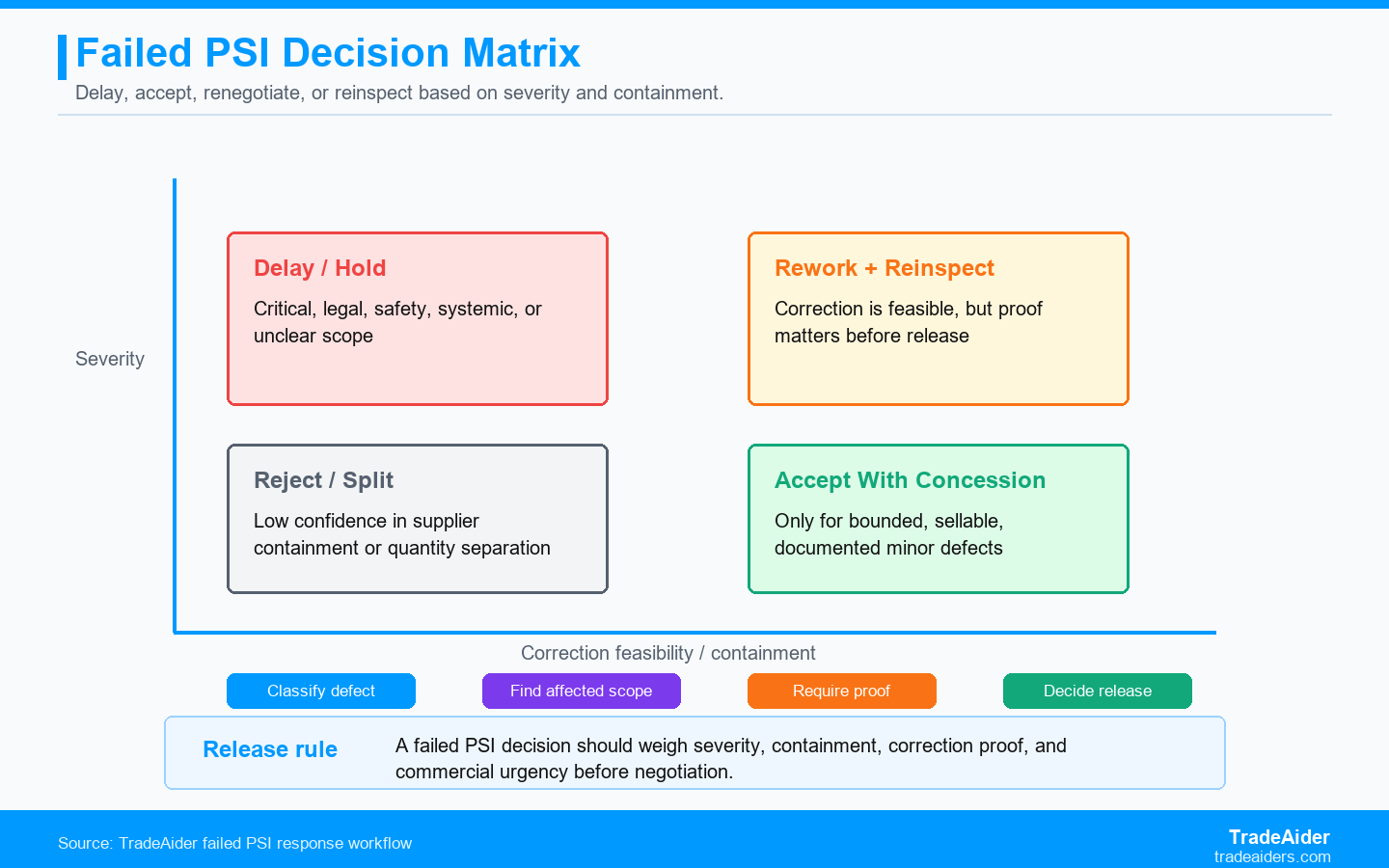
A failed PSI decision should weigh severity, containment, correction proof, and commercial urgency before negotiation.
When To Delay Shipment
Delay shipment when the failure could become more expensive or harder to control after arrival.
Delay is usually the right decision for safety, legal, warning-label, certification, or critical function problems. It is also the right decision when defects appear systemic rather than isolated. A systemic failure means the sample result suggests a process issue across the lot, not a few random blemishes.
Delay is also appropriate when the supplier cannot identify affected scope. If the factory cannot say which production date, line, SKU, carton group, or material batch caused the issue, acceptance becomes guesswork. The buyer should ask for sorting, rework, segregation, and evidence before release.
The buyer should also delay when destination correction is unrealistic. Some defects can be fixed at a warehouse, but many cannot. Repacking, relabeling, component replacement, and function correction usually cost more after import and may disrupt receiving or marketplace launch.
When Acceptance With Renegotiation Can Make Sense
Accept only when the defect is bounded, sellable, documented, and cheaper to manage than delay.
Acceptance with renegotiation can make sense for minor cosmetic issues, packaging scuffs, small measurement deviations within customer tolerance, or noncritical defects that do not affect safety, legality, function, or channel acceptance. Even then, the buyer should document the concession clearly.
A concession should state what is being accepted, which SKUs or cartons are affected, whether the supplier provides credit or replacement parts, whether the buyer changes product grading, and what standard applies to the next order. Without that detail, the supplier may treat the concession as a new tolerance.
Acceptance is risky when the buyer is emotionally anchored to the shipment deadline. A late shipment is painful, but a bad shipment can create months of returns and support work. Renegotiation is not a substitute for containment.
How To Negotiate After A Failed PSI
Negotiate from evidence first, money second.
The buyer's first message should not be a price demand. It should summarize the failed finding in operational terms: inspected quantity, defect type, severity, sample count, affected SKU or carton group, photos, and why the issue blocks release. This makes the supplier respond to evidence rather than turning the discussion into a general complaint.
The second message should ask for containment. The supplier should explain whether the defect is limited to a production date, material batch, shift, SKU, carton group, or line. If the supplier cannot define affected scope, a simple promise to be more careful is not enough. The buyer needs sorting, segregation, rework, replacement, or another physical action that can be verified.
The third message should define verification. If the buyer needs proof before release, reinspection should be part of the corrective path. A supplier photo may help, but it is weaker than independent verification when the defect was serious enough to fail the original PSI. The buyer should decide whether the corrected lot, affected SKU, or full shipment needs reinspection.
Only after containment and verification should the buyer discuss commercial remedy. The remedy may be a discount, freight contribution, replacement parts, free rework, priority production on the next order, or reimbursement for reinspection. The remedy should compensate for cost or delay, but it should not replace correction when the goods remain risky.
| Negotiation Stage | Buyer Message | Supplier Evidence Needed | Release Impact |
|---|---|---|---|
| Finding | The report failed because these defects exceeded the agreed rule | Defect photos, counts, affected SKU, sample basis | Confirms the dispute is evidence-based |
| Containment | Show which goods are affected and how you will separate them | Sorting plan, carton list, batch or production record | Prevents unknown-risk release |
| Correction | Explain the rework, replacement, relabeling, or repacking action | Corrective action record and completion timing | Creates a path to release |
| Verification | Reinspection is required before shipment release | Independent check of corrected scope | Restores buyer confidence |
| Commercial remedy | Credit or concession should reflect delay and correction cost | Written agreement linked to the failed finding | Protects margin without hiding defects |
This order keeps the buyer from trading away control too early. A discount may be appropriate, but it should be a remedy for a known, controlled problem. If the problem is not controlled, the buyer is not negotiating price; the buyer is deciding whether to import uncertainty.
Where TradeAider Fits After A Failed PSI
TradeAider fits by helping the buyer convert a failed report into a controlled next step.
After a failed PSI, the buyer can use the report evidence to request supplier sorting, rework, relabeling, replacement, price concession, shipment split, or hold. The next TradeAider role may be reinspection after correction, because the buyer needs to know whether the supplier's corrective action actually worked.
For future orders, the failed report can update the inspection checklist. If missing accessories caused failure, add accessory count and photo evidence. If labels failed, add artwork and barcode confirmation. If workmanship drifted during production, add DPI to catch the pattern earlier.
If the buyer needs help deciding whether the failed result is acceptable, TradeAider can review the report, approved spec, supplier response, final payment status, and shipment deadline. The business fit is decision support before the shipment crosses the point where correction becomes expensive.
SPAR Scenario: Discount Was Not The Right Fix
The buyer delayed because the defect could not be safely priced away.
Situation: A German importer orders 3,500 bathroom shelves. PSI fails because sampled units show loose wall anchors and several retail boxes have the wrong installation warning insert.
Problem: The supplier offers a 6% discount if the buyer releases immediately. The importer needs inventory, but the loose anchors create customer safety complaints and the wrong insert creates installation risk.
Action: The buyer delays shipment, requires the supplier to replace the inserts, sort affected anchor packs, and document the rework. TradeAider reinspects the corrected scope before release.
Result: The shipment is delayed four days, but the buyer avoids selling a known installation risk. The supplier still gives a concession for delay, but the decision is based on corrected evidence rather than accepting a defect for money.
Action Card: Failed PSI Response
Use the failed report to control risk before negotiating price.
- Separate critical, major, and minor defects before discussing shipment release.
- Identify whether defects are isolated, SKU-specific, carton-specific, or systemic.
- Do not accept safety, legal, warning-label, or critical function failures for a discount.
- Require written supplier corrective action and reinspection when correction proof matters.
- If accepting a concession, document the exact defect, affected scope, credit, and next-order standard.
Once the immediate shipment decision is made, the buyer should update the next-order control plan. A failed PSI is rarely just a one-time report problem. It may reveal weak incoming materials, unclear work instructions, poor packing-line checks, or a supplier team that does not understand the buyer's defect standard.
That next-order plan should say what changes before production starts, what evidence the supplier must provide during production, and whether the next lot needs DPI before final PSI. This turns a failed inspection from a crisis into a stronger sourcing system. The worst outcome is not a failed PSI; it is failing, negotiating a discount, and then repeating the same defect on the next shipment.
If your PSI failed and the supplier is asking you to ship anyway, send TradeAider the report, defect photos, PO, approved spec, supplier response, shipment deadline, and final payment status. The next step is to ask TradeAider to help choose delay, rework, reinspection, concession, or hold after a failed PSI.
Frequently Asked Questions
Should I always delay shipment after a failed PSI?
No. Delay is usually right for critical, systemic, compliance, label, or function failures. Minor bounded defects may be accepted with a documented concession if customer impact is low.
Is a supplier discount enough after failed PSI?
Only if the defect is controlled and acceptable. A discount does not fix safety exposure, returns, retailer rejection, or a defect pattern that remains in the lot.
When should I reinspect after a failed PSI?
Reinspect when the supplier sorts, reworks, relabels, replaces parts, or claims that a defect pattern has been corrected and the buyer needs proof before release.
Can I split shipment after a failed PSI?
Sometimes. A split can work if affected and unaffected goods are clearly segregated, documented, and verified. It is risky when the factory cannot identify affected scope.
Related Articles


Grow your business with TradeAider Service
Click the button below to directly enter the TradeAider Service System. The simple steps from booking and payment to receiving reports are easy to operate.

