
- Sobre Nós

- Nossos Serviços
- Sua Indústria
- Recursos
- Notícias e Blog
You can tell whether a product is made in China only by checking a stack of evidence: country-of-origin marking, product and carton labels, supplier documents, factory identity, shipment paperwork, and inspection evidence. A barcode prefix, online seller name, or marketplace listing can support a question, but it cannot prove manufacturing origin by itself.
The old shortcut was simple: look at the barcode, search the supplier name, or read the product page. That shortcut is not reliable enough for importers, distributors, Amazon sellers, retailers, or compliance teams. Modern supply chains split brand ownership, barcode licensing, trading companies, assembly sites, and export paperwork across different entities. One product can be designed in one country, branded by a company in another country, packed by an exporter, and manufactured in China.
GS1 is useful for product identification, but its own country-of-origin guidance makes one point very clear: the prefix does not prove where a product was manufactured. The GS1 Company Prefix identifies a company number system, not a factory floor.
For US importers, country-of-origin marking is a legal and documentation issue, not a barcode guessing game. CBP country-of-origin marking guidance explains that imported articles generally need origin marking that tells the ultimate purchaser where the article was made, so the physical mark and shipment file matter more than a code shortcut.
- Best first check: inspect the physical product, retail packaging, carton marks, and manual for a clear country-of-origin statement.
- Most common mistake: treating the first digits of a barcode as proof that the product was made in that country.
- Best importer rule: origin claims should match the supplier's legal identity, factory site, invoice, packing list, and inspection photos.
- Highest-risk clue: origin labels that appear only on cartons but not on product or retail packaging where the destination market expects them.
How Can You Tell If a Product Is Made in China?
To check whether something is made in China, inspect the country-of-origin mark on the product and packaging, compare it with commercial invoice and packing list details, verify the actual factory or production site, review supplier business documents, and collect inspection photos before shipment. Do not use a barcode prefix as proof of manufacturing origin.
A barcode can help identify a product or company record, especially through services such as Verified by GS1, but it does not answer where the goods were manufactured. The practical value of barcode checking is mismatch detection: if the product, supplier, label, and barcode owner do not align, the buyer should investigate further.
CBP rulings also show why the words "country of origin" are tied to manufacture, production, or growth of the article rather than the country of the brand owner. A CBP origin definition ruling is a useful reminder that a product substantially transformed in China may need a different origin analysis from a product only packed or exported from China.
The FTC Made in USA standard creates another boundary: US-origin advertising claims should not be mixed casually with import origin marking. For an importer, the safe question is not "What country does the code suggest?" but "What evidence supports the origin claim on this actual shipment?"
Made in China Evidence Check Table
Use this table to separate weak clues from evidence that can support an importer release decision.
| Evidence | What It Can Prove | What It Cannot Prove | Buyer Action |
|---|---|---|---|
| Product origin mark | Declared country on the physical item | Whether the declaration is true | Photograph and compare against order file |
| Retail package label | Consumer-facing origin statement | Factory identity | Check placement, wording, and SKU match |
| Carton mark | Outer-shipment origin or handling mark | Retail compliance by itself | Confirm carton, product, and package agree |
| Commercial invoice | Exporter and declared shipment data | Actual production site alone | Match supplier, SKU, and order quantity |
| Factory identity | Where production was said to happen | Legal origin without product evidence | Verify address, license, and role |
| Barcode prefix | GS1 member organization allocation clue | Manufacturing country | Use only as mismatch signal |
| Inspection photos | What was seen before shipment | Legal origin ruling | Capture mark, carton, product, and documents |
The table shows why a reliable origin check is a cross-check. One piece of evidence can be wrong, outdated, incomplete, or attached to the wrong SKU. The buyer is looking for agreement across the physical goods, packaging, supplier file, and shipment file.
A practical threshold is simple: if the origin mark affects customs, platform listing, retail receiving, consumer disclosure, or compliance documentation, do not approve shipment from a supplier message alone. Ask for photos and documents before the goods leave the factory.
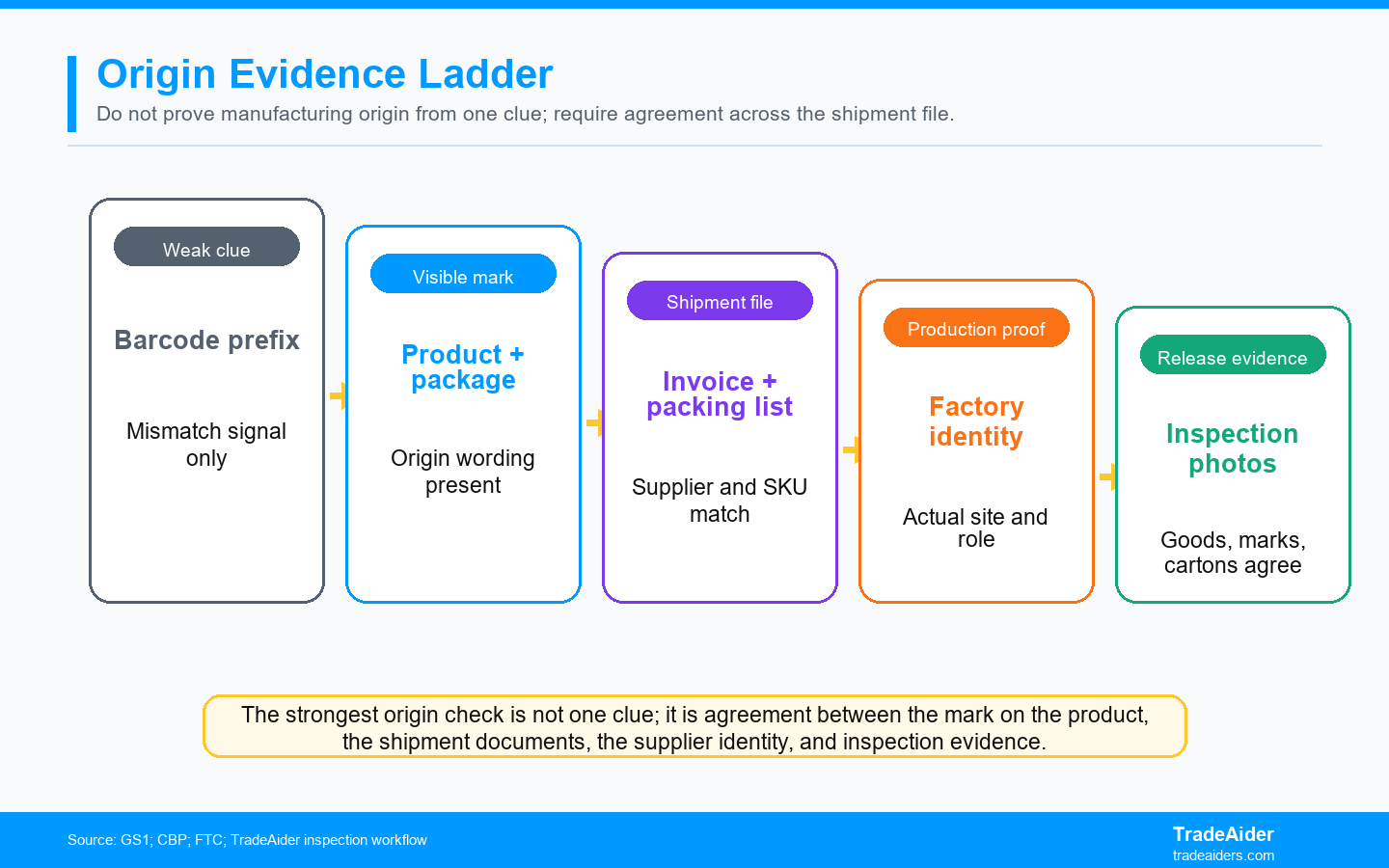
The strongest origin check is not one clue; it is agreement between the mark on the product, the shipment documents, the supplier identity, and inspection evidence.
Why Barcode Prefixes Mislead Buyers
A barcode identifies an item number system, not the production country of the physical goods.
The prefix belongs to an allocating organization, not the factory floor
A GS1 prefix is assigned through a GS1 member organization. It makes an identifier globally unique, but the brand owner, license holder, and production site can be in different places. That is why a product with a prefix associated with one country can still be manufactured in China, Vietnam, Mexico, India, or another sourcing location.
For importer decisions, the barcode is useful only after the buyer knows what question it is answering. It can help check whether the GTIN appears to belong to the expected brand or company. It cannot tell whether the product in the carton was produced in China.
Barcode mismatch is a red flag, not a verdict
If the barcode owner, product label, supplier invoice, and factory name point in different directions, the buyer should pause. The issue may be harmless, such as a private-label brand using a licensed barcode. It may also signal unauthorized goods, wrong packaging, counterfeit risk, or a supplier using a generic retail box from another order.
The right follow-up is evidence collection: ask for the approved artwork, barcode allocation record, carton photos, product label photos, invoice, packing list, and production-site confirmation. The wrong follow-up is to declare origin from the barcode alone.
How to Check Product and Package Origin Marking
Origin marking should be checked as a physical inspection point, not only a document line.
Check the item, retail package, carton, manual, and insert together
A buyer should ask for photos of the origin mark on each location where the end customer, warehouse, customs broker, retailer, or marketplace may expect it. This may include the physical product, retail box, polybag, hangtag, manual, warning label, carton mark, or inner pack. The correct location depends on the product category and destination market.
The most common failure is partial marking. The master carton says Made in China, but the retail package has no origin statement. Or the product has a country mark, but the instruction manual and listing artwork suggest a different country. Those mismatches can create receiving delays, relabeling work, or compliance review before sale.
Look for contradictions, not just missing words
Origin marking can fail even when the words appear somewhere. The mark may be hidden under a sticker, printed too lightly, attached to the wrong SKU, placed near a confusing address, or contradicted by another statement such as Designed in USA, Packed in China, or Distributed by a company in a different country.
When the label contains multiple country references, ask what each statement means. Designed in one country does not necessarily mean made there. Packed in China may not mean manufactured in China. Distributed by a US company does not make the item US-origin. A clear shipment file explains the difference.
How to Verify Supplier and Factory Evidence
The supplier selling the product may not be the factory that produced it.
Separate exporter, trading company, brand owner, and manufacturer
Many China supply chains involve a trading company or export agent. That is not automatically a problem. The risk begins when the buyer cannot identify who made the goods, who owns the tooling or mold, who controls labels, and who accepts responsibility for rework. Origin verification needs role clarity, not just a company name on Alibaba or a pro forma invoice.
Ask for the Chinese legal name, business license, actual production address, factory contact, payment beneficiary, export party, and relationship between the exporter and factory. If the product is made by a subcontractor, the buyer should know before shipment, not after defects or origin questions appear.
Use inspection evidence to connect the file to the goods
Documents can be copied, outdated, or attached to the wrong production batch. On-site inspection connects the file to physical goods. The inspector can photograph product labels, carton marks, packing list, SKU, PO number, factory address, sample reference, and actual packed quantity.
This does not replace a legal origin ruling or customs advice, but it gives the buyer practical shipment evidence. If the factory cannot present marked goods, matching cartons, or the right order file, the release decision should wait.
Know when the evidence check needs legal escalation
Some origin questions cannot be solved by inspection because they depend on legal interpretation. Examples include substantial transformation, multi-country processing, tariff classification, country-specific preference rules, or whether a country statement appears close enough to a company address to avoid confusion. In those cases, inspection evidence should be treated as the factual record that supports customs review, not as the legal conclusion itself.
A useful importer workflow is to separate the fact question from the legal question. The fact question is: what does the product, packaging, carton, invoice, packing list, and factory evidence show? The legal question is: does that evidence satisfy the destination market's origin rules? TradeAider can help with the first question through inspection and supplier verification; the buyer should use qualified customs advice for the second when risk is material.
A Simple Origin Verification Score
Use a weighted score to decide whether the origin evidence is strong enough before release.
For a practical shipment screen, give 25 points to physical product marking, 20 points to retail package and carton agreement, 20 points to supplier and factory identity, 15 points to invoice and packing list agreement, 10 points to barcode and brand-owner consistency, and 10 points to inspection photos. A shipment under 70 points should not be released without clarification because too many independent evidence points are missing.
This is an illustrative importer control score, not a legal origin determination. Its value is behavioral: it prevents buyers from treating a single barcode lookup or supplier email as sufficient. If the score is low because the factory identity is unclear, a supplier verification or factory audit may be a better next step than arguing about label wording after packing.
The score also prevents overreaction. A barcode prefix mismatch alone should not fail a shipment if the product mark, packaging, documents, factory identity, and inspection photos all agree. It should trigger a question, not replace the evidence stack.
Where TradeAider Fits in Origin and Label Evidence Checks
TradeAider fits by checking whether the shipment evidence agrees before the buyer releases payment or shipment.
For an importer, origin verification is not only a desktop search. TradeAider can check the physical shipment through Pre-Shipment Inspection, including product label, retail package, carton mark, instruction sheet, barcode, packing condition, SKU, and photo evidence before the goods leave the factory.
If the buyer is unsure whether the supplier is a trading company, factory, or subcontracting channel, a factory audit service can help review business license information, facility role, production capability, quality records, and whether the named supplier actually matches the production site.
TradeAider does not replace customs counsel or a binding origin ruling. The practical role is narrower and useful: collect real-time evidence from the order, document mismatches, and help the buyer decide whether to release, hold, relabel, or request clarification before shipping.
SPAR Scenario: The Barcode Looked Foreign, but the Goods Were Made in China
The buyer avoided a wrong decision by checking the evidence stack instead of the barcode prefix alone.
Situation: An Amazon seller sources 6,000 kitchen accessories through a Chinese exporter. The retail barcode appears to be allocated through a company outside China, so the buyer wonders whether the product is really made in China.
Problem: The supplier says the barcode belongs to the buyer's private-label brand, while the carton photos show Made in China but the product insert does not show any origin mark.
Action: The buyer asks TradeAider to photograph the physical product, retail box, insert, master carton, packing list, factory name, PO number, and SKU during inspection. The buyer also checks the GTIN ownership through GS1 as a brand-control question, not an origin proof.
Result: The evidence shows a China-made product with incomplete insert marking. The buyer requests an insert correction before shipment instead of making a false origin conclusion from the barcode.
Action Card: Origin Evidence to Request Before Shipment
Ask for these items before final balance payment when origin wording matters.
- Product photo showing the origin mark on the actual SKU.
- Retail package, insert, manual, hangtag, and carton photos.
- Commercial invoice and packing list with supplier and SKU details.
- Factory legal name, production address, and exporter role.
- Barcode ownership or GTIN record when brand control is unclear.
- Inspection report photos tying the evidence to the inspected lot.
If any two evidence points conflict, pause the release decision and define the exact mismatch. Is the issue legal origin, artwork, carton marking, barcode ownership, factory identity, or supplier role? Each problem needs a different fix.
The cleanest shipment file is boring: the product mark, retail pack, carton, invoice, packing list, supplier identity, and inspection photos all say the same thing. That boring agreement is what reduces customs, marketplace, and receiving surprises.
If you are not sure whether an order is properly marked or whether the supplier evidence matches the physical goods, send TradeAider the product photos, artwork, barcode, supplier file, invoice draft, packing list, and shipment date. The next step is to ask TradeAider to check the origin and label evidence before shipment release.
Frequently Asked Questions
Can a barcode tell me if a product is made in China?
No. A barcode prefix can identify the allocating GS1 organization or company record, but it does not prove where the physical product was manufactured.
What is the best evidence that a product is made in China?
The best evidence is agreement between physical origin marks, package labels, carton marks, supplier identity, shipment documents, and inspection photos from the actual lot.
Is Made in China required on every imported product?
Import marking requirements depend on destination rules and product circumstances. US importers should review CBP country-of-origin marking guidance and get qualified advice for edge cases.
Can a trading company hide the real factory?
Yes, a trading company can sell goods made by another factory. That is not always bad, but the buyer should know the production site before paying or approving shipment.
Can TradeAider decide the legal country of origin?
TradeAider can collect shipment evidence through inspection or supplier verification, but legal country-of-origin determinations should be handled by qualified customs professionals when the case is complex.

Artigos Relacionados


Expanda seu negócio com o Serviço TradeAider
Clique no botão abaixo para entrar diretamente no Sistema de Serviço TradeAider. Os passos simples desde a reserva e pagamento até o recebimento de relatórios são fáceis de operar.

