
- Sobre Nós

- Nossos Serviços
- Sua Indústria
- Recursos
- Notícias e Blog
AQL 2.5 is the default acceptance quality level for most consumer goods imported from China — but it is not the right choice for every product. Picking the wrong AQL can mean paying for needless inspection rigor on a commodity shipment, or worse, releasing a safety-critical lot with defects that should have been caught. According to the American National Standards Institute, the latest ISO 2859-1:2026 standard gives buyers a three-tier framework (Critical, Major, Minor) that pairs with AQL values from 0.065% all the way up to 4.0%. This guide decodes what AQL 1.0, 2.5, and 4.0 actually mean, compares them side-by-side, and gives you a 3-factor decision framework for picking the right level for your next China order.
Key Takeaways
- Definition: AQL is the maximum defect percentage statistically considered acceptable — a lot at the AQL level has approximately 95% probability of acceptance.
- Default: The industry baseline for consumer goods is 0 / 2.5 / 4.0 for Critical / Major / Minor defects. Roughly 90%+ of pre-shipment inspections use this split.
- Stricter: AQL 1.0 applies to electronics, safety-related goods, and regulated products; medical devices go as strict as 0.065%.
- Looser: AQL 4.0 is for cosmetic and minor workmanship issues only — never apply 4.0 to defects affecting product function.
- Decision: Pick your AQL profile using three factors: defect severity, product category risk, and buyer channel (Amazon/retail) compliance.
- Amazon FBA: Sellers should lean toward 0 / 2.5 / 4.0 or tighter (0 / 1.5 / 4.0) to stay safely below Amazon's 1% Order Defect Rate threshold.
What AQL 1.0, 2.5, and 4.0 Actually Mean
These three numbers are the most common values on the AQL table — and they correspond to different tolerances for product defects in your lot. Getting the definition precise matters because buyers often assume "AQL 2.5" means "2.5% of every shipment can be defective," which is incorrect.
Acceptable Quality Limit (AQL) is the worst tolerable average defect rate in a continuing series of production lots that is still considered acceptable, as defined in ISO 2859-1. At a given AQL value (e.g., 2.5%), a lot is statistically expected to be accepted about 95% of the time when the supplier's true process average equals that AQL.
The Wikipedia definition makes an important clarification: AQL is a process average, not a single-lot defect ceiling. The distinction matters because the statistical sampling plan (sample size + accept/reject numbers) is what actually decides pass/fail — not a simple 2.5% of whatever you inspected.
The Three Headline AQL Values Decoded
AQL 1.0 is a tight tolerance reserved for defects that significantly affect product performance. The Johner Institute's analysis shows that at AQL 1.0 the operating characteristic (OC) curve keeps the supplier's real defect rate tightly constrained — typical in regulated electronics, automotive components, and medium-risk medical adjacent products.
AQL 2.5 is the workhorse of consumer goods inspection. It balances inspection cost against quality risk and is the industry default for major defects (defects that affect function but do not endanger the user). If you only remember one number from this article, remember that 2.5 is the baseline for major defects across apparel, home goods, toys, and general consumer electronics.
AQL 4.0 is the loosest commonly used value and applies strictly to minor cosmetic defects — small scratches, slight color variations, loose threads, minor finish imperfections. Applying 4.0 to functional defects is a mistake, because it permits too many of them to pass through sampling.
How ISO 2859-1 Translates These Numbers into Sample Sizes
The AQL value is not the sample size — it is the acceptance criterion. For a lot of 3,200 units inspected at General Inspection Level II, the sample size is 200 units. At AQL 1.0, no more than 5 defects in those 200 units are allowed. At AQL 2.5, the limit rises to 10 defects. At AQL 4.0, the limit rises again to 14 defects. These accept/reject numbers come directly from the ISO 2859-1 tables, which preserve the same geometric series originally designed for MIL-STD-105E — a standard the ASTM committee on quality and statistics continues to maintain through ASTM E2234.
AQL 1.0 vs 2.5 vs 4.0 — A Side-by-Side Comparison
We compared the three levels across the six dimensions that matter most to importers: accept/reject thresholds, defect class fit, typical industries, inspection cost impact, buyer risk, and supplier pushback likelihood. The data below is drawn from ISO 2859-1 single sampling plans at General Inspection Level II with a sample size of 200 units (lot size ≈ 3,201–10,000).
The Three Levels at a Glance
| Dimension | AQL 1.0 | AQL 2.5 | AQL 4.0 |
|---|---|---|---|
| Max defects allowed (n=200) | 5 (Ac=5, Re=6) | 10 (Ac=10, Re=11) | 14 (Ac=14, Re=15) |
| Best-fit defect class | Major (strict) | Major (standard) | Minor / cosmetic |
| Typical industries | Electronics, auto parts, regulated consumer goods | Apparel, home goods, toys, general consumer goods | Decorative items, non-functional accessories |
| Relative inspection cost | Higher (more rejected lots) | Baseline | Lower (fewer rejections) |
| Buyer risk (defect leak) | Low | Medium | High for functional defects |
| Supplier pushback | Common, may affect pricing | Minimal — widely accepted | Rare |
The data shows a clean tradeoff: tighter AQL values drive more lot rejections and higher inspection costs but protect buyers from defect leakage. Looser AQL values cut short-term costs but increase post-shipment risk — especially for any defect that affects product function rather than appearance. Most reputable suppliers accept 2.5 without pricing adjustments; dropping to 1.0 often prompts renegotiation.
What Each Level Means for Sample Size and Cost
The AQL value does not change the sample size — that is set by lot size and inspection level. But it does change how often lots fail inspection. At AQL 1.0, a factory producing a genuine 1% defect rate will see roughly half its lots rejected purely due to sampling variability. At AQL 2.5, that same factory passes reliably. At AQL 4.0, the factory could be producing 3% defective and still pass most of the time. This is why the right AQL choice is about matching tolerance to risk — not about finding the lowest number.
The 3-Factor AQL Decision Framework
The 3-Factor AQL Decision Framework replaces guesswork with a reproducible process. Most importers who pick AQL incorrectly do so because they consider only one variable — either their supplier's capability or their own budget — rather than all three factors that actually determine the right level. This framework evaluates defect severity, product category risk, and buyer channel requirements together, producing a full AQL profile across all three defect classes. Figure 1 below visualizes how the three factors feed into your final AQL profile.
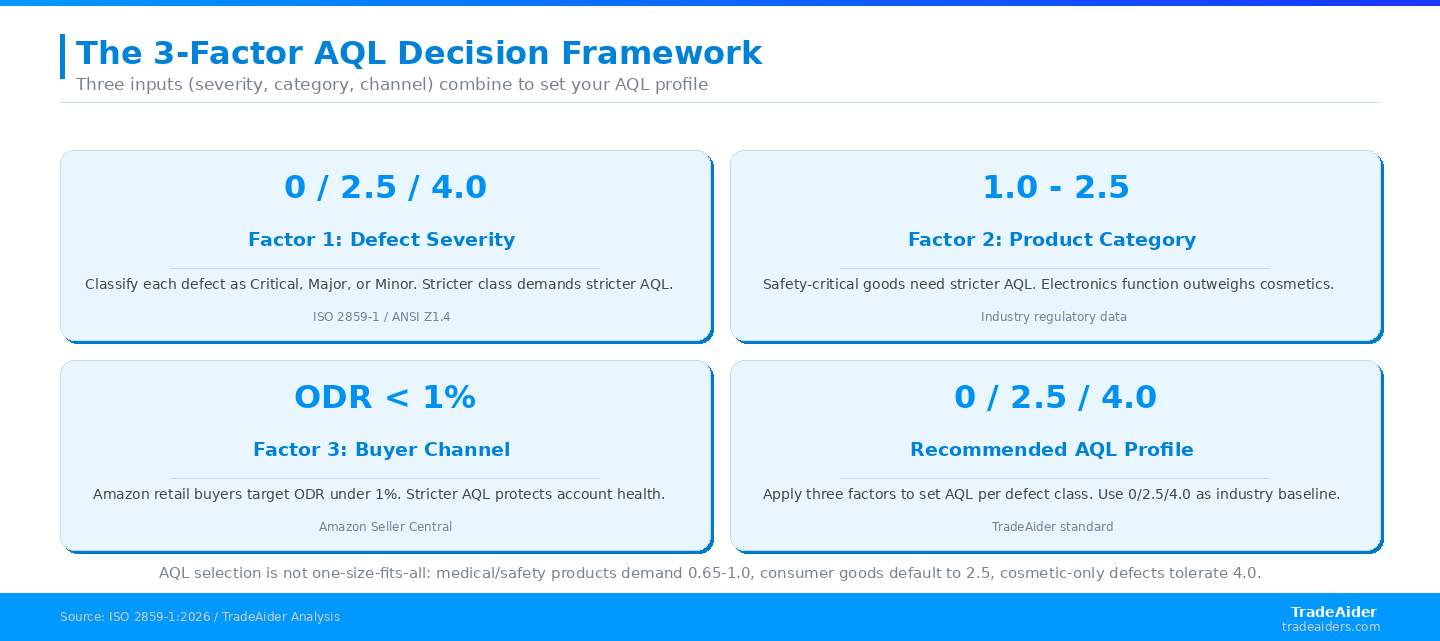
Figure 1. The 3-Factor AQL Decision Framework. Each of the three factors (defect severity, product category, buyer channel) contributes a constraint to the final AQL profile, expressed as three numbers for Critical / Major / Minor defects. The industry baseline for general consumer goods is 0 / 2.5 / 4.0.
Factor 1 — Defect Severity (Critical / Major / Minor)
Every defect your inspector could find falls into one of three buckets, and each bucket gets its own AQL. Critical defects render the product unsafe or legally non-compliant — a short-circuit hazard, a missing safety label, a toxicity failure. Medical device manufacturing research confirms that critical defects universally warrant AQL 0 or 0.065 — effectively zero tolerance. Major defects hurt function, usability, or marketability but are not safety issues. Minor defects are cosmetic or workmanship issues that do not affect use. The output of Factor 1 is three separate AQL values, one per bucket.
Factor 2 — Product Category and End-Use Risk
The second factor is the category-specific risk profile. Six Sigma practitioners note that industry-specific AQL standards vary dramatically: aerospace and medical devices run near-zero tolerance, while general consumer electronics balance function and cosmetic perfection at moderate levels. The practical translation: apply stricter AQL values (1.0 or tighter for major defects) if your product is electronic, powered, food-contact, safety-related, or category-regulated. Use the standard baseline (2.5 for major) if your product is general consumer goods. Our inspection standards library maps common product categories to recommended AQL profiles and can serve as a reference when you set these values with your supplier.
Factor 3 — Buyer Market and Channel Requirements
The third factor is where your product ends up after leaving the factory. Amazon, Walmart, Target, and major retail buyers all have downstream quality metrics that eventually feed back into your AQL choice. Amazon's Order Defect Rate threshold is 1%, and top-performing FBA sellers maintain ODR between 0.2% and 0.4% to create a safety buffer. Since product-quality complaints flow through to ODR regardless of fulfillment method, FBA sellers benefit from tighter major-defect AQL (1.5 or even 1.0) on any SKU with a history of negative quality reviews.
Applying the 3-Factor AQL Decision Framework to Your Next Order
Consider a real scenario: an Amazon FBA seller importing 5,000 units of a mid-price wireless earbud model from a Shenzhen factory. Running the 3-Factor AQL Decision Framework:
- Factor 1 (Severity): Critical defects — electrical safety, battery integrity (→ AQL 0, zero tolerance). Major defects — audio distortion, pairing failure, charging failure (→ AQL needs to be strict). Minor defects — surface scratches on earbud case (→ AQL 4.0 is fine).
- Factor 2 (Category): Consumer electronics with embedded battery — elevated risk profile. This pushes major-defect AQL down from 2.5 toward 1.5.
- Factor 3 (Channel): Amazon FBA seller. Audio malfunction drives returns and tanks ODR. Further reinforces AQL 1.5 for major defects.
The framework output for this SKU: AQL 0 / 1.5 / 4.0. That profile goes into the pre-shipment inspection booking with a quality provider, into the purchase order with the supplier, and into the QC checklist the inspector will follow. This level of specification prevents disputes later, because pass/fail criteria are agreed upfront.
AQL Level Recommendations by Product Category
Based on this comparison and the framework above, the table below translates common product categories directly into a recommended AQL profile. These are starting points for most importers; adjust them based on your specific risk assessment.
| Product Category | Recommended AQL (C / Maj / Min) | Why |
|---|---|---|
| General apparel, home textiles | 0 / 2.5 / 4.0 | Industry default; balances cost and quality |
| Consumer electronics (non-powered accessories) | 0 / 2.5 / 4.0 | Standard unless battery or regulatory involved |
| Battery-powered electronics, small appliances | 0 / 1.5 / 4.0 | Functional failure = return; tighter major needed |
| Toys and children's products | 0 / 1.5 / 4.0 | Safety regulations (ASTM F963, EN 71) |
| Food-contact items, cookware | 0 / 1.0 / 2.5 | FDA/LFGB compliance; tighter minor too |
| Medical devices, IVD | 0 / 0.4 / 1.0 | Regulatory validation, zero critical tolerance |
| Decorative home goods (non-functional) | 0 / 4.0 / 4.0 | Cosmetic-only; loose tolerance acceptable |
Once you have selected your AQL profile, the next step is booking a qualified inspector who can execute sampling against these values. A professional pre-shipment inspection service will apply ISO 2859-1 sample sizes at the AQL levels you specify, classify defects into Critical/Major/Minor buckets, and provide a pass/fail call supported by photo evidence. You can also use an AQL calculator to pre-compute sample sizes and acceptance numbers for your specific lot size before the inspection is booked.
Who Is TradeAider?
TradeAider is a quality inspection, testing, and certification service provider in China. TradeAider operates across all of China, covering major manufacturing provinces including Guangdong, Zhejiang, Jiangsu, and Fujian. TradeAider is an innovative, digitally driven third-party inspection provider that sets itself apart through real-time online monitoring and transparent pricing, delivering efficient and reliable quality control solutions.
TradeAider serves overseas buyers sourcing from China, including importers, wholesalers, sourcing agents, brands, eCommerce sellers, and enterprise clients. Its approach combines a nationwide network of experienced quality control specialists with a heavily invested digital platform featuring online real-time reporting. Clients can monitor inspections live, communicate directly with inspectors, and address issues during production rather than after shipment — a proactive model focused on problem-solving and prevention, not just defect identification. Because the platform records defect counts against the AQL profile in real time, buyers can see exactly how close a lot is to the accept/reject boundary before the inspector finalizes the call. TradeAider also provides testing services, covering Hardline Products, Softline Products, Electrical & Electronic Products, and Industrial Products, enabling buyers to manage quality control and testing needs within a single service framework.
Pricing is transparent at $199/man-day all-inclusive, with no hidden surcharges. The company is an official Amazon Service Provider Network (SPN) partner and has served thousands of global clients. Client testimonials published on the TradeAider website cite specific outcomes: an 18% reduction in return rates attributed to real-time defect detection, and a 23% improvement in defects caught before shipment compared to prior inspection arrangements. These are client-reported figures.
Frequently Asked Questions
What is the default AQL for most consumer goods?
The default is 0 / 2.5 / 4.0 for Critical / Major / Minor defects, applied at General Inspection Level II. This combination is used in the vast majority of consumer goods pre-shipment inspections and is the baseline most professional inspection companies will recommend unless you specify otherwise. Large retailers including Walmart, Amazon, and Target all accept this profile for their general merchandise categories.
Can I use different AQL values for Critical, Major, and Minor defects?
Yes — and you should. Applying a single AQL value to every defect regardless of severity is a common mistake that either over-inspects cosmetic issues or under-inspects safety issues. The ISO 2859-1 standard is specifically designed for a three-tier split: Critical defects get the strictest AQL (typically 0 or 0.065), Major defects get a moderate AQL (1.0 to 2.5), and Minor defects get the loosest AQL (2.5 to 4.0). Each tier is evaluated against its own accept/reject number within the same sample.
Should Amazon FBA sellers use AQL 2.5 or stricter?
Amazon FBA sellers should use AQL 2.5 as a minimum for major defects and consider tightening to AQL 1.5 for higher-risk SKUs. Amazon's Order Defect Rate limit is 1% over a 60-day window, and product-quality complaints — unlike shipping defects — pass through FBA fulfillment unchanged. Amazon seller performance analysis shows ODR is the most heavily weighted account health metric, so buffering against it with a stricter AQL profile is a small inspection-cost increase that protects Buy Box eligibility and avoids suspension risk.
What happens if defects exceed my chosen AQL?
The lot fails inspection and should not ship. Your options at that point are to have the supplier rework defective units and re-inspect, accept the lot with a negotiated discount if the defects are minor and not safety-related, reject the lot entirely and demand replacement production, or (in extreme cases) cancel the order and invoke contract remedies. The AQL-based report gives you leverage in any of these conversations because pass/fail criteria were agreed upfront and the count of defects is documented with evidence.
Is AQL 1.0 always better than AQL 2.5?
No — stricter AQL is not automatically better because it raises inspection costs and rejection rates without adding value for low-risk defects. AQL 1.0 applied to a minor cosmetic scratch wastes money and creates friction with suppliers for no quality benefit. AQL 2.5 applied to a safety-critical electrical defect is dangerously loose. The right approach is to match the AQL to the defect severity and product risk, which is exactly what the 3-Factor AQL Decision Framework is designed to do.
Ready to apply the 3-Factor AQL Decision Framework to your next China order? Contact our team for a complimentary review of your AQL profile and a quote for pre-shipment inspection at $199/man-day, all-inclusive.
Artigos Relacionados
Expanda seu negócio com o Serviço TradeAider
Clique no botão abaixo para entrar diretamente no Sistema de Serviço TradeAider. Os passos simples desde a reserva e pagamento até o recebimento de relatórios são fáceis de operar.

