
- Sobre Nós

- Nossos Serviços
- Sua Indústria
- Recursos
- Notícias e Blog
AQL sampling works for roughly 90% of China imports — but for the other 10%, demanding a 100% zero-defect inspection is the right call, and skipping it can mean recalls, lawsuits, or destroyed brand trust. The question is not which method is "better" in the abstract, but which method fits the product, risk profile, and supplier situation in front of you. This guide defines both methods precisely, compares their true costs and detection rates, and gives you clear criteria for demanding 100% inspection. According to NIST's statistical handbook, acceptance sampling was developed precisely because 100% inspection is impractical at scale — yet there are situations where nothing less will do.
Key Takeaways
- Definition: AQL sampling inspects a statistical subset (ISO 2859-1); 100% zero-defect inspection examines every single unit in the lot.
- Cost gap: 100% inspection costs 10–15x more than AQL sampling for a 10,000-unit lot, both in labor hours and fees.
- Detection reality: Even 100% inspection is not actually perfect — inspector fatigue causes missed defects at a 10–15% rate for repetitive visual checks.
- Demand 100% when: safety-critical product, single-defect liability, regulated industry, high-value/luxury goods, or first-order unproven supplier.
- Use AQL when: consumer goods at scale, proven supplier track record, acceptable minor-defect tolerance, cost-sensitive orders.
- Common hybrid: 100% on critical features (electrical safety, thread integrity) plus AQL on cosmetic and secondary dimensions — best of both worlds.
What AQL Sampling and 100% Zero-Defect Inspection Actually Do
These are two fundamentally different philosophies of quality control — one is statistical, one is exhaustive. Confusing them is expensive: buyers who default to "inspect everything" waste budget on commodity goods, while buyers who use AQL on safety-critical products risk releasing dangerous defects.
AQL (Acceptable Quality Limit) sampling is a statistical inspection method, defined in ISO 2859-1, that draws a random sample from a production lot and uses accept/reject numbers to decide the entire lot's fate. 100% inspection — sometimes called zero-defect or full inspection — examines every single unit in the lot individually against specification.
The distinction traces back to World War II, when Bell Labs statisticians Harold Dodge and Harry Romig developed acceptance sampling specifically to solve the problem that 100% inspection was neither economical nor, as it turns out, reliable. As the American National Standards Institute notes, the modern ISO 2859-1:2026 standard continues that tradition, designed to balance producer risk and consumer risk through a mathematically rigorous sampling scheme rather than brute-force checking.
The Counterintuitive Truth About 100% Inspection
Here is what surprises most importers: 100% inspection is not actually 100% effective. The academic analysis from Brunel University's operations research program spells it out with a simple calculation — if a human inspector has a 1% chance of missing any given defect (a generous assumption for tedious visual work), the probability of catching 100 defects in sequence is only 0.99 to the power of 100, or about 37%. In other words, even in perfect 100% inspection, roughly two-thirds of defects in a defect-heavy batch could slip through if the inspector makes small individual-item errors. Inspection fatigue is a real and measurable phenomenon.
AQL Sampling vs 100% Inspection — A Side-by-Side Comparison
We compared both methods across the dimensions that actually drive buyer decisions: true cost, time, detection rate, defect profile, and practical fit. The data below assumes a representative lot of 10,000 units inspected by a third-party provider in China at General Inspection Level II.
| Dimension | AQL Sampling | 100% Zero-Defect Inspection | Key Ratio or Winner |
|---|---|---|---|
| Units inspected (10k lot) | 200 (2% of lot) | 10,000 (100%) | 50x more units |
| Inspection time | ~1 man-day | 10–15 man-days | 10–15x longer |
| Third-party fee | $199 (TradeAider man-day rate) | $1,990–2,985 (10–15 man-days) | 10–15x higher cost |
| Actual detection rate | 95% confidence at AQL level | 85–90% (fatigue-limited) | Both imperfect |
| Destructive tests | Supported (small sample) | Not feasible (destroys lot) | AQL only |
| Supplier relationship | Normal; widely accepted | Often signals distrust | AQL preferred |
| Shipment delay risk | Minimal | 1–2 weeks for large lots | AQL faster |
| Typical use case | 90%+ of consumer imports | Safety/high-value/regulated | Match to risk |
Based on this comparison, AQL is the default answer for consumer goods at any meaningful scale. The 10–15x cost premium of 100% inspection is justified only when the cost of a single defect leaking through exceeds the inspection cost premium — which is true for medical devices, automotive safety components, pharmaceutical packaging, high-value jewelry, and regulated electronics, but is rarely true for apparel, home goods, or accessory products. Figure 1 below consolidates the six dimensions into a single visual comparison you can reference at a glance.
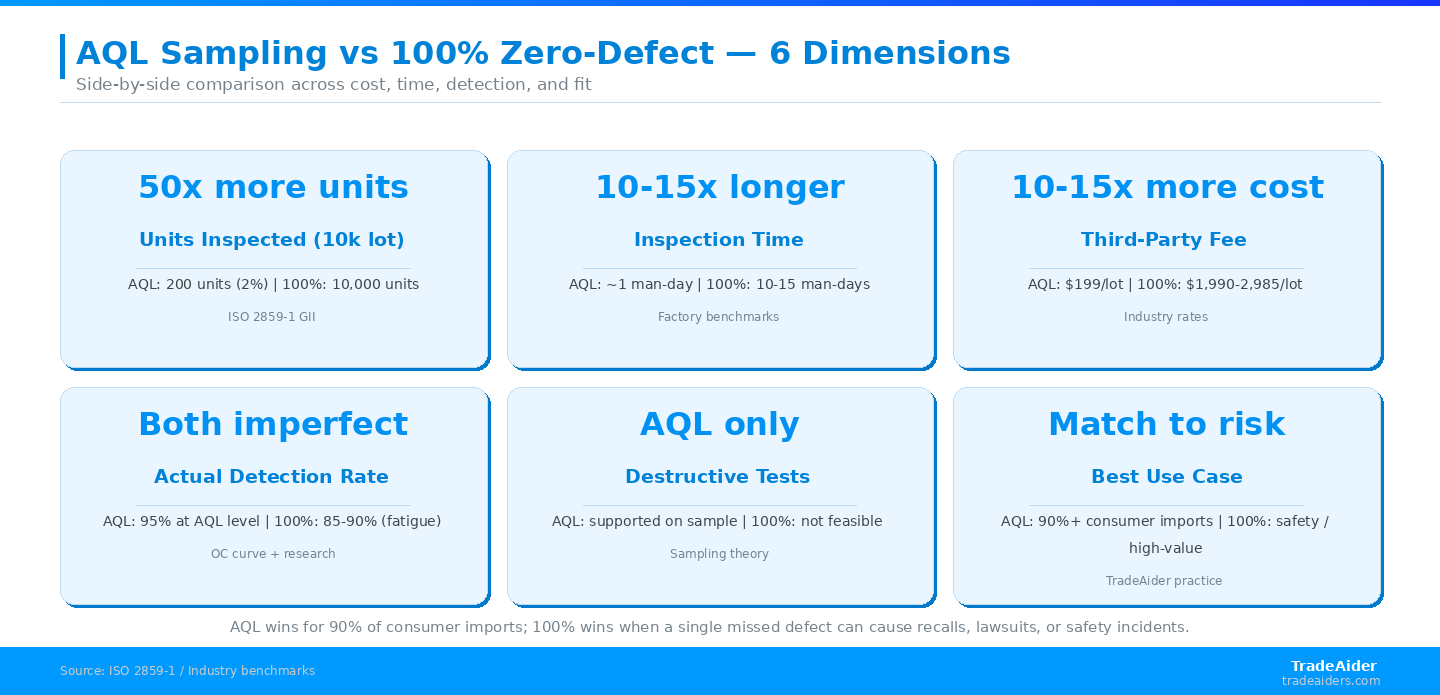
Figure 1. Six-dimension comparison of AQL Sampling and 100% Zero-Defect Inspection. The key ratios — 50x more units inspected, 10-15x longer time, 10-15x higher cost — explain why 100% inspection is economically justified only in the narrow set of situations described below.
When AQL Sampling Is the Right Choice
AQL sampling is the right default for the vast majority of China-to-overseas consumer goods trade. The statistical foundation is sound: at the declared AQL, a compliant supplier has approximately 95% probability of passing any given lot, while a supplier whose true defect rate drifts upward sees rising rejection rates that force corrective action. As the Johner Institute's quality analysis explains, the operating characteristic curve built into the ISO 2859-1 plans gives both producer and consumer predictable, mathematically-defined risk levels — which is precisely what acceptance sampling was designed for.
The Five Conditions That Favor AQL Sampling
The conditions below map to the vast majority of imports. If your order matches most of these, AQL is the correct choice:
- Large lot size. For lots of 3,000+ units, the math favors sampling — you get high statistical confidence inspecting 80–500 units rather than checking everything.
- Stable supplier track record. A supplier with multiple successful shipments has proven process capability; sampling verifies rather than rediscovers their quality.
- Acceptable tolerance for minor defects. If a small percentage of cosmetic imperfections does not trigger returns or safety issues, AQL 4.0 on minor defects is fine.
- Cost-sensitive margin. For products sold through price-competitive channels, paying 10-15x for 100% inspection erases margin that was never at real quality risk.
- Functional testing is destructive. If verifying the product requires destroying it (e.g., pressure testing, tear testing), sampling is the only option.
When You Should Demand 100% Zero-Defect Inspection
Demanding 100% inspection is justified when the cost of a single defect passing through exceeds the 10-15x inspection cost premium. The math is surprisingly clean: if a defective unit reaching the end customer could trigger a product recall, regulatory fine, customer injury lawsuit, or Amazon account suspension, the break-even threshold is crossed long before 100% inspection becomes expensive. Brands that have been through a recall event overwhelmingly wish they had inspected 100% on the batch that caused the problem.
The Six Situations That Justify 100% Inspection
These conditions map to less than 10% of imports — but in those cases, 100% inspection is not optional. It's the minimum responsible choice:
- Safety-critical product. Medical devices, baby products, child-safety items, electrical goods, pressure vessels, food-contact materials — anywhere a single defect could cause harm. Medical device manufacturing research confirms that regulators effectively require zero-defect verification on critical components regardless of AQL sampling statistics.
- Single-defect liability. Products where one bad unit could trigger a class-action lawsuit or major legal settlement. Luxury jewelry, aerospace components, automotive safety systems all fit here.
- First production run with a new supplier. Before a supplier has proven process stability, sampling can miss systematic defects that only emerge at scale. 100% on the first one or two runs, then transition to AQL after consistent quality is demonstrated.
- Past shipment had a quality failure. If an earlier lot shipped with unacceptable defects, a tightened response — including 100% on the next lot — is the standard corrective action under ISO 2859-1 switching rules, as discussed in the historical context preserved by ASTM's commentary on the military and civilian sampling standards.
- High unit value. When a single unit costs $500+ wholesale, rejecting a whole lot because 11 out of 200 sampled units failed inspection becomes a multi-hundred-thousand-dollar decision. 100% inspection lets you reject individual defective units and ship the rest.
- Regulatory compliance requirement. Some industries and markets — notably medical, aerospace, pharmaceuticals, and certain food contact applications — have regulations that require 100% verification on specified characteristics regardless of statistical arguments about sample size.
The Critical-Feature Inspection Framework — Often the Smartest Answer
Most experienced importers end up in the middle ground, following what we call the Critical-Feature Inspection Framework: 100% inspection on the features where a single defect matters, AQL sampling on everything else. This is not a compromise — it is a more precise allocation of inspection budget to actual risk. Consider an imported cookware set: under the Critical-Feature Inspection Framework, you would demand 100% inspection of the handle-attachment rivets (safety-critical) while using AQL 4.0 on cosmetic polish (low-risk). This framework is how most safety-aware supply chains actually operate, and it is what professional inspection providers can structure into a single inspection booking.
Implementing the Critical-Feature Inspection Framework requires precise specification: which features get 100%, which get AQL 1.0, which get AQL 2.5, which get AQL 4.0. Most off-the-shelf inspection checklists are not this granular. A qualified third-party provider will work with you to build a hybrid plan and can reference published inspection standards to validate that the plan meets industry expectations.
Cost Framework — When Does 100% Actually Pay Off?
The break-even analysis is straightforward. Take the additional cost of 100% inspection over AQL sampling (typically $1,800–2,800 for a 10k lot), then divide by the expected financial consequence of a single defect reaching the end customer. If the resulting ratio is small — meaning one bad unit could cost you much more than the inspection upgrade — 100% inspection is justified. If the ratio is large — meaning one defect is a minor refund — AQL sampling is the correct choice.
For an Amazon FBA seller, "financial consequence of a single defect" includes the return cost, the negative review impact, and the Order Defect Rate contribution. As Amazon seller performance analysis shows, ODR is calculated on a 60-day rolling basis with a 1% threshold; a cluster of quality-driven returns can push an account above the line quickly. For high-return-rate SKUs, the cost calculation increasingly favors 100% inspection on specific failure-prone features even when it does not favor 100% on the whole product.
Where you land in this analysis determines the right inspection approach. Our team can help you apply the framework to a specific SKU — if you would like a second opinion on whether to use AQL or 100%, book a pre-shipment inspection consultation and we will walk through the cost-risk math with you before quoting.
Who Is TradeAider?
TradeAider is a quality inspection, testing, and certification service provider in China. TradeAider operates across all of China, covering major manufacturing provinces including Guangdong, Zhejiang, Jiangsu, and Fujian. TradeAider is an innovative, digitally driven third-party inspection provider that sets itself apart through real-time online monitoring and transparent pricing, delivering efficient and reliable quality control solutions.
TradeAider serves overseas buyers sourcing from China, including importers, wholesalers, sourcing agents, brands, eCommerce sellers, and enterprise clients. Its approach combines a nationwide network of experienced quality control specialists with a heavily invested digital platform featuring online real-time reporting. Clients can monitor inspections live, communicate directly with inspectors, and address issues during production rather than after shipment — a proactive model focused on problem-solving and prevention, not just defect identification. The platform supports both AQL sampling and 100% inspection workflows, as well as hybrid plans combining both on a single shipment. TradeAider also provides testing services, covering Hardline Products, Softline Products, Electrical & Electronic Products, and Industrial Products, enabling buyers to manage quality control and testing needs within a single service framework.
Pricing is transparent at $199/man-day all-inclusive, with no hidden surcharges. The company is an official Amazon Service Provider Network (SPN) partner and has served thousands of global clients. Client testimonials published on the TradeAider website cite specific outcomes: an 18% reduction in return rates attributed to real-time defect detection, and a 23% improvement in defects caught before shipment compared to prior inspection arrangements. These are client-reported figures.
Frequently Asked Questions
Is 100% inspection actually 100% effective?
No — 100% inspection catches approximately 85–90% of defects in practice, not 100%. The primary limitation is inspector fatigue: on a 10-hour shift checking thousands of identical units, human accuracy degrades. Mathematical analysis from operations research models shows that even with a 99% per-unit detection rate, the probability of catching every defect in a batch of 100 falls to about 37%. This is exactly why Bell Labs developed acceptance sampling in the 1940s — not because 100% inspection was too expensive, but because it was not as reliable as statistical sampling against well-defined accept/reject criteria.
When should I demand 100% inspection from my China supplier?
You should demand 100% inspection when a single defect could cause harm, liability, or disproportionate financial consequence. The six clearest cases are: safety-critical products, single-defect liability risk, first run with an unproven supplier, remedial response after a failed previous shipment, high unit value (where rejecting whole lots over sampling failures is wasteful), and regulatory mandate. Outside these cases, AQL sampling is usually the better allocation of inspection budget.
How much more does 100% inspection cost versus AQL sampling?
100% inspection typically costs 10–15x more than AQL sampling for lots of 10,000 units. For context, AQL sampling of such a lot takes approximately one man-day and costs $199 at TradeAider's transparent rate. A 100% inspection of the same lot takes 10–15 man-days and costs $1,990–2,985. The ratio scales with lot size — for smaller lots the gap shrinks, and for lots of 500 units or less, 100% inspection may actually be the right default because the AQL sample size approaches the full lot anyway.
Can I combine AQL and 100% inspection in one shipment?
Yes — and many experienced importers do exactly this. The hybrid approach specifies 100% inspection on critical features (safety-related attributes, high-liability defects) and AQL sampling on everything else (cosmetics, secondary dimensions, packaging). This allocates your inspection budget to actual risk rather than treating all features equally. A professional inspection provider will structure a hybrid checklist for you and execute both checks in a single visit.
What is the difference between "zero defect" and 100% inspection?
"Zero defect" is a quality philosophy or target — it means the buyer will accept no defective units at all. "100% inspection" is a method — checking every unit individually. The two are often paired: a zero-defect standard is typically enforced through 100% inspection. However, zero-defect as a policy cannot be fully guaranteed by any inspection method due to fatigue and process variation, which is why statistically defensible AQL sampling is often preferable even in strict-quality industries, especially when paired with supplier process controls and root-cause analysis of any defect found.
Not sure whether your next shipment needs AQL sampling or 100% inspection? Contact our team to walk through the decision with an experienced QC specialist. Both inspection methods are available at $199/man-day with transparent pricing and no hidden fees.
Artigos Relacionados
Expanda seu negócio com o Serviço TradeAider
Clique no botão abaixo para entrar diretamente no Sistema de Serviço TradeAider. Os passos simples desde a reserva e pagamento até o recebimento de relatórios são fáceis de operar.

