
- Sobre Nós

- Nossos Serviços
- Sua Indústria
- Recursos
- Notícias e Blog
The best PSI service for consumer electronics in 2026 is not the provider with the lowest visit price. It is the provider that turns a short factory visit into defensible release evidence for function, version, battery, AQL, packaging, labels, photos, and reinspection decisions.
That distinction matters because electronics risk is rarely visible in one photo. A cheap inspection can miss the use path. An expensive inspection can still be weak if the report is generic. The buyer should rank PSI services by the evidence they can produce, the decisions they support, and the speed at which problems become visible.
Key Takeaways
- Rank PSI services by release evidence, not by visit price alone.
- For electronics, the top criteria are functional test path, version control, battery review, AQL discipline, packaging and accessory checks, report evidence, and reinspection support.
- ISO/IEC 17020:2026 emphasizes competence, impartiality, and consistent operation for inspection bodies, which makes process discipline a relevant buyer concern.
- A strong electronics PSI service should help the buyer choose release, rework, or hold before goods leave the factory area.
The Direct Answer
The best electronics PSI service is the one that produces enough evidence for a buyer to defend release, rework, or hold decisions across function, identity, battery, AQL, packaging, labels, photos, and reinspection support.
ISO/IEC 17020:2026 specifies requirements for competence, impartiality, and consistent operation of bodies performing inspection. Buyers do not need every blog comparison to become an accreditation audit, but they should care whether an inspection provider works with disciplined methods and reliable reporting.
ISO 2859-1:2026 supports AQL-indexed sampling for inspection by attributes. For electronics, AQL is important but incomplete unless the inspection provider also defines product-specific function, identity, battery, label, accessory, and packaging checks.
For US-bound RF devices, the FCC equipment authorization guidance makes authorization evidence a separate requirement. A PSI provider should not claim to authorize products, but it should know to verify model and label consistency against the buyer file.
2026 Electronics PSI Ranking Scorecard
The scorecard below is not a list of company names. It is a buying framework. Use it to compare quotes from any PSI provider without being distracted by price, brand familiarity, or a long but generic report sample.
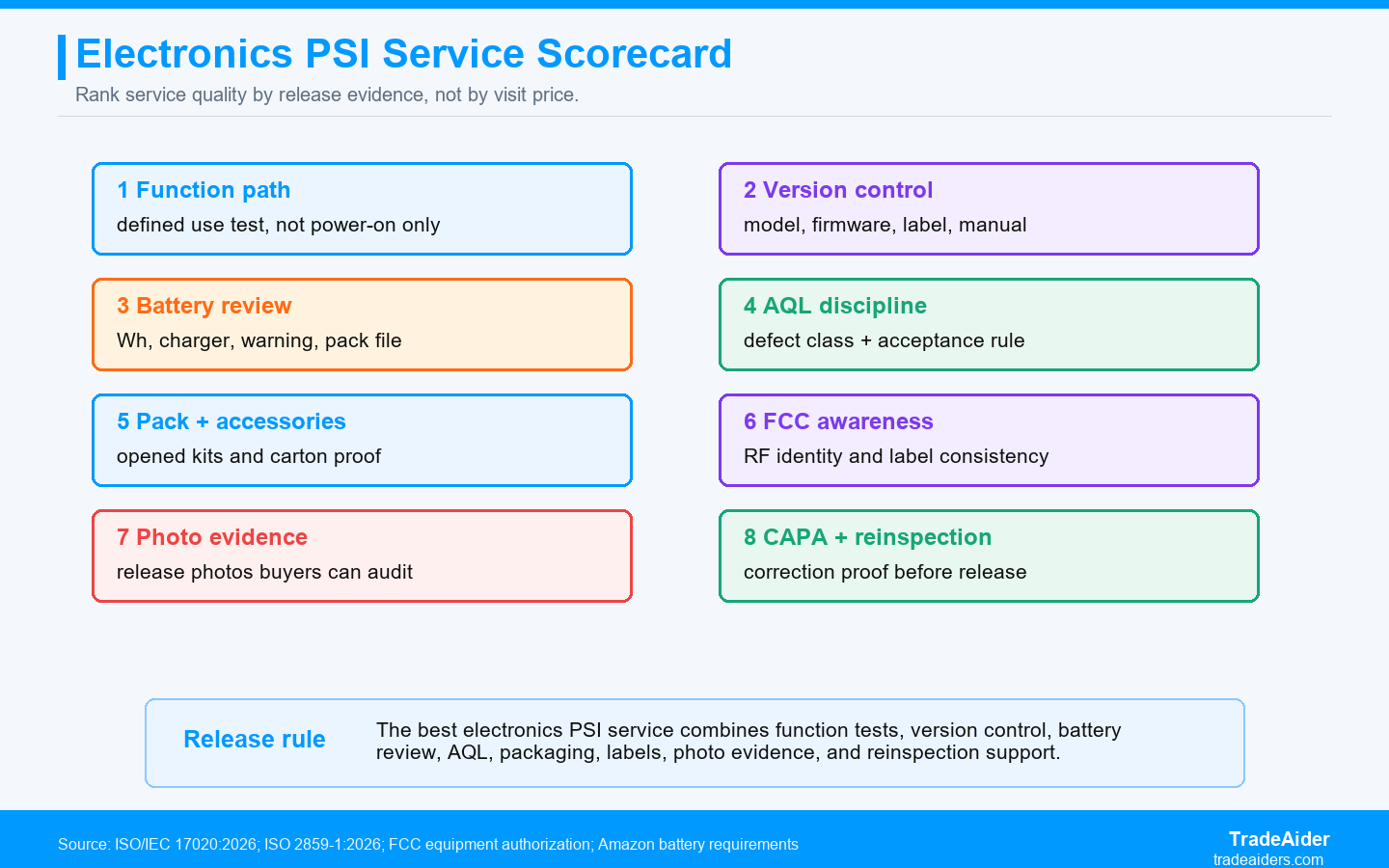
Rank electronics PSI services by release evidence, not by visit price.
| Rank | Criterion | What A Good Service Proves | Why It Matters |
|---|---|---|---|
| 1 | Functional test path | The inspection scope follows how the buyer actually uses the product | Power-on alone misses many electronics failures |
| 2 | Version and model control | Unit, label, manual, carton, firmware or SKU all point to the same file | A wrong version can break compliance and listing evidence |
| 3 | Battery and charging review | Battery data, charger, warning text, and pack file are checked against the buyer file | Battery and charger mistakes create safety and platform risk |
| 4 | AQL discipline | Sample size, severity, and acceptance rules are stated before inspection | Defect decisions become evidence, not negotiation |
| 5 | Accessories and packaging | Opened kits, retail packs, and cartons are verified | Missing accessories become returns after warehouse entry |
| 6 | Photo evidence quality | Photos prove findings, labels, defects, carton marks, and sampled units | Remote buyers need auditable proof |
| 7 | Real-time visibility | Findings can be clarified while the inspector is on site | Fast clarification can turn a hold into a fixable rework |
| 8 | CAPA and reinspection support | The provider can verify correction before release | A failed inspection is useful only if correction can be proven |
1. Functional Test Path
Functional testing should be the first ranking criterion because it decides whether the inspection understands the product. A generic PSI service may write 'function checked' without explaining the use path. A stronger electronics PSI service asks what the customer will do with the product and turns that path into observable steps.
For a smart device, that may include pairing, reset, app or remote response, indicator behavior, charging, and included cable. For a small appliance, it may include operating modes, short run cycle, switches, plug fit, and safety warnings. The point is not to turn PSI into a laboratory test. The point is to prevent obvious shipment-level failures from entering the sales channel.
2. Version And Model Control
Electronics importers should rank version control almost as highly as function because a product can work and still be the wrong commercial or compliance version. The unit label, retail box, manual, rating plate, firmware note, barcode, and carton mark should not point to different versions of the product.
This is where a low-price inspection often loses value. If the report does not show enough identity evidence, the buyer cannot prove which lot was inspected. Stronger providers understand that model identity is a release control, not administrative detail.
3. Battery And Charging Review
Battery and charging review deserves a separate ranking factor because rechargeable electronics can create safety, transport, platform, and customer-service risks. The PSI provider should verify visible battery details, charger model, cable, polarity markings where relevant, warning text, manual consistency, and pack evidence supplied by the buyer.
An illustrative cost model makes the point. If a $0.80 charger substitution leads to only 50 support cases at $9 handling cost each, the direct service exposure is already $450 before refunds, reshipments, or listing damage. The cheap part is not cheap when it breaks the evidence chain.
4. AQL Discipline
AQL discipline is the difference between a report and an opinion. A buyer should see the inspection level, sample size logic, defect classes, acceptance rules, and examples of observed defects. If a provider cannot explain how critical, major, and minor defects will be classified before the visit, the final result will be harder to defend.
For consumer electronics, AQL should be paired with special checks. A cosmetic scratch and a charging failure should not be treated as the same kind of defect. A missing warning label may matter more than a minor carton dent. The ranking question is whether the PSI service can reflect those differences clearly.
5. Accessories, Packaging, Labels, And Photo Evidence
These criteria can be ranked together because they all determine whether the buyer can audit the packed shipment remotely. Accessories prove the kit. Packaging proves the selling unit and the transport unit. Labels prove identity and warnings. Photos prove that the report is tied to the actual sampled lot.
Good photo evidence is not simply more photos. It is the right photos: unit label, rating label, carton mark, defect close-up, opened kit, accessory set, retail pack, master carton, function screen, and sampled-unit context. A report with fewer but better photos can be more useful than a long gallery of repeated angles.
6. CAPA And Reinspection Support
A PSI service should also be judged by what happens after failure. If the provider only reports defects and disappears, the buyer still has to prove correction. If the provider can help define rework evidence and return for reinspection, the failed inspection becomes part of a control loop.
This does not mean the inspection company should approve unsafe design changes or make legal compliance decisions. It means the service should be able to verify shipment-level corrections: labels replaced, manuals inserted, accessories added, cartons repacked, affected batches separated, or function failures retested after factory action.
Where TradeAider Fits For Electronics Importers
TradeAider fits this ranking framework by giving importers a PSI workflow focused on real-time visibility, practical release evidence, and inspection reporting. The buyer still owns compliance decisions, product design approval, and market authorization. TradeAider helps inspect the produced lot and make the release decision less blind.
Scenario: The Best PSI Service Was Not The Cheapest
A buyer receives three PSI quotes. The cheapest quote covers a visual check and carton count. The middle quote includes function, labels, AQL, accessories, packaging, and report photos. The highest quote uses broad language but does not specify the electronics test path. The best option may be the middle quote because it produces decision evidence, not because it sits at a comfortable price point.
The buyer should ask each provider to show how the report will prove function, identity, battery and charger review, accessory count, barcode, and carton evidence. If the provider cannot map the report to release, rework, and hold decisions, the price comparison is incomplete.
How To Compare Quotes Without Losing Scope
When comparing quotes, normalize the scope first. Ask whether the price includes product-specific functional tests, opened-kit inspection, accessory count, barcode and carton photos, battery and charger checks, AQL defect classification, real-time communication, and reinspection options. Only then compare the man-day cost.
TradeAider publishes inspection pricing around the man-day model and also offers a quote calculator. Use price transparency as one input, but do not let it replace scope clarity. A cheaper quote that omits battery, identity, or function evidence can become expensive after shipment.
What To Send Before Asking For A Quote
To get a meaningful PSI quote, send the PO, product specification, SKU list, approved sample notes, functional test path, battery and charger file, label artwork, manual, accessory list, packing method, destination market, and expected inspection date. If the shipment is headed to Amazon or another e-commerce channel, include platform packing and barcode rules. Then request a PSI scope that reflects those risks.
The better the brief, the easier it is to compare services. You are not buying an inspector's time in the abstract. You are buying a specific set of checks that should help you decide whether the shipment can leave the factory.
Importers can turn the eight criteria into a weighted score without inventing a fake universal ranking. For a rechargeable smart device, function path, battery review, model control, and real-time clarification may deserve the highest weight. For a simple wired accessory, AQL discipline, packaging, barcode, and photo evidence may matter more. The ranking should follow the product risk profile, not a generic provider brochure.
A practical scoring method is to give each criterion a 0, 1, or 2 before comparing quotes. Zero means the quote does not address the criterion. One means the quote mentions it but does not define evidence. Two means the quote explains what will be checked, what photos will be provided, and how a failed finding changes the release decision. Under this method, a lower-priced quote with many zeros is not truly cheaper; it has pushed risk back to the buyer.
The score should also account for communication timing. Electronics findings often require quick buyer clarification: ask for another label photo, open one more carton, retest a failed unit, confirm a firmware screen, or separate affected accessories. A provider that reports only after leaving the factory may still deliver a formal report, but the buyer loses the easiest correction window.
Who Is TradeAider?
TradeAider provides pre-shipment inspection, during-production inspection, factory audit, e-commerce quality support, product testing coordination, and real-time quality visibility for importers. For consumer electronics, its useful role is helping buyers turn a remote inspection into evidence for release, rework, or hold decisions.
If you already know the product category, shipment status, destination market, and key electronics risks, send the inspection scope to TradeAider and ask the team to align the report with the eight criteria above.
Frequently Asked Questions
Does this ranking compare inspection companies?
No. This ranking compares PSI service criteria, not specific inspection companies. It helps electronics importers evaluate any quote or provider by evidence quality, scope discipline, report usefulness, and reinspection support.
Is a cheap visual inspection enough?
Usually not for consumer electronics. A visual inspection may catch cosmetic and packaging issues, but electronics also need function, identity, battery, label, accessory, and AQL checks to support a release decision.
What is the most important PSI criterion?
The most important criterion is the functional test path because it proves the inspection understands the product's real use. Without it, AQL and photos may document a shipment that was never meaningfully tested.
Should reinspection be included in the first quote?
At least discuss it before the first inspection. If the shipment fails, reinspection can verify corrective action and prevent the buyer from relying only on factory promises or selective rework photos.
Artigos Relacionados



Expanda seu negócio com o Serviço TradeAider
Clique no botão abaixo para entrar diretamente no Sistema de Serviço TradeAider. Os passos simples desde a reserva e pagamento até o recebimento de relatórios são fáceis de operar.

