
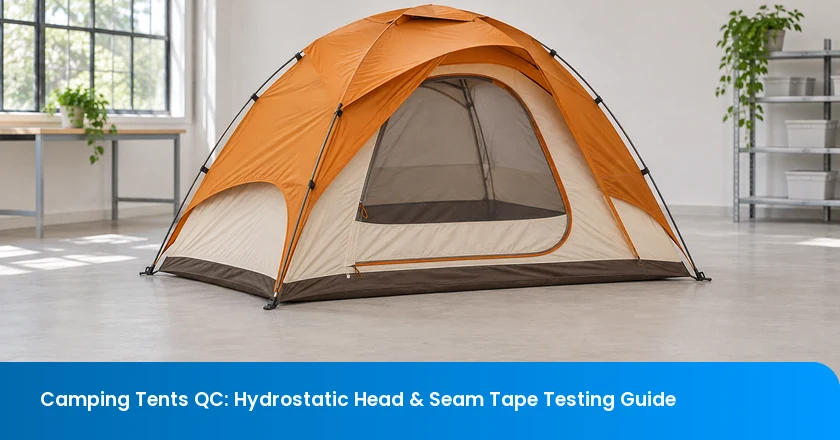
Camping-tent waterproof quality control needs evidence for the fabric, the seams and the assembled shelter. Hydrostatic head testing measures fabric resistance to water pressure. Seam checks locate water entry, while a suitable peel test assesses the tape bond. Comparing those results before and after relevant conditioning helps buyers understand how the selected construction performs.
For an importer or outdoor brand, the useful outcome is a test brief tied to the purchased tent. It should identify the rainfly and floor materials, the sealing construction, the intended use and the criteria behind each acceptance decision.
Key takeaways for tent waterproof QC
- Compare hydrostatic results only after checking the method, specimen condition and reported endpoint.
- Check seam watertightness and tape adhesion separately, including corners and intersections.
- Choose ageing exposures for the actual materials and intended use, with criteria agreed before testing.
- Keep buying claims, production checks and maintenance instructions consistent with the tent construction.
Start with the tent, its materials and intended use
Start the actual tent check by connecting fabric hydrostatic resistance, seam leakage, tape bonding and performance after relevant ageing. Each answers a different waterproofing question. Keep the model, construction and intended use consistent across the evidence so that a strong fabric result cannot conceal an unresolved seam problem.
Identify the rainfly, floor, inner tent and any separate footprint. Record the base fabric, coating on each side, seam type and sealing system for the parts intended to resist water. A welded joint, a sealed stitched joint and a taped stitched joint need checks suited to their construction. Confirm whether the sample represents the production materials and assembly process.
The wider product reference also matters. ISO 5912:2020 addresses camping-tent safety, performance and fitness for use. A fabric test answers a narrower material question within that whole-product assessment. Select applicable product requirements alongside the waterproofing brief. ISO camping-tent scope
Specify a comparable hydrostatic head test
Hydrostatic head, often shortened to HH, expresses water pressure as an equivalent height of water. The test applies water pressure to a fabric specimen and observes penetration according to the selected procedure. The report must make that procedure identifiable, including its edition and any permitted choices or deviations.
The following public method descriptions help select a starting point. The laboratory needs the complete applicable procedure to conduct and report the test.
| Method | Publicly described scope | Buyer’s comparison check |
|---|---|---|
| ISO 811:2018 | Fabric resistance to water penetration under hydrostatic pressure, with or without a water-resistant finish. | Identify the tested fabric, exposed face and specimen condition. |
| AATCC TM127 | Fabric water-penetration resistance under hydrostatic pressure, without restraint. Results may differ from rain or spray methods. | Confirm whether the intended test requires restraint and an appropriate method. |
| ASTM D751-26 | Coated-fabric methods include hydrostatic procedures using a Mullen-type tester or a rising water column. | State the selected procedure and tester, along with relevant conditions. |
Before comparing suppliers, ask for the pressure application rate or specified hold procedure, specimen area, clamping or restraint, conditioning, water conditions and penetration endpoint. A report stating only “waterproof test passed” leaves the comparison unresolved. Increasing pressure to an endpoint and holding a specified pressure answer different test questions.
Record the individual results, units and any observations such as edge leakage or specimen slippage. Have the laboratory handle invalid or abnormal tests according to the method. Agree how results will be evaluated against the rainfly or floor specification before samples are tested. A stated minimum needs an identified requirement and a defined decision rule.
Choose ratings in the context of the whole tent
MSR explains waterproof ratings as pressure expressed through an equivalent water height. For its own tents, it chooses coatings for each tent to balance waterproofness, tear strength and weight. That approach gives buyers a reason to examine the coating and product design alongside the advertised rating. MSR fabric and waterproof-rating guidance
A rainfly and a floor serve different positions in the shelter. The floor faces ground contact, wear and local loading. The fly must work with its shape, tension and clearances. Ask the designer or supplier which use conditions informed each component’s requirements, including expected wear and storage.
Use HH data to compare the specified fabric under comparable conditions. Assess expected weather protection through the rest of the tent’s evidence as well. Wind-driven entry, an opening, a poorly pitched fly or a leaking attachment can remain relevant even when the fabric meets its pressure requirement. An advertised rating alone cannot establish a fixed number of hours in heavy rain.
Inspect seam construction and locate water entry
Map the actual tent’s seam intersections, floor corners and attachments before the check. On taped seams, inspect coverage of the stitched path, alignment, wrinkles, gaps, lifting edges and visible contamination. Photograph the location and compare it with the approved construction reference. Then record where water enters during the agreed seam-leak check.
A visual defect indicates where to investigate. Its waterproofing effect still needs an appropriate observation. For example, a wrinkle can create a potential channel, while an exposed stitch hole may give another entry path. Trace the first observed wet point and its route rather than attributing every damp patch to the nearest tape edge.
Ask the factory to identify the tape, coating and application process used for that seam. Compare the approved application settings and records for temperature, pressure and feed or dwell conditions. If a change in coating or tape occurred, ask what verification supports the new combination. Settings copied from another material need a compatibility basis.
Repair compatibility also depends on the treated side. GEAR AID distinguishes its seam sealants by coating compatibility and notes that a fabric can have silicone outside and polyurethane inside. Identify the actual inner coating and follow the tent maker’s repair guidance when selecting a sealant or repair process. GEAR AID sealant compatibility guidance
For the seam record, include the joint location, specimen source, sealing side, water application, exposure and observed entry point. Keep a manual lifting observation separate from a measured adhesion result. The illustration shows the relationship between tape coverage, the stitch path and the bond that needs assessment.
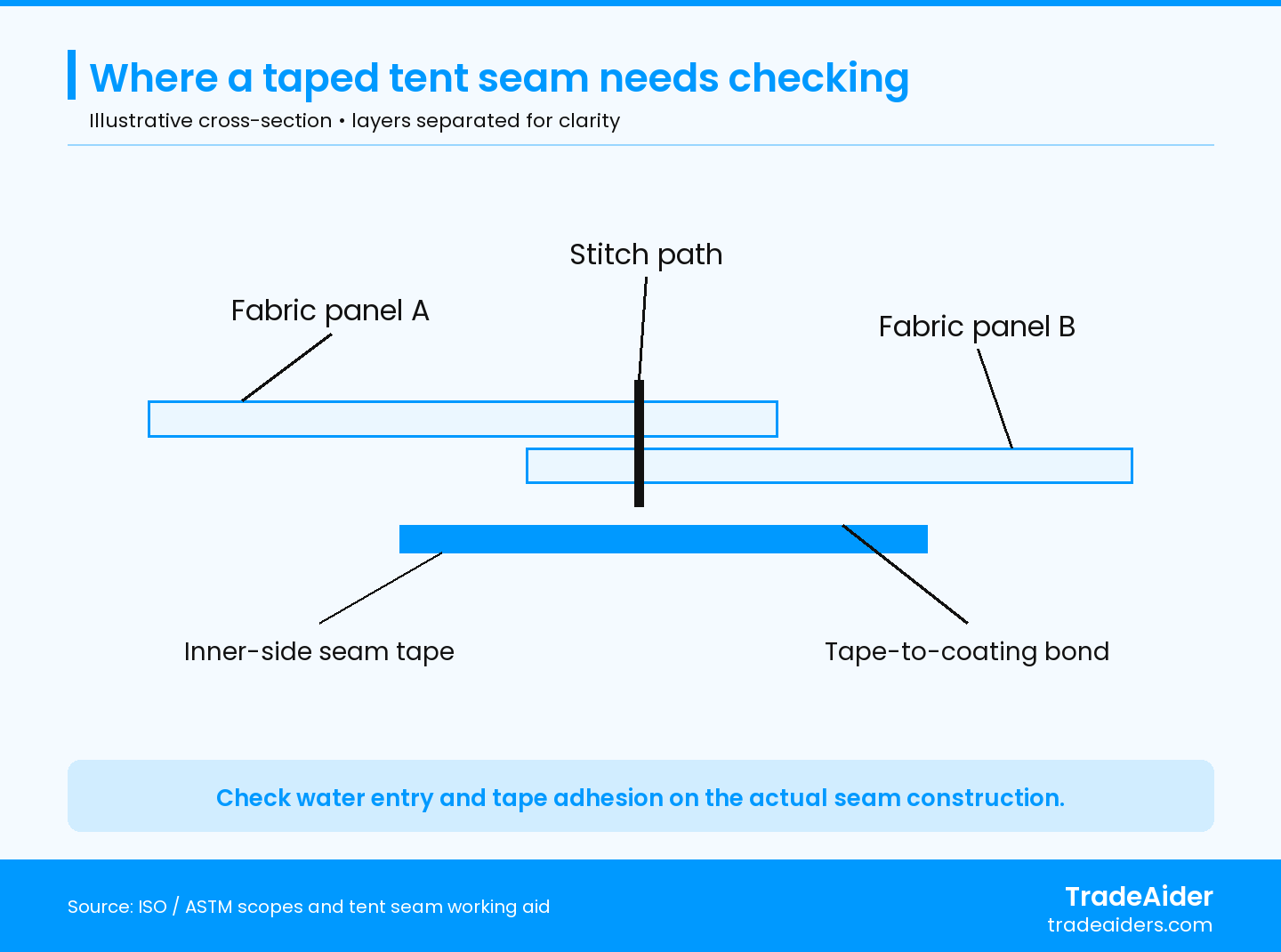
Illustrative taped-seam cross-section, shown apart for clarity. Actual seam, coating and sealing construction vary by tent.
Define what a seam-tape peel test will measure
Peel testing separates a bonded assembly under defined conditions and measures the force associated with separation. For tent tape, the test must suit the tape, coated fabric and way the specimen can be gripped. Ask the laboratory to identify the geometry and explain its relevance to the actual production seam.
ISO 11339:2022 describes T-peel testing of bonded assemblies with flexible adherends, meaning the flexible materials joined by the adhesive. Its scope states that the method does not provide design information. Use its measured result within the specified assembly and test conditions when judging a proposed bond. ISO T-peel scope
ASTM D3330/D3330M addresses pressure-sensitive tape peel adhesion. Its specified methods limit comparisons between tapes from different manufacturers because backing stiffness and adhesive behavior can affect the result. The standard also explains that there is usually no direct relationship between peel results and a functional performance requirement. Check applicability before selecting it for heat-applied tent tape. ASTM tape-peel significance and limitations
Include specimen width, peel geometry, separation rate, conditioning, time after bonding and reporting units in the test brief. Record the failure location, such as adhesive separation, coating detachment or fabric tearing. Similar force values can accompany different failure mechanisms. Pair the agreed bond assessment with seam watertightness checks to address both properties.
Check waterproofing and bonding after relevant ageing
ISO 1419:2019 describes accelerated-ageing methods for assessing deterioration of coated fabrics. Select a relevant exposure for the material and intended use, then specify which properties will be measured afterward. A reference to the standard needs the applicable method and conditions to make the result interpretable. ISO coated-fabric ageing scope
Polyurethane coatings can undergo hydrolysis, a chemical breakdown involving water. In its own fabric-development account, NEMO describes assessing candidates under controlled heat, humidity and other hydrolysis-inducing exposures. The example shows why an initial waterproof result can leave durability questions unanswered. Its development exposures require their own technical selection and interpretation. NEMO fabric-development account
Use matched specimens from identified materials and seams for baseline and conditioned testing. Define exposure, duration, recovery conditions and acceptance criteria in advance. Depending on the failure being investigated, follow conditioning with fabric pressure testing, seam-leak checks and bond assessment. Keep changes in stickiness, cracking or lifting in the observation record.
Report the actual exposure and remaining performance. Relating an accelerated test to outdoor service life requires supporting validation for that product and environment. An unsupported conversion from laboratory hours to years would hide differences in moisture, temperature, sunlight, abrasion and storage.
Connect fabric and seam results to an assembled tent
Pitch the actual tent according to its instructions before an assembled check. Confirm fly tension, closures, ventilation, floor corners and attachments. Agree water application, exposure, observation points and acceptance criteria. Record the setup so a later repeat uses comparable conditions, including any ground support or footprint.
Observe from inside and outside where practical. Record when and where wetting first appears, whether water tracks from an opening and whether contact between layers affects the observation. A controlled water test needs a defined procedure to support a claim about performance. An informal hose demonstration should retain its observed conditions and limited purpose.
For TradeAider pre-shipment inspection, the order quantity is 100% complete and at least 80% packed for export. Agree the actual tent checks, sampling, references and available equipment before the visit. Connect observed construction and workmanship to the relevant sample and test records, with the report identifying any checks that could not be performed.
Illustrative investigation of a leaking floor corner
Consider a hypothetical tent order whose fabric meets the agreed hydrostatic requirement, while an assembled check reveals water entering at a floor-corner seam. The actual seam check shows a tape wrinkle near the intersection. This example contains no measured client results.Enter the fabric result in the record’s fabric row and the water-entry location in the seam row. Keep the affected units identified while the factory investigates the corner construction and tape application. Compare the coating, tape and process with the approved reference. The observed wrinkle is a lead to investigate, and the leak path needs confirmation.If the investigation supports a compatible rework, define how the repaired joint will be checked. Repeat the relevant seam water test and bond assessment under the agreed conditions, including conditioning when durability of the repair is part of the requirement. Record the rework scope and results against the acceptance basis.If the buyer’s specification contains only a fabric rating, mark the seam criterion as missing and assign the technical owner to define it. Keep the seam acceptance decision pending. Repeating the passing fabric test would leave the observed corner failure unresolved.
Keep buying and maintenance instructions material-specific
When buying, match the shelter to expected conditions, pitching needs, weight and repair arrangements. Ask for the rainfly and floor specifications separately, plus evidence for the seams and assembled design. Check whether the care label explains compatible cleaning and repair for the actual coating.
NEMO’s own tent-care guidance recommends complete drying before storage, a cool, dry and dark location, and loose long-term storage. It warns that long-term compression can damage tent materials and seam tape. Apply the actual maker’s instructions to the purchased tent and its components. NEMO cleaning, repair and storage guidance
Before a trip, inspect the coating and seams and investigate known leakage. Distinguish a loss of surface water beading from a damaged waterproof barrier or detached tape. Select the repair for the diagnosed defect and compatible surface, then check the repaired area before relying on it in use. Set maintenance intervals from condition and manufacturer guidance.
Use a tent waterproof-QC record
Copy this record for the actual tent model and check each evidence item against its stated reference. Fill in the specimen or lot identity, method conditions, observations and acceptance basis. Where information is missing, name the person responsible for obtaining it and keep the corresponding decision pending.
| Check | Reference and conditions | Result and next action |
|---|---|---|
| Product identity | Model / revision ___ · Materials and coating sides ___ | Sample-to-production match ___ · Change to investigate ___ |
| Fabric pressure resistance | Part and specimen ___ · Method, condition, endpoint and criterion ___ | Individual results and units ___ · Decision / owner ___ |
| Seam leakage | Joint location ___ · Water procedure and criterion ___ | Entry point / observation ___ · Follow-up ___ |
| Tape bonding | Assembly and peel method ___ · Width, rate and conditioning ___ | Force, units and failure location ___ · Decision / owner ___ |
| Aged performance | Exposure and recovery ___ · Baseline and post-exposure criteria ___ | Fabric / seam / bond findings ___ · Required action ___ |
| Assembled tent | Pitch and water-test setup ___ · Observation points and criterion ___ | Water-entry record ___ · Disposition / owner ___ |
| Production and care | Lot, approved sample and changes ___ · Label / repair instructions ___ | Mismatch or missing information ___ · Corrective action / verification ___ |
Attach photographs and test reports using the same specimen and joint identifiers. State whether each result meets its criterion, needs investigation or awaits information. In the floor-corner example, the passing fabric row stays separate from the open seam action until the repair and its verification are resolved.
Prepare the inspection handoff
Send TradeAider the actual tent and order information you already have, the factory, destination, timing and concerns. Include available specifications, approved samples and reports. We can discuss suitable references, sampling and feasible checks, with an inspection report recording the agreed checks, findings and limitations. Contact our team to discuss your order.
FAQ
Does dampness inside a tent prove that a seam leaks?
Dampness alone does not identify a leaking seam. Check the actual tent’s wetting location, weather, ventilation and contact between layers. Record those circumstances and investigate whether moisture comes from condensation or external water entry. A repeat under defined conditions can help locate a path before choosing corrective action.
Can a fabric spray fix a failed taped seam?
A surface water-repellent treatment does not repair a detached seam-tape bond. Identify whether the issue concerns surface wetting, the barrier coating or the joint itself. Use the maker’s compatible repair process for that defect and verify the repaired area under relevant conditions.
Is a hand pull enough to approve seam-tape adhesion?
A hand pull provides a qualitative observation unless a defined inspection procedure gives it a specified acceptance role. When the specification requires measured adhesion, use the agreed method and report its conditions, force and failure location. Record any equipment limitation before deciding how the missing result will be obtained.

Artigos Relacionados



Expanda seu negócio com o Serviço TradeAider
Clique no botão abaixo para entrar diretamente no Sistema de Serviço TradeAider. Os passos simples desde a reserva e pagamento até o recebimento de relatórios são fáceis de operar.

