
- Sobre Nós

- Nossos Serviços
- Sua Indústria
- Recursos
- Notícias e Blog
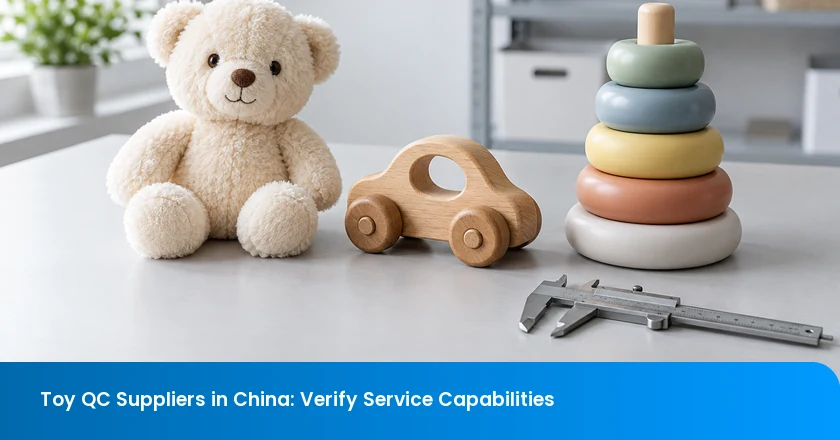
When comparing toy quality control (QC) suppliers in China, verify the people and organizations behind each quoted service. Ask who will inspect the factory’s goods, which laboratory will perform the tests, and who will issue each report. A provider can be suitable for inspection while its laboratory coordination remains unverified. The most useful selection process therefore connects capabilities to named executors, relevant evidence, and a clearly bounded appointment.
Decide Which Toy Quality Control Services You Are Buying
An inspection provider, a testing laboratory, and a service coordinator can have different responsibilities even when one company quotes the whole assignment. Inspection examines goods against agreed specifications and checks. Laboratory testing applies defined methods to identified samples. A coordinator arranges those activities, but arranging a test does not establish that the coordinator performs it.
To define the inspection portion, consult the inspection-standard guidance.
Here, “suppliers” means providers of toy quality-control services, rather than toy manufacturers. Start your brief with the decisions you need help making: whether production matches the approved sample, whether packaging is correct, or whether specified laboratory evidence is available. Then assign each decision to the appropriate service and deliverable. A factory audit addresses a further question about the manufacturing operation; it cannot replace either product inspection or laboratory work.
Put the inspection criteria in writing before discussing inspector availability. For example, a plush toy assignment may require checks of stitching, appearance, accessories, quantities, and retail packaging against approved references. Any laboratory work needs a separately agreed scope.
Identify the Contracting Company and the China Execution Team
Before awarding work, verify the contracting entity, operating location, assigned team, subcontractors, and reporting owner. A familiar trading name is insufficient if the quotation, invoice, accreditation document, and report identify different organizations without explaining their relationship.
Request the legal company name and registration details, then reconcile them with the agreement and payment instructions. Ask where the inspector will travel from, whether employees or subcontractors will attend, and who substitutes if the assigned inspector becomes unavailable. These questions clarify operational responsibility without assuming that either staffing model is inherently better.
For China execution, confirm the factory address, the production contact, the language used during the visit, and the language of the final report. Establish who receives urgent findings while the inspection is underway. A sales contact may arrange access, but a named technical reviewer should be able to explain an inspection conclusion or escalate an unresolved laboratory question.
Retain the answers with the appointment record. If the supplier changes the executing organization later, require notice and review the affected responsibilities again. Company information is a starting point for this check, followed by assignment-specific confirmation. For an initial review of the service organization, see TradeAider’s company background.
Ask for Evidence of Relevant Toy Inspection Experience
A relevant redacted report and a technical discussion about your actual toy reveal more about inspection suitability than a long product-category list. Ask the proposed team to explain how it would check your design, which references it needs, and which questions it would refer to a laboratory.
Match experience to construction and use. Plush toys, battery-operated toys, and wooden wheeled toys create different inspection tasks. A provider should be able to discuss the product’s materials, accessible components, assembly, functions, markings, and packaging without claiming that one generic checklist covers every design. Ask for an example close enough to show transferable inspection reasoning; an unrelated consumer-goods report proves much less.
A useful technical conversation also exposes limits. If a provider proposes an on-site check, ask about the procedure, equipment, acceptance criterion, and record it will produce. If those are undefined, “we test everything” is a reason to clarify the offer. A field observation must not be presented as completion of a laboratory method that the inspector has neither agreed nor performed.
Read the Sample Inspection Report as a Buyer
A useful sample inspection report separates observations, specifications, sampling, unperformed checks, and actions. You should be able to reconstruct why the inspector reached a conclusion, rather than seeing only a colored pass label.
Check whether photographs identify the product and finding, measurements include units and criteria, and defect counts connect to the sampled units. Look for clear treatment of inaccessible goods, missing approved samples, incomplete production, or equipment that was unavailable. Such limitations should remain visible instead of disappearing into an overall result.
Where the report uses an acceptance quality limit (AQL) sampling plan, ask for the lot size, inspection level, selected sample size, and acceptance criteria. These inputs concern inspection sampling; they do not establish laboratory competence or guarantee that every toy is defect-free. You can review the sampling inputs with the AQL calculator.
Check Conflicts of Interest and Report Escalation
ILAC, the International Laboratory Accreditation Cooperation, describes accreditation as evaluation for specified activities that addresses competence and impartiality. Its explanation of accreditation helps distinguish a scoped assessment from a general marketing assurance. A claimed accreditation still needs verification; do not assume every inspection business holds one.
Separately, ask the provider to disclose commercial relationships with the factory, referral payments, or other interests that could affect the assignment. Confirm who can amend findings, how amendments are recorded, and whether the buyer receives the report directly. These are procurement checks, not a claim that a written policy removes every conflict.
Agree an escalation contact outside the factory relationship. If access is restricted or pressure is applied to change a finding, the inspector needs an agreed route to notify you. Evaluate whether the provider explains that route clearly and preserves the original observations when a conclusion is challenged.
Verify the Named Laboratory and Its Relevant Scope
Ask for the laboratory’s legal name, actual testing location, accreditation number, and relevant scope document. Establish whether the inspection company owns the laboratory, contracts with it, or simply introduces customers. Each arrangement can work, but the proposal should make the relationship and reporting responsibility explicit.
The ILAC signatory directory helps users find an accreditation body in the economy where testing or inspection is needed. Use the relevant body’s records to check the laboratory’s current listing and scope, rather than treating a logo copied into a sales presentation as sufficient evidence.
Compare the named site and scope with the proposed work. Ask the laboratory to resolve unclear method descriptions, exclusions, or document versions. If part of the work will be sent elsewhere, obtain the other laboratory’s identity and verify that part separately. Do not let “our partner lab” conceal another unidentified subcontractor.
The handoff matters as much as the directory check. Agree who selects and identifies samples, who authorizes additional work, and whether you receive the performing laboratory’s report. Require notice before substituting a laboratory. Accreditation checks help assess competence for the stated activity; they do not themselves establish that your toy complies or that every destination requirement has been addressed.
For US Children’s Toys, Verify Rule-Specific CPSC Acceptance
For applicable US children’s product requirements, general laboratory accreditation is not the whole check. The US Consumer Product Safety Commission (CPSC) defines third-party testing as work by an accredited laboratory it has accepted for the specific children's product safety rules. Review its laboratory acceptance guidance when assessing that part of a proposal.
The CPSC laboratory search lists accepted testing laboratories and provides test-scope filters. Match the proposed performing laboratory to the relevant entries, then ask it to confirm coverage of the tests in your quotation. A listing for one rule does not establish acceptance for every other proposed test.
Keep this verification specific to the destination and toy. A US acceptance record does not establish suitability for a different market’s conformity route. The provider should explain which work it can arrange, identify any gaps, and distinguish that service from the importer’s own responsibilities.
Compare Itemized Toy QC Quotes on the Same Scope
CPSC’s toy safety guidance advises discussing the product with a laboratory and obtaining an estimate that itemizes the proposed applicable sections. For US children’s toys, that gives buyers a concrete basis for comparing laboratory proposals instead of relying on a single “toy testing” price.
Apply the same procurement discipline to the inspection portion. Compare equivalent work before deciding which proposal offers better value. The following quote comparison identifies commercial differences; it is not a prescribed testing program or a claim about standard industry prices.
| Quote item | Details to align | Difference to resolve |
|---|---|---|
| Factory inspection | Location, scope, man-days, sampling and report | Travel or additional time excluded |
| Laboratory work | Named lab, methods, variants and samples | Different tests hidden in a package price |
| Sample handoff | Selection, identification, courier and custody | Factory-selected samples versus independent selection |
| Follow-up | Clarifications, retesting, revisit and cancellation | Extra charges or a new booking required |
Ask when the quoted turnaround starts: booking, factory access, or laboratory receipt of acceptable samples. Record assumptions about production readiness and sample availability. Otherwise, two identical delivery promises can describe different schedules.
TradeAider’s product testing service describes needs alignment, sample identification and traceability, testing, report review, and report delivery. Use those stages to discuss the required handoff and deliverable through the product testing service.
Use a Pilot Assignment to Set the Provider’s Approved Scope
A successful inspection pilot supports the observed inspection service; laboratory coordination needs its own verified handoff before that service is approved. Define pilot acceptance before the visit so that a favorable product result does not become the sole measure of the provider.
Assess access preparation, adherence to the brief, clarity of evidence, communication of limitations, and response to a technical question. A report that identifies a genuine problem may demonstrate stronger work than a superficial passing report. Record the service you are approving, the factory or geographic coverage, and any conditions for adding further work.
Illustrative Example: Approve Inspection While Testing Stays Pending
Consider an illustrative comparison of 2 providers for a plush toy line at a factory in China. Provider A completes a pilot inspection with clear photographs, traceable observations, and useful explanations of limitations. Its bundled proposal also includes chemical testing, but it cannot yet identify the performing laboratory. Provider B names its laboratory, although its quotation includes different sample and courier arrangements.
In this illustrative comparison of 2 providers, the buyer can conditionally approve A for the demonstrated inspection scope while keeping 1 service pending: laboratory coordination, until the performing laboratory and its scope are verified. The reasoning assumes the inspection pilot met the agreed criteria. That evidence concerns A’s inspection work; it cannot establish the competence or scope of an unnamed separate laboratory. B’s more detailed laboratory proposal also does not automatically prove that B offers the better inspection service.
The buyer asks A to name the laboratory, identify the proposed methods, and document sample transfer and report ownership. Both providers must clarify their quote inclusions before a cost comparison. A’s appointment expands only after the laboratory and handoff are verified. If the gap remains, the buyer can retain the limited inspection appointment and commission a separately verified laboratory.
This is a hypothetical procurement decision, not a rating of actual suppliers or a toy compliance result. Conditional appointment of a provider does not release a shipment. It defines which services the buyer has evidence to purchase and which still need qualification.
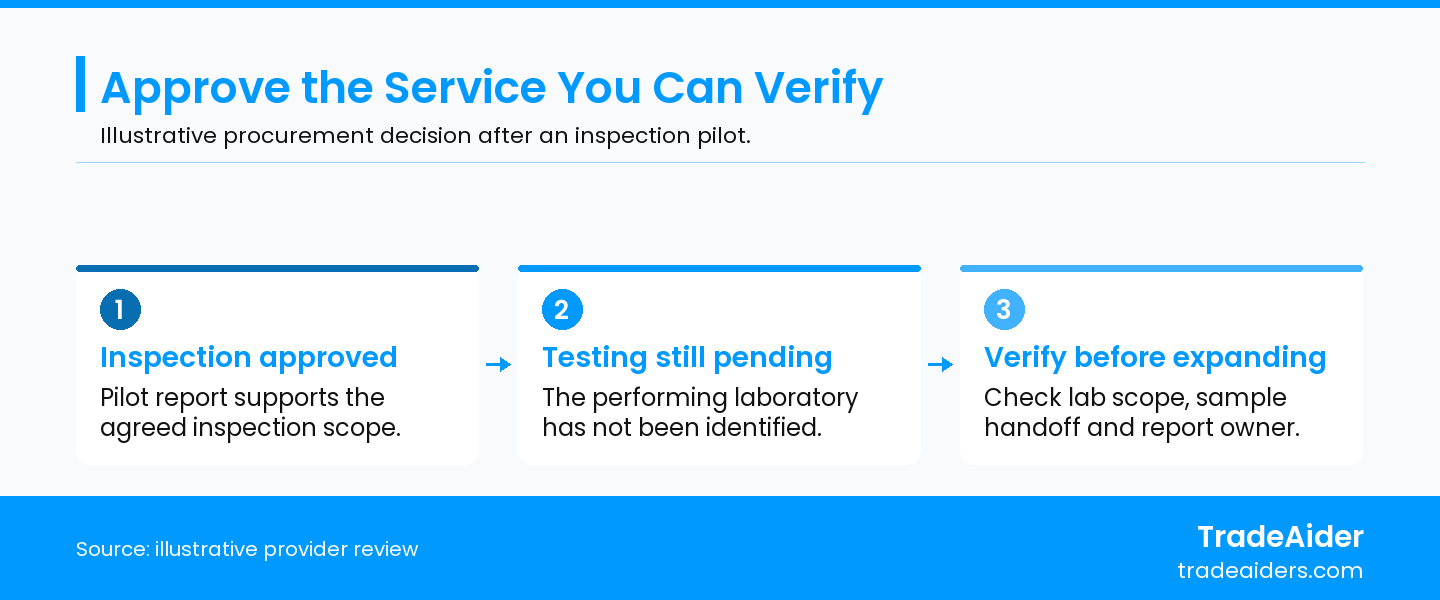
Illustrative provider selection: a satisfactory inspection pilot does not approve an unidentified laboratory partner.
Prepare a Provider Brief That Makes Proposals Comparable
Send toy specifications, age grading, destination markets, factory location, requested service stages, and reporting expectations. Ask each provider to return a scoped proposal naming who executes the work and who owns the deliverables. Keep these decisions explicit:
- Approve inspection and laboratory coordination separately when their evidence differs.
- Verify the actual performing site and relevant scope before accepting laboratory capability claims.
- Compare equivalent inspection time, testing, sample handling, and follow-up arrangements.
- Require notice and review before an executing team or laboratory is substituted.
Include product photographs, materials, the approved reference sample status, production timing, and existing reports. These inputs support a discussion of inspection criteria, testing needs, sample management, and reporting deliverables. To review the required services and obtain a proposal for the agreed work, contact TradeAider to discuss your toy QC scope.
Frequently Asked Questions
Can the toy factory pay for the inspection service?
Payment alone does not establish independence; the buyer should retain instructions, report access, and control over acceptance. If the factory pays, document who appointed the inspector and who can change the scope. Require direct reporting to the buyer and disclosure of relevant relationships. Treat an unexplained restriction on report access as an issue to resolve before booking.
What if a provider cannot share confidential client reports?
Accept a redacted or demonstration report if it preserves enough structure and evidence to assess reporting competence. Client names, commercial details, and identifying photographs may legitimately be removed. Ask the provider to explain how observations connect to criteria and conclusions. A demonstration proves less about past performance, so combine it with a technical discussion and a defined pilot assignment.
Should I insist on the same inspector for every visit?
Continuity helps, but a documented backup and briefing process matter more than a promise that one person is always available. Ask how replacement inspectors receive approved samples, defect references, previous findings, and open actions. Require confirmation of relevant toy experience when personnel change. Review the first replacement report closely for consistent interpretation of the agreed criteria.
Can I appoint separate inspection and testing service providers?
Yes, provided sample handoffs, responsibilities, and reporting requirements are coordinated explicitly. Identify who selects samples, records their origin, ships them, and answers laboratory questions. Give each provider the relevant product references and define who resolves discrepancies. Separate appointments can make responsibility clearer, but the buyer must ensure that neither provider assumes the other has completed an unassigned task.
Artigos Relacionados
Expanda seu negócio com o Serviço TradeAider
Clique no botão abaixo para entrar diretamente no Sistema de Serviço TradeAider. Os passos simples desde a reserva e pagamento até o recebimento de relatórios são fáceis de operar.

