
- Sobre Nós

- Nossos Serviços
- Sua Indústria
- Recursos
- Notícias e Blog
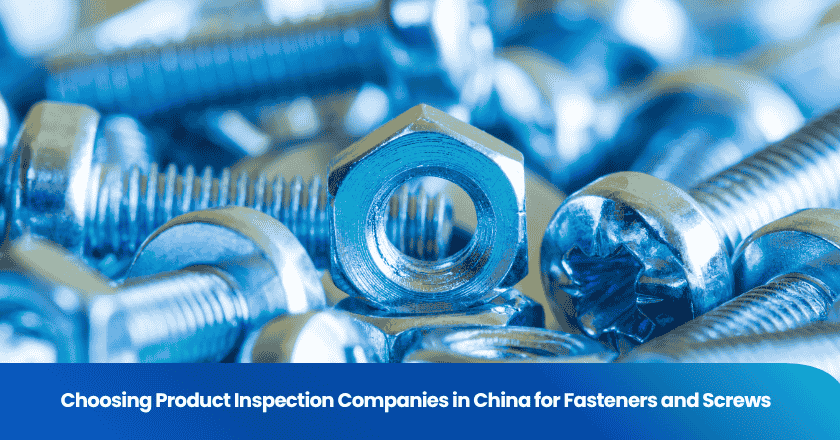
Fasteners are small. A single M6 hex bolt costs pennies. But when 5,000 of them arrive with stripped threads, wrong grades, or undersized diameters, the entire assembly they were meant to hold together fails — and the cost of that failure can reach tens of thousands of dollars in rework, delays, and lost customers. Choosing the right product inspection company in China for fasteners and screws is not about finding the cheapest option. It is about finding a partner who understands that a 0.1mm deviation in thread pitch can mean the difference between a secure joint and a product recall.
This article walks through the specific criteria that matter when evaluating inspection companies for fastener quality, what tests they should perform, and how real-time reporting helps you catch batch-level problems before they leave the factory.
Key Takeaways
- Fastener inspection requires specialized knowledge — thread gauges, hardness testing, and dimensional measurement with micrometers are essential tools that not all inspection companies carry.
- Seven evaluation criteria define the right partner — fastener expertise, testing equipment, geographic coverage, reporting speed, pricing transparency, inspector qualifications, and service flexibility.
- Common fastener defects are invisible without testing — grade substitution, thread tolerance violations, and plating failures cannot be detected by visual inspection alone.
- Real-time reporting enables same-day decisions — you see dimensional data, test results, and photos as the inspection happens, not days later.
Why Fastener Inspection Demands Specialized Expertise
Small Parts, outsized Risk
Fasteners — bolts, screws, nuts, washers, rivets, and anchors — are the invisible backbone of every assembled product. A furniture manufacturer importing M8 socket head cap screws from China does not think about them until a dining table leg collapses because the screw sheared under load. A power tool brand does not worry about thread engagement until customers report that battery compartment screws back out during use.
According to the ASTM F606 standard for mechanical testing of fasteners, properties like tensile strength, proof load, and hardness must meet strict thresholds for each grade. A Grade 8.8 bolt that tests at Grade 4.8 strength because the factory used lower-carbon steel will fail under the loads it was engineered for. This kind of material substitution is one of the most common — and most dangerous — defects found during fastener inspections in China.
The ISO 898-1 standard defines mechanical properties for carbon steel and alloy steel fasteners, specifying minimum tensile strength, yield strength, and hardness for each property class. Your inspection company must know these standards cold — not just recognize the names, but understand how to verify compliance through actual testing.
Why Generic Inspection Is Not Enough
Many product inspection companies in China offer "general merchandise" inspection. Their inspectors arrive with basic tools — a tape measure, a visual checklist, a camera. For textiles or plastic toys, that may suffice. For fasteners, it does not. Proper fastener inspection requires:
- Thread gauges (go/no-go) — to verify that internal and external threads fall within tolerance. A go gauge must thread in freely; a no-go gauge must not engage more than two turns.
- Digital calipers and micrometers — to measure shank diameter, head height, thread length, and overall length to 0.01mm precision.
- Hardness testers — Rockwell or Vickers, to verify that heat treatment achieved the target hardness for the specified grade.
- Torque testing equipment — to verify that screws achieve proper clamp load without stripping or galling.
- Plating thickness gauges — magnetic or eddy current, to verify that zinc, chrome, or other coatings meet minimum thickness requirements per ASTM B117 salt spray standards.
When evaluating inspection companies, ask specifically what equipment their inspectors bring for fastener jobs. If the answer is "standard toolkit," keep looking.
Seven Criteria for Evaluating Inspection Companies
1. Fastener-Specific Experience
Ask the inspection company how many fastener inspections they perform per month and whether they have inspectors trained in thread measurement and mechanical testing. Experience matters because fastener defects are subtle — a thread that is 0.05mm oversize looks identical to a correct thread to an untrained eye, but will fail in assembly.
A practical test: send the inspection company a sample inspection protocol for a Grade 10.9 M12 hex bolt and ask them to describe their testing approach. If they cannot immediately reference ISO 898-1, thread gauge types, and hardness testing locations on the bolt, they lack the specialization you need.
2. Testing Equipment and Lab Access
On-site inspection covers dimensional checks, visual defects, and basic functional tests. But full mechanical verification — tensile testing, proof load testing, and salt spray corrosion testing — requires laboratory equipment. The right inspection partner either carries portable hardness testers and plating gauges to the factory or can coordinate sample submission to an accredited testing lab.
TradeAider inspectors bring thread gauges, digital calipers, and hardness testers to the factory floor. For full lab testing, samples are coordinated through product testing services with accredited laboratories.
3. Geographic Coverage in Fastener Manufacturing Zones
China's fastener manufacturing is concentrated in specific regions: Haiyan (Zhejiang), Yongnian (Hebei), Wenzhou, and Ningbo. Your inspection company must have inspectors in or near these zones. Travel time and costs increase significantly when an inspector has to travel from a distant city, and delays in scheduling can push your shipping date.
| Region | Specialty | Key Products |
|---|---|---|
| Haiyan, Zhejiang | High-volume standard fasteners | Hex bolts, nuts, washers |
| Yongnian, Hebei | Standard and specialty fasteners | Screws, anchors, self-tapping screws |
| Wenzhou, Zhejiang | Precision and stainless fasteners | Stainless screws, socket head cap screws |
| Ningbo, Zhejiang | Export-grade fasteners | Automotive bolts, structural fasteners |
4. Reporting Speed and Transparency
Traditional inspection companies deliver reports 2-3 days after the inspection. For fasteners, this delay is costly — your factory may have already packed and loaded the container by the time you see the results. The right inspection partner provides real-time reporting, so you can review dimensional data and defect photos during the inspection and make same-day decisions.
TradeAider's platform gives you real-time access to inspection progress, photos of each measured sample, and immediate pass/fail determinations. If thread gauges reveal a batch of undersized M6 screws, you see it within hours — not after the cargo ship has left port.
5. Pricing Transparency
Many inspection companies quote a low base rate but add surcharges for travel, weekend inspections, holiday premiums, and report customization. By the time the invoice arrives, the actual cost may be double the quoted rate.
TradeAider charges a flat rate of $199 per man-day with no hidden fees. For a typical fastener order of 10,000 to 50,000 units, one man-day covers AQL sampling, dimensional measurement, thread gauging, visual inspection, and full photographic documentation. Use the inspection calculator to estimate costs for your specific order.
6. Inspector Qualifications
Ask whether inspectors are full-time employees or freelance contractors. Full-time inspectors receive ongoing training, follow standardized procedures, and are accountable to the company. Freelance inspectors may lack consistent training and quality standards vary between individuals.
Also ask about product-specific training. An inspector who primarily checks garments may not know how to use a Rockwell hardness tester or read a thread pitch gauge correctly.
7. Service Flexibility
Your fastener orders may range from a 500-unit sample run to a 500,000-unit production batch. Your inspection partner should offer services that scale to these different needs:
- Pre-production inspection — Verify raw material certificates, check incoming steel grade, and confirm the factory's production setup matches your specifications before the first part is made.
- During-production inspection — Pull samples from the production line to check dimensional consistency, thread quality, and surface finish while the machines are still running.
- Pre-shipment inspection — Full AQL sampling of the finished batch, covering dimensions, threads, mechanical properties, surface finish, labeling, and packaging.
- Factory audit — Verify the manufacturer's quality management system, equipment capabilities, and certifications (ISO 9001, IATF 16949 for automotive fasteners).

- Seven-dimension evaluation framework for selecting a fastener inspection partner: each criterion addresses a specific capability gap that can compromise quality verification.
Common Fastener Defects That Require Inspection
Dimensional Violations
Fasteners must conform to exact dimensional specifications. Even small deviations cause assembly problems:
- Undersized shank diameter — A bolt that measures 7.85mm instead of the specified 8.00mm will have excessive clearance in the hole, reducing shear strength and causing misalignment.
- Oversized thread diameter — A screw that is 0.1mm over specification will be difficult to drive, may cross-thread, or may not engage the mating part at all.
- Incorrect thread pitch — M8x1.25 and M8x1.0 bolts have the same nominal diameter but different thread spacing. Mixing them up causes assembly failures that are nearly impossible to detect visually.
- Head height out of tolerance — A socket head cap screw with an oversized head will not sit flush in a countersunk hole; an undersized head will not provide adequate clamp area.
Inspectors verify these dimensions using calibrated digital calipers and thread gauges on every sample in the AQL batch. Use the AQL calculator to determine sample sizes.
Material and Grade Substitution
This is the defect that keeps importers up at night. The factory quotes Grade 10.9 bolts but ships Grade 4.8 — visually identical, but with less than half the tensile strength. Detecting this requires:
- Hardness testing — Grade 4.8 steel measures approximately 80-95 HRB on the Rockwell scale. Grade 10.9 measures 32-39 HRC. A portable hardness tester applied to the bolt head or shank reveals the truth in seconds.
- Head marking verification — Grade markings on bolt heads (the raised numbers and lines) should match the specified grade. But markings can be forged — hardness testing is the definitive check.
- Material certificates — Request mill test certificates (MTC) for the raw steel used in your order. Cross-reference the heat number on the certificate with the markings on the wire rod coils at the factory during pre-production inspection.
Surface and Plating Defects
Plating quality affects both appearance and corrosion resistance:
- Insufficient zinc thickness — Electro-zinc plating should be 5-8 microns thick for indoor applications and 12-25 microns for outdoor use. Below-spec plating rusts within weeks of exposure to humidity.
- Hydrogen embrittlement — High-strength fasteners (Grade 10.9 and above) that undergo electroplating must be baked within hours to release trapped hydrogen. Without baking, the bolts become brittle and fracture under load — a defect that is invisible until the part fails.
- Surface defects — Burrs, cracks, folds, and seams on the fastener surface indicate poor tooling or material quality. Inspectors check for these under magnification.
Threading Defects
- Stripped or incomplete threads — Thread rolling or cutting tools that are worn produce threads with incomplete profiles. The thread crest may be flat instead of pointed, reducing engagement depth.
- Galling — Stainless steel fasteners are prone to galling (cold welding between mating threads). Inspectors check for galling by test-driving sample nuts onto bolts.
- Thread alignment — Bent or misaligned threads cause cross-threading during assembly. A go/no-go gauge catches this immediately.
What a Professional Fastener Inspection Report Includes
A thorough fastener inspection report should contain:
| Report Section | What It Covers |
|---|---|
| Order summary | PO number, product description, quantity, factory name and location |
| AQL sampling plan | Lot size, inspection level, AQL level, sample size drawn |
| Dimensional data | Measured values for each dimension (diameter, length, thread pitch, head height) per sample |
| Thread gauge results | Go/no-go results for each sample, internal and external threads |
| Hardness test results | Rockwell or Vickers hardness readings, compared to grade requirements |
| Visual and surface defects | Photographs of defects — burrs, plating issues, head damage, surface cracks |
| Defect summary | Critical/major/minor defect counts, AQL pass/fail determination |
| Labeling and packaging | Carton markings, product labels, barcodes, packing quantity verification |
Frequently Asked Questions
How many fasteners should be inspected per order?
Sample size depends on your lot size and AQL level. For a standard order of 50,000 M6 screws at AQL 2.5 Level II, you would inspect approximately 315 samples from the lot. Of those, a subset of 5-10 would undergo dimensional measurement and hardness testing. Use the AQL calculator to determine the exact sample size for your order.
Can inspectors perform hardness testing at the factory?
Yes, portable Rockwell hardness testers can measure bolt hardness on-site. The inspector presses the tester against the bolt head or shank and records the reading. For more precise testing (Vickers microhardness for case-hardened fasteners, or full tensile testing), samples must be sent to an accredited laboratory. Your inspector can coordinate both on-site and lab testing in a single visit.
How much does a fastener inspection cost?
TradeAider charges $199 per man-day for fastener inspection. A typical order of 10,000 to 100,000 units requires one man-day for a full pre-shipment inspection including dimensional checks, thread gauging, hardness testing, and visual inspection. Orders with multiple product types or extremely tight tolerances may require additional time.
What if the inspection finds grade substitution?
If hardness testing reveals that fasteners do not meet the specified grade, the inspector documents the actual hardness readings with photographs. You then have clear evidence to present to the factory — this is not a subjective judgment, it is a measured deviation from the agreed specification. You can request re-manufacture with the correct material, negotiate a price adjustment for the lower grade, or reject the lot. Contact our team to schedule a fastener inspection with hardness verification.

Artigos Relacionados
Expanda seu negócio com o Serviço TradeAider
Clique no botão abaixo para entrar diretamente no Sistema de Serviço TradeAider. Os passos simples desde a reserva e pagamento até o recebimento de relatórios são fáceis de operar.

