

Furniture quality inspection moves through material checks, in-process assembly and finishing, final inspection, container loading and showroom readiness after arrival. Each stage examines different features and conditions. Connect them with the approved product references, identified goods, recorded findings and a clear owner for the next action.
For a furniture importer or manufacturer, the aim is to check the right feature while it is accessible and keep the evidence useful at later handoffs. A finished-product pass cannot automatically establish hidden workmanship, formal test performance or arrival condition. Plan the full journey rather than rely on one final checklist.
Keep Each Furniture Stage Connected
- Agree the build, criteria and relevant market requirements early.
- Check materials and accessible assembly work before later stages hide them.
- Keep final sampling, formal testing and loading observations distinct.
- Carry goods identity, findings and correction evidence to the next owner.
- Record delivered condition before showroom preparation or use.
Inspection Journey
Furniture quality inspection is a connected journey from material selection through manufacturing, finished-product checks, loading and arrival. Each stage answers a different question about the product and the evidence available.
Overview
Start with the approved build: the agreed furniture configuration, materials, hardware, finish and assembly references. Keep the applicable drawings, samples, instructions and acceptance criteria available as goods move through production. A product name alone cannot identify which version was inspected or tested.
The buyer and factory should agree what each stage will check, who will perform the work and how unresolved findings will be handled. Use the inspection standards resource to help frame product-specific criteria, then record the actual requirements for the order. Digital checklists and linked photographs can make evidence easier to retrieve, but only when they identify the build, goods, stage and result accurately. The next team needs those references, not just a message that the previous stage passed.
Key Stages
Each stage needs its own checks and handoff record. Identify the goods examined, the criterion used, the result and the owner of any unresolved question. This keeps later teams from treating an earlier, narrower observation as approval for work that has not yet been assessed.
| Stage | Main check | Handoff to retain |
|---|---|---|
| Material inspection | Material/component identity, condition and agreed specifications before use. | Material references, relevant documents and the affected stock or build. |
| In-process checks | Fit, joint and fastener installation, assembly and finishing while accessible. | Observed work, location of findings, correction and next verification owner. |
| Final inspection | Finished configuration, visible condition, function and packing within scope. | Named lot, units examined, results, limitations and buyer disposition. |
| Container loading | Goods identity, packaging condition and agreed loading arrangements. | Loading record, observations, affected cartons and transport handoff. |
| Showroom readiness | Delivered condition, completeness and correct display assembly. | Receiving evidence, discrepancies, correction and permission for display or use. |
The matrix is a planning aid, not a universal visit schedule. Assign checks where the relevant feature is accessible, and agree what happens when production, packing or delivery conditions differ from the plan. A passed final sample cannot reconstruct an unrecorded hidden joint or establish the condition of goods after transport.
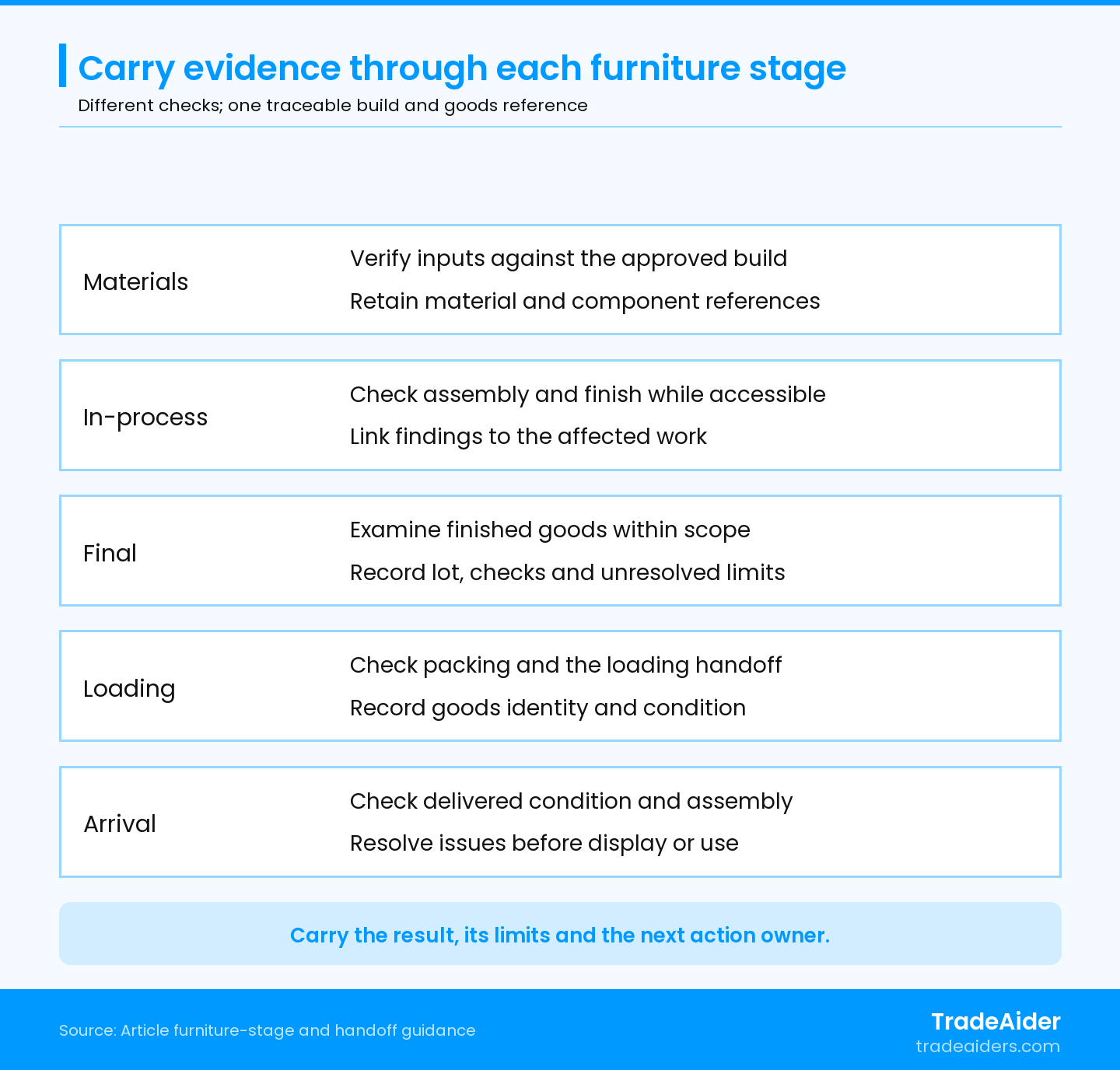
Keep the approved build, identified goods and unresolved findings connected across stages. Later checks complement earlier evidence; they do not automatically replace it.
Furniture Quality Inspection Stages
Furniture inspection stages should follow the work actually available to examine. Materials, unfinished assemblies, completed products and packed cartons expose different features; the scope should reflect those differences.
Material Inspection
Material inspection checks inputs before they are built into furniture. Compare wood or panels, metal parts, fabrics, foam, hardware and other relevant components with the approved specifications and references. Record identity, dimensions, condition, finish or color where appropriate, together with the lot or source reference needed for later tracing.
For wood, agree the moisture-check method, measurement locations and acceptance basis for the product and intended conditions. Do not apply one universal moisture percentage to every species, construction or destination. Examine visible cracks, distortion, contamination or surface damage, but keep those observations separate from claims about strength, composition or emissions.
Review the relevant supplier documents or test evidence for characteristics that cannot be established by appearance. If a material differs from the approved reference, the factory and buyer need a defined review before substitution. Retain the decision and affected stock identity so an apparently acceptable component does not enter production under an unrecorded exception.
In-Process Checks
In-process checks examine assembly and finishing before later work hides the relevant features. Compare component fit, joint alignment, fastener installation, adhesive application and accessible dimensions with the approved method. Check the actual operation and location of the finding rather than infer every internal connection from the appearance of the assembled furniture.
Finishing checks can include surface preparation, visible coverage, color or sheen against the approved reference, and relevant drying or curing instructions. The applicable process conditions and test methods need agreement; a dry-looking surface does not establish every coating property. Record the affected work and what changed after correction.
Where outside observation is needed while manufacturing continues, discuss during production inspection for the actual stage and checks. Give the inspector current build references, known concerns and access to the work. The factory remains responsible for its process controls, while the buyer should know who will review findings and verify any proposed correction before the next handoff.
Final Inspection
Final inspection compares finished furniture with the approved build and the named lot being assessed. Examine visible finish, dimensions, assembly, hardware, moving parts, instructions, accessories and packaging within the agreed scope. For flat-pack goods, record which units were assembled, using which supplied parts and instructions, rather than assume unopened cartons demonstrate a completed build.
NIST describes acceptance sampling as drawing a random sample to support accepting or rejecting a lot. That does not establish that every unit is defect-free. Agree the lot boundaries, product variants, selection method, checks and acceptance rules, and identify any access or testing limitation in the report.
A visible wobble, loose fitting or damaged finish can justify a finding, but a simple on-site observation does not automatically establish formal stability, long-term durability, material emissions or every market obligation. Resolve discrepancies through an authorized decision and appropriate evidence. Keep corrected goods identifiable, with the verification scope stated before the buyer relies on the result.
Container Loading
Container loading checks focus on the goods and arrangements at the transport handoff. Confirm the intended shipment, carton or unit identification, visible packaging condition and agreed handling, positioning and securing arrangements. Examine relevant container conditions and record exceptions within the booked scope; do not use a universal rule that every chair belongs above every cabinet.
Packaging performance is a separate question. ISTA’s test-procedure guidance distinguishes screening tests from tests that simulate hazards associated with a particular shipment type. Select any validation method for the actual product/package combination, distribution mode and purpose, rather than assume one parcel procedure applies to all furniture.
Retain relevant loading photographs, quantities or identification records and the agreed handoff details. If packaging or load arrangements change from those assessed, identify the change for review. A loading observation records what was visible then; it cannot guarantee that no damage will occur later in transit or replace earlier packaging validation.
Showroom Readiness
Showroom readiness begins with the receiving team’s record of delivered condition. Compare the goods, labels, components and instructions with the shipment and approved references. Photograph relevant packaging and visible damage before removing or correcting evidence that may help explain a discrepancy.
After unpacking, confirm completeness, correct assembly and the agreed appearance and function for display or use. Cleaning, tightening or adjustment should follow the applicable instructions and an authorized correction process; do not hide a damaged or potentially unsafe condition to make a display look ready. Retain what was found and what was changed.
Agree which receiving, retailer or service team owns this work. Earlier manufacturing or third-party checks do not automatically include local showroom attendance or repairs. If you need to identify the inspection organization involved in an earlier handoff, review TradeAider’s company background and confirm the actual assignment and reporting responsibilities.
Tests and Checklists
Furniture tests and checklists should follow the product category, intended use, build and destination. A method for one seating, storage or upholstery question does not automatically cover every furniture characteristic.
Common Tests
Common furniture checks include dimensions, fit, moving-part function, visible finish, hardware installation and the condition of relevant materials. Formal strength, durability, coating, fabric, stability or packaging tests need the applicable method, preparation, equipment and acceptance criteria. Agree loads, cycles and conditions where they matter rather than invent a generic furniture test.
For a US example, CPSC’s clothing-storage-unit guidance defines covered products and addresses stability, restraints and warnings. The definition and exclusions matter: the rule is not a universal test for every table, chair or cabinet. Determine whether the actual design falls within the covered category before specifying its evidence route.
For covered upholstered seating in the United States, CPSC’s upholstered-furniture guidance describes smolder-resistance methods for relevant cover fabrics, barrier materials, filling and decking materials. Its product definition and exceptions still need review. A visual fabric or foam check cannot establish that performance, and the requirement should not be generalized to every piece of furniture.
Plan any necessary specialist testing early enough for its result to inform the relevant build or material decision. Record which product configuration and materials the evidence covers, especially when a later substitution could change that basis.
Inspection Checklists
Inspection checklists make agreed checks repeatable when they identify the actual product and stage. Record the build reference, goods examined, criterion, method, result, evidence location, limitation and person responsible for the next action. Use a distinct status for an unperformed or unresolved check instead of marking every completed form passed.
Keep material, process, final, loading and receiving entries connected without copying irrelevant checks into every stage. Dimensions, finish, hardware, function and packaging can each require different observations. A photograph should show the affected part and context, while a measurement needs its unit and applicable criterion.
Where a sample-based plan applies, use the AQL calculator to review the agreed inputs. AQL means acceptance quality limit. Retain the lot, inspection level, sampling plan and defect classifications with the record; the calculator cannot select the appropriate scope or turn an incomplete sample into proof about every unit.
Defects and Prevention
Defects and prevention work should begin with a clear observation and the affected goods. Record what differs from the criterion before deciding why it happened or whether a proposed correction covers the relevant population.
Typical Defects
Typical furniture findings include scratches, dents, uneven finish, color differences, incorrect dimensions, poor fit, loose or missing hardware, restricted movement and damaged packaging. Record the part, location, build and relevant condition. A small-looking deviation can have a different consequence when it affects assembly or a load-bearing connection rather than an appearance surface.
Illustrative example: a loose joint is visible during frame assembly, but upholstery later covers the connection. A final functional check might reveal movement without showing the original installation detail. The in-process finding, correction record and affected-build reference help the reviewer decide what further verification is needed. This is a hypothetical stage-handoff example, not a TradeAider customer case or proof that a particular joint design is unsafe.
Prevention Methods
Prevention needs a plausible mechanism and checks that can test it. A USDA Forest Products Laboratory diagnostic guide links surface distortions in veneered furniture and cabinetry to moisture changes in the product. That mechanism is useful for investigation, but it does not establish the cause of every observed crack or finish problem.
Keep material identification, relevant conditioning or moisture records, process instructions and storage or handling information available. Review a recurring finding against those records before changing a limit or blaming a single operation. Verify the proposed correction on the affected goods and consider any secondary effect on finish, assembly or packaging.
Support prevention with current instructions, suitable fixtures and equipment maintenance, staff practice and clear exception reporting. Standardized forms help only when people use the same applicable criteria. Give corrective work an owner and a review point, and check whether the relevant problem recurs. Neither a new checklist nor an extra final visit by itself demonstrates that the underlying cause has been removed.
Standards and Third-Party Checks
Standards and third-party checks need a defined product and evidence purpose. Agree the relevant market, furniture category and criteria, then decide what can be observed on-site and what needs another test or document.
Industry Standards
Industry standards can address materials, structural performance, stability, surface properties, upholstery or packaging, but the appropriate set depends on the actual product and intended use. Confirm the applicable version, method and acceptance criteria. A family name such as “chair” or “cabinet” is not enough to select every requirement.
For furniture entering the United States, EPA’s composite-wood guidance covers specified panel categories, including hardwood plywood, medium-density fiberboard and particleboard, and finished goods containing them. At the October 25, 2026 check, the page also announced October 2026 updates to incorporated test standards. Confirm the applicable versions and effective dates for the actual order; an announcement should not be treated as proof that a change is already effective.
Keep relevant material identity, documentation and test evidence linked to the supplied construction. Visible panel condition cannot establish formaldehyde-emission conformity. Likewise, a report of appearance or assembly findings does not replace every applicable product-safety or market-access document. Identify those requirements and competent reviewers while the build and material choices can still be addressed, rather than wait for the final packing stage.
Third-Party Inspections
Third-party inspections can provide agreed evidence at a suitable manufacturing stage. The scope should identify the product and build, accessible goods, required checks, criteria and reporting limits. Independent observation can support the buyer’s decisions, while the factory’s process control and the buyer’s disposition authority remain separately assigned.
Agree how findings reach the people who can act, which corrected goods will be verified and what must be handed to the next team. Confirm any specialist test, loading or receiving work separately instead of inferring it from a general inspection booking. For final pre-shipment work, verify the provider’s actual production and packing readiness criteria before scheduling.
Contact our team with the available furniture and order information, factory, production stage, timing, destination and known concerns. TradeAider can discuss a stage-specific inspection scope and a report recording the agreed checks, findings and limitations. Identify the final report user and agree technical criteria, language, format and acceptance needs before inspection. Missing information can be clarified during the initial inquiry.
FAQ
Can final inspection replace a missed material check?
Only for characteristics that remain accessible and within the agreed final scope. A later measurement or visual check may answer a specific question, but hidden material identity, composition or an earlier processing condition may need records, testing or another evidence route. State what can still be verified and what remains unresolved instead of treating the final pass as a substitute for every missing check.
What if the furniture build changes after testing?
Review whether the existing test evidence still covers the changed build. A different panel, joint, hardware item, upholstery material or packaging arrangement may change what the evidence establishes. Record the change and ask the competent technical or compliance reviewer what further work is needed. A previous pass belongs to its assessed configuration; it should not automatically be extended to an unreviewed substitution.
Can arrival damage be attributed to the factory automatically?
No; compare the available manufacturing, packing, loading and receiving evidence before assigning a cause. Photograph the delivered condition and relevant packaging, identify the affected goods and preserve the handoff records. A damaged unit at arrival establishes a current finding, but may not show when or why the damage occurred. Resolve the technical investigation and any commercial claim through the appropriate agreed process.

Artigos Relacionados



Expanda seu negócio com o Serviço TradeAider
Clique no botão abaixo para entrar diretamente no Sistema de Serviço TradeAider. Os passos simples desde a reserva e pagamento até o recebimento de relatórios são fáceis de operar.