
- Sobre Nós

- Nossos Serviços
- Sua Indústria
- Recursos
- Notícias e Blog
Product quality can affect Amazon search ranking, but not because Amazon publishes a simple quality score that an inspector can raise. The more useful connection is indirect: a listing earns attention by making promises, and the delivered product either confirms those promises or gives buyers a reason to hesitate, return, or complain. Quality control protects the physical evidence behind the click.
That distinction matters for Amazon FBA sellers sourcing from China. A defect found before shipment can still be held, sorted, corrected, or checked again. The same defect discovered after launch becomes harder to isolate because the product, listing, review history, inventory plan, and supplier conversation are already moving at different speeds. Treat quality as a control for buyer experience, not as a shortcut to a hidden algorithm.
Protect the Product Evidence Behind the Click
Product quality should be treated as an indirect buyer-experience control, not as a publicly confirmed direct ranking input. Amazon's seller guidance does not provide a complete ranking formula, so claims that a better factory result automatically lifts an ASIN are too strong. What a seller can manage is the chain between a buyer's expectation and the product that arrives.
Amazon says positive reviews can boost product ranking and build trust with shoppers. That supports protecting the delivered experience.
High-exposure listing claims should map to specific inspection evidence before release. A claim about a leakproof lid, a smooth finish, a complete kit, or a precise size is not merely copy. It is a promise buyers can test quickly. Protect the product experience that makes buyer confidence possible.
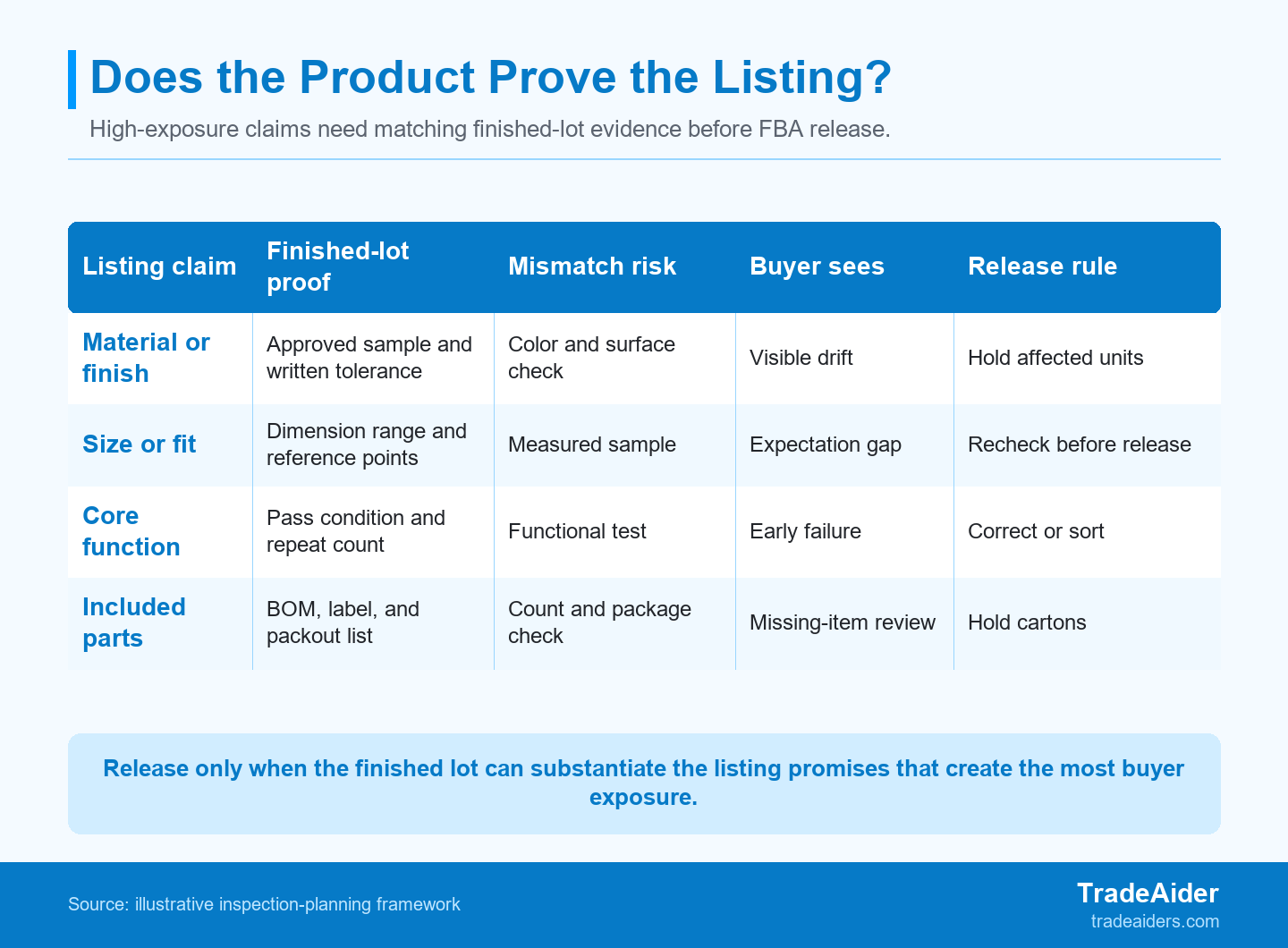
Use the listing claim as the starting point: each high-exposure promise needs a defined finished-goods check and a response rule before the lot is released.
- Do not confuse terms: search ranking and Best Sellers Rank answer different questions.
- Start with exposure: inspect the claims a buyer is most likely to notice after delivery.
- Use proof, not reassurance: an approved sample, measurement, function test, count, or document should support each important claim.
- Learn from outcomes: recurring review themes can improve the next specification and inspection plan.
What the A9 Shorthand Leaves Out
Amazon's seller guidance describes titles, descriptions, bullet points, and images as parts of search optimization and customer evaluation. Those elements help shoppers understand the offer before purchase. The factory-side question is different but connected: can the finished lot substantiate the material, color, size, quantity, function, and presentation shown on that page?
Amazon explains that BSR is calculated with sales volume data and that search results appear based on search ranking. That is a useful boundary. It means a seller should not look at a category rank, call it an A9 diagnosis, and assume a factory defect is the only explanation. Price, relevance, inventory, traffic quality, listing clarity, and buyer response can all affect the commercial picture.
Search Ranking and BSR Answer Different Questions
Best Sellers Rank (BSR) is a category sales-rank measure shown on Amazon product pages. Search ranking is the ordering a shopper sees after entering a particular query. A desk lamp can have a strong category sales history while appearing differently for different search terms, and the same product can have different ranks across Amazon stores. This is why a quality investigation should begin with the buyer-facing promise and observed outcome, not a single number.
For example, a listing may attract clicks for a clamp lamp because the image and bullet points emphasize desk stability. If the clamp slips in ordinary use, the quality issue is real even before the seller can prove any effect on organic position. The defect contradicts the reason a shopper selected the item. Preventing that contradiction is a useful operating goal whether the seller is watching paid traffic, search performance, or category sales.
Use Observable Buyer Signals Instead of Algorithm Lore
Amazon says its Search Catalog Performance dashboard reports impressions, clicks, cart adds, purchases, and conversion rates. Eligible brands can use those stages to ask a more disciplined question: are shoppers finding the product but abandoning the purchase, or are they purchasing and then reporting a recurring mismatch?
Those signals do not identify a private algorithm weight. They do help isolate where to look next. A decline in conversion may point to price, content, competition, or product experience. A repeated complaint about one component points the seller back to the specification, approved sample, and inspection record. TradeAider's inspection resources can help turn that investigation into named inspection criteria so the next lot is judged against a defined reference instead of a vague request to make it "better."
Turn Listing Promises Into Finished-Goods Evidence
Amazon lists materials, colors, quantities, sizes, and dimensions as product-description details that help customers find and evaluate products. A listing promise is a product claim in the page that a buyer expects the delivered item to prove. It may appear in the title, a bullet, an image, A+ content, a package photo, or an answer to a common buyer question.
Not every detail deserves identical inspection effort. Prioritize the claims that influence selection and that a buyer can verify quickly. A cosmetic color variation may be less consequential than a missing adapter, but a color mismatch can become critical when the listing is built around a matching set. The right check depends on the product, its approved reference, and the consequence if the promise fails.
| Listing Promise | Evidence to Define | Typical Check | Release Question |
|---|---|---|---|
| Material or finish | Approved sample and tolerance | Visual and material comparison | Does the lot match what the page shows? |
| Size or fit | Measurement points and range | Dimension check | Will a buyer receive the stated size? |
| Core function | Pass condition and repeat count | Functional test | Does it perform the advertised task? |
| Included contents | BOM and packout list | Accessory and package count | Will the buyer receive the complete offer? |
This map also makes listing revisions safer. If a supplier cannot repeatedly meet a feature claim, the seller has two honest options: correct the product or narrow the promise. Leaving a generous claim in place while hoping defects remain invisible is not an SEO strategy. It is an expectation gap waiting to reach the customer.
Choose Proof That Matches the Claim
NIST explains that acceptance sampling supports an accept-or-reject disposition decision for a lot rather than an estimate of lot quality. In plain language, acceptance sampling is a planned sample check used with defined criteria to support a lot decision. It is not a prediction of a future review rate and it is not proof that every unit will perform perfectly.
Match the proof to the promise. A size claim needs measurement points and tolerances. A "works with" claim may need a functional test with the relevant connection or load. A complete-kit claim needs a count against the approved packout. A safety, durability, or regulated claim may need evidence beyond a standard on-site inspection, which is why the seller should define the boundary before booking. Once the checks are defined, an AQL sample plan can help translate the lot size into a structured sample approach.
A Product Mismatch Can Be Visible Before a Ranking Change
A seller can resolve a documented product mismatch while the completed lot is still under buyer control, rather than waiting for marketplace feedback. That does not make inspection a ranking guarantee. It gives the buyer more options before the lot is dispersed, reviews accumulate, and a supplier dispute becomes harder to separate from inventory timing.
The useful trigger is evidence conflict. The approved sample, the written specification, the listing image, and the current production unit should tell the same story. When they do not, start with the claims that carry the greatest buyer exposure. A tiny cosmetic variance can wait for a later decision; a failure in the feature that caused the shopper to buy should not.
Illustrative Scenario: A Desk Lamp Listing Needs More Than a Passing Photo
The desk-lamp example is an illustrative composite showing a hold, correction, and recheck path for high-exposure listing mismatches. It is not a TradeAider client case or Amazon performance forecast. A US Amazon FBA seller sources desk lamps from a new China supplier.
The finished lot contains 2,400 desk lamps awaiting FBA release. The planned page emphasizes a matte black finish, tool-free assembly, a stable desk clamp, and a USB-C charging port.
Production is complete, export cartons are ready, and the seller has an approved sample plus a draft listing before the finished-lot check.
Under normal indoor light, part of the finished lot looks glossier than the approved low-gloss sample. The USB-C port mark and carton labels match the approved artwork.
A separate sample shows two clamp pads detaching after repeated opening and closing. These 2 buyer-facing claims, finish consistency and clamp stability, are more exposed than the port mark because shoppers can see the finish immediately and rely on the clamp for the product's core use.
The buyer should not treat a few product photos as enough evidence. The relevant decision is whether the current lot substantiates the specific claims that invite the click. The finish needs a written reference and visual acceptance rule. The clamp needs a repeatable pass condition. Amazon's launch guidance includes product design, testing, finalization, inventory management, and fulfillment as launch activities. That is a useful reminder that product readiness belongs in the launch plan alongside page preparation.
The seller holds the affected finish and clamp groups, requests correction, and keeps the listing language aligned with the evidence actually available. The response is not to declare the full order unusable or to promise that a recheck will protect rank. It is to isolate the contradiction, correct it, and preserve a clear release decision for the parts of the lot that meet the agreed standard.
The supplier separates the affected units, replaces the clamp pads, confirms the acceptable finish reference in writing, and provides photos under defined lighting. If a product category needs formal performance evidence beyond a factory check, the buyer should add product testing support rather than treating a visual inspection as a substitute for every requirement.
A targeted recheck compares the corrected groups with the approved reference, repeats the clamp cycling check, and records the pass-or-hold result against the updated criteria.
This example is a conditional release decision for a current lot, not a forecast of review volume or organic position. It shows how a seller can prevent a visible listing contradiction before FBA inventory is released.
The same record should state which claim is on hold, who owns the corrective work, and what evidence ends the hold. That discipline keeps a release discussion from becoming a general argument about quality.
Use Buyer Feedback to Improve the Next Inspection Plan
Amazon says Customer Review Insights buckets review themes and shows their positive or negative impact on star rating. That makes recurring feedback more useful than a pile of disconnected comments. If buyers repeatedly mention a loose lid, weak finish, missing part, confusing size, or poor package protection, the seller can ask whether the problem is a product defect, a listing mismatch, a packaging issue, or a gap in the original test.
Do not automatically classify every negative review as factory failure. A sizing explanation may be unclear, a use case may be misunderstood, or the product may be outside its intended application. But a repeated buyer theme should create a disciplined comparison: what did the listing promise, what did the approved sample show, what did the inspection check, and what changed in production? For Amazon sellers, FBA quality inspection scope can combine the product, packaging, and label checks that need to agree before the next shipment.
This feedback loop also changes supplier conversations. Instead of telling a factory that "customers are unhappy," the seller can identify a named failure mode, show the affected promise, define the revised acceptance criterion, and ask for a corrective response that can be rechecked. That is more specific, more traceable, and easier to carry into the next purchase order.
Keep the review theme separate from the presumed cause until the evidence is checked. A finish complaint can originate in materials, coating process, transit protection, product images, or an expectation set too broadly. That distinction helps the seller correct the actual failure rather than expanding an inspection checklist without a clear reason.
Build the Inspection Scope Around High-Exposure Promises
A pre-shipment inspection scope should prioritize the listing promises a buyer can most quickly verify after delivery. Start with the product's core function, then consider visible finish, material identity, dimensions, accessory completeness, package contents, labels, and any claim that is prominent in the product images or bullet points. Give each selected item a reference, method, pass condition, and response if it fails.
A useful scope is short enough to be executed consistently and detailed enough to remove interpretation. "Check quality" is not a criterion. "Measure the clamp opening against the approved range, cycle the clamp ten times, and classify pad detachment as a major finding" is a criterion. The exact numbers depend on the product and agreement, but the form of the instruction is reusable.
When the lot is complete and the export packing is stable, a pre-shipment inspection gives the buyer a documented point to review product condition, packaging, labels, carton information, and selected functional checks before release. It does not replace supplier management, product development, laboratory testing, or Amazon listing work. It makes the finished-lot decision more evidence-based.
Before the visit, place the approved sample, specifications, artwork files, and selected claim-to-proof map in one review pack. Confirm which differences are acceptable variations and which require a hold. That preparation helps the inspection result answer a release question rather than merely describe what was seen on the day.
Assign one owner to confirm the evidence pack before the inspection date.
Set the Release Rule Before Inventory Leaves China
A seller should release a lot only after the high-exposure listing promises have defined acceptance criteria and acceptable current-lot evidence. Keep the rule simple: if the product cannot support the claim that drives the buyer's choice, either correct the lot, narrow the claim, or hold the affected units for a documented decision. Agree the review date and responsible contacts before supplier handover.
- List the five claims most likely to influence a buyer's choice.
- Assign each claim a reference, test method, and pass condition.
- Identify which failures require a hold, sort, correction, recheck, or listing revision.
- Confirm the inspection timing after production is complete and the export-packed lot is ready.
- Review the result before the FBA shipment plan depends on the inventory.
TradeAider can help a seller turn that list into a shipment-specific scope with product, packaging, label, and selected function checks. Use the inspection quote calculator once the order quantity, location, and required checks are clear. For a new supplier, a changed product, or a launch that relies on strong buyer-facing claims, define the evidence before the cartons leave China.
Before release, name the person who can clear each hold and the evidence that person must see. For a finish issue, retain the approved reference, comparison images, and recheck result. For a functional issue, record the unit sample, method, result, and any units segregated from the shipment. A buyer should be able to answer three questions without reopening the entire dispute: what failed, which units were affected, and what result permits release. This record does not make a marketplace outcome certain; it makes the lot decision traceable.
Set the release date only after the supplier's corrective work and the buyer's recheck are both recorded. If carton marks, labels, or packaging were also part of the promise map, compare those records against the shipment plan before handover. The goal is a bounded decision: release the verified groups, keep unresolved groups on hold, and update the listing if the final evidence supports a narrower claim. That approach gives the seller a clear handoff from factory control to FBA fulfillment and a file that can guide the next order.
For a repeat order, use the dated result to decide whether the existing scope still covers the highest-exposure claim again.
Bring the listing, approved sample, product specification, and known review concerns into the inspection request so the scope reflects the offer shoppers will actually receive. Get a free inspection quote.
Frequently Asked Questions
The FAQ applies the article's established boundaries to common seller decisions without adding a new marketplace claim. They do not replace product-specific testing, compliance review, or current Amazon guidance.
Does product quality directly change Amazon search ranking?
No public Amazon guidance identifies product quality as a standalone direct search-ranking input, so quality should be managed as a buyer-experience control. A product that matches the listing is better positioned to protect buyer confidence, conversion, and review quality, but that does not prove a fixed algorithmic effect. Treat inspection as evidence for the product promise, then measure marketplace outcomes separately.
Is Amazon BSR the same as search ranking?
No. BSR is a category sales-rank measure, while search ranking governs which products appear when shoppers enter a specific query. When investigating a weak listing, compare query behavior, conversion, inventory, price, content, and buyer feedback instead of treating a BSR change as a complete diagnosis for a particular buyer query.
Which listing promises should a factory inspection test?
Test the promises that a shopper can quickly verify after delivery, including material, size, function, included parts, finish, and label details. For each one, write the approved reference, check method, pass condition, and response if the result fails. That keeps the inspection focused on customer-facing risk before goods are released.
When should an FBA seller book a pre-shipment inspection?
Book the inspection when production is complete and the export-packed lot is stable enough for the chosen product, packaging, label, and carton checks. For a new or changed product, share the listing, approved sample, specifications, and known risk points before the visit. The aim is to review a finished lot that still has enough time for a documented hold, correction, or recheck.

Artigos Relacionados
Expanda seu negócio com o Serviço TradeAider
Clique no botão abaixo para entrar diretamente no Sistema de Serviço TradeAider. Os passos simples desde a reserva e pagamento até o recebimento de relatórios são fáceis de operar.

