
- Sobre Nós

- Nossos Serviços
- Sua Indústria
- Recursos
- Notícias e Blog

Quality control ensures consistency in apparel manufacturing when the approved reference, material evidence, graded size range, labels, and named lot still describe the same garment. That sounds straightforward until a fabric lot changes, a grade rule is revised, or a carton group loses its connection to the sample that was approved. A final inspection can support a release decision for the population presented. It cannot repair a change that was never connected to that population. The practical job is to keep one current control record, then contain drift while the affected range can still be separated.
Four Decisions Keep Bulk Apparel Consistent
A consistent apparel program answers four connected questions: which approved reference controls this build, which material and measurement evidence applies, which units could share a change, and which named lot is being released. The answers should stay connected from pre-production through packing. This is an operational model, not a substitute for a product specification, market rule, or performance test.
- Reference: identify the current sample, revision, graded measurement table, and pack-out version.
- Evidence: match fabric, trims, test results, and labels to that current build and destination.
- Containment: map a finding to a size range, material lot, or production window before calling it isolated or widespread.
- Release: sample and release the named lot whose identity, packing status, and supporting records are known.
Turn the Approved Sample Into a Current Control Record
ISO 10005:2018 gives guidance for establishing, reviewing, accepting, applying, and revising quality plans for an intended output. For apparel, the useful application is not a generic quality-plan template. It is a controlled record that states which garment reference, evidence, and action rule apply to the bulk build now on the line. Begin with the specification that the buyer actually approved, then give it a revision identifier and an owner who can authorize a change.
Treat the approved sample as the reference inside a live record, not as a souvenir in a sample room. The record should tie together the shell fabric and color reference, trims, graded measurement table, construction details, care and fiber-label version, packaging version, change owner, and applicable production window. A physical sample can show a look and feel. It cannot, by itself, tell an inspector whether the cartons in front of them used a later grade rule or an earlier label file.
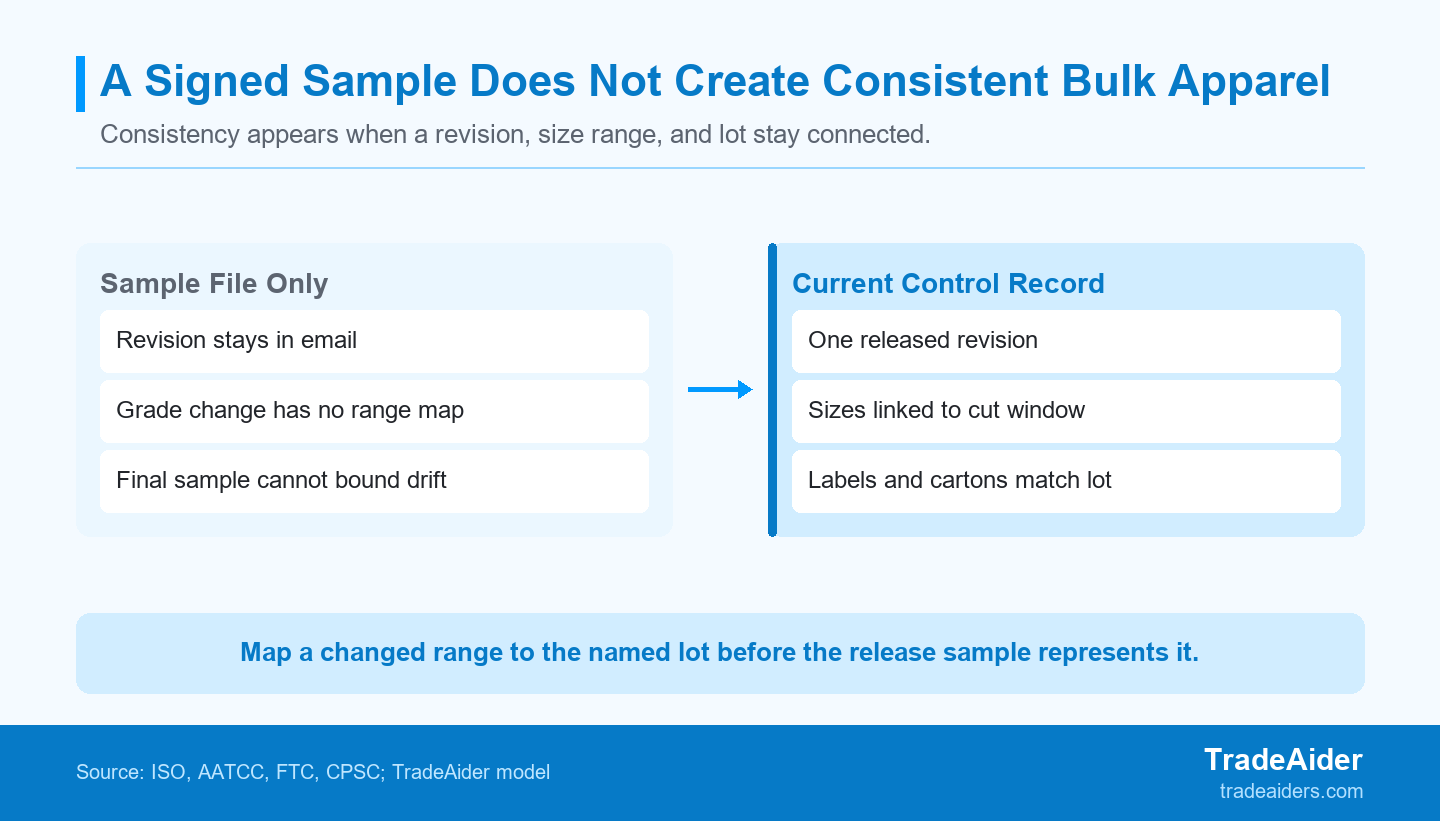
A sample becomes a useful control only when its revision can be reconciled to the size range and lot presented for release.
That distinction matters when a buyer hears, "the sample is approved" after production has already moved. Approval describes a decision at a point in time. Consistency depends on whether the records and physical units still point back to the same decision. Before the apparel scope is finalized, buyers can review the inspection standard before approving the apparel scope and turn broad expectations into checkable requirements.
| Control Field | What It Connects | Decision It Supports |
|---|---|---|
| Approved revision | Sample, specification, graded measurements | Which requirement governs the check |
| Production window | Cut bundles, sewing run, or finishing date | How far a finding may reach |
| Lot and carton identity | Units, labels, packing, and final sample | What can be released or held |
Set this record before cutting when possible, and update it through an explicit change path rather than a chain of informal messages. For buyers who want an independent checkpoint before repeat production begins, TradeAider can confirm the approved apparel build before cutting.
Keep a Version and Change Path Beside the Sample
When fabric, trim, grade rule, care label, print placement, or packing changes, record the affected requirement, decision owner, production window, and evidence needed before release. This makes it possible to distinguish a local correction from a change that could extend across a size range or carton group. The change path can be simple, but it must answer: what changed, which approved reference replaces the old one, which physical population could be affected, and what proof closes the change.
For example, a replacement zipper may need a trim reference and functional check; a revised care instruction may need market-specific label review; and a grade-rule adjustment needs the revised measurement table plus a way to identify the sizes and bundles produced after it took effect. Do not force every change through the same evidence gate. Match the gate to the product promise and the risk created by the change. The record is a boundary tool, not a root-cause investigation or a guarantee that every remaining unit is compliant.
Control Fabric, Color, and Dimensions Before Cutting
Material consistency starts before the cutting room makes a small variation expensive to separate. Specify the property that matters, the method that measures it, the approved result, and the material or color reference to which that result belongs. Dimensional stability, for example, is not a generic promise. AATCC’s Laundering Module identifies TM135 as the test method for fabric dimensional changes after home laundering. That method boundary is why a buyer should name the property, procedure, and accepted result before bulk cutting instead of relying on a vague note such as "wash tested."
Use the same discipline for shade, hand feel, print placement, seam allowance, and graded dimensions. A color swatch may establish the approval reference for a particular fabric lot, while a measurement table establishes the points of measure that must be checked by size. Neither should silently stand in for the other. When a fabric, supplier, or process is substituted, ask whether the earlier evidence still applies to the changed build and whether the affected output can be identified.
Labels are part of the product record, not a late-stage graphic task. For US sales, FTC apparel-label guidance says most textile and wool products need labels stating fiber content, country of origin, and the responsible business identity. In the EU, Regulation (EU) No 1007/2011 separately governs textile fibre names and fibre-composition labelling. These are distinct market paths. Keep the destination, current fiber statement, label artwork, and garment revision together, and seek specialist advice for the full market-specific compliance assessment.
Test the Property the Customer Will Notice
AATCC’s Colorfastness Module includes TM61, the accelerated method for colorfastness to laundering. A test result is useful only when its scope matches the claim the customer will notice. If the commercial concern is post-laundering dimensions, specify the measurement points, laundering procedure, drying condition, and allowable result. If the concern is appearance, color transfer, or performance, identify the relevant method rather than stretching one dimensional-change result into evidence for all three. The point is not to create more paperwork. It is to stop an approved result from being carried into a different fabric, color, size range, or consumer claim without a deliberate decision.
Build the evidence gate around the change: retain the lab report or buyer-approved result with the material reference; verify that the sample tested matches the construction and finish being produced; and flag any mismatch before it becomes a labeling or shipment discussion. This is especially important when merchandising changes land late. A new wash, coating, print process, or care instruction may alter what needs to be verified even if the garment silhouette has not changed.
Use In-Line Checks to Contain Repeating Drift
In-line checks are most valuable when they convert a repeat observation into a defined recheck population. A point of measure (POM) is a named measurement location on a garment. If the same POM drifts in a particular size, do not jump from a few units to either "the order failed" or "it was isolated." Ask which cutting window, operator run, panel set, material roll, size range, or finishing step could share the condition. The answer defines where correction and remeasurement should start.
Containment should be proportional to what is known. A documented size-L cutting window may support a focused hold and recheck of that range. Missing bundle or carton records may require the boundary to expand because the affected population cannot be shown. Record the finding, reference revision, observed units, suspected population, immediate containment, and the evidence needed to close it. An in-line observation does not prove root cause, but it can prevent a recurring issue from becoming a mixed shipment.
When a style is already in production, buyers can use a during-production inspection to contain repeat drift while the relevant range can still be identified and corrected.
Release a Named Lot, Not a Generic Garment
Final inspection should release a named lot, not the abstract idea of a garment style. Acceptance Quality Limit (AQL) is a documented acceptance plan that selects units from a defined lot. ISO 2859-1:2026 describes acceptance sampling for lot-by-lot inspection with sampling plans indexed by AQL. The standard does not say a passed sample proves every unit is defect-free or that it replaces earlier fabric, change, or process control. It gives a structure for a decision about the lot that was actually sampled.
Define the lot before the visit: style and color, purchase order or production reference, quantity, carton range, completed quantity, packed quantity, and any separated rework or changed range. Then make the sample basis visible in the inspection brief. A buyer who has contained a size-specific concern should not allow the unresolved range to be mixed back into the presented population simply because it shares the same style name. When the population changes, the release decision changes with it. Use TradeAider's resource to calculate an AQL sample for the named apparel lot after the population has been defined.
Care instructions need their own evidence path. The FTC's Care Labeling Rule guidance explains that covered apparel requires care instructions and that manufacturers and importers need a reasonable basis for them. A final label check can confirm whether the presented instruction, location, and artwork match the approved file. It cannot establish a reasonable basis for a care claim when the relevant fabric or process evidence is absent.
Traceability rules also have a defined scope. For apparel designed or intended primarily for children age 12 or younger, CPSC guidance on textiles and apparel describes tracking-label requirements that include product and packaging identification information. This is a category-specific example, not a universal apparel rule. It does, however, show why the garment, its packaging, and its production identity should remain connected when a buyer needs to make a release or hold decision.
A pre-shipment inspection (PSI) is a final check of a completed order and its packed presentation. It is most useful when the physical order is stable enough to represent. For an inspection of the packed apparel lot, buyers should confirm that the scope and supporting records are ready.
Illustrative Scenario: A Grade Rule Changes Mid-Run
The following illustrative example shows why a measurement finding must be connected to a size range and cutting window before a buyer decides whether it is local, range-wide, or unbounded. It is not a TradeAider client case and does not set a universal garment tolerance.
Map the Affected Size Range Before Accepting Rework
A changed grade rule is not automatically an all-order failure or a harmless sample variation. It is a range-mapping problem first: identify which size and cutting window it reaches, hold the subset that cannot be connected to the approved table, remeasure the defined population, and then decide whether that population can be released separately. This sequence avoids both overreaction and false reassurance.
Buyer context: A US apparel importer is preparing a fall retail launch.
Order context: The order is 4,800 woven utility jackets in two colors and sizes S through XL. Before cutting, the buyer approved a measurement specification, bulk-fabric swatch, care-label text, and pack-out reference.
Readiness state: The factory is still in line production, so the changed size range is not ready for a final release decision.
Observation: During an in-line POM check, 3 size-L jackets show a chest measurement beyond the buyer's stated tolerance. Sizes S, M, and XL checked in the same visit remain within the current table.
Second observation: The factory reports that the grade rule was adjusted after the first cutting window, but its production record does not show which cut bundles or cartons used the revised rule.
Analysis: The evidence does not prove that all 4,800 jackets are nonconforming, and it is not safe to call the three units isolated. The missing connection is between the grade-rule change, the size range, the cutting window, and the current carton population. Until that connection is restored, the size-L range has a different decision status from the sizes that can be traced to the original table.
Decision: Place the size-L population made after the grade-rule adjustment on hold. Keep cartons that cannot be connected to a cutting window out of the release sample until the supplier maps them. The hold is a boundary decision, not a conclusion about root cause.
Corrective action: Compare the revised grade rule with the approved measurement specification, identify the affected bundles, remeasure a defined size-L recheck population, and correct or separately disposition units that do not match the agreed requirement. The buyer should also require a clear link from the corrected population to its carton identity.
Verification gate: The revised size-L range is mapped, remeasured to the current specification, and reconciled to the carton identity before any split release. Only then can a final sample support the defined population that remains.
Boundary: This example does not determine why the measurement shifted, establish a universal apparel tolerance, or replace applicable performance and compliance testing.
Write an Apparel Inspection Brief That Can Be Repeated
A repeatable apparel inspection brief links the current product reference to the physical lot and the person who owns the decision after a finding. Include the approved sample and revision, fabric and trim references, graded measurement table, required visual and functional checks, label and pack-out versions, lot definition, sample basis, evidence required after a finding, and the buyer or team that can accept, hold, or request correction. This gives the inspection team a scope that can be executed consistently without treating every garment category as identical.
Before booking, make the handoff concrete. State the purchase order, style, color, sizes, quantities, carton range, destination, required market labels, applicable test evidence, and any open change or rework population. Identify the point of measure that needs special attention, the current revision of the approved file, and the action expected if a condition repeats. A short, specific brief helps a supplier prepare the correct population and helps the buyer receive findings that can be acted on rather than debated.
For TradeAider, a pre-shipment inspection is scheduled when 100% of the order quantity is completed and at least 80% is packed for export. The completed and packed population gives the final sample a stable basis. It does not replace earlier control of a changed style, material, or size range. When the lot is stable, buyers can plan a pre-shipment inspection for the packed apparel lot with the current reference and supporting records. Use the readiness point to confirm that the lot presented for inspection is the lot the buyer intends to release, including any documented split or hold decision.
When the current reference, evidence, and lot definition are ready, Schedule an apparel inspection with TradeAider.
Frequently Asked Questions
What Does Apparel Quality Control Check for Consistency?
Apparel quality control checks whether the bulk garment, its records, and its packed presentation still match one current approved specification. The practical scope can include fabric and trims, measurements by size, construction, labels, packing, and the identity of the lot being reviewed. The scope should be tailored to the product and destination rather than copied from a generic defect checklist.
Can a Final Apparel Inspection Catch Every Consistency Problem?
No. A final apparel inspection can confirm the defined sample and visible pack-out, but it cannot recreate missing material, change, or in-line evidence. It is strongest when the lot is named, the current revision is known, and any earlier drift has been contained or documented. A passed final sample supports the decision for that defined population, not a promise that every potential performance or compliance issue has been eliminated.
How Should Buyers Handle a Changed Garment Measurement?
Treat a changed garment measurement as a bounded production question. Identify the affected size range, cutting window, reference revision, and recheck population before deciding whether to hold, correct, or release units separately. Recheck against the current approved table and keep the resolved range connected to its bundle or carton identity. Do not assume a few observations prove either a whole-order problem or an isolated exception.
When Is Apparel Ready for Pre-Shipment Inspection?
For TradeAider, apparel is ready for a pre-shipment inspection when 100% of the order quantity is completed and at least 80% is packed for export. The buyer should also have the current reference, inspection scope, lot definition, and any open corrective-action decision ready. This timing gives the final sample a stable population while preserving the distinction between final inspection and earlier production control.

Artigos Relacionados

Expanda seu negócio com o Serviço TradeAider
Clique no botão abaixo para entrar diretamente no Sistema de Serviço TradeAider. Os passos simples desde a reserva e pagamento até o recebimento de relatórios são fáceis de operar.

