
- Sobre Nós

- Nossos Serviços
- Sua Indústria
- Recursos
- Notícias e Blog
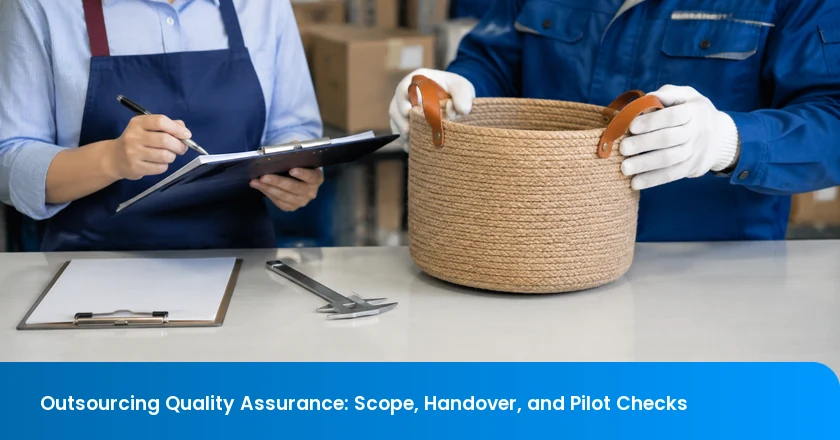
Quality assurance means planned activities that give confidence in meeting quality requirements. Outsourcing some of that work can add inspection capacity, but the handover needs more than a booking and a product photo. Define the checks, keep a named buyer responsible for specifications and exceptions, and test the arrangement before extending it across suppliers. For physical products, a useful pilot shows whether the provider can follow your methods and report unresolved issues—not simply whether the first lot receives a pass.
Three Checks Before Expanding Outsourced QA
- If acceptance criteria are disputed, settle the approved brief before booking.
- If a pilot omits an agreed method, require demonstrated correction before adding factories.
- If reports cannot be retrieved independently, resolve record access before increasing reliance on the provider.
What Can You Outsource in Product Quality Assurance?
ASQ distinguishes planned assurance activities from operational quality control; inspection compares characteristics with requirements. Its explanation of quality assurance versus quality control helps separate the system you manage from the checks you commission.
A practical starting assignment might cover dimensions, workmanship, labeling, packaging, and agreed functional checks on an identified order. Use an inspection standard resource to frame the inspection discussion, then specify your product's actual requirements. A general checklist cannot decide which drawing revision or customer-approved finish applies.
Separate factory assessment, production inspection, and laboratory testing in the scope. They answer different questions: how the supplier operates, what the accessible goods show, and whether a submitted sample meets a particular test requirement. Buying one does not automatically include the others. List the deliverable for each commissioned activity and identify work that remains outside the assignment.
Outsourcing is ready to start when an outside team can understand the requirements and your team can act on its findings. If the product specification is still disputed, first settle who approves it. If nobody can answer a technical question during the visit, appoint that person before booking. Extra inspection capacity will not resolve an undefined acceptance criterion.
Assign Decisions Before Handing Over Inspections
Assign specifications and exceptions to the buyer, production correction to the factory, and agreed checks and findings to the provider. Put actual names and backups against those responsibilities. Otherwise, a report may arrive on time while the shipment waits for a decision nobody owns.
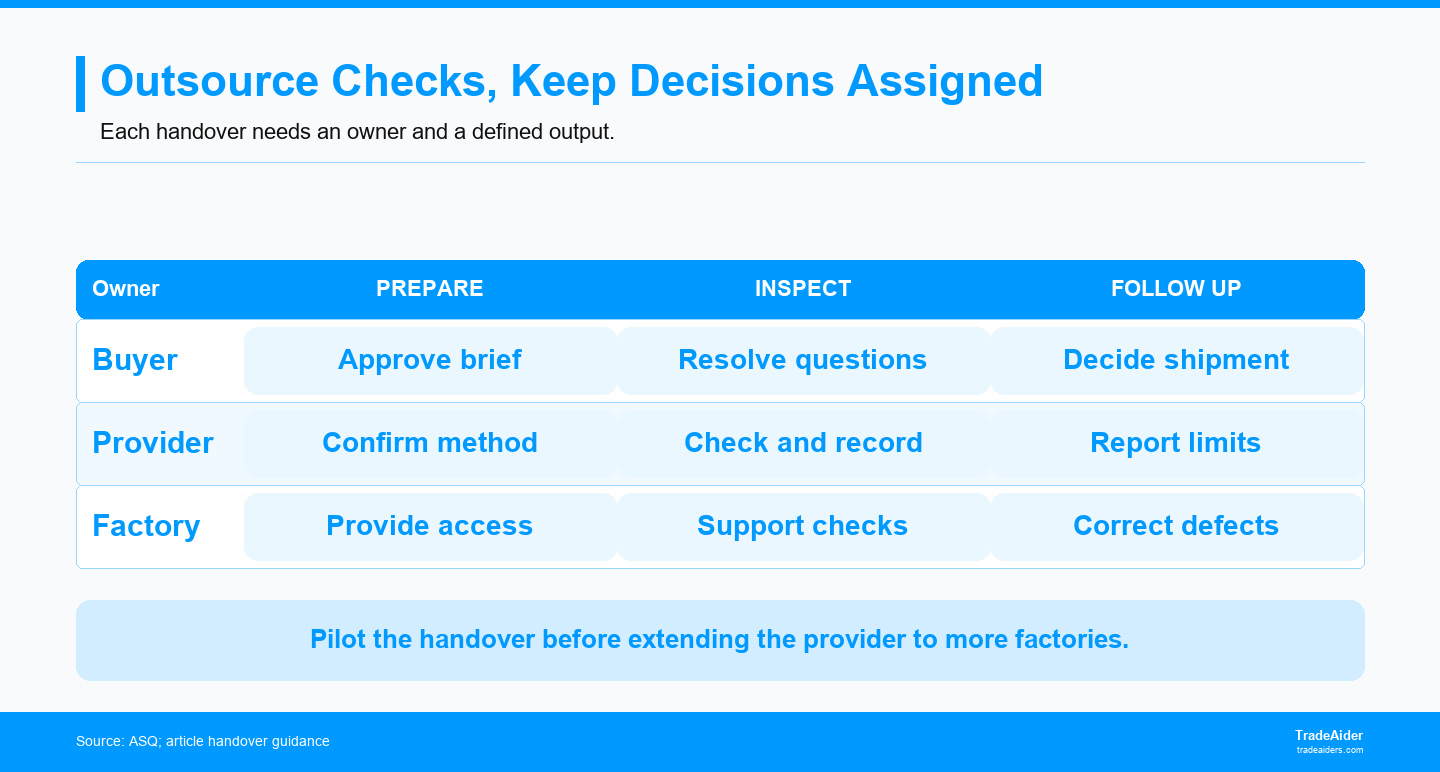
Agree the handover before the visit so inspection findings reach someone authorized to act.
| Handover item | Owner | Required output |
|---|---|---|
| Product requirement or exception | Buyer's technical owner | Approved revision or written disposition |
| Inspection execution | Provider's inspection lead | Recorded methods, findings, and limitations |
| Access and correction | Factory's responsible manager | Available goods and identified corrective work |
| Shipment disposition | Buyer's authorized decision-maker | Release, hold, or documented next action |
Agree how the report's result relates to shipment authorization. The provider should not quietly accept a deviation because the factory says delivery is urgent. If the buyer permits an exception, record who approved it, which goods it covers, and whether any follow-up remains. This is an operating arrangement; legal duties and contractual liabilities need their own assessment.
Write a Brief the Inspector Can Execute
A usable brief identifies product revision, lot, methods, limits, access, evidence and escalation authority. “Check quality” is not an executable instruction. Give the inspector enough detail to perform the same check your technical reviewer expects to see in the report.
- Identify the goods: purchase order, product codes, variants, quantities, factory location, and approved reference version.
- Define the checks: sample-selection instructions, measurement points, equipment, test conditions, acceptance limits, and defect classifications.
- Specify the record: measurements, photographs, sample identification, incomplete checks, and the reason each could not be completed.
- Arrange access: available cartons, safe work area, required fixtures, opening and repacking permissions, and factory assistance.
Ask the provider to mark unclear instructions before the visit. For a pull test, for example, the load, application method, and holding time matter; a photograph of an intact handle does not establish that the test was performed. Keep the approved brief under one revision and require acknowledgment when it changes.
Define What Happens When Instructions Are Incomplete
Timing belongs in the handover too. If you need findings while the factory can still adjust production, consider a during-production visit rather than expecting a finished-goods inspection to explain every earlier process problem. Confirm the relevant operations and goods will be accessible at the agreed stage.
A missing method or unavailable reference should trigger a named escalation rather than an invented pass criterion. Set a response window that fits factory working hours and the buyer's time zone. Authorize which unaffected checks may continue while the question is open.
The report should distinguish a failed check from a check not performed. If the fixture is missing, record that limitation and its affected scope; do not describe the product as compliant based on appearance. Preserve the original question, the buyer's written response, and any revised instruction together so a later reviewer can reconstruct the decision without relying on a chat summary.
Verify the Provider Against the Actual Assignment
Evaluate the people and methods that will serve your order, not only the provider's general presentation. Request a relevant redacted report and walk through one difficult requirement. Can the provider explain sample selection, show the equipment needed, and distinguish an observed defect from an unverified condition? Ask who reviews an inspector's work before the report reaches you.
Confirm coverage at the actual factory location, the availability of a qualified replacement, and how subcontracted work is disclosed. A provider may be suitable for routine workmanship checks yet need a specialist for a particular test. Establish that boundary before the factory has set aside goods and the shipment date is close.
NIST states that laboratories accredited through its National Voluntary Laboratory Accreditation Program (NVLAP) are assessed against the management and technical requirements of ISO/IEC 17025:2017. Its NVLAP overview and laboratory directory illustrate why laboratory competence should be checked against a defined scope. This does not mean every inspection assignment needs NVLAP accreditation, or that one laboratory's accreditation covers every product test.
Where testing is needed, verify the proposed laboratory, relevant method, scope, and applicable customer or market requirements. Keep that qualification separate from the on-site provider's ability to select and identify samples. An impressive certificate cannot repair a sample that no longer matches the goods under review.
Follow initial company research with assignment-specific questions about your product, factory, reporting needs, and proposed personnel; a profile is not a substitute for a practical pilot. For the background portion of that review, see the TradeAider company profile.
Compare Quotes for the Same Work and Follow-Up
A day rate is meaningful only when the included work is comparable. Send each provider the same brief, locations, quantity information, and reporting deadline. Ask how many man-days it estimates, what assumptions drive that estimate, and which circumstances would change the price. More time is not automatically better coverage if the difficult test is excluded.
ASQ separates prevention, appraisal, internal failure and external failure costs. Its cost-of-quality guidance puts inspection spending in a wider context. For your comparison, keep the quoted service fee separate from internal review time and the uncertain costs of defects. Do not treat hoped-for avoided returns as guaranteed savings.
Request a written breakdown covering travel, time on-site, report preparation, specialist testing, sample shipping, cancellation, and a return visit. Establish what happens if production is not ready or access is refused. Also clarify whether correcting an incomplete report is included and who pays if another visit is needed because the agreed method was not followed. Name who can authorize additional billable work before it begins.
Include your own team's work in the budget: preparing references, answering field questions, reviewing findings, and approving corrections. Track those hours during the pilot instead of assuming outsourcing eliminates them. The first assignment may need more coordination than routine repeat orders, so keep setup effort visible rather than spreading it invisibly across every quoted visit.
Before comparing totals, reconcile exclusions line by line. A lower quotation that omits functional checks and follow-up is a different purchase. If the budget is constrained, ask which checks would be removed and what decision would then lack evidence; avoid accepting an unexplained shorter visit.
Control Files, Access, and Report Ownership
Map how a booking becomes a retrievable report before you give the provider access to product files. TradeAider's booking and report-access workflow shows its stated steps through online viewing and official report download. Use that overview to identify the access and export questions you still need answered for your team.
Share the references needed to perform the job without granting unrestricted access to unrelated product files. Specify who can download drawings, see customer details, amend checklists, and receive reports. If the provider uses another inspector or laboratory, establish which information may be passed on and how that recipient is authorized.
FTC personal-information guidance recommends written security expectations for service providers and checking compliance. The FTC guide to protecting personal information is relevant when shared files contain personal or customer data. It is not a product-drawing standard or a complete statement of your cross-border obligations.
For technical files, adopt a separate practical control: one approved reference set, a visible revision identifier, and an acknowledgment that the inspector received it. Remove obsolete versions from active use. If a requirement changes after booking, record whether the revised method needs different equipment or more time; simply emailing a new attachment may not prepare the field team.
Agree ownership and export arrangements for reports, original photographs, measurements, and correspondence. Specify retention, deletion, access removal, and incident notification in the service agreement, with specialist advice where necessary. Before expanding the service, test that your team can retrieve a complete assignment record in a usable format. Check that downloaded photographs retain their connection to individual report findings. A dashboard view is not enough if the supporting files disappear when the contract ends.
Test the Handover Before Expanding Coverage
Choose a pilot that includes a requirement needing careful execution, not just convenient goods near the entrance. Agree what will demonstrate service readiness: the right reference used, agreed methods performed, limitations raised promptly, and findings traceable to the inspected goods.
Acceptance sampling supports an accept-or-reject decision about a lot rather than estimating its quality. NIST's acceptance-sampling explanation helps keep the pilot's conclusions bounded: the lot result is not itself a measure of the provider's long-term competence.
For a finished-goods pilot, pre-shipment inspection can provide documented findings from the agreed checks. Schedule it when production is 100% complete and at least 80% of the goods are packed for export, with access confirmed. Keep two decisions separate: whether to accept this shipment and whether to extend the provider's assignment.
Illustrative Pilot: The Written Method Was Not Used
Consider an illustrative importer planning to outsource checks at 4 factories. It starts at 1 factory with 600 completed storage baskets, of which 510 are packed. The approved brief specifies a handle-pull method, including load and holding time. An earlier demonstration used only a lift by hand, so the buyer has already asked the provider to correct its approach.
The pilot report nevertheless calls the handles acceptable after visual examination and another hand-lift check. It records neither the agreed load nor the holding time. The repeated omission matters even if the report includes clear photographs: the promised method still has not been demonstrated.
This illustrative handover pilot exposes a repeated inspection method mismatch, so rollout pauses until execution is verified. The omission does not prove defective handles. It leaves the handle criterion unresolved for all 600 baskets, and the buyer does not extend the provider to the other 3 factories on this evidence.
The buyer clarifies the controlled method, the provider's supervisor demonstrates the setup, and the factory restores access to the lot. Repeat checks must record selected units, load, duration, and findings for the buyer's review before shipment or expansion. The quantities in this example illustrate order and rollout scope, not a universal sample plan or test requirement.
Approve the Provider Only After a Repeat Check
Correct the handover and demonstrate the agreed method again before extending the provider to more suppliers. When reviewing the repeat assignment, compare the original omission with the replacement evidence. A revised report heading or a promise to retrain staff does not show that the omitted work was completed.
Give each pilot issue an explicit status: closed by verified execution, still open, or outside the approved scope. If a requirement cannot be checked on-site, arrange the appropriate alternative rather than marking it complete. Have the buyer's technical owner approve the disposition and keep the old and corrected records together.
Successful repeat execution can close the specific handover gap, but it does not establish performance at every factory. Expand in stages and review the next assignments for the same weakness before reducing oversight. Keep shipment disposition separate: accepting the provider's corrective work does not automatically approve every product characteristic or resolve other open findings.
Set Review and Exit Rules Before the Next Booking
Maintain a review owner, exception log, replacement arrangements and portable records as outsourced coverage grows. Review report completeness, adherence to agreed methods, response to technical questions, and closure of repeated omissions. Keep those service measures separate from the number of defects found, which also depends on the products and factories inspected.
Define events that reopen qualification: a new product family, a different factory region, a change of inspection lead, or repeated unexplained departures from the brief. The response need not always be termination. It may be a supervised assignment, narrower scope, or additional method training—but state what evidence will justify returning to normal coverage.
Prepare for interruption as well. Name a backup contact, keep the approved references outside the provider's platform, and agree how open assignments transfer if the relationship ends. Do not cancel access before exporting the records your team needs, but remove it promptly once the agreed transfer is complete.
Send the product specifications, factory address, production schedule, and proposed checklist. TradeAider can confirm the inspection scope and arrange the agreed checks, with findings documented in the inspection report. Your team can then review those findings against the shipment requirements and the pilot's service expectations. Contact our team to scope a pilot inspection.
Frequently Asked Questions
Can the factory choose and pay the inspection provider?
It can arrange payment, but you should still approve the provider, control instructions, and receive the unedited findings directly. Document any existing relationship between factory and provider. Payment arrangements should not give the factory authority to remove findings, substitute references, or decide which issues reach the buyer.
Do we need an internal quality manager after outsourcing?
You still need a named owner with enough technical authority to approve instructions, resolve exceptions, and review the provider's work. That need does not automatically require a full-time job title. If the owner lacks expertise for a specific requirement, arrange qualified technical support rather than asking the inspector to invent the criterion.
Can remote video replace the first on-site pilot?
Remote video can support instruction review, but it may not establish sample selection, physical access, or reliable measurement at the factory. Decide whether the specific check can be witnessed and documented adequately. Where the camera view or handling arrangement leaves a material gap, retain an on-site assignment for that work.
What happens if we replace the provider mid-order?
Transfer the approved references and unresolved finding history, then confirm which existing records the incoming provider can actually rely on. Identify what remains unchecked and whether access must be arranged again. Avoid restarting every completed check automatically, but do not describe an inherited report as work the new provider independently performed.

Artigos Relacionados
Expanda seu negócio com o Serviço TradeAider
Clique no botão abaixo para entrar diretamente no Sistema de Serviço TradeAider. Os passos simples desde a reserva e pagamento até o recebimento de relatórios são fáceis de operar.

