
- Sobre Nós

- Nossos Serviços
- Sua Indústria
- Recursos
- Notícias e Blog
Implementing apparel quality control testing is a staging exercise rather than a single event. A workable program fixes the material and the approved sample before cutting, checks work in progress while defects can still be corrected, verifies the finished batch and its labels before release, and keeps a record of every check tied to a style, version and lot. Each stage answers a question the next stage depends on. When a stage is skipped or left undocumented, the release decision rests only on the stages that did leave evidence, and the order is as safe as its weakest recorded step.
What an Apparel QC Testing Program Has to Cover
Apparel quality control testing is the set of checks and tests a buyer uses to confirm that garments match the specification that was approved, and it works as a program because no single check can cover a whole order. The program has three production stages — pre-production, during production, and post-production — supported by two capabilities: laboratory test methods that measure performance, and tools and records that keep the work repeatable. Each stage leaves evidence the next stage uses. Pre-production fixes the material and the approved sample. During production, checks compare the running batch with that reference. Post-production confirms the finished batch, its labels and its test results. The release decision comes last, and it can only be as strong as the records the earlier stages produced.
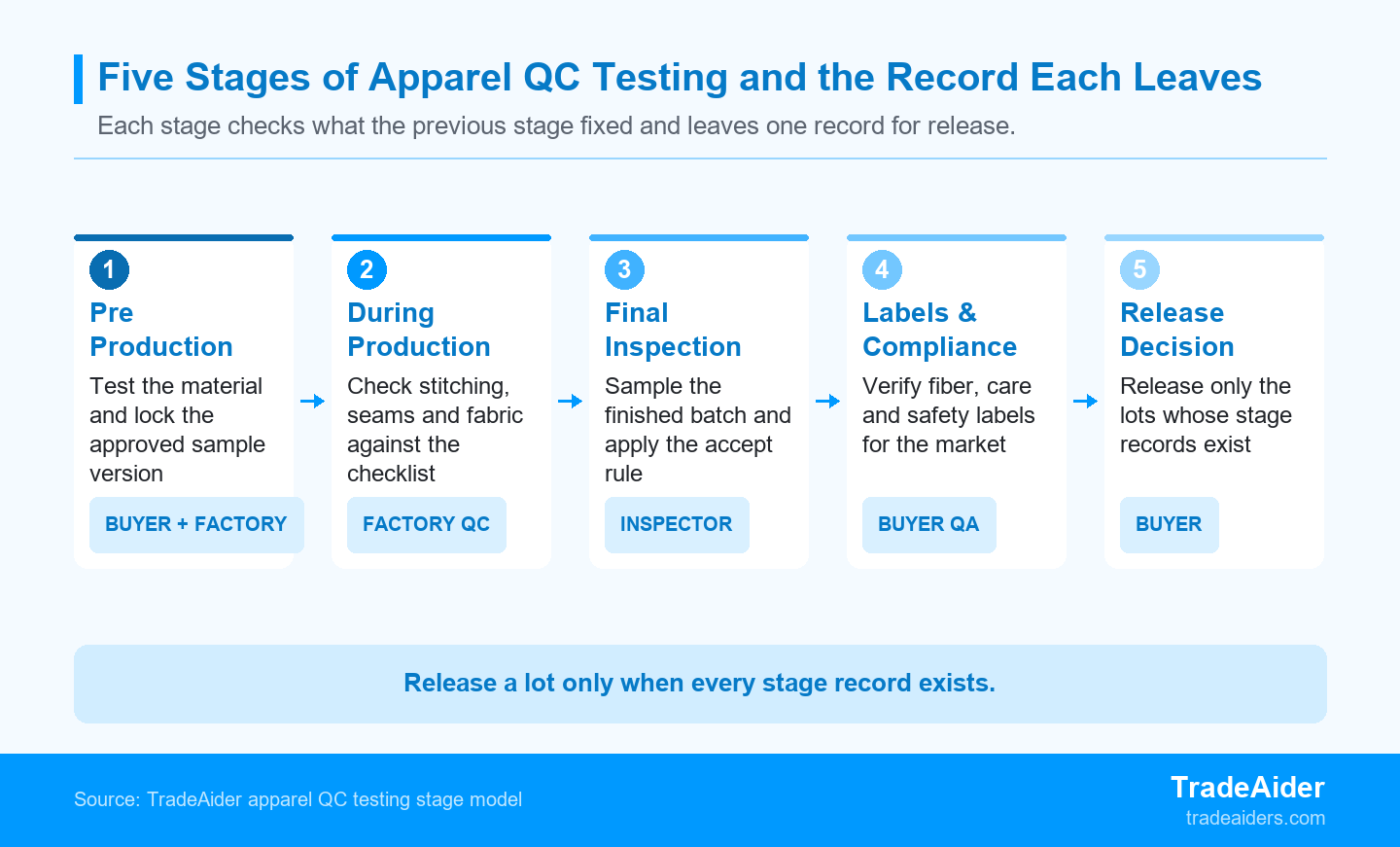
Stage sequence: each stage checks what the previous stage fixed and leaves a record the release decision can use.
Pre-Production: Lock the Material and the Approved Sample
Pre-production is where the reference is set. The two decisions made here — which material is approved and which sample version is signed off — become the standard that every later check measures against, so an error at this stage is expensive to correct later. Buyers who skip it often discover the problem only at final inspection, when the fabric is already cut and the garments are already sewn.
Inspect and Test the Material Before It Is Cut
Fabric should be inspected and, where the order depends on its performance, tested before it is cut. A shade band, a weave fault or a shrinkage problem found on the roll can be rejected or redirected; the same fault found after cutting is already inside the garment, where removing it means scrap. Practical checks at this point include a visual inspection of the roll for holes, stains and weaving faults, a check that the shade matches the approved standard, and a laboratory test of the properties the order depends on. The test sample should come from the bulk roll the order will use, because a lab dip or a sample-room piece can behave differently from the production fabric.
Approve the Sample and Freeze Its Version
A pre-production sample confirms that the factory's own line can meet the specification, and once it is approved it should be frozen as a numbered version. Freezing means the approved piece is kept intact as the physical reference and given an ID that appears on the specification and on any test submission. Every later change — a substitute trim, a different thread, a revised construction — should create a new version rather than quietly replacing the old one. Without a version ID, the approved sample and the running batch can look identical in a photograph while differing in the details that matter.
During Production: Catch Defects While They Can Still Be Fixed
In-line inspection means checking garments while they are still being made, rather than only after they are finished. The point is timing: a defect caught at the sewing line can be corrected within the same batch, while the same defect caught at final inspection has already been repeated across the run. Buyers who want to see how the work is actually performed can review TradeAider's company background before sharing production records with an outside party.
Run In-Line Checks Against a Written Checklist
A written checklist is what makes an in-line check repeatable. It names the points in the process where a check happens, the characteristic checked at each point, and the accept-or-reject rule the inspector applies. Written rules survive a shift change and a new inspector; an informal check does not. Start the checklist from the operations that can drift — cutting, sewing, pressing and finishing — and keep it short enough that an inspector can actually complete it at the line. A useful checklist also records who performed the check, when, and on which batch, because that record is what a later reviewer uses to judge whether the check happened at all.
Watch Stitching, Seams and Fabric Consistency
The characteristics that drift most often between the approved sample and a running batch are the ones that are hard to see in a finished garment: stitch density and tension, seam strength, skipped or broken stitches, and the consistency of the fabric itself. These belong at the in-line points, because they are the ones a final inspection is least able to recover. Tracking them by batch also produces a trend a buyer can read, so a slow drift becomes visible before it turns into a rejection. The same record lets a buyer compare one run with the next, so a supplier that drifts across several orders is visible before a whole shipment is at risk.
Post-Production: Verify the Batch Before It Ships
Post-production is the release gate. The finished batch is compared with the approved version, its labels are checked against the destination market, and the test results are read against the goods they are meant to cover. For children's products sold in the US, the rules add a further discipline: under 16 CFR part 1107, testing continues periodically and after a material change in the product's design or manufacturing process, which means a test result is tied to the version it tested rather than to the product in general.
Final Inspection and AQL Sampling
Final inspection applies a sampling plan to the finished batch, and the plan decides how many units to inspect and how many defects still allow acceptance. The acceptance quality limit, or AQL, is the defect count the plan treats as acceptable for the sample size drawn; it converts a batch of thousands into a defined number of inspected units and a defined accept-or-reject rule. The AQL calculator sizes that sample from the lot quantity. Sampling also carries an evidence condition: under 16 CFR 1109.5, documentation for relying on a test report must identify the item tested, a lot or batch number, and the method and sampling protocol used. For the periodic testing of children's products, 16 CFR 1107.21 requires representative samples whose selection supports inferences about the untested units.
That requirement is specific to children's products, but as a transferable lesson the same representativeness logic applies to any batch a buyer intends to release.
Labels, Packaging and Compliance Records
Labels and packaging travel with the product, so they are checked before packing rather than after. In the US, fiber content, care instructions and clothing flammability are regulated matters: the FTC textile labeling rules name the fibers that make up 5 percent or more of the fiber weight and group smaller amounts as other fiber; 16 CFR part 423 requires a permanent care label that stays legible for the useful life of the product; and 16 CFR part 1610 sets standard methods of testing and rating the flammability of clothing textiles, with named exemptions.
For the EU market, the structure of the obligation differs but the consequence does not: the European Commission's textiles overview notes that over 70% of fashion products consumed on the EU market are imported and that market surveillance enforces product compliance rules in the internal market and at external borders, and the REACH regulation places responsibility on industry to manage the risks from chemicals and to provide safety information on the substances, so a substituted material is a new question rather than an extension of an earlier result.
A substituted material or a changed supplier is a new labeling question rather than a continuation of the earlier one, so the label check belongs at the point where the goods are still in the factory and can still be corrected.
The Test Methods Behind the Checks
Inspection confirms workmanship; test methods measure performance. The methods an order needs depend on the property the buyer is buying, so a program should match each test to a question rather than run a fixed list. The table below maps the common questions to the method families that answer them.
| Buyer question | Method family | What the result tells you |
|---|---|---|
| Will the garment keep its size after washing? | Dimensional stability / shrinkage test | Whether the measured size change stays inside the tolerance you set |
| Will the color survive washing, rubbing and light? | Colorfastness test | How much color transfers or fades under the tested conditions |
| Will the fabric hold together under force? | Breaking strength, grab test (ASTM D5034) | Breaking force and elongation within the stated fabric scope |
| Will the surface wear through? | Abrasion resistance, Martindale (ASTM D4966) | Cycles to a stated wear endpoint, with a known precision limit |
Read the table as a scope statement. A method answers the question it was designed for and no more, which is why a buyer should name the property and the method in the purchase order rather than ask for testing in general. When an order needs laboratory work alongside the on-site checks, TradeAider's product testing service describes testing in accredited laboratories against regulatory, market and company requirements.
Shrinkage and Colorfastness
Shrinkage is the change in a garment's size after washing or drying compared with its original dimensions. Colorfastness is how well a dyed fabric holds its color through washing, rubbing or light. Both tests simulate the care conditions the label allows, which is why the care instruction and the test condition have to agree: a garment labeled for machine washing should be tested under machine washing. Testing several pieces from the batch shows whether the result is stable or varies between rolls, and a stable result is the one a buyer can extend to the rest of the lot.
Durability and Wear Resistance
Durability tests measure how fabric resists force and abrasion, and each method states its own scope and limits. ASTM's grab test for breaking strength and elongation is considered satisfactory for acceptance testing of most woven or nonwoven fabrics, but the standard itself says it is not recommended for knitted fabrics because of their high stretch. ASTM's Martindale abrasion method is widely used, especially outside the United States, yet the standard does not consider it satisfactory for acceptance testing of commercial shipments because between-laboratory precision is poor. A buyer should read a durability result with those limits in view rather than as a single pass-or-fail verdict.
Tools and Records That Keep the Program Repeatable
Tools speed up detection, but they do not decide what a defect is; a defined standard does that, and a record keeps the result retrievable. A program that adds a tool without a standard and a record produces faster disagreement, not better quality. The useful rule is to define the defect and the record first, then choose the tool that fits.
Automated and Handheld Inspection Aids
Automated systems use cameras and sensors to flag stitching errors, tears or color variation across large batches, and handheld devices measure fabric thickness, color or seam strength on the spot. Both extend what an inspector can cover. Neither replaces a defined defect standard or a trained operator, because a tool reports what it was set to detect, and someone has to set that threshold and act on the result. Choose the aid only after the defect standard is written, and train the operator on the same accept-or-reject rule the manual check uses, so a tool result and a manual result mean the same thing.
Quality Records and Traceability
One record set, keyed by style, approved sample version and production lot, is what makes the program auditable. The fields matter because they let a later reviewer reconstruct what was checked and what it covered, and the US documentation rule for relying on a test report points the same way by requiring the item, the lot or batch, and the method and sampling protocol. Keep the record beside the packing record so the covered scope can be compared with the goods awaiting release, and use the inspection-standard guidance to keep the acceptance criteria separate from the laboratory methods.
A Practical Implementation Sequence
Roll the program out one stage at a time, and define the record each stage leaves before the order starts. Begin with pre-production material and sample approval, then set the in-line points and their checklist, then the final sampling plan, then the label and compliance check. The release decision comes last and depends on the records, not on a single inspection result. When a stage record is missing, the honest position is to hold the affected styles until it exists rather than to release on the strength of the stages that passed.
- Before the order starts, approve the material and freeze the sample version so every later check has a reference.
- During production, check the drift-prone characteristics against a written checklist at each defined point.
- Before release, sample the finished batch, verify the labels against the destination market, and confirm the test results name the goods they cover.
- Keep one record set by style, version and lot, and hold release until every stage record exists.
Illustrative Example: Rolling Out Staged Testing on a Multi-Style Order
A growing apparel brand sources a multi-style knit program from one China factory. A 12,000-piece program runs across 6 styles and three fabric bases in a single production window. The brand has relied on one final inspection and holds no pre-production material test or in-line record.
Three observations appear when the brand compares its records with the run. No incoming fabric test was recorded before cutting. In-line checks were not defined, so inspectors applied their own judgment and the results were not comparable between shifts. One style's care label was drafted after packing had begun.
The final inspection cannot show whether the material, the sample version or the labels were correct earlier, so the release decision is unsupported for the styles without those records. Stage the rollout: add a pre-production material and sample check, define in-line points with a checklist, and verify labels before packing, releasing only the styles whose records exist.
Draw and test material samples, record the approved sample version, and assign one owner and one record to each stage. Release a style only when its material test, in-line records, final inspection result and label check are all present. This is an illustrative example: it carries no measured defect rate, no client result and no automatic approval of future programs.
When you are ready to move from a loose set of checks to a staged program, submit the style list, materials and target markets, the current inspection points and test methods, the approved sample versions and any sealed references, and the existing reports and records by lot. The provider reviews the stage plan, aligns the test methods and inspection points, and defines the record fields you will use for release, returning a scoped apparel testing and inspection proposal with a stage-by-stage checklist and record set. contact TradeAider about your apparel QC plan
Frequently Asked Questions
What are the main steps of apparel quality control testing?
Apparel quality control testing runs as a sequence of stage checks: pre-production material and sample control, in-line inspection during production, and final inspection, label checks and testing before release. The order matters because each stage fixes something the next stage relies on. Treat the record set — style, version, lot, method and result — as part of the process, because a check that leaves no record cannot support the release decision.
How many times should clothes be checked during production?
There is no single number. Check at each defined production point where a characteristic can still be corrected, then inspect the finished batch before release. A small order may need only a material check, one in-line point and a final inspection, while a multi-style program needs a point for each operation that can drift, such as cutting, sewing and finishing. The right number is the number of stages whose result a later stage or the release decision depends on.
Do I need lab testing if I already inspect the goods?
Yes, when the order depends on a property inspection cannot see, such as shrinkage, colorfastness or fabric strength. Inspection confirms workmanship — stitching, alignment, finish and labels — while testing measures performance under conditions the garment meets after sale, such as washing, light and abrasion. If the buyer's promise includes how the garment behaves after washing, inspection alone cannot verify it.
What records should I keep for apparel QC?
Keep one record set that ties each check to a style, an approved sample version, a production lot, the method used and the result. Add the date, the inspector and the accept-or-reject rule applied. The set should sit beside the packing record so the covered scope can be compared with the goods awaiting release. A record that names the item and the lot but not the method, or the method but not the lot, cannot be matched to the goods.
Artigos Relacionados
Expanda seu negócio com o Serviço TradeAider
Clique no botão abaixo para entrar diretamente no Sistema de Serviço TradeAider. Os passos simples desde a reserva e pagamento até o recebimento de relatórios são fáceis de operar.

