
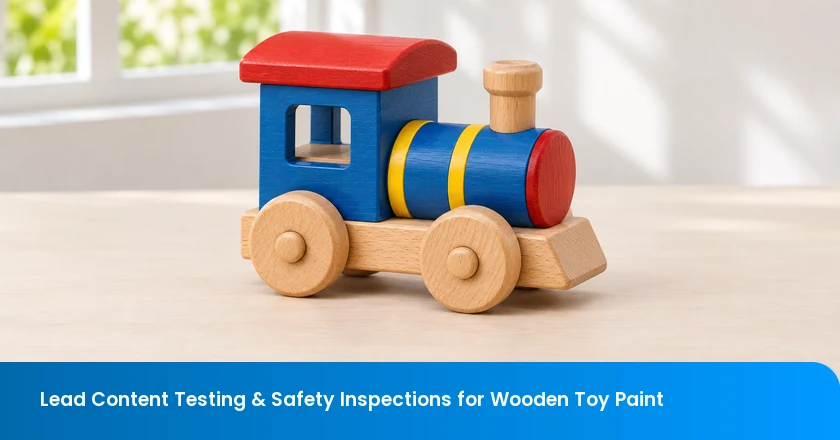
Lead testing for wooden toy paint starts with the actual coating, the destination market and the required measurement. Arrange appropriate laboratory evidence for the paint and other applicable materials, then inspect the finished toy for damaged finish, splinters and construction defects. A reliable assessment connects both sets of findings to the toy and coating being purchased.
A wooden train can have a painted roof, a clear-coated body, printed decoration, glued joints and separate wheels. A result for one material may leave the others unresolved. Buyers need the test basis, sample preparation and follow-up action to be clear for each material.
Build the assessment around the actual coating
- Identify paint, clear finishes, wood and other accessible components separately.
- Match the test result to the destination’s measurement basis and material category.
- Connect the sampled formulation and paint lot to current production.
- Record finish and construction findings, then resolve affected goods and missing evidence.
Separate the paint question from the wooden toy
Assess the coating, underlying wood and other accessible components separately. Chemical evidence establishes a result for a specified material and method. Physical inspection records observable finish and construction findings. Plan both around the actual toy, including its intended age group and foreseeable use.
CDC states that no safe blood lead level in children has been identified. Lead-exposure prevention therefore deserves attention even when paint looks intact. Keep the assessment focused on the source material and applicable evidence. CDC childhood lead prevention guidance.
CPSC explains that a coating generally can be scraped off and separated from the substrate, meaning the material beneath it. Material that cannot be removed without taking substrate with it is treated as part of the substrate for the lead-content assessment. Have the laboratory resolve uncertain finishes or printing before preparing the sample. CPSC coating and substrate explanation.
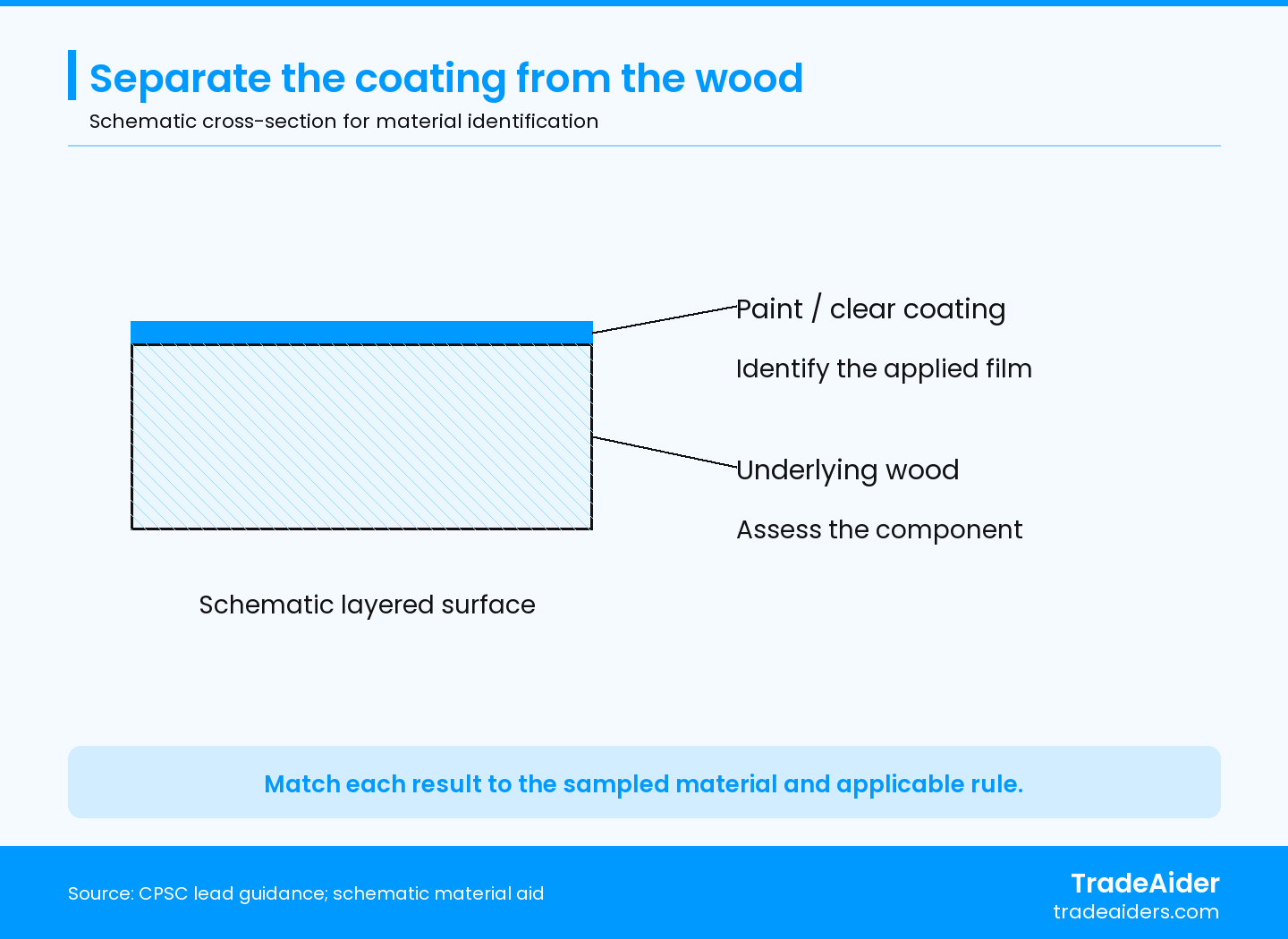
Schematic material-identification aid with illustrative layer proportions. Classify each material under the applicable market requirements.
Make a material list using photographs and part locations. Include each paint color, clear finish, ink, exposed wood component and attached material. Record which layers lie over others. Descriptions such as “eco paint,” “water-based” and “non-toxic” need corresponding technical evidence for the actual formulation and application. They provide too little information to select a lead test by themselves.
Match the lead test to the destination market
Lead requirements use different measurement bases. Total lead measures the amount present in a material. Migration and leaching tests measure release under prescribed conditions. Identify the relevant material category and method before comparing a report result with a limit. The following selected provisions orient a coating assessment as of November 2026.
| Market and material | Lead requirement and basis | Buyer implication |
|---|---|---|
| US coating | United States. The lead limit for paint and similar surface coatings on children’s products is 90 ppm. CPSC paint guidance. | Identify the coating separately from its wooden support. |
| US underlying component | United States. Accessible components of children’s products have a total-lead limit of 100 ppm. A paint layer does not make the underlying component inaccessible. CPSC total-lead guidance. | Check the component’s applicable evidence and any qualifying testing determination. |
| EU toy material | European Union. The current toy directive sets lead migration limits of 2.0 mg/kg for dry, brittle, powder-like or pliable material, 0.5 mg/kg for liquid or sticky material, and 23 mg/kg for scraped-off material. Applicability depends on the actual material and exposure scope. Current directive, Annex II chemical requirements. | Have the laboratory classify the material. The directive includes an exception where the stated exposure hazards are clearly excluded by accessibility, function, volume or mass. |
| Canadian accessible coating | Canada. Applied coatings, removable films and stickers on accessible toy parts must not contain more than 90 mg/kg total lead when tested using good laboratory practices. Canadian toy-coating provision. | Keep the coating result and accessible-part identity together. |
| Japanese covered toy coating | Japan. For covered toy coatings, the prescribed leaching test sets lead at no more than 90 µg/g under its specified procedure and calculation. This is a leaching result. CAA-linked toy specifications, coating test. | Confirm product scope, sample preparation and the prescribed result calculation with the laboratory. |
A dried paint film needs its correct material classification. “Dry” in an everyday description does not settle the EU category. Similarly, a foreign-market migration report cannot by itself answer a US total-lead requirement. Ask the laboratory to identify coverage of each requested market explicitly. Other chemical, mechanical, labeling and documentation requirements remain part of the complete toy assessment.
The new EU toy safety regulation generally applies from 1 August 2030. Specified administrative and enforcement provisions apply earlier. The current directive remains the basis for the migration row above. New EU regulation, application and repeal provisions.
Identify the coating before arranging laboratory samples
A useful laboratory request identifies the material actually used on the toy. Obtain the paint manufacturer, formulation or product code, color, supplier lot and application location. Connect those details to the toy model, production order and photographs. When a coating system has a primer, color layer and clear finish, ask how the laboratory needs them identified and prepared.
CPSC component-part guidance uses dried paint film, which can be prepared on a suitable substrate. Liquid paint cannot properly support that component-part certificate. Small painted areas are not exempt from the US coating limit. Ask the laboratory about the quantity of matching coated material needed and the permitted preparation route. CPSC dried-film and component-part answers.
Agree who selects, identifies, seals and sends the samples. Keep a record of the selection date, source lot and material labels, together with any separately prepared coating panels. If a factory supplies a painted panel, establish how its paint and application correspond to production. A panel described only as “same red” leaves an identity gap.
Ask the laboratory before combining colors, layers or components. Composite testing and reliance on component-part evidence have applicable conditions. Uncontrolled mixing can conceal which material produced a finding and make follow-up difficult. Preserve separate material identities even when the laboratory approves a particular grouping or sampling approach.
CPSC identifies conditional testing determinations for some untreated materials and certain unfinished engineered wood. A testing determination does not remove the applicable lead-content limit or certification responsibility. Document why a particular wood component qualifies, and assess the applied finish separately. CPSC material and testing-determination guidance.
If the supplier cannot identify the formulation or connect a report to the current material, record the missing item and assign an owner. Resolve that uncertainty through supplier records, an appropriate sample or laboratory advice before treating the existing report as evidence for the order. Maintain the distinction between an unavailable document and a demonstrated test failure.
Understand laboratory tests, XRF and home kits
Laboratory testing should answer a defined material-and-market question. Send the material list and intended destinations, then confirm the requested methods, applicable criteria, preparation and reporting. A report should make the tested sample identifiable and show the result, unit, method and comparison criterion. Clarify qualifications, exclusions or insufficient sample quantities before making the purchasing decision.
X-ray fluorescence, or XRF, is a method family. CPSC lists a specific XRF method among accepted paint-test methods. The laboratory must confirm instrument, method, material and applicable-rule scope. A handheld scan described simply as “XRF passed” supplies too little detail to establish that connection. CPSC listed paint-test methods.
If XRF is proposed for preliminary screening, define what the screening result will trigger and what further work is needed. If it is proposed as the applicable compliance test, confirm that exact method and laboratory scope. For a coated wooden part, ask how the procedure distinguishes the coating from the underlying material and how limitations will appear in the report.
EPA recognition of lead test kits concerns its renovation, repair and painting program for target housing and child-occupied facilities. That recognition does not establish that a kit answers toy-compliance testing requirements. Select the toy test against the relevant product rule and material. EPA lead-kit recognition scope.
For applicable US children’s products, the responsible domestic manufacturer or importer issues the Children’s Product Certificate based on passing testing at a CPSC-accepted third-party laboratory. Check that the laboratory’s acceptance covers the applicable rule. Keep the supporting report linked to the certificate and actual product identity. CPSC certificate guidance.
Review photographs, sample descriptions and material locations alongside the numerical results. A report heading naming the toy model may still cover only the submitted components. Ask for clarification where the tested color, coating system, sample date or current production relationship is unclear. File the explanation with the evidence used for the decision.
Inspect the wood, finish and attached parts
Physical inspection of a painted wooden toy should follow the agreed product specification, approved reference and defect criteria. Examine exposed wood, edges, joints and coating condition. Record the location and extent of a finding so the supplier can identify the affected operation and the buyer can decide the next action.
- Check accessible surfaces and edges for splinters, cracks, rough machining or sharp features.
- Look for peeling, flaking, chips, blistering, exposed underlayers and incomplete finish coverage.
- Compare wheels, axles, handles and attached decorations with the approved construction. Record looseness, missing parts and assembly differences.
- Check the agreed labels, intended age information, warnings and packaging against the approved market file.
- Photograph the defect and identify the sampled unit, part location and production lot. Separate observed defects from checks that could not be completed.
CPSC toy guidance considers accessibility before and after age-appropriate use-and-abuse testing. Applicable toy tests depend on design, age and requirements. Agree the method, equipment and responsible testing route for construction concerns. CPSC toy-testing guidance.
Describe an on-site observation accurately. “Wheel moved during handling” and a result from a specified attachment test carry different evidence. Avoid improvised force, duration or impact criteria. Where the required method cannot be performed at the factory, record the limitation and arrange the appropriate follow-up. An acceptable surface appearance establishes no chemical concentration result.
TradeAider’s pre-shipment inspection takes place when the order quantity is 100% complete and at least 80% packed for export. For wooden toys, agree the finish, assembly, labeling and packaging checks that the order needs. Use the report to retain the agreed observations and outstanding findings alongside the separate laboratory evidence.
Control paint changes and respond to findings
Paint selection needs a defined formulation, intended application and evidence for the relevant toy requirements. Obtain technical information for the actual coating system and communicate restrictions to the factory. A safety data sheet can help identify a material, but a general safety description leaves the required toy test and finished application to be addressed.
After initial certification, CPSC material-change guidance requires retesting the finished product or affected component for rules affected by the change and issuing a new Children’s Product Certificate based on passing results. Review a paint-supplier, formulation or construction change for its actual effect on compliance and evidence coverage. CPSC material-change testing guidance.
Illustrative scenario. A wooden train’s red roof paint changes while the supplier’s report covers the earlier formulation. The train still matches the approved shape, and a separate blue-body result is available. Neither resolves coverage of the changed roof. The buyer identifies the affected paint and production lots, holds those goods and requests the coating records needed for technical review and any applicable testing.
Once the changed material has suitable evidence, the buyer checks its connection to the held lots and records the disposition. If the supplier instead repaints the roofs, that corrective route needs its own material identity and verification. A new carton label or a photograph of an unchanged toy shape cannot close the coating-evidence gap.
For a result above the applicable limit, segregate the affected goods, preserve the sample and records, and investigate the material source and production scope. An inconclusive result needs clarification of the method, sample or reporting limitation. Detectable lead requires comparison with the applicable criterion. Determine corrective action, retesting and any market notification or recall obligations for the actual finding and distribution status.
Keep a usable paint-test and inspection record
Use a buyer working record to connect each coating and component to the applicable criterion, sample identity, test evidence, physical finding and outstanding action. Copy the structure below for each relevant material. It is a recommended working aid that the team can adapt to the actual toy.
| Record field | Complete for this material | Check before closing |
|---|---|---|
| Toy and location | Model ___ / age group ___ / part and photo ___ | The sample location is identifiable. |
| Coating identity | Manufacturer ___ / formulation ___ / color and layers ___ / paint lot ___ | Records correspond to current production. |
| Market and method | Destination ___ / applicable criterion ___ / method ___ / material category ___ | The measurement basis matches the criterion. |
| Sample and report | Selected by ___ / sample ID ___ / production lot ___ / laboratory and report ___ | Result, unit, scope and limitations are clear. |
| Physical inspection | Reference ___ / check and method ___ / finding and photo ___ / incomplete check ___ | Observed condition and test evidence stay distinguishable. |
| Action and disposition | Affected goods ___ / action and owner ___ / verification ___ / decision and date ___ | Outstanding evidence has a recorded resolution. |
For the illustrative train, enter the red roof and its new formulation in the coating row. Link the paint lot to the affected production lot, leave the report field open until coverage is resolved, and record the hold and its owner. The completed record should show which evidence supported the final decision. Repeat for other materials as needed.
Plan the inspection around the actual toy and order
Start with the product and order information you have available, intended age group, factory, destination, timing and known paint concerns. Share existing reports and approved references where available. Before inspection, agree the technical references, sampling, feasible checks, required report language and how limitations will be recorded.
Contact our team to discuss a suitable inspection scope for the wooden toy order and a report of the agreed checks and findings.
FAQ
Does a clear finish belong in the coating list?
Yes. Include a clear finish in the material list and have the laboratory classify it under the applicable coating and toy requirements. Record the product code, supplier lot and application location. A transparent layer can be easy to overlook in photographs, so identify it explicitly when preparing samples.
Does below the detection limit mean no lead?
No. It means the laboratory did not detect lead above the stated detection limit using that method. Read the report’s terminology and ask the laboratory whether its detection or reporting limit supports comparison with the applicable criterion. Keep the reported result and limitation together when recording the decision.
What should a parent do if lead exposure is suspected?
Keep the suspected toy out of the child’s reach and discuss the exposure concern with the child’s health care provider. CDC advises talking to the provider about a blood lead test when concerned about lead exposure. Follow any applicable official recall instructions for the identified product. CDC exposure and testing guidance.

Artigos Relacionados


Expanda seu negócio com o Serviço TradeAider
Clique no botão abaixo para entrar diretamente no Sistema de Serviço TradeAider. Os passos simples desde a reserva e pagamento até o recebimento de relatórios são fáceis de operar.