
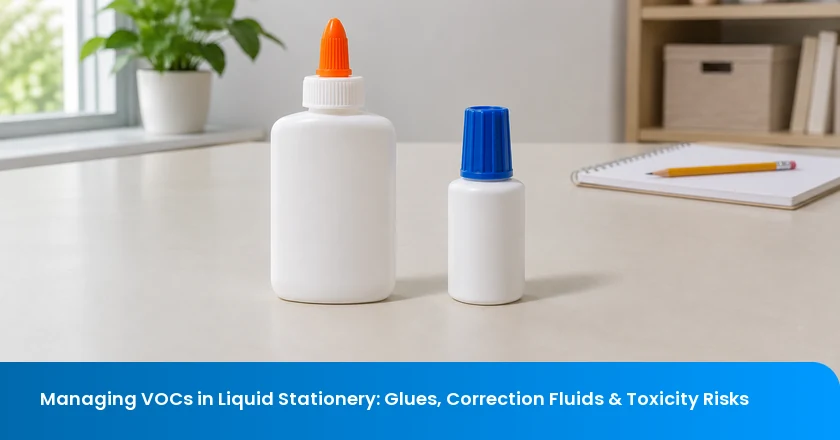
Managing volatile organic compounds (VOCs) in liquid glues and correction fluids starts with the actual formulation and intended use. Check what the product’s claims and reports establish, then follow suitable handling, storage and disposal directions. A low-VOC label can describe a useful property, but it does not settle every toxicity or exposure question.
For a school-supply importer or institutional buyer, the task is to qualify the exact product and its evidence. For an office or classroom user, it is to choose an appropriate material and control the activity. Both decisions benefit from keeping VOC content, emissions into air and intended-use toxicological assessment separate.
VOCs describe volatility, not a single toxicity rating
VOCs can be released as gases from certain solids and liquids. The US Environmental Protection Agency identifies correction fluids, glues and adhesives among potential sources. It also explains that health effects vary with the chemical, exposure level and duration. Some exposures can cause irritation or other adverse effects; this does not give every liquid stationery product the same hazard profile.
Assess how the material will be encountered: inhalation during application, skin or eye contact, and foreseeable accidental ingestion. Consider the intended user, activity, quantity open at once and ventilation. A brief supervised paper-craft task and prolonged use of an open solvent-containing product create different assessment questions.
Toxicity also extends beyond the substances included in a VOC result. Product-specific review needs to consider relevant ingredients and exposure routes, including any hazards identified in the safety information. Avoid assigning a universal “safe” room concentration or predicting long-term disease from a product-category name. General indoor-air studies do not measure the exposure created by your particular bottle, room and activity.
Compare the actual glue and correction-fluid formulations
A water-based glue, a solvent-containing adhesive and a fast-drying correction fluid need their own formulation and use information. These descriptions help identify questions to ask, but do not establish a fixed VOC level or complete safety classification.
For a liquid glue, identify its intended substrate and application. A glue selected for paper crafts may have different instructions from an adhesive intended for another material or professional use. Ask how the manufacturer supports age suitability and relevant chemical claims for the purchased formulation.
For correction fluid, check the application system, directions, closure and any thinning or refill instructions. “Fast-drying” describes performance, not a toxicological conclusion. Confirm the formulation behind the offered product instead of borrowing the safety information for a similar-looking bottle.
Packaging and use matter alongside composition. A leaking closure, an unidentifiable refill or instructions inconsistent with the supplied material can defeat an otherwise careful purchasing decision. Record the formulation revision and packaging configuration so later changes can be evaluated against the evidence you accepted.
Separate VOC content, air emissions and toxicological review
VOC content concerns what is counted in the product; emissions testing concerns release into air under defined conditions. A toxicological assessment considers relevant hazards and intended exposure. EPA’s technical overview explains that some content-based low- or zero-VOC labels use outdoor-air regulatory definitions and may not assess all emissions relevant to indoor health. Measurement methods are selective, so the tested scope matters.
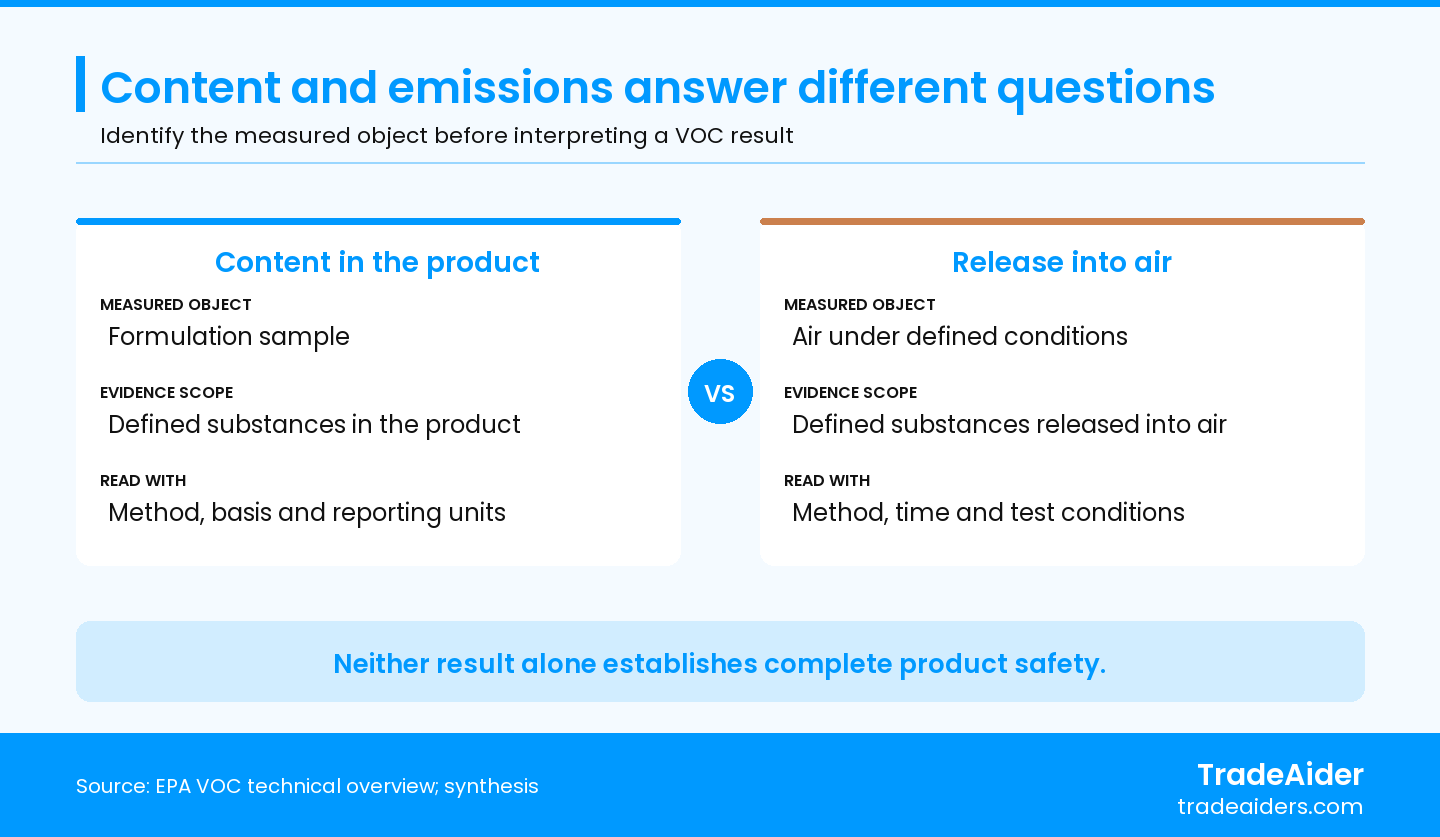
Conceptual distinction: content in the product and emissions under defined conditions are different measured quantities. Read the method, scope and conditions; neither result alone replaces intended-use toxicological assessment.
Ask which VOC definition, substances and exclusions support the claim. Identify the reporting basis and units, and whether the sample was assessed as supplied or under stated preparation conditions. For emissions evidence, read the application amount, test environment, sampling period and other conditions relevant to interpretation. Results from different questions cannot be ranked as though they were equivalent.
Method selection needs the same discipline. EPA’s Method 24 overview identifies a surface-coatings method for volatile matter, water content, density and solids measurements. A laboratory needs an applicable basis before using it for a particular stationery formulation. Its familiar name alone does not establish suitability for every glue or correction fluid.
Give the laboratory the purchasing question, product matrix and intended claim. Agree the target substances, method, sample preparation, units, reporting limits and acceptance basis. If a report says “not detected,” ask for the laboratory’s definition and the limits for the tested targets. Do not turn a limited solvent panel into a statement that every hazardous substance is absent.
Also separate chemical tests from physical order checks. Bottle identity, artwork, closure condition and visible leakage can be inspected against agreed references. Chemical composition and exposure-related claims need their appropriate testing or assessment evidence; appearance and odor cannot supply those results.
Match US and EU requirements to the product
US art materials. The Consumer Product Safety Commission’s art-material guidance defines the consumer products covered by the Labeling of Hazardous Art Materials Act (LHAMA). Covered art materials need chronic-hazard toxicological assessment at least every 5 years and an ASTM D4236 conformance statement. That assessment-and-labeling obligation alone is neither a non-toxic certification nor a rule requiring a General Certificate of Conformity or Children’s Product Certificate.
Other US product questions. Determine whether the particular glue or correction fluid is an art material, a children’s product or another consumer product. CPSC’s Federal Hazardous Substances Act guidance describes precautionary labeling for products meeting its hazardous-substance definition in customary or reasonably foreseeable handling and use. A warning does not make a banned hazardous children’s product acceptable. Assess applicable product rules rather than requesting one universal VOC, heavy-metal or phthalate panel.
EU chemical classification. The Commission’s CLP overview explains classification, labeling and packaging of hazardous substances and mixtures. Pictograms, signal words, hazard statements and precautionary statements communicate the classified hazards. Read them together with product identity and directions; a single symbol is not a complete chemical-safety score.
EU toy classification. Toy requirements apply when the specific product is a toy; a technical standard belongs within the relevant conformity assessment rather than acting as a law for all stationery. The Commission’s toy-safety guidance says the new Toy Safety Regulation starts applying on 1 August 2030. Its future application does not remove current applicable obligations. Establish the product category and market requirements before choosing the evidence package.
Request a supplier packet for the exact formulation
A safety data sheet (SDS) can help identify hazards and precautions, but it is not necessarily a complete recipe or a batch test certificate. The US OSHA SDS framework covers product identity, hazards, ingredient information, first aid, handling, storage and exposure controls, with scoped ingredient disclosure and trade-secret provisions. This occupational framework does not mean every consumer bottle has the same SDS obligation.
Use this packet to connect the offered claims to the ordered product. Fill missing fields and assign the follow-up before approving the claim. Where confidential composition is needed, arrange an appropriate supplier-to-assessor review rather than treating an incomplete public ingredient list as the full formulation.
| Evidence item | Fill in | Resolve before approval |
|---|---|---|
| Product and use | Model: ___; age/activity: ___; market: ___ | Applicable product category |
| Formulation | Code/revision: ___; SDS date: ___ | Current identity and review route |
| VOC claim | Exact wording: ___; basis/method: ___ | Substances, units and limits covered |
| Reports and assessment | Report ID/date: ___; sample: ___ | Ordered formula and use match |
| Label and package | Artwork revision: ___; closure: ___ | Claims, warnings and agreed checks |
| Use and end of life | Directions: ___; disposal region: ___ | Storage, first aid and local route |
For an order requiring documented tests, TradeAider’s product testing process describes needs alignment, sample identification and report issuance. Discuss the exact testing objects, projects and standards, then agree what the resulting report will cover.
Choose alternatives by intended use and supported claims
Use the actual assessment behind a safety claim. ACMI’s materials-safety guidance describes its Approved Product (AP) seal as an intended-use toxicological evaluation and explains that smell is not a good indicator of toxicity. The seal does not establish a VOC-free or allergy-free formula, and a weak odor does not establish safety.
An appropriate water-based glue or a non-liquid correction option may suit the task, but compare intended age, application, evidence and directions. “School glue,” “natural” and “low odor” are descriptions to investigate, not substitutes for the applicable assessment. Confirm that an alternative still performs the required paper-bonding or correction task.
For a known ingredient sensitivity, obtain relevant manufacturer information and appropriate professional advice rather than testing the material on a child’s skin. For bulk school purchasing, a homemade recipe does not provide the formulation consistency, instructions and safety evidence needed to qualify the order.
Reduce exposure during ordinary use
EPA’s exposure-reduction guidance recommends ventilation, following label directions, reducing sources and limiting quantities of VOC-emitting products. Apply those measures to the actual product and activity, without assigning a guaranteed reduction or importing a household-study concentration multiplier into a classroom.
Prepare the work area before opening the material. Use only what the activity needs, close containers promptly and keep the product information available to supervising adults. Follow the product’s age and use directions and any hazard-specific restrictions. If adequate use conditions cannot be provided, select a more suitable product or activity.
Protective measures should follow the actual hazards and instructions. Do not prescribe one glove type, disposable mask or respirator for every glue and correction fluid. Where specialist protection is needed, have the responsible safety professional determine the controls. An air cleaner or protective item does not replace suitable product selection and the required use conditions.
Store and dispose of products according to their hazards
Keep containers identifiable and follow their storage precautions, including any heat, ignition or incompatibility warnings. EPA’s US household-hazardous-waste guidance advises original labeled containers, no mixing of leftovers and consultation with local collection authorities. It identifies drains and, in some cases, ordinary trash as improper disposal routes for household hazardous waste.
Determine the local route for the actual residue and container. School and business waste can fall under different arrangements from household collections. Do not assume that every liquid stationery product has the same waste classification, or that drying a water-based glue automatically makes it suitable for ordinary trash. Plan disposal before accumulating large amounts of unused stock.
Respond promptly to an actual exposure
If someone collapses, has a seizure, has trouble breathing or cannot be awakened, seek local emergency help immediately. The National Capital Poison Center’s first-aid guidance provides these emergency triggers and product/exposure-specific poison advice. For an exposure, follow appropriate first-aid directions and contact the local poison service promptly; keep the exact product, label and exposure details available. Do not guess a treatment from a “low-VOC” claim or wait for an inspection report.
Illustrative example: a correction-fluid report does not match the order
This is a hypothetical example, not client data. A supplier offers correction fluid labeled “low VOC” and “non-toxic.” Its report identifies an older formulation and a limited solvent panel. The buyer’s order uses a different formulation revision, with no documented explanation of the report’s coverage. The buyer holds approval of the unsupported claim and artwork while asking the supplier to identify the ordered formula. The laboratory is asked whether its results apply to that formula and what substances and limits were covered. The buyer also obtains the appropriate intended-use toxicological basis and applicable market-labeling review. If current, matched evidence supports the intended use and wording, the buyer can evaluate the claim within that scope. If the evidence remains incomplete, the claim remains unsupported and further work or another product is needed. Packaging and agreed physical checks are still assessed separately. The gap does not prove that the product is toxic. It shows why an old-formula result cannot establish the offered claim without a justified connection. A lower reported VOC value would not resolve that missing connection by itself.
What should justify a liquid-stationery safety claim?
- The exact formulation, intended user and activity are identified.
- VOC content, air-emissions evidence and toxicological assessment retain their separate scopes.
- The applicable product/market requirements and proposed label are supported.
- Use, storage, disposal and incident directions are available for the actual product.
Discuss the test scope for your stationery order
Begin a TradeAider inquiry with the product and order information available, formulation identity if known, intended age and use, destination and proposed claims. Share existing reports and the questions they leave open. Before commissioning work, agree the testing objects, methods, sample identity, reporting and limitations. Contact our team to discuss an appropriate testing plan and report scope.
FAQ
Can a workplace exposure limit be used as a classroom safety limit?
Do not transfer an occupational limit into a child-use approval without an appropriate assessment. A value listed for workplace exposure has its own purpose and conditions. Identify the population, activity and exposure assumptions relevant to the proposed school use, and ask the responsible assessor to explain the applicable basis instead of using an SDS value as a universal classroom pass mark.
How should a school manage refill containers?
Use the intended refill system while preserving product identity, warnings and batch traceability. Confirm that the refill belongs with the receiving container and application system. Keep the manufacturer’s directions available, avoid food or beverage containers, and identify who controls the refill stock. A larger purchase pack should not leave classroom users with an unidentified liquid or missing precautions.
Can a test report cover every color or pack size in a product family?
Only if the report and technical assessment establish that coverage. Ask which formulations, variants and packaging configurations were represented and why the selection applies to the ordered items. If a variant is outside the stated scope, request the laboratory or assessor’s explanation and any needed additional work; a shared brand name does not establish coverage.
Artigos Relacionados

Expanda seu negócio com o Serviço TradeAider
Clique no botão abaixo para entrar diretamente no Sistema de Serviço TradeAider. Os passos simples desde a reserva e pagamento até o recebimento de relatórios são fáceis de operar.

