
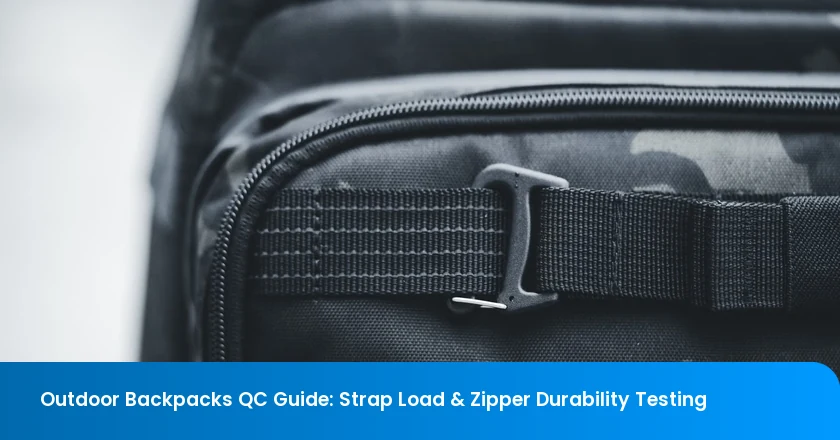
Outdoor backpack quality control should check the strap load path and zipper durability using methods and conditions suited to the actual construction. Separate webbing strength, seam or attachment performance, and assembled-bag load checks. For zipper cycling, record the specimen, applied tension, motion, completed cycles and failure criteria; a smooth manual check or an unexplained cycle count cannot establish service life.
For buyers and manufacturers, useful testing means knowing what the result covers and what remains unverified. Agree the intended use and acceptance requirements, retain the conditions with each result, and distinguish practical on-site checks from controlled laboratory work.
Keep Backpack Test Results in Scope
- Check the complete load path, including textile and hardware connections.
- Separate material, attachment and assembled-product evidence.
- Record load, restraint, motion, duration or cycles and failure criteria.
- Keep zipper strength, operation and endurance questions distinct.
- Investigate failures and verify the affected construction after correction.
Outdoor Backpacks QC Overview
Outdoor backpack quality control should connect textile and hardware checks to the finished construction and intended use. Strap load and zipper durability need evidence that identifies what was tested and under which conditions.
Hardline vs. Softline Testing
Hardline and softline testing are useful working categories for hardware and textile checks. They complement each other; neither term identifies a universal backpack certification or proves that the complete load path performs as required.
Hardware review can include buckles, adjusters, attachment rings and a frame where present. Textile review covers fabric, webbing, lining, stitching and sewn joints. A shoulder strap transfers load through several of these features, so a good result on the webbing alone cannot establish how its attachment or adjuster behaves.
Map the relevant locations on the actual model: shoulder-strap roots, lower attachments, handles, adjustment hardware and zipper installations. Compare their construction with the approved references. Note skipped stitches, damaged yarns, exposed sharp edges, loose hardware or incorrect assembly separately from a formal strength result.
Comfort, fit and outdoor exposure can also matter for the intended use, but a routine visual or load check does not establish every aspect of them. Keep the scope focused on the property being assessed rather than call the backpack comprehensively certified after a few component checks.
Standardized QC Procedures
ASTM D2061 covers strength tests for zippers and zipper parts, and explains that one test alone does not determine suitability for a particular end use. A zipper-strength method should therefore not be presented as a universal endurance target or a complete backpack approval.
Choose the method and applicable edition for the material, component or assembly, then agree the acceptance requirements separately. Method titles and public scopes help with selection but do not provide the full procedure. The laboratory or competent test provider needs the complete applicable procedure; a short description is not enough to claim formal conformity.
Use the inspection standards resource to help organize product checks, then keep the actual test conditions and results together. A practical record can include:
| Record field | Information to retain |
|---|---|
| Product and specimen | Model, construction revision, material or component reference, lot and specimen identity. |
| Method and preparation | Method/version, conditioning, specimen preparation and any agreed deviation. |
| Setup and conditions | Clamping, support, loading direction, applied mass or measured force, duration, motion and relevant environment. |
| Planned work | Target load or cycles, inspection points and agreed failure or acceptance criteria. |
| Actual result | Completed work, measured value where applicable, failure location, observation and photographs. |
| Status and follow-up | Passed, failed, interrupted or not performed; limitation, review owner and disposition. |
Record units and distinguish an applied mass from a measured force. An unfinished test should remain unfinished in the report rather than receive a pass because no break was seen before it stopped.
Strap Load-Bearing Test Methods
Strap testing should distinguish the webbing material, the sewn attachment and the complete backpack. These specimens answer different questions and should not share an unexplained load-bearing pass.
Tensile and Seam Strength
ASTM D6775 addresses breaking strength and elongation of textile webbing, tape and braided material using split-drum specimen clamps. Select it only where the actual material and specimen fall within its scope. A material breaking result does not establish the carrying rating of the assembled bag.
Webbing width, construction, condition and gripping arrangements matter when comparing results. Do not use a generic cotton, polyester or nylon strength table to approve the supplied strap. The material name alone does not describe the actual specimen, and a result for another webbing construction may not apply.
ISO 13935-2:2026 describes a grab method for maximum force to rupture of applicable straight sewn seams, with force applied perpendicular to the seam. Coated fabrics are normally outside its scope, and it uses constant-rate-of-extension testing machines. Check those limits before applying it to a backpack construction.
A curved strap root, coated panel or complex reinforced junction may need another suitable method. Distinguish a straight-seam specimen from a whole attachment pulled through its actual load path. Identify what failed: webbing, thread, fabric beside the seam, hardware, or a slipping grip. A grip problem or unsuitable specimen can invalidate the intended comparison.
Keep material, sewn-joint and complete-bag results identifiable. Report the actual specimen and method, including any limitation, instead of extending a narrow test pass to the entire carrying system.
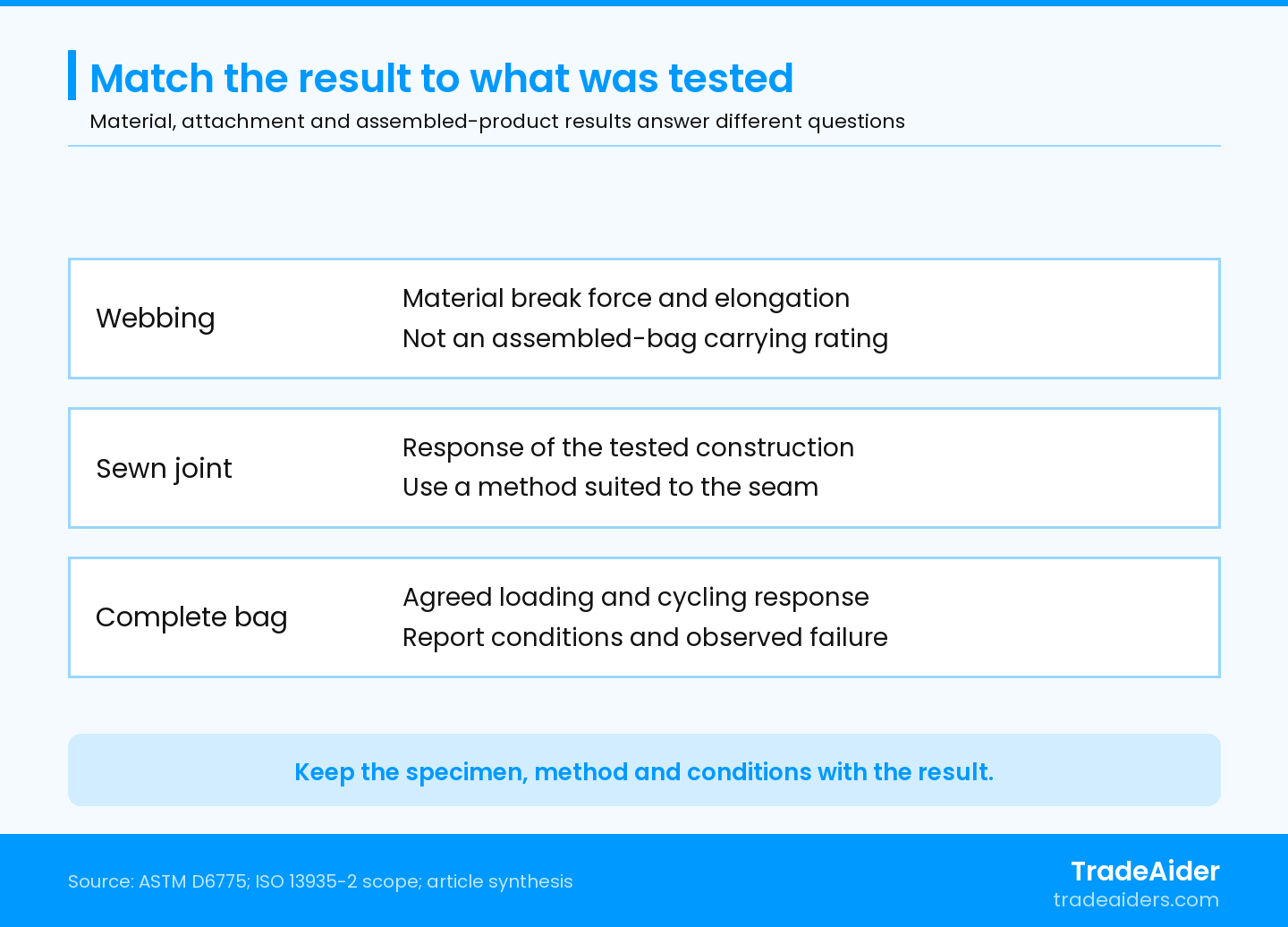
A webbing result does not establish the performance of its attachment or the complete backpack. Identify the actual specimen, method and conditions; select suitable tests for the seam construction and assembled product.
Mechanical and On-Site Testing
Static loading, cyclic lifting and a controlled shock or jerk check impose different loading histories. An improvised site lift does not establish a rated carrying load or the backpack’s service life.
A static test maintains an agreed load for a defined duration. A cyclic test repeatedly applies the specified action. A shock or jerk assessment introduces a more abrupt event. Define the support, strap or handle used, load distribution, direction, travel or motion, duration or cycles, and the observations that constitute failure. The same nominal load can have different effects under different setups.
For assembled bags, watch the relevant attachments, seams, adjustment hardware and body panels. Record slippage, permanent deformation, stitch opening, tearing or hardware damage against the agreed criteria. Loading through a handle is not automatically equivalent to loading through both shoulder straps. Use suitable equipment and controlled arrangements where repeated or impact loading is involved.
A routine visit can perform agreed practical checks when the necessary method, equipment, time and access are available. If the required controlled setup or endurance capacity is missing, record the limitation and arrange appropriate specialist work rather than substitute an informal tug.
For checks on current output, discuss during production inspection with the actual construction references, known concerns and agreed method. Confirm what can be observed on-site and which tests require a separate arrangement; do not infer a complete endurance program from a general inspection booking.
Zipper Reciprocating Durability Checks
Zipper durability assessment needs the actual specimen, installation, loading, motion and failure criteria. Smooth manual operation is useful evidence of current function, while repeated-cycle resistance is a separate question.
Fatigue and Endurance Testing
SATRA TM50 describes repeated opening and closing of a slide fastener while it is tensioned along its length and across its width. Testing stops at failure or a set cycle count. Those conditions are part of the result, not optional details that can be replaced by a cycle number alone.
Specify whether the test uses a separate zipper specimen or the installed backpack assembly. Identify the zipper construction, slider, stops, tape and relevant attachment. Record stroke length, operating motion and speed, tension or other applied loads, conditioning and the definition of a completed cycle under the selected procedure. A loose component test may not reproduce lining interference, curvature or stress in the finished opening.
Agree the target and failure criteria before testing. Relevant observations can include chain separation, damaged elements, slider or puller failure, tape damage, jamming or unacceptable operating behavior. Record the cycle at first relevant failure, the completed count and any interruption. Inspect and photograph the affected location so a later reviewer can understand what stopped the test.
Select the cycle target for the actual construction, agreed procedure and intended claim; there is no universal backpack value or automatic conversion into years of service. Actual use can involve dirt, moisture, overfilling and different operating directions that a particular test may not represent. The result supports its stated conditions and acceptance requirements. Identify any important exposure that was not included.
Keep endurance specimens separate from routine workmanship sampling. The AQL calculator can help review agreed lot-sampling inputs; AQL means acceptance quality limit. It does not choose an endurance method, define the cycle target or establish that the tested specimens represent every durability risk in the lot.
Functional and Visual Inspection
ASTM D2062 addresses zipper operability, including opening and closing, separator functioning and sticking at stops. Select the methods relevant to the actual zipper construction; a separator check is not applicable to every closed-end backpack opening.
During routine inspection, operate the relevant compartments and pockets over their intended travel. Look for snagging of lining or seam allowances, misaligned elements, uneven tape installation, difficult movement, damaged pulls and insecure stops. Check the assembled opening, since a zipper can operate acceptably before sewing but catch fabric after installation.
Compare the slider, puller, tape, element type and installation with the approved references. Record which opening and unit had the problem. A photograph of a damaged puller or caught lining is more useful when it shows the location and surrounding construction, rather than an isolated close-up without product identity.
Use the agreed method for any strength, locking, corrosion, abrasion or environmental requirement. Do not present a quick manual operation check as conformity to a formal test procedure or proof of all those properties. If a zipper is lubricated, adjusted or replaced after a problem, identify the intervention and assess the corrected construction under the relevant conditions.
Practical Impact of QC Results
Backpack QC results support a product-specific buying or improvement decision when they identify the tested construction, conditions, outcome and remaining limitations. A pass without that context is difficult to compare or use.
Evaluating Backpack Inspection and Test Reports
When reviewing an outdoor backpack inspection or test report, buyers should verify who performed the inspection or testing, what the assessment actually covered, and how the reported results were obtained. The name of an inspection service provider alone does not establish that every durability test was performed by that organization or that the product has received an independent durability certification.
A reliable report should clearly identify the inspection or testing provider, the product or sample tested, the relevant batch or production lot, and the scope of work. For backpack durability assessments, this may include strap tensile strength, seam strength, load-bearing performance, zipper reciprocating cycles, and hardware functionality. The report should also specify the test methods, applicable standards, testing conditions, measured results, and acceptance criteria where relevant.
It is equally important to distinguish between third-party product inspection and laboratory testing. An on-site inspection may include visual checks, functional assessments, and agreed mechanical tests, while specialized laboratory testing may require dedicated equipment and controlled testing conditions. Buyers should confirm which activities were performed directly by the inspection provider and which, if any, were conducted by a separate testing laboratory.
TradeAider provides third-party inspection and testing services, supported by a nationwide network of quality control specialists and an online reporting system. However, the actual inspection scope, assigned personnel, testing arrangements, and report details should always be verified against the specific service agreement and issued report.
Ultimately, an inspection report documents the findings and results within its defined scope. It should not automatically be interpreted as a product durability certification or as proof that every backpack of the same model will perform identically under all conditions. Buyers should evaluate the actual test evidence against their product requirements before making quality acceptance decisions.
Manufacturer Improvements
Manufacturers should use the failure location and test conditions to guide investigation, then identify the change and renew the affected evidence before extending approval. A failed observation is a starting point for the investigation, not automatic proof of its root cause.
Illustrative example: a webbing specimen meets its agreed material criterion, but a completed backpack fails at a shoulder-strap attachment during the specified assembly test. The material pass does not cancel the assembly finding. The team checks the failed junction, seam construction, panel, gripping arrangement and loading conditions before choosing a correction. This is a hypothetical example, not a TradeAider customer case or measured result.
After changing the construction or process, keep the revised build and verification evidence identifiable. A stronger webbing specification alone may not address a seam or panel failure. Similarly, replacing a zipper slider may not resolve a lining snag caused by its installation. Confirm that the revised result addresses the observed problem and the original requirement.
Use a focused follow-up record:
- Identify the model, build, lot, tested unit and failed location.
- Retain the method, conditions, completed work and photographs.
- Separate the observed finding from the proposed cause.
- Name the correction and the goods or construction it affects.
- Define the further inspection or testing needed and its acceptance basis.
- Assign the review owner and record the disposition of unresolved findings.
Contact our team with available backpack and order details, construction references, factory, stage, timing, destination and known failures. Include existing test reports and the final report user. TradeAider can discuss an appropriate product-inspection scope and a report of agreed checks, observations, measurements and limitations. Confirm methods, criteria, access, language, format and recipient acceptance before inspection.
FAQ
Can one backpack sample be used for every durability test?
Only when the agreed sequence is suitable and earlier work does not invalidate later results. Loading, conditioning, abrasion or destructive testing can alter the specimen. Identify the sequence and distinguish fresh specimens from those already exposed to another test. If accumulated exposure is part of the intended assessment, state it explicitly rather than compare the result with a fresh-sample test without explanation.
Does a water-resistant zipper make the whole backpack waterproof?
No; the installed zipper and the rest of the bag need evidence for the actual water-protection claim. Seams, fabric, openings, assembly and the relevant exposure conditions can affect the result. A component description should not be extended to whole-bag waterproof performance. Request a suitable assessment of the claimed construction and use conditions when that property matters.
Can a load-tested or damaged sample return to saleable stock?
Keep it identified and segregated until its disposition is authorized; do not assume it is fit to sell. A test may leave visible damage or weaken a component without an obvious external sign. Record what the specimen experienced and follow the agreed handling and disposal arrangements. A passed test result and permission to return that tested unit to stock are separate decisions.
Artigos Relacionados

Expanda seu negócio com o Serviço TradeAider
Clique no botão abaixo para entrar diretamente no Sistema de Serviço TradeAider. Os passos simples desde a reserva e pagamento até o recebimento de relatórios são fáceis de operar.