
- Sobre Nós

- Nossos Serviços
- Sua Indústria
- Recursos
- Notícias e Blog
Reed diffuser orders are liquid-filled glass units, and a pre-shipment inspection is the check that decides whether the packed cartons can ship. A clean cosmetic sample does not prove that an order is ready, because a short fill, a weak cap seal or a mislabelled batch can survive an appearance check and only surface after the container has been handled or shipped. The fill, the seal, the bottle, the label and the carton therefore have to be read together, as one release decision rather than five separate opinions.
What a Reed Diffuser Pre-Shipment Inspection Must Establish
A reed diffuser pre-shipment inspection must establish that the finished retail unit and the packed master carton range describe the same goods.
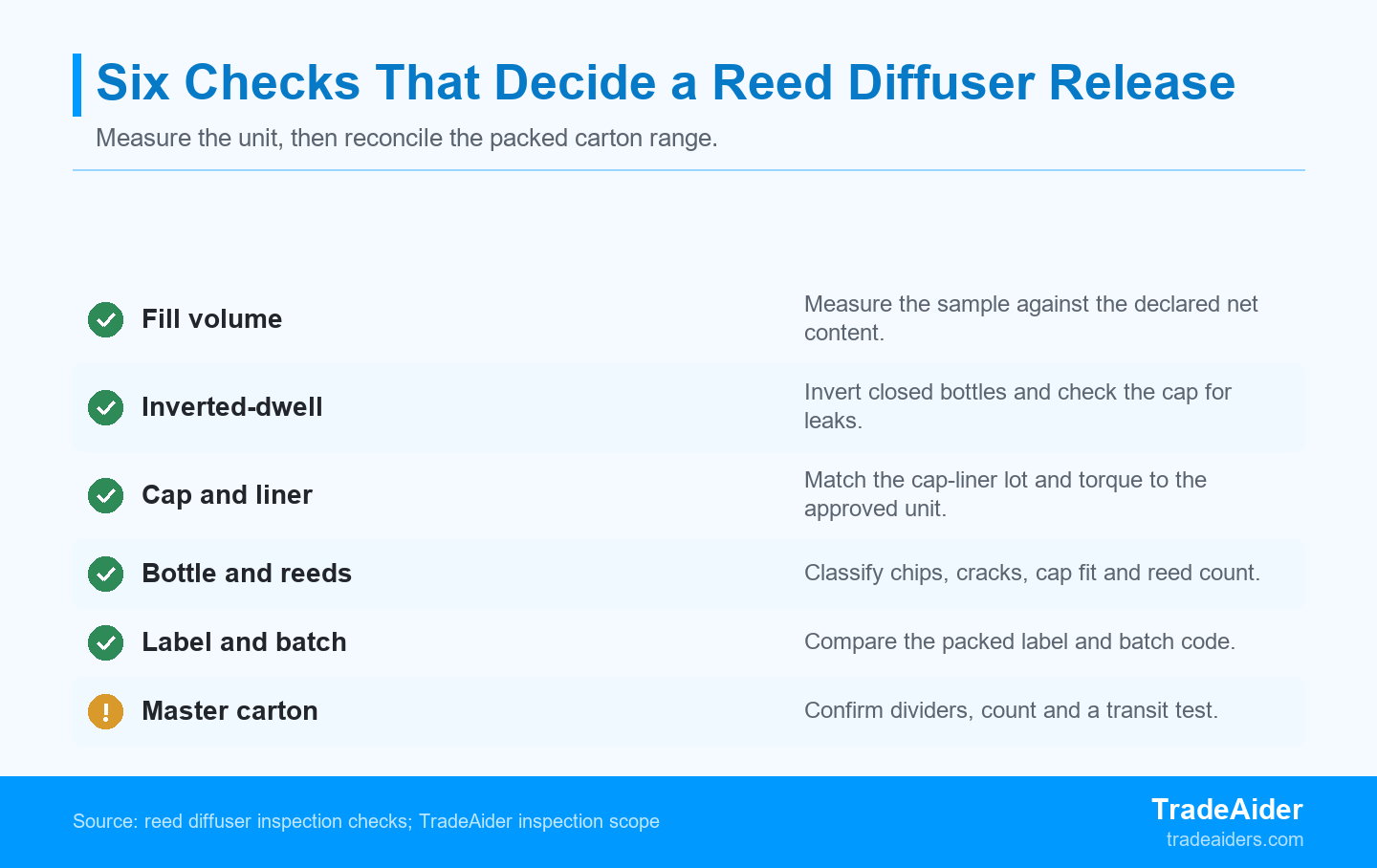
Six checks decide a reed diffuser release, because a clean cosmetic sample can still hide a short fill, a weak seal or a mislabelled carton.
Review TradeAider's company background before sharing a specification and a fill volume with an inspection team, because the release decision depends on who reads the records.
A pre-shipment inspection is the final independent check of a packed order against the agreed specification before it leaves the factory. For a reed diffuser, the inspector reads the finished bottle, its cap and its label, then confirms that the carton range being released holds those same units. Those two objects carry different evidence: the bottle proves the fill and the seal, while the carton proves the count, the marks and the packed population. A release decision that reads only one of them can clear cartons whose contents were never checked.
TradeAider's pre-shipment inspection runs when 100% of the order is complete and at least 80% is packed, so the checklist applies to packed goods rather than to a line still in progress.
Treat the two objects as one release question rather than two separate tasks. The table below maps each reed diffuser check to the failure it catches and the record it produces.
| Check | Failure it catches | Record it produces |
|---|---|---|
| Fill volume | Short or over-filled retail unit | Measured volume against the declared net content |
| Inverted-dwell | Leak or weak seal on a closed bottle | Dwell time, observation and unit identity |
| Cap and liner | Missing, wrong or over-tightened closure | Cap-liner lot and torque setting |
| Bottle and reeds | Chip, crack, cap fit or wrong reed count | Defect class: critical, major or minor |
| Label and batch | Wrong revision, missing element or lost traceability | Approved revision and batch code |
| Master carton | Crushed, under-filled or mis-marked carton | Carton count, marks and transit-test report |
Read the table as a single rule: release only the carton range whose fill, seal, bottle, label and carton records all describe the same goods, and hold the range where one record disagrees.
Fill Volume and Net-Content Checks
The fill-volume check measures the liquid in a sample of finished retail bottles against the declared net content and the agreed tolerance.
Fill volume is the measured liquid volume in a finished retail bottle compared with the declared net content. Measure it after the cap is fitted, because a bottle weighed before capping can hide a spill or an over-fill that appears later. Record the volume, the tolerance and the bottle identity together, so a short fill can be traced to a filling period rather than to the whole order.
NIST Handbook 133 provides test procedures for checking the net contents of packaged goods, including packages labeled by volume. Use the NIST Handbook 133 procedure rather than an eyeball estimate, because the declared net content is a claim the buyer makes to the customer.
Keep the sampling rule separate from the check itself. inspection-standard guidance sets the sample size and the accept or reject number, while the fill measurement supplies the data. If the sample shows a short fill or an over-fill beyond tolerance, treat the affected filling period as the hold range and recheck it after the correction.
Leakage and the Inverted-Dwell Check
Leakage is the release-critical failure on a liquid reed diffuser, because a leaking bottle stains the carton, damages the label and contaminates neighbouring units.
A leak turns one defective bottle into several unsellable ones, and the damage often appears only after the carton has been stacked, handled or shipped. That is why a confirmed leak holds the affected range instead of being recorded as a cosmetic note. A leak can start at the cap, at the neck finish or at a hairline crack in the glass, so the check has to look at the closed unit and at the surface beneath it, not only at the liquid level.
How the Inverted-Dwell Test Reveals a Leak
An inverted-dwell check leaves a filled, closed bottle upside down for a set time and then inspects the cap, the neck and the surface beneath it.
An inverted-dwell check is an on-site test that leaves a filled, closed bottle upside down for a set time to reveal a leak or a weak seal. Agree the dwell time with the buyer and write it into the brief: a longer dwell exposes a slower leak, while a short one catches only an obvious drip. Record the dwell time, the observation and the unit for every sampled bottle, so one carton can be compared with the next.
For certain liquid household substances, 16 CFR part 1700 requires a restricted-flow closure so that not more than 2 milliliters can be obtained when the inverted, opened container is taken or squeezed once. That rule covers only the listed household substances and does not apply to every diffuser, so treat it as evidence that a liquid closure is a controlled performance element and check the diffuser's own hazard and destination rather than borrowing the requirement.
Cap, Neck and Closure Integrity
A cap and neck seal holds the liquid, so the liner material, the cap torque and the neck finish have to match the filled unit.
Ask the factory for the cap-liner lot and the torque setting, then compare both with the approved reference. A cross-threaded cap, a missing liner or an over-tightened closure can pass a glance and still leak under the inverted-dwell test. Check that the seal still holds after the first opening, because a cap that leaks only once it has been used will not appear in a single closed-bottle check. If the liner or the torque changes, treat the change as a new closure to be rechecked rather than as a like-for-like substitution.
Illustrative Example: A Cap-Liner Change and a Short Fill
In an illustrative case, a home-fragrance brand orders 8,000 reed diffusers in 200 master cartons and the inverted-dwell and fill checks catch a leak and a short fill on a traceable carton range.
A home-fragrance brand places an order of 8,000 reed diffusers in 200 master cartons with a factory in China for the US market. The factory runs low on the approved cap liner and switches to a similar liner from a different lot part-way through capping, without telling the buyer. The order is complete and packed, and the buyer assumes the caps are identical to the approved sample, so it does not ask for a cap-lot record.
The inverted-dwell check leaves a thin ring of oil under 4 of the 20 sampled bottles, and the factory cannot show which cap-liner lot was used in each carton. The fill-volume check finds two sampled bottles below the declared net content. A cap-liner change and a short fill are both process problems that appear on the finished unit before the cartons leave the factory, so the inverted-dwell and fill checks can still change the outcome while a cosmetic glance would confirm nothing.
Hold the cartons packed after the liner change, separate them from the earlier cartons, and require the factory to restore the approved liner and refill the short-filled units before release. The factory restores the approved cap liner or submits the substitute liner with a seal check, refills the short units, and re-torques the caps to the approved setting. Recheck the corrected cartons with the same inverted-dwell and fill check and keep both the liner record and the recheck result in one file. This is an illustrative home-fragrance example, not measured client defect data, a supplier rating, or a compliance result.
The lesson is the boundary rather than the leak: the hold covers only the 30 cartons capped after the liner change, and release follows the recheck. Apply the same logic to a short fill or a label revision, and define the affected range before agreeing a correction.
Bottle, Cap and Reed Defects
The bottle, the cap and the reeds are the visible retail unit, so chips, cracks, scuffs and a misaligned or cross-threaded cap are defects the buyer classifies as critical, major or minor.
Classify by severity rather than by count. A chipped or cracked bottle, a missing liner or a cross-threaded cap is critical because it can leak or injure; a light scuff, a print smear or a bent reed is usually minor. Agree the classes and the accept or reject numbers before the visit, so the result is a decision rather than a debate. A glass defect near the base or the shoulder deserves a closer look, because a hairline crack can pass the fill check and still fail after handling.
Check the reed count, the reed length and the cap colour against the approved sample as well, since a short reed pack or a mismatched cap changes what the customer receives even when the liquid is correct. Use the AQL calculator to translate the lot size into a sample size and an accept or reject number for the visual checks.
Labels, Warnings and Batch Traceability
A reed diffuser label carries the product identity, the declared quantity, the safety information and the batch code, so the label check links the finished unit to the rule and to the carton range.
Compare the packed label with the approved revision, then confirm the batch code ties the unit to the carton. A revision mismatch is a hold trigger rather than a print-quality note, because the released artwork may describe a different formula or fill.
Where the fragrance mixture is hazardous, Regulation (EC) No 1272/2008 (CLP) governs the classification, labelling and packaging of substances and mixtures in the European Union, so the label content follows the classification rather than the marketing copy.
The Research Institute for Fragrance Materials provides a scientific basis for the safe use of fragrance ingredients for the protection of consumers and the environment. An inspection can confirm that a label is present and matches the approved file; it cannot create a classification or a fragrance-safety finding, so route that question to the buyer's specialist instead of turning a visual check into a compliance conclusion.
Which Label Elements Belong on the Retail Pack
HSE guidance groups the hazard label, the hazard statements, the precautionary statements, the signal words and the hazard pictograms as the visible elements of a chemical label.
On the retail unit, check the product identity, the declared net quantity, the supplier or importer details, any required warning panel and the batch code. Read the consumer-facing container and not the shipping carton alone, because an overcap, a sleeve or a gift box can hide an element the customer has to see. Keep the approved artwork revision beside the packed sample, so a missing element is visible before release rather than after the order has shipped.
Carton Protection, Dividers and Transit Checks
A glass bottle in a master carton has to survive handling and transport, so dividers, cushioning and a correct count protect the fill and seal that the earlier checks confirmed.
A master carton is the outer shipping carton that holds a defined quantity of retail units and carries the marks used for traceability. Check the divider, the cushioning and the count against the approved packing configuration, then confirm that the carton marks and the lot code match the units inside. A carton that is under-filled will let the bottles move, so a correct count is part of the protection and not only a quantity check.
ASTM D4169 provides a uniform basis for evaluating, in a laboratory, the ability of shipping units to withstand the distribution environment, and ISTA test procedures range from non-simulation integrity tests to general simulation tests of transport hazards. Scope the test to the shipment route and the buyer's requirements, and keep the report with the order file. When the cartons are ready to be stowed, book the pre-shipment inspection that confirms the packed range against the agreed specification.
Match the carton mark, the lot code and the packing list before you accept the range, because a correct unit inside a mis-marked carton can still be refused at the destination. For a glass product, a light drop and a random-vibration step are the usual starting points, and the buyer should state the test series and the levels in the brief rather than leave them to the factory. If a carton fails the test, the correction is a packaging change followed by a retest, not a second visual pass over the same units. Keep the failed carton, the test report and the corrected packaging reference together, so the release decision shows exactly what changed and which cartons the retest covers.
Turn the Checklist Into a Release Decision
Send the SKU, the declared fill volume, the label file and the schedule with the request, and release only the carton range whose records reconcile.
- Measure the fill volume of a sample against the declared net content and tolerance.
- Run the inverted-dwell check and confirm the cap-liner lot and the torque setting.
- Classify bottle, cap and reed defects as critical, major or minor.
- Compare the packed label and the batch code with the approved revision.
- Release only the carton range whose records reconcile, and hold and reinspect the rest.
Prepare one brief before the visit: the SKU and bottle, the declared fill volume and tolerance, the fragrance formula or safety data sheet, the approved label revision, the destination market, and the order size and shipment date. Then agree the checks, the sample plan and the hold, rework and release rule in writing. If the fill, the seal, the bottle, the label and the carton records all point to the same range, release it; if one disagrees, hold that range and reinspect it after the correction.
For a scoped reed diffuser inspection, contact TradeAider about your reed diffuser inspection plan with those inputs. TradeAider's pre-shipment inspection checks quantity, packaging and accessories, visual condition, dimensions and weight, and on-site testing, and issues a formal report, so the checklist becomes a documented release decision rather than a verbal assurance.
Frequently Asked Questions
Is a fill-volume check enough for a reed diffuser order?
No. A fill-volume check confirms the declared quantity, but it says nothing about the seal that holds the liquid in place, so a correctly filled bottle can still leak through a weak cap seal or a missing liner. Run the fill check and the inverted-dwell check as two separate records, and treat a short fill and a confirmed leak as different hold triggers, because the correction and the affected carton range are usually not the same.
How long should the inverted-dwell check last?
The dwell time is agreed with the buyer and written into the inspection brief rather than fixed by default. A longer dwell exposes a slower leak that a quick look would miss, while a very short dwell catches only an obvious drip. Many buyers use a dwell long enough to reveal a slow seal failure, then record the dwell time, the observation and the unit for every sampled bottle, so results can be compared across cartons and across production periods.
Can a pre-shipment inspection confirm a reed diffuser label is legally compliant?
No. An inspection can confirm that the packed label matches the approved revision and carries the visible elements, such as the product identity, the declared quantity, any required warning panel and the batch code. It cannot create a classification or a legal conclusion, because that depends on the actual formula, the hazard assessment and the destination rule. Route an unresolved classification or fragrance-safety question to the buyer's specialist, and keep the inspection result as evidence about the packed unit.
Does a carton drop test replace the fill and leak checks?
No. A transit or drop test checks whether the packaging protects the unit through handling and transport, while the fill and leak checks verify the unit itself. A carton can pass a transit test and still hold a short-filled or leaking bottle, and a unit can pass the fill check and still be crushed in a weak carton. Keep the transit-test report and the fill and seal records in the same order file, because they answer different release questions.

Artigos Relacionados


Expanda seu negócio com o Serviço TradeAider
Clique no botão abaixo para entrar diretamente no Sistema de Serviço TradeAider. Os passos simples desde a reserva e pagamento até o recebimento de relatórios são fáceis de operar.

