
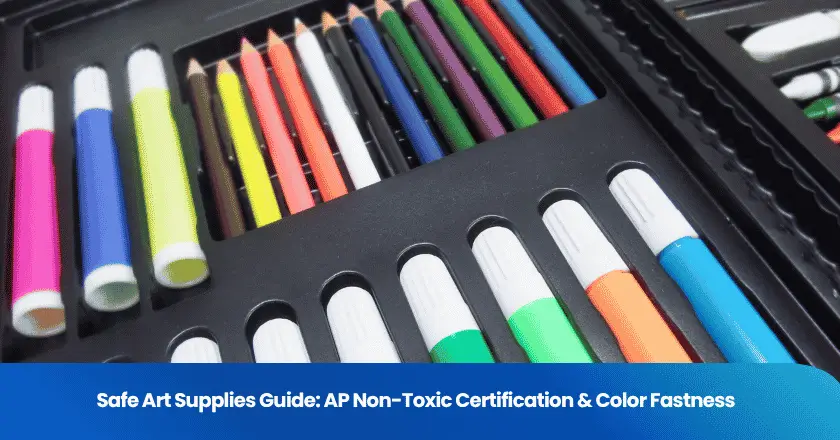
Parents and teachers prioritize art supplies that are safe for children while encouraging creativity. Start with products intended for the child’s age and activity, check what the safety label actually covers, and assess color durability separately. The AP seal concerns intended-use toxicological safety; it does not rate fading or washability. For families, educators and school-supply buyers, the useful comparison is whether the material suits both the activity and the planned display.
Choose art supplies for safety and lasting color
- Match safety evidence to the exact product, intended user and market; an AP seal is different from a regulatory conformance statement.
- Check the named rating system and medium before comparing resistance to fading.
- Use home swatches to compare visible performance, without treating them as toxicology tests or lifetime predictions.
- Select washable paint for cleanup needs and separately consider how long the artwork will be displayed.
Art Supplies Safety Certification
Safety programs and legal requirements have different scopes. Check the exact product and intended use before relying on a label: a certification seal, a statement about hazard labeling and a toy-conformity mark do not establish the same thing.
AP Non-Toxic Seal Meaning
The Art and Creative Materials Institute (ACMI) uses the AP (Approved Product) seal for art materials evaluated by a board-certified toxicologist as non-injurious when used as intended. Its CL (Cautionary Labeling) seal identifies materials with precautions for safe use. ACMI’s seal guidance says not to give CL products to children in grade 6 or lower.
Read age directions and the intended activity alongside the seal. A paint suitable for brushing onto paper is not automatically suitable for every use a child might imagine. Keep the original packaging available to the supervising adult instead of transferring an unidentified material into a classroom jar.
For bulk orders, make label accuracy and the agreed product characteristics part of the purchase specification. TradeAider explains sampling and customer-specific criteria in its inspection standards.
Regulatory Standards (CPSIA, EN 71, ASTM D4236)
CPSIA means the Consumer Product Safety Improvement Act, and EN 71 refers to the European series of toy-safety standards. Their roles differ from a private certification program.
For US consumer art materials, the Consumer Product Safety Commission (CPSC) describes a chronic-hazard toxicological assessment at least every 5 years and an ASTM D4236 conformance statement, whether or not the product poses a hazard. CPSC’s art-material guidance explains these obligations under the Labeling of Hazardous Art Materials Act (LHAMA). Conformance concerns assessment and labeling; the statement alone does not mean “non-toxic.”
US art materials that are children’s products have additional requirements, as applicable, including testing, certification and tracking labels. The CPSC art-material FAQ distinguishes these from the basic art-material obligations. Phthalate requirements concern children’s toys and child care articles; do not assume every art material automatically has the same testing scope.
| Label or framework | What to check | What it does not replace |
|---|---|---|
| ACMI AP | Exact certified product and intended use | Other applicable product or market requirements |
| ASTM D4236 / LHAMA | US chronic-hazard assessment and appropriate labeling | A separate non-toxic certification |
| CPSIA-related requirements | Applicable children’s-product rules and Children’s Product Certificate | Assessment of which rules actually apply |
| EU toy rules / EN 71 | Toy classification, relevant requirements and conformity evidence | AP certification or universal approval for all art supplies |
For an art product classified as a toy in the EU, check applicable toy-safety requirements and CE conformity evidence. The European Commission’s toy-safety guidance also explains the transition: Regulation (EU) 2025/2509 starts applying on 1 August 2030. Do not treat its later application date as a reason to skip current obligations.
How to Spot Genuine Safety Labels
Use ACMI’s certified-product search to check AP or CL status by brand or medium. Match the product identity, rather than assuming one certified item covers every material sold under the brand. If a listing is missing or unclear, ask ACMI or the manufacturer to clarify.
For an institutional order, also identify who will perform any independent checks and what the resulting report covers. Start provider verification with TradeAider’s company information.
- Read the actual product name, age directions and warnings, not just the seller’s listing title.
- For US supplies, look for the ASTM D4236 conformance information and any required precautions.
- Ask the supplier to resolve differences between online claims, packaging and the product documentation before buying in quantity.
Color Fastness in Paint and Crayons
Color fastness describes resistance to color change or loss under an exposure such as light, moisture or friction. Lightfastness means resistance to fading under light. Water resistance and rub transfer answer different questions; a favorable result for one does not establish the others.
Why Color Fastness Matters
For children’s art, using supplies with poor color fastness can result in artwork that fades quickly or colors that bleed. Strong color retention is especially useful for displays in classrooms or homes. Environmental factors like sunlight and humidity affect preservation, so the intended display location matters alongside the material.
Safety and lightfastness require different evidence. A toxicological evaluation addresses health under intended use, while a fading comparison addresses color under a particular exposure. Washability concerns cleanup. Choose which product properties matter for the project, then ask for evidence covering those properties rather than using one label to answer all three questions.
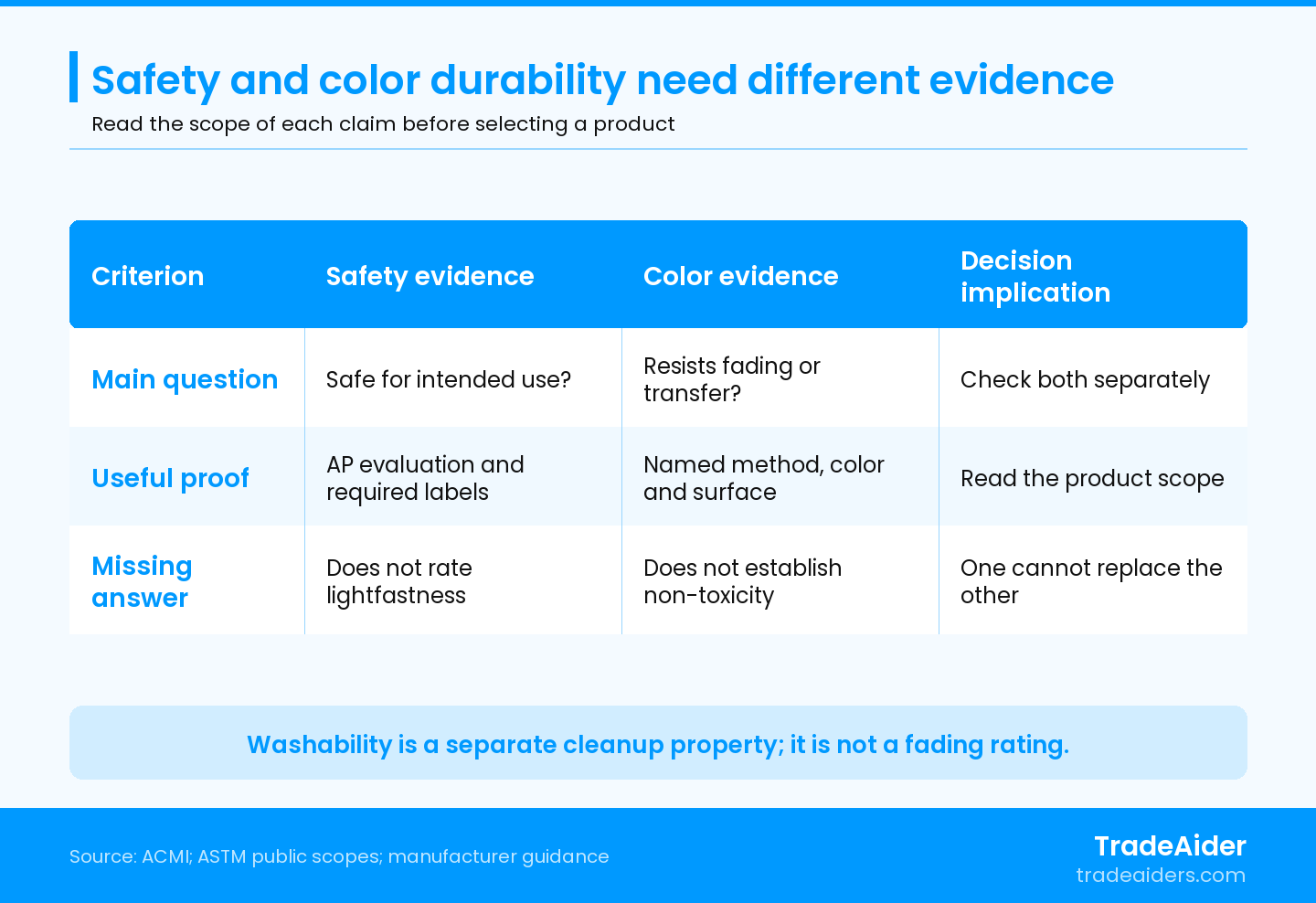
Safety labels, lightfastness ratings and washability describe different properties. Check the exact product, intended use and method behind each claim.
Finding Color Fastness Ratings
Consumers can often find color fastness ratings on product packaging or brand websites. Read the rating legend for the exact product line and color. A set may contain colors with different results; the word “artist” or a prominent star symbol is not a substitute for that detail.
ASTM D6901 covers composition, performance and labeling of artists’ colored pencils. It is not a universal color-fastness specification for paint and crayons. Ask which method is relevant to the actual medium instead of copying a standard number from another category.
For school-supply importers needing documented testing, TradeAider’s product testing process describes needs alignment and report issuance. Confirm the proposed method and product scope before booking; do not assume the service grants ACMI certification.
Winsor & Newton’s terminology guide describes ASTM pigment lightfastness from I, the highest, to V, the lowest, and separately uses AA/A/B/C permanence ratings. Those descriptions illustrate why a rating needs its own legend; permanence and pigment lightfastness are related but distinct.
| Rating shown | How to read it |
|---|---|
| Stars | Use the manufacturer’s legend; three stars has no universal meaning. |
| ASTM lightfastness | Check the applicable medium, method and individual color; do not convert a category into a guaranteed lifetime. |
| Blue Wool reference | Compare fading against identified reference materials under the stated exposure. |
At-Home Color Fastness Tests
Parents and teachers can perform simple comparisons to check the visible durability of art supplies. Keep the paper, paint thickness and drying conditions alike so a difference is easier to interpret.
- Sunlight comparison: Place a color swatch in a sunny window, covering half with opaque material. Record the start date and compare the exposed and covered areas over time.
- Rub comparison: After drying as directed, rub a colored area with a clean, dry cloth to check visible transfer.
- Water comparison: For a medium intended to resist water after drying, apply a small amount of water to a designated swatch and observe bleeding. Watercolor reactivation is not automatically a defect.
ASTM D5383’s visual method uses indoor sunlight with simultaneous Blue Wool references. A casual home swatch does not reproduce that controlled comparison or establish a century-long life. It can reveal an obvious difference under the conditions tried; it cannot establish chemical safety.
Choosing the Best Paint for Kids Crafts
Choose paint for the child’s age, intended activity, working surface and cleanup needs. For a temporary paper activity, easy washing may matter more than archival permanence. For a keepsake display, consider color retention and suitable storage as separate selection questions.
Safety Checklist for Art Supplies
Institutional buyers arranging agreed product checks can review the booking and report workflow.
To support safe creativity, use this checklist before purchasing:
- Choose a product intended for the age group and activity, and verify its labels and warnings.
- Look for AP-certified options for younger children; check the exact product rather than relying on a generic “non-toxic” listing.
- Choose a washable formulation where cleanup is important, checking which surfaces the claim covers.
- For a known allergy, obtain ingredient information and appropriate professional advice; do not conduct an improvised skin or exposure test on the child.
- Protect work surfaces, supervise the activity and follow the manufacturer’s cleaning directions.
Crayola’s paint comparison distinguishes its water-based acrylic, tempera and washable paints. It describes its washable paints as neither permanent nor lightfast, with washability from most launderable clothing and skin. This is a product-specific distinction, not a claim that every brand’s formulation behaves alike.
| Paint type | Typical activity | Check on the exact product |
|---|---|---|
| Tempera paint | Paper crafts and posters | Age suitability, cleanup and permanence; not all tempera is washable |
| Watercolor | Paper art and exploring blending | Lightfastness and intended water-soluble behavior |
| Acrylic paint | Suitable canvas, wood or stone projects | Age, surface compatibility and dried-paint cleanup |
| Finger paint | Supervised tactile painting | Explicit finger-paint use, age directions and washability |
Tips for Long-Lasting Color
Follow product storage instructions and protect artwork from direct sunlight. Keep paints in a cool, dry place as directed and ensure lids are tightly sealed to prevent drying. Choose paper suitable for the medium; for work intended to be kept, consider acid-free paper rather than treating the paint’s rating as the only preservation factor.
A finish is an additional material, not an automatic cure for fading. Before varnishing an acrylic project, check the paint and finish manufacturers’ instructions for compatibility, age suitability and safe application. Try a separate sample first. For everyday children’s drawings, careful storage or a photograph may be more practical than adding a coating.
For a school-supply order, prepare the product description, intended age group, destination market, label artwork and the checks you need. TradeAider can discuss the proposed testing or inspection scope and clarify the checks and report expectations before booking. Contact our team.
FAQ
Can art supplies without the AP seal still meet US requirements?
Yes, but a missing AP seal alone establishes neither compliance nor noncompliance with US requirements. Verify the actual product’s assessment, labeling and any applicable children’s-product evidence. If you specifically require ACMI certification for a school purchase, resolve that program status separately rather than accepting another document as an AP award.
Does washable paint have to be lightfast for every kids craft?
No. A short-lived activity may prioritize cleanup, while a classroom display calls for attention to fading as well. Decide how the artwork will be used before paying for a permanence claim. For a keepsake, check individual colors and the planned display conditions; for exploratory painting, follow the age and cleanup instructions even when permanence is unimportant.
What is the difference between latex and acrylic paint for kids projects?
Latex commonly describes house paint, while acrylic covers several art and coating products; neither name alone establishes suitability for children. Select a product specifically intended for the child’s age and activity. A household wall-paint label is not interchangeable with a children’s-art label, and an adult artist’s acrylic may have different precautions or cleanup needs.
Artigos Relacionados


Expanda seu negócio com o Serviço TradeAider
Clique no botão abaixo para entrar diretamente no Sistema de Serviço TradeAider. Os passos simples desde a reserva e pagamento até o recebimento de relatórios são fáceis de operar.

