
- Sobre Nós

- Nossos Serviços
- Sua Indústria
- Recursos
- Notícias e Blog
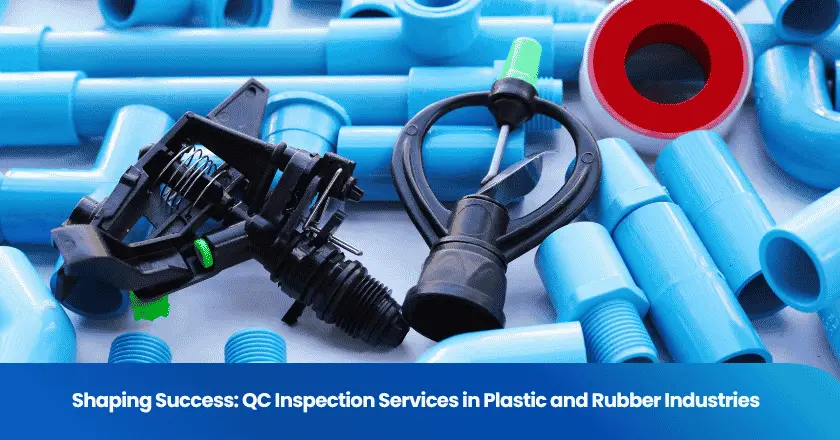
Plastic and rubber products are used across a wide range of industries, from household goods and packaging to automotive components, electrical products, medical products, and industrial parts.
Although these materials can be processed into highly consistent products, manufacturing defects can occur at different stages. Problems with dimensions, molding, material consistency, surface finish, hardness, assembly, or functionality may affect whether a finished product meets the buyer's requirements.
This is why QC inspection services in the plastic and rubber industries need to go beyond a simple visual check. A suitable inspection program should evaluate the characteristics that matter to the specific product and monitor whether mass production remains consistent with the approved specifications.
Why Quality Control Matters for Plastic and Rubber Products
Plastic and rubber products are often produced through processes such as injection molding, blow molding, extrusion, compression molding, or other specialized manufacturing methods.
Small changes in production conditions can affect the finished product. For example, problems with molding conditions may result in deformation, flash, short shots, sink marks, color variation, or dimensional inconsistencies.
For rubber products, material formulation and curing conditions can also influence properties such as hardness, elasticity, compression behavior, and appearance.
Common quality risks include:
| Risk Area | Typical Issues |
|---|---|
| Dimensions | Incorrect size, thickness, diameter, or tolerance |
| Molding | Flash, short shots, sink marks, warping, deformation |
| Surface | Scratches, bubbles, cracks, stains, flow marks |
| Material | Inconsistent material, contamination, incorrect formulation |
| Color | Color variation, incorrect shade, uneven coloration |
| Rubber Properties | Hardness variation, poor elasticity, cracks, deformation |
| Assembly | Misalignment, loose components, incorrect fitting |
| Function | Leakage, sealing failure, poor flexibility, incorrect operation |
| Packaging | Incorrect quantity, damaged packaging, labeling or carton errors |
The appropriate inspection scope depends on the product, manufacturing process, technical specifications, and intended application.
Key Inspection Areas for Plastic Products
1. Dimensions and Tolerances
Dimensional consistency is often critical for molded plastic products because components may need to fit with other parts.
Inspectors can check dimensions such as:
- Length and width
- Height
- Diameter
- Wall thickness
- Hole diameter
- Component spacing
- Weight
- Other buyer-defined dimensions and tolerances
Measurements should be compared with the approved drawing, specification, sample, or technical requirements.
For products requiring tight engineering tolerances, specialized measurement equipment or laboratory testing may be necessary beyond a standard visual inspection.
2. Molding Defects
Plastic molding defects can affect both appearance and functionality.
Common defects include:
- Flash
- Short shots
- Sink marks
- Warping
- Weld lines
- Flow marks
- Burn marks
- Bubbles
- Cracks
- Deformation
Not every visible molding mark is automatically a critical defect. Acceptance should be based on the buyer's specifications, approved sample, product function, and agreed defect classification.
3. Surface Finish and Appearance
For consumer-facing plastic products, appearance can have a direct effect on perceived product quality.
Inspection may include checking:
- Surface scratches
- Color consistency
- Gloss or texture
- Printing
- Coating
- Logos
- Mold marks
- Stains
- Burrs
- Visible deformation
Inspectors can compare finished products against approved samples and defined appearance standards.
Key Inspection Areas for Rubber Products
Rubber products require additional attention to material behavior and physical characteristics.
Hardness and Elasticity
Rubber hardness can affect how a component performs in its intended application. Depending on the product, buyers may specify a hardness range using an appropriate measurement method.
Other relevant characteristics may include:
- Elasticity
- Compression behavior
- Flexibility
- Recovery after deformation
- Surface condition
Where these characteristics are critical to product performance, appropriate testing equipment and defined test methods should be used.
Surface and Molding Defects
Rubber molding can produce defects such as:
- Flash
- Cracks
- Bubbles
- Voids
- Surface contamination
- Incomplete molding
- Deformation
- Uneven edges
These defects should be evaluated according to the product's function and agreed acceptance criteria rather than appearance alone.
Sealing and Leakage Performance
For rubber seals, gaskets, O-rings, and similar products, dimensional accuracy and material properties may directly affect sealing performance.
Depending on the product, quality control may therefore include:
- Dimensional inspection
- Hardness testing
- Visual inspection
- Compression-related checks
- Leakage testing
- Functional testing
The exact test method should be determined according to the product specification and application.
Plastic and Rubber Inspection Should Be Product-Specific
One of the biggest limitations of a generic QC checklist is that different plastic and rubber products have completely different quality requirements.
For example:
| Product | Important QC Considerations |
|---|---|
| Plastic household products | Appearance, dimensions, color, molding, assembly |
| Plastic packaging | Dimensions, sealing, appearance, closure function |
| Injection-molded components | Dimensions, tolerances, molding defects, material consistency |
| Rubber seals | Dimensions, hardness, elasticity, sealing performance |
| Rubber hoses | Dimensions, surface condition, connections, leakage |
| Automotive rubber/plastic parts | Dimensions, material properties, assembly, function |
| Electrical plastic components | Dimensions, molding, assembly, material requirements, applicable testing |
| Consumer products | Appearance, function, materials, packaging, labeling |
The inspection plan should therefore be developed around the actual product rather than applying the same checklist to every plastic or rubber item.
Inspection at Different Production Stages
Quality control can begin before the final product is ready for shipment.
| Inspection Stage | Main Purpose |
|---|---|
| Pre-Production | Check materials, specifications, approved samples, components, and production requirements |
| During Production | Monitor molding, processing, workmanship, dimensions, and production consistency |
| Pre-Shipment | Inspect finished products, quantity, appearance, dimensions, function, and packaging |
| Container Loading | Verify quantity, carton condition, loading arrangement, and shipment details |
For products with complex molding processes or tight specifications, during-production inspection can be particularly useful because defects may be easier to correct before the entire order is completed.
Material and Component Quality
The finished product can only be as consistent as the materials and components used to manufacture it.
Depending on the product, buyers may define requirements for:
- Plastic resin or material type
- Rubber material
- Color masterbatch
- Additives
- Metal inserts
- Adhesives
- Packaging materials
- Purchased components
When material composition or chemical properties are important, laboratory testing may be required.
An on-site inspection can verify defined production and material requirements, but it should not be presented as a substitute for laboratory analysis when a technical test is required.
Inspection vs. Laboratory Testing
Plastic and rubber products may require both physical inspection and laboratory testing, but these serve different purposes.
| QC Inspection | Laboratory Testing |
|---|---|
| Evaluates production units on site | Tests samples using defined laboratory methods |
| Checks dimensions, appearance, workmanship, quantity, and defined functional characteristics | Evaluates specific physical, chemical, mechanical, or material properties |
| Helps identify production inconsistencies | Provides measured test results for specified properties |
| Can be conducted during production or before shipment | Usually requires samples and controlled test procedures |
| Useful for monitoring mass-production consistency | Useful when technical or regulatory testing is required |
For example, an inspector may identify visible molding defects or measure product dimensions during an on-site inspection, while laboratory testing may be required to determine specific material properties or chemical characteristics.
How QC Inspection Helps Prevent Production Problems
The value of inspection is not limited to finding defects in finished products. When performed during production, it can provide information while corrective action is still possible.
A practical process may look like:
Define Requirements → Review Production → Inspect Samples → Identify Defects → Correct Issues → Verify Improvements → Inspect Finished Products
For example, if repeated dimensional deviations are found during production, the buyer can communicate the issue to the manufacturer and request adjustment before the entire order is completed.
This makes inspection part of a broader process-control approach rather than simply a final pass/fail activity.
What Buyers Should Provide Before Inspection
Clear inspection criteria make the results more useful.
Before arranging an inspection, buyers should provide relevant technical and commercial information:
| Information | Examples |
|---|---|
| Product specifications | Dimensions, weight, materials, tolerances |
| Technical drawings | Drawings and engineering requirements |
| Approved sample | Reference sample for appearance and construction |
| Material requirements | Plastic or rubber type, grade, hardness |
| Functional requirements | Sealing, flexibility, fitting, operation |
| Packaging | Individual and carton packaging requirements |
| Labeling | Product markings, barcodes, carton marks |
| Quality criteria | Defect classification, AQL, buyer-specific requirements |
| Testing requirements | Applicable physical, mechanical, or laboratory tests |
The more clearly these requirements are defined, the easier it is for inspectors to evaluate the production against the buyer's expectations.
Corrective Action and Re-Inspection
Finding a defect is only one part of quality control.
When an inspection identifies problems, the manufacturer may need to:
- Identify the cause of the defect.
- Adjust the production process or replace defective components.
- Rework or segregate affected products.
- Verify the corrective action.
- Conduct re-inspection when required.
TradeAider can help supervise corrective actions on site, verify the improvements, and support re-inspection when needed.
This approach helps buyers follow quality issues from identification to verification, rather than stopping at the initial inspection report.
Third-Party QC Inspection for Plastic and Rubber Products
For international buyers sourcing plastic and rubber products from overseas factories, third-party inspection can provide an independent assessment of production quality.
Depending on the product, inspection services can cover:
- Dimensions and tolerances
- Appearance and workmanship
- Molding defects
- Material and component requirements
- Hardness or defined physical checks
- Assembly
- Functionality
- Packaging and labeling
- Quantity
- Shipment condition
The inspection scope can be adapted to the product's manufacturing process and the buyer's quality requirements.
TradeAider provides third-party inspection and testing services for different types of manufactured products, allowing buyers to integrate quality checks at different stages of production.
Conclusion
Plastic and rubber manufacturing involves a wide range of production processes and product requirements. A visual inspection alone may not be sufficient to evaluate the characteristics that matter to a particular product.
A well-designed QC inspection service for plastic and rubber products should focus on the actual manufacturing process and the product's critical quality characteristics, including dimensions, molding, material consistency, surface finish, hardness, assembly, and functionality where applicable.
For technical material or performance requirements, on-site inspection can be combined with appropriate laboratory testing.
By defining clear inspection criteria and checking quality at appropriate stages of production, buyers can gain better visibility into manufacturing consistency and address problems before products are shipped.
Artigos Relacionados
Expanda seu negócio com o Serviço TradeAider
Clique no botão abaixo para entrar diretamente no Sistema de Serviço TradeAider. Os passos simples desde a reserva e pagamento até o recebimento de relatórios são fáceis de operar.

