
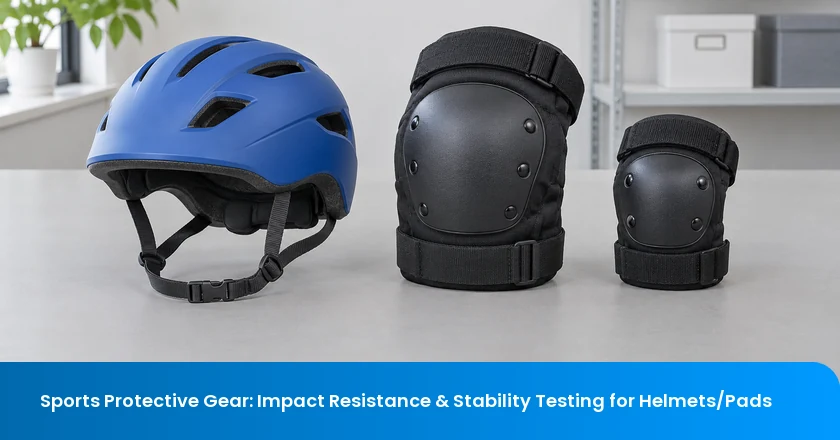
Sports protective gear needs evidence that it manages the relevant impacts and remains over the area it is intended to protect. For helmets, impact attenuation, positional stability and fastening strength answer different questions. For pads, impact performance belongs alongside coverage, restraint and freedom of movement. Start with the sport, user and market before selecting a test or interpreting a label.
Laboratory results, manufacturing checks and correct use contribute different parts of the decision; a favorable result in one does not establish every other part.
What impact protection can—and cannot—do
A helmet can help protect against serious head or brain injury, but it cannot promise protection from every injury. CDC’s helmet guidance states that there is no concussion-proof helmet and emphasizes appropriate certification, fit, age suitability, maintenance and consistent, correct use. Do not turn a certification mark into a guarantee that a collision will be harmless.
Think of protection as a system. The shell, cushioning, coverage and fastening have different jobs, and their interaction matters. Impact attenuation means reducing the impact response measured by a defined test. Stability concerns keeping the protector in its intended position. A thicker cushion or harder shell, considered alone, does not establish that the complete product performs better.
For a buyer, this changes the first question from “Which foam is best?” to “What hazards and use conditions must this complete design address?” For a wearer, it means choosing equipment made for the activity and fitting it correctly, rather than borrowing a similar-looking item from another sport.
Choose requirements for the actual sport and market
Write down the intended activity, claimed protection, user group, sizes and destination. Then identify the applicable legal requirements, sport rules and product standards. They may have different roles: a law can impose market obligations, while a technical standard defines particular performance requirements or methods.
In the United States, CPSC’s bicycle-helmet guidance explains that marketing can bring a multipurpose helmet within bicycle-helmet requirements if a reasonable consumer would understand bicycling to be an intended use. Helmets marketed exclusively for certain other activities fall outside that bicycle-helmet scope. The wording on packaging and online listings therefore belongs in the assessment.
The NOCSAE standards library separately lists headgear laboratory methods, football-helmet performance specifications and procedural guides. Read the relevant specification with its referenced methods and effective requirements. An organization’s name, or “ASTM tested” without an identified specification, cannot tell you which sport, configuration or performance criteria were covered.
How laboratory impact tests evaluate helmets
A controlled helmet impact test evaluates a defined assembly under specified conditions. A headform is a test form representing the head; it carries the helmet in the required position. The apparatus delivers the prescribed impact, and instrumentation records the response. Headform selection, impact surface, location, speed, sample preparation and test sequence can affect the interpretation.
For a concrete, limited example, CPSC’s US bicycle-helmet summary describes headform impacts onto specified anvils and failure when a tested sample exceeds 300 g peak acceleration under the prescribed conditions. Here, g expresses acceleration relative to gravity. This is a criterion for that bicycle-helmet procedure, not a universal adult-sports limit or a threshold below which concussion cannot occur.
The same guidance describes environmental conditioning and testing the helmet as offered for sale, including the manufacturer’s attachments. A report should identify the samples and conditions actually evaluated. A dry, room-temperature result cannot silently stand in for every condition required by the applicable protocol.
Separate complete-product performance from material development. A small material specimen used in a fracture or toughness test can help engineering compare materials, but it does not reproduce the complete helmet’s geometry, liner, straps and fit. Likewise, a scan may reveal particular structural information without establishing impact attenuation. Do not substitute those results for the applicable finished-product tests.
Test stability and retention as separate functions
Impact attenuation, positional stability and retention strength are separate functions. In CPSC’s bicycle-helmet test summary, the positional-stability test requires the helmet not to come off the headform. The retention-strength test separately requires the straps not to separate or extend more than 30 mm under its prescribed loading. These conclusions depend on their respective procedures.
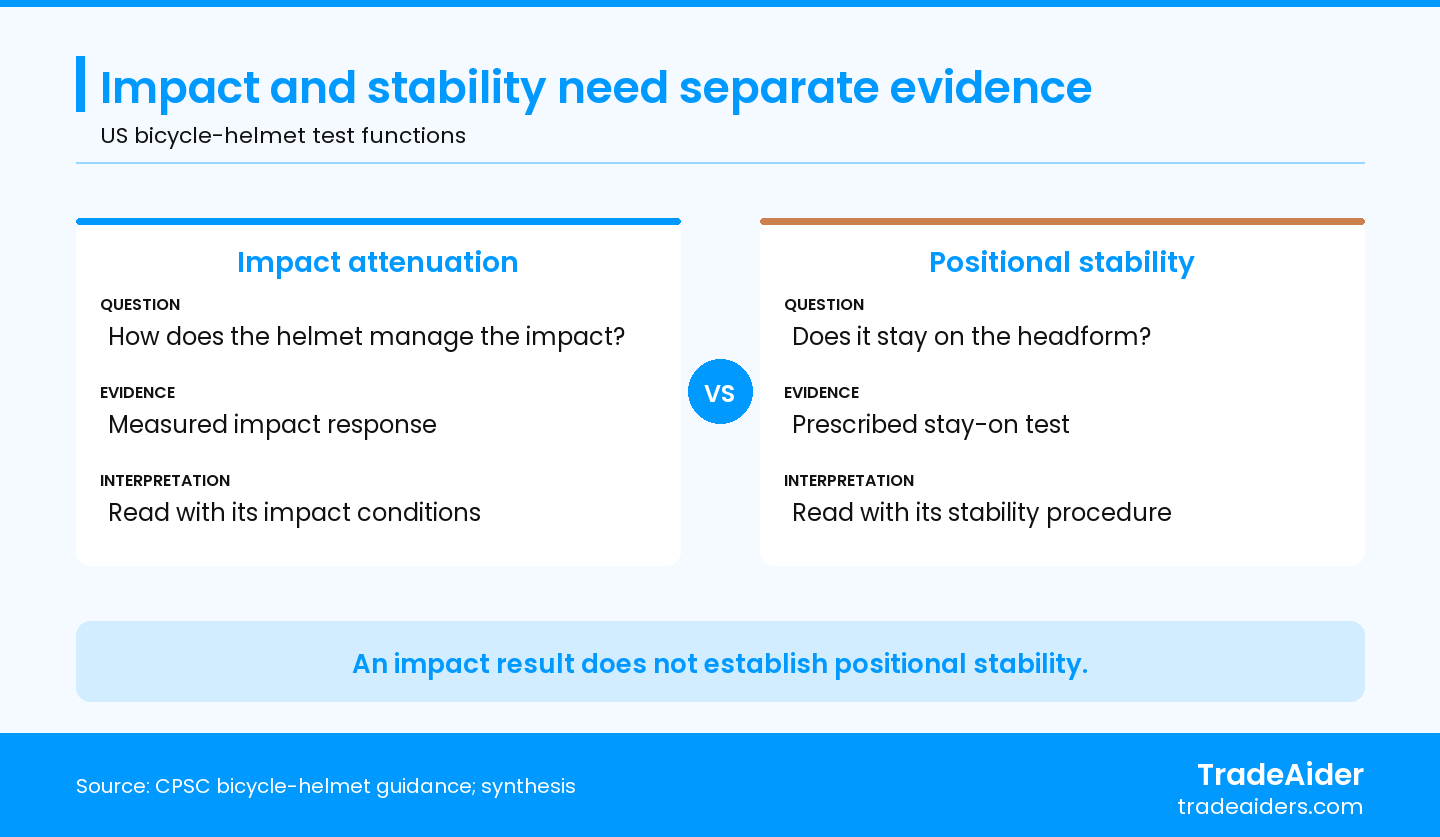
US bicycle-helmet example: impact attenuation and positional stability are separate requirements. Follow the applicable procedure for each; this diagram is not a test setup.
A roll-off or positional-stability assessment asks whether the helmet can be pulled off its test position. A retention-strength assessment challenges the fastening system. An impact report does not answer either question merely because straps were present during the impact. Nor does a buckle that closes smoothly establish its performance under the required load.
For order checks, compare strap routing, anchors, adjustment range, buckle engagement and supplied instructions against the approved design. These observations can reveal mismatches to investigate. They are not instructions to improvise a laboratory load test on a person, and a hand pull is not a certification result.
Assess pads for impact, coverage and restraint
Protective pads need their own test basis. BSI’s EN 14120 listing concerns wrist, palm, knee and elbow protectors for users of roller-sports equipment. Its scope is useful precisely because it identifies the products and activity. Do not transfer that designation automatically to football shoulder pads, a chest protector or protective equipment for another sport.
SATRA’s technical explanation of roller-sports protectors distinguishes force transmitted through the protector, impact strength of the protective shell, abrasion, ergonomics and restraint. It also explains that impact energies depend on the intended wearer’s body-mass range. These are different assessment questions, rather than one generic “pad strength” score. Use the applicable procedure to establish the required conditions and criteria.
An intact outer shell does not by itself show how much force reached the inner side. A cushioning result does not show that a knee pad remains over the knee during the intended movement. A comfortable fit does not establish abrasion performance. Ask which of these questions each report actually answers.
Inspect the complete pad system: protective area, shell and cushioning arrangement, edges, stitching, sleeves, straps and closures. Consider how it is positioned, adjusted and worn with other equipment. For a fitting or movement evaluation, define the intended size/user conditions and observations in advance. Do not expose a wearer to intentional impacts to demonstrate protection.
Read the test conditions before comparing results
Compare results only after aligning their test basis. ASTM F355’s public scope and significance information provides an instructive example: for its sports surfaces and facility-padding context, results obtained under different impact conditions are not directly comparable. That comparison discipline is useful when reading other reports, but F355 is not a universal wearable-pad or helmet certification method.
For the helmet or pad being purchased, check the standard and edition, complete sample description, size, preparation, impact conditions, measured quantity, units and acceptance criterion. Determine whether the report covers the required test sequence or only a selected check. A lower number cannot be called better protection if the two numbers represent different quantities or conditions.
Where evidence is incomplete, ask the laboratory to explain the missing coverage. Distinguish a failed requirement from an untested requirement: both can prevent an approval decision, but they require different follow-up.
Read certification and conformity evidence correctly
A standard, a test report, certification and a market-conformity process are related records, not interchangeable labels. Read the actual product identification, claim and responsible issuer before treating a mark as proof.
For EU personal protective equipment, the European Commission’s PPE overview distinguishes essential health and safety requirements, the presumption of conformity available through applicable harmonized standards, and the prescribed conformity-assessment process. It warns that voluntary certificates are not a substitute for the required compliance evidence. An EN number on a supplier sheet alone does not complete that process.
For US children’s products subject to applicable children’s-product safety rules, CPSC’s Children’s Product Certificate guidance describes certification based on testing by a CPSC-accepted third-party laboratory, with applicable exemptions, exceptions and determinations. Identify the product and rules first. Do not assume that every protective item is a children’s product or that an adult-use report supplies the required children’s-product evidence.
Certification also concerns the evaluated model. NOCSAE’s football-helmet add-on statement says NOCSAE itself does not certify or approve products. It explains that attached add-ons can create a new model requiring a separate certification process, and that the manufacturer and SEI may declare the original certification void. Check the helmet-and-accessory combination rather than borrowing the original helmet’s status. This does not mean every unattached headband creates a new model.
Check the manufactured product against the tested design
Manufacturing checks connect the ordered product to the approved construction. Compare model and size markings, shell and liner arrangement, pad coverage, fastening components, assembly, labels, instructions and packaging. Record visible cracks, loose attachments, sharp edges, inconsistent closures or differences from the approved reference.
A material description or supplier photograph is not enough to establish that production matches the tested design. Ask the supplier to explain substitutions in cushioning, shell construction, strap material or closure geometry. Have the responsible technical reviewer determine which changes affect the evidence and what additional assessment is needed.
Keep the order-inspection findings specific: identify the sample, location, reference and observed difference. Use an agreed sampling and defect-classification plan for workmanship. The absence of visible defects does not establish impact performance, and destructive protective-performance testing requires suitable samples, equipment and a defined method.
Prepare a product-specific test brief
Use the brief below to discuss the product with the laboratory. Fill the available information, mark gaps and assign them to the responsible supplier or technical owner. Before testing starts, agree the applicable methods and acceptance criteria rather than asking for a generic “sports safety pass.”
| Brief item | Fill in | Agree before testing |
|---|---|---|
| Use and market | Sport: ___; users/sizes: ___; destination: ___ | Required protective functions |
| Exact construction | Model/revision: ___; shell/liner: ___; restraint: ___ | Variants and attachments covered |
| Test basis | Specification/edition: ___; methods: ___ | Applicable requirements and criteria |
| Samples and preparation | Allocation: ___; conditioning: ___; sequence: ___ | Representative and destructive samples |
| Results and reporting | Measured quantities/units: ___; report scope: ___ | Traceable results and limitations |
| Open questions | Missing input: ___; owner: ___; next action: ___ | Pending items resolved before approval |
Plan enough identifiable samples for the required sizes, configurations, conditioning and test sequence. Keep impact-tested or otherwise damaged specimens out of saleable stock. Where the requested test cannot be performed with the proposed equipment or sample, resolve that limitation before work rather than recording an improvised check as a standard test.
TradeAider’s product testing process describes needs alignment, sample identification, implementation and report issuance. Use the inquiry to agree the testing objects, standards, samples and report scope for the actual protective gear.
Illustrative example: a pad stays intact but moves off target
This is a hypothetical example, not client data. A roller-sports knee pad has an impact report for its original construction. The production version changes the strap and closure. During a supervised movement evaluation agreed for the intended size, the pad remains intact but migrates away from the intended knee area. The buyer holds approval of the changed configuration and asks the supplier to investigate sizing, instructions and restraint. The technical reviewer determines which evidence is affected. Restoring the original arrangement or developing a revised closure is followed by the relevant reassessment and testing, including verification that the pad remains correctly positioned under the agreed evaluation. If the movement method or acceptance criterion has not been defined, the result remains pending while the technical owner establishes that basis. Do not invent a universal displacement limit. The observation does not measure injury risk or prove that every size failed; it shows why an impact result alone cannot resolve a changed restraint system.
Fit, inspect and replace gear according to its use
Follow the sport- and model-specific fitting, care, impact and replacement instructions. Select the appropriate size and adjust the equipment as directed; check that the helmet sits in its intended position and that pads cover the intended areas through the permitted movement. Recheck fit when equipment, clothing or adjustment changes.
Before use, look for damage, loose components, worn closures and deterioration, and stop using suspect equipment while obtaining manufacturer guidance. A clean exterior does not rule out hidden impact damage. US bicycle-helmet guidance specifically requires a warning about potentially invisible impact damage and return to the manufacturer, or destruction and replacement, after such an impact.
Do not apply one replacement interval to every helmet and pad. Follow the manufacturer and any applicable sport or certification program, including its inspection or recertification requirements. Use only permitted cleaning methods and replacement components; an unapproved alteration can change both fit and the evaluated protective system.
What should support a protective-gear purchase?
- The intended sport, user, size and market match the evidence.
- Impact performance and stability or restraint are assessed separately where required.
- The supplied construction and accessories match the evaluated configuration.
- Reports, conformity records, instructions and manufacturing findings support their own stated scopes.
Discuss the testing scope for your protective gear
Begin a TradeAider inquiry with the product and order information available, intended sport, users, sizes and destination. Share construction details, existing reports and concerns about impact performance, restraint or changes. Before commissioning work, agree samples, methods, criteria, reporting and limitations. Contact our team to discuss an appropriate testing plan and the report scope.
FAQ
Can a helmet tested for one activity be sold for several sports?
Only when the claimed activities are supported by the applicable requirements and evidence for that model. List each intended activity rather than using “multisport” as a general assurance. Ask which requirements the manufacturer evaluated and whether the product, package and online descriptions agree. A supported claim for one activity does not automatically authorize a broader use.
Can one report cover every helmet or pad size?
Coverage must be established by the applicable sampling and assessment basis, not by a shared product name. Ask which sizes and variants were selected, how they represent the offered range, and which constructions or attachments are excluded. If a purchased version differs, obtain the laboratory or responsible scheme’s explanation of its coverage and any additional work needed.
Is a comfort liner interchangeable with an impact liner?
Treat them as different functions unless the manufacturer’s design and evidence establish otherwise. A comfort component can affect fit, while an impact-managing liner belongs to the protective construction. Use the specified replacement part and fitting directions. Do not remove cushioning to create space, or assume that a visually similar aftermarket insert preserves the original performance or certification.

Artigos Relacionados
Expanda seu negócio com o Serviço TradeAider
Clique no botão abaixo para entrar diretamente no Sistema de Serviço TradeAider. Os passos simples desde a reserva e pagamento até o recebimento de relatórios são fáceis de operar.