
- Sobre Nós

- Nossos Serviços
- Sua Indústria
- Recursos
- Notícias e Blog
Quality inspection methods are the practical ways a buyer verifies whether products, materials, labels, packaging, quantities, or supplier processes match requirements. The right method depends on the evidence needed: visual inspection finds visible defects, measurement checks dimensions and tolerances, functional testing checks performance, AQL sampling supports lot decisions, audits check supplier systems, and laboratory testing handles hidden safety or material claims.
A method should start with the buyer requirement. ISO 9001 frames quality around requirements, controlled processes, documented information, performance evaluation, and improvement. For importers, that means the inspection method should be chosen after the PO, approved sample, specification, label file, and release rule are clear.
Inspection also needs repeatability. ISO/IEC 17020:2026 defines inspection around competence, impartiality, consistent operation, and determining conformity with requirements. A method is weak if two inspectors would reach different decisions from the same evidence.
When the method uses samples, ISO 2859-1:2026 provides current AQL-indexed sampling schemes for lot-by-lot attribute inspection. That is useful for finished goods, but it is not a substitute for measurement methods, function tests, document checks, or lab tests where those are needed.
The ASQ seven basic quality tools show why method choice should organize data, not just collect observations. A check sheet, Pareto view, or cause-and-effect logic can turn defects into action rather than a pile of photos.
- Start with the proof question: what must the buyer know before release?
- Match the method to the risk: visual defects, dimensions, function, labels, materials, and process capability need different evidence.
- Use AQL only for the right job: it supports lot acceptance but does not prove hidden safety or long-term performance.
- End with action: every method should support release, hold, sort, rework, test, or reinspection.
Which Quality Inspection Method Should Buyers Use First?
Buyers should choose the first quality inspection method by the risk that can still be changed. Use pre-production review when materials, samples, labels, or setup are uncertain; use during-production inspection when defects can spread; use pre-shipment inspection with AQL sampling when finished goods need a release decision; use testing when hidden safety, material, or performance claims need proof.
The common mistake is asking one method to do every job. A visual check can find stains, scratches, poor workmanship, wrong labels, and packing defects. It cannot prove chemical composition or long-term durability. AQL sampling can support a lot decision. It cannot explain the process cause unless the report records concentration and the buyer investigates.
Method selection is therefore a chain: define the requirement, decide what evidence would prove it, choose the inspection or testing method, collect the evidence, then define the release action. If a method cannot support the action, it is probably the wrong method or it needs a companion method.
The BLS profile for quality control inspectors describes the job around examining products and materials for defects or deviations from specifications. Importers should read that literally: a method needs a specification, a product or material to examine, and a decision rule for deviations.
Step-by-Step Quality Inspection Method Selection
Use the method that produces the evidence needed for the buyer decision.
| Step | Buyer Question | Best-Fit Method | Evidence to Require |
|---|---|---|---|
| 1. Freeze requirements | What must the goods match? | Product-file review | PO, approved sample, spec, tolerance, label, packing file |
| 2. Map the lot | What does the sample represent? | AQL or risk-based sampling | Lot size, carton range, SKU spread, sample count |
| 3. Check visible quality | Can the buyer see or feel the defect? | Visual inspection | Photos, defect count, severity, location |
| 4. Verify dimensions | Does the product fit the tolerance? | Measurement inspection | Tool, reading, tolerance, failed samples |
| 5. Check performance | Does it work as promised? | Functional test or lab test | Test steps, result, pass/fail criteria |
| 6. Decide release | Can the lot ship? | Report review and action rule | Release, hold, sort, rework, test, or reinspect |
The table deliberately separates product-file review from inspection execution. Many weak reports fail before the factory visit because the inspector is not given the latest approved sample, tolerance, artwork, label, or packing rule.
The method can be simple for a repeat low-risk order and more layered for a new supplier, high-value launch, regulated product, or known defect history. The decision logic stays the same.
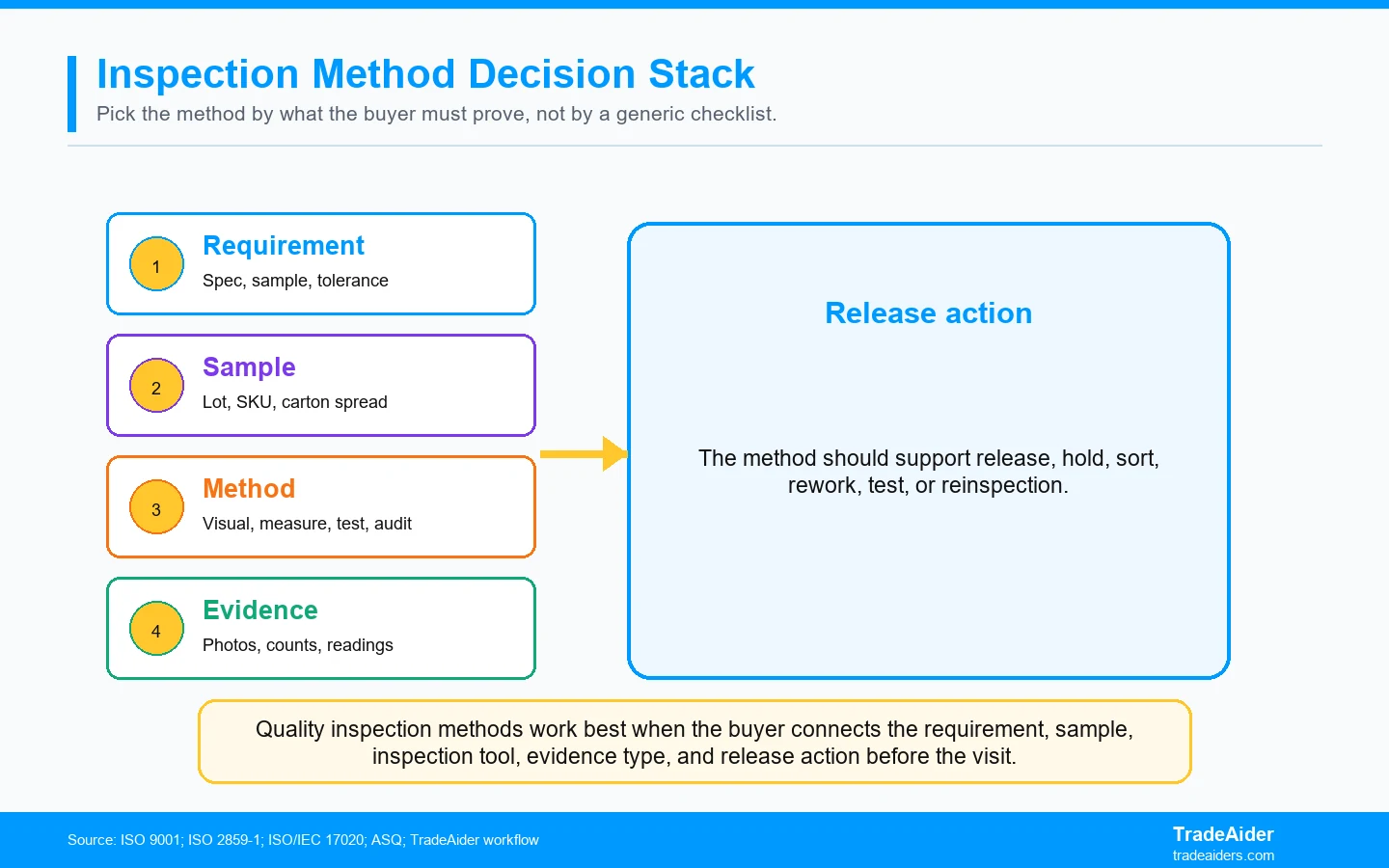
Quality inspection methods work best when the buyer connects the requirement, sample, inspection tool, evidence type, and release action before the visit.
Choose Inspection Methods by the Evidence You Need
A quality inspection method should answer a specific proof question, not merely make the report look complete.
Visual inspection answers buyer-visible risk
Visual inspection is useful for workmanship, finish, color, assembly, scratches, dents, stains, cracks, loose parts, wrong components, poor packaging, and label placement. It is flexible and often essential for consumer goods because buyer dissatisfaction is frequently visible.
The limitation is just as important. Visual inspection is not a chemistry test, electrical safety test, fatigue test, or process capability study. If the buyer needs hidden proof, a visual method should trigger testing or document review instead of pretending to close the risk.
Measurement inspection answers tolerance risk
Measurement methods use tools such as calipers, gauges, scales, torque tools, templates, barcode scanners, and fixtures to compare products with tolerances. The report should show the tool, sample size, reading, tolerance, and failed samples.
For importers, the method should focus on critical-to-quality dimensions. Measuring many irrelevant points wastes attention, while skipping one fit-critical dimension can make a clean-looking shipment unusable.
Sampling Methods Decide Whether the Result Represents the Lot
A strong inspection method can still mislead the buyer if samples come from the wrong cartons or subgroups.
AQL needs lot structure before table lookup
The buyer should define total quantity, carton count, SKUs, colors, sizes, production dates, packing versions, and any high-risk subgroup before selecting samples. A correct AQL sample size taken from the easiest cartons can still miss the risky part of the lot.
TradeAider buyers can use the AQL calculator to plan sample size, but the report should also show sample spread. The buyer needs to know which cartons, SKUs, colors, or groups were actually inspected.
Targeted checks should be transparent
Sometimes the buyer needs extra attention on a high-risk subgroup, such as a new color, changed material, late-packed SKU, corrected defect, or subcontracted process. That can be useful, but it should not be hidden inside the normal AQL result.
The report should state what was sampled under the AQL plan and what was checked as a targeted risk. That prevents the buyer from treating targeted evidence as if it represented the whole shipment.
Inspection Timing Is Part of the Method
The same product risk needs different methods depending on whether the order is before production, in production, finished, or being loaded.
Earlier methods protect correction leverage
Pre-production review can catch wrong materials, sample misunderstandings, label errors, tooling problems, and packaging confusion before mass production. During-production inspection can catch process drift while the supplier can still adjust the line.
Those methods do not replace final inspection. They reduce the chance that final inspection becomes expensive bad news after the goods are packed. The earlier the risk can spread, the earlier the inspection method should appear.
Final methods protect release evidence
Pre-shipment inspection is strongest when goods are complete enough to represent the shipment. For TradeAider PSI, the order should be 100% completed and at least 80% packed for export. That matters because labels, inner packing, cartons, accessories, and quantities are part of the buyer's release decision.
Container loading supervision is a different method. It protects quantity, handling, carton condition, loading sequence, container condition, and seal evidence at the handover point. It should not be confused with product inspection.
Reporting Turns Inspection Methods Into Decisions
The method is incomplete until the report tells the buyer what the findings mean.
Defect severity gives the report action value
Critical, major, and minor defects should be defined before inspection. A sharp edge, wrong safety label, failed function, missing accessory, color mismatch, loose thread, cracked carton, or small surface mark should not be argued after findings appear.
Good reports show defect photos, counts, severity, sample location, carton number, and whether the issue is random or concentrated. The buyer can then decide whether to release, sort, rework, test, or reinspect.
Methods should feed the next order
NIST process-control guidance separates ongoing process behavior from one-time lot acceptance. That distinction helps importers use the inspection report beyond the current shipment.
If one method repeatedly finds the same defect family, the next order may need a different method, earlier timing, clearer tolerances, supplier process evidence, or laboratory testing. A quality inspection method should improve the next product file, not only close today's report.
Scenario Estimate: The Right Method Earlier Can Reduce Rework Scope
Method timing can decide whether the buyer corrects one subgroup or reopens a packed shipment.
Assume a 14,000-unit order has a label placement error that starts after a packaging station change. If the buyer finds it only at final inspection, 4,000 packed units may need carton opening, relabeling, repacking, and reinspection.
If a during-production method checks the first packed units after the station change, the supplier may isolate the issue at 900 units instead. At $0.22 per unit for relabeling and handling, the direct correction exposure changes from about $880 to about $198 before counting delay or extra carton damage.
This is an illustrative estimate, not a universal ROI promise. It shows why method selection should follow the defect mechanism: when a mistake can spread through production, a final inspection method may be too late to control the scope.
Where TradeAider Fits in Method Selection
TradeAider helps importers choose inspection methods by order stage, product risk, sample plan, evidence need, and release action.
If the risk is setup, Pre-Production Inspection can verify materials, samples, labels, and readiness before mass production. If the risk is process drift, During Production Inspection can check early output and correction evidence.
If the buyer needs finished-lot release evidence, Pre-Shipment Inspection can apply AQL sampling, visual checks, measurements, functional checks, label review, packing evidence, and defect classification.
If the risk is hidden safety, material, or performance, TradeAider can coordinate product testing services rather than asking a visual inspection method to prove what requires a test.
SPAR Scenario: The Method Changed After the Evidence Need Changed
The buyer moved from final inspection only to a combined method because the defect could spread.
Situation: A buyer ordered 10,800 consumer products with a new label and a revised accessory set.
Problem: The supplier planned only final inspection, but the buyer's main risk was a setup error that could repeat across every packed carton.
Action: TradeAider added an early production check for labels and accessories, then used PSI with AQL sampling for finished release.
Result: The buyer corrected 520 early units, released the remaining clean lot after PSI, and kept the early label check for the next order because the supplier still had a manual label station.
Quality Inspection Method Checklist
Use this checklist before booking the inspection.
- What buyer requirement must be proven before release?
- Can the defect be seen, measured, function-tested, document-checked, or only lab-tested?
- Which order stage still allows correction?
- Does the sample represent SKUs, cartons, colors, sizes, and risk groups?
- Which findings trigger release, hold, sort, rework, testing, or reinspection?
- How will this report improve the next purchase order?
A method is useful when it produces evidence that the buyer can act on. If the method only creates a longer report, simplify it or change the timing.
The strongest inspection plans usually combine methods: product-file review, AQL sampling, visual checks, measurements, functional checks, document review, and testing where needed.
If you know the product risk but are not sure which method belongs before shipment, send TradeAider the PO, approved sample, specification, production status, known defect risk, and shipment date. The next step is to choose the right inspection method for your order before the report becomes too late to change the outcome.
Frequently Asked Questions
What are the main quality inspection methods?
The main methods include product-file review, visual inspection, measurement inspection, functional testing, AQL sampling, process checks, audits, loading supervision, and laboratory testing when hidden claims need proof.
Is AQL a quality inspection method?
AQL is an acceptance sampling method used to decide whether a defined lot passes or fails based on sampled defects and preset acceptance rules.
When should buyers use 100% inspection?
Use 100% inspection only when every unit must be checked because the risk is high, the value is high, or the defect cannot be managed through sampling.
Can visual inspection replace product testing?
No. Visual inspection can find visible defects, labeling issues, and packing problems, but chemical, electrical, safety, material, or durability claims may need testing.
How do I choose between PPI, DPI, and PSI?
Use PPI for setup risk, DPI for defects that can spread during production, and PSI for finished-lot release when goods are complete and mostly packed.

Artigos Relacionados
Expanda seu negócio com o Serviço TradeAider
Clique no botão abaixo para entrar diretamente no Sistema de Serviço TradeAider. Os passos simples desde a reserva e pagamento até o recebimento de relatórios são fáceis de operar.

