
- Sobre Nós

- Nossos Serviços
- Sua Indústria
- Recursos
- Notícias e Blog
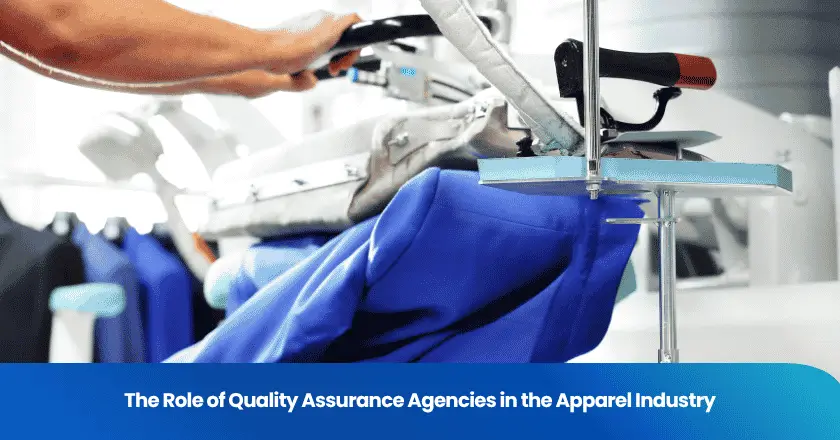
A quality assurance agency in the apparel industry is the outside party that builds and runs the prevention side of quality. A final inspection alone cannot make an apparel order consistent, because by the time the packed lot is checked the defects were already created in the fabric, the pattern and the sewing line. Quality assurance prevents those defects by controlling the process, from the technical package to the in-line check, while quality control detects them by inspecting and testing the output. The sections below set out what each stage does, what a brand gains, and how the role is changing under fast fashion and technology.
What Quality Assurance Means in the Apparel Industry
Quality assurance (QA) in apparel is the prevention-first part of quality management: the planned work that builds confidence a garment will meet the agreed standard across design, materials, production and delivery. Quality control (QC) is different. It inspects and tests the output to detect whether a garment meets the requirement, after the work is done. QA changes the process so a defect is less likely to be made; QC finds the defect that was made. A brand needs both, because a process system without an output check can drift, and an output check without a process system can only reject what has already been built.
The distinction is not a marketing invention. ISO 9000 defines quality assurance as the part of quality management focused on providing confidence that quality requirements will be fulfilled, and it separates that prevention from the defect detection of quality control. In apparel, that definition is practical: the confidence comes from a specification the factory works to, checks placed where the work happens, and records a buyer can read.
Quality management also assumes the system keeps improving, not just holds. The Baldrige Performance Excellence Program at the U.S. National Institute of Standards and Technology describes a framework to improve an organization's performance and get sustainable results. For an apparel programme that means a defect trend, a rework reason and a test result should feed the next order rather than disappear into a filing cabinet.
The stakes are higher for garments than for many products because the customer wears the result. Fit, colour, seam strength, shrinkage and label accuracy are all visible in use, so a defect is felt rather than merely counted. A buyer usually cannot watch every stage of production, so the checks and the records carry the assurance. For information about the organization handling that work, review TradeAider's company background.
The table below sets the two functions side by side, because the most common apparel quality mistake is to buy one and expect the other.
| Dimension | Quality assurance | Quality control |
|---|---|---|
| Focus | Prevention: build confidence the requirements will be met | Detection: verify whether the output meets the requirement |
| When | Across design, materials and production | At defined inspection and testing points |
| Method | Standard, technical package and process control | Inspection, sampling and laboratory testing |
| Output | A controlled process and the records behind it | An accept, rework or reject decision |
| Owner | The process owner, supported by the QA agency | The inspector or the testing laboratory |
The decision the table points to is simple. Fix the requirement and the process first, then place the inspections and tests where they can still change the order. If a brand buys only the final inspection, it has bought detection without prevention, and it will pay to discover defects it could have avoided. A short written quality plan that names the standard, the stages and the records turns that decision into something a factory and an agency can both follow, and it keeps the two functions from being confused when a shipment is under time pressure.
How Apparel Quality Assurance Agencies Work Across Production
An apparel quality assurance agency carries the standard through the production path with three methods: a technical package that fixes what correct means, in-line checks that catch a defect while the line is still running, and final inspection and laboratory testing that confirm the packed order. Each stage has a method, an owner and a record. The stage map matters because each method catches a different class of problem: the technical package prevents a wrong build, the in-line check prevents a repeated defect, and the final stage confirms what is about to ship. Keep the requirement separate from the method used to check it, because a clear requirement can still be measured in more than one way; the inspection-standard guidance explains how the two are kept apart.
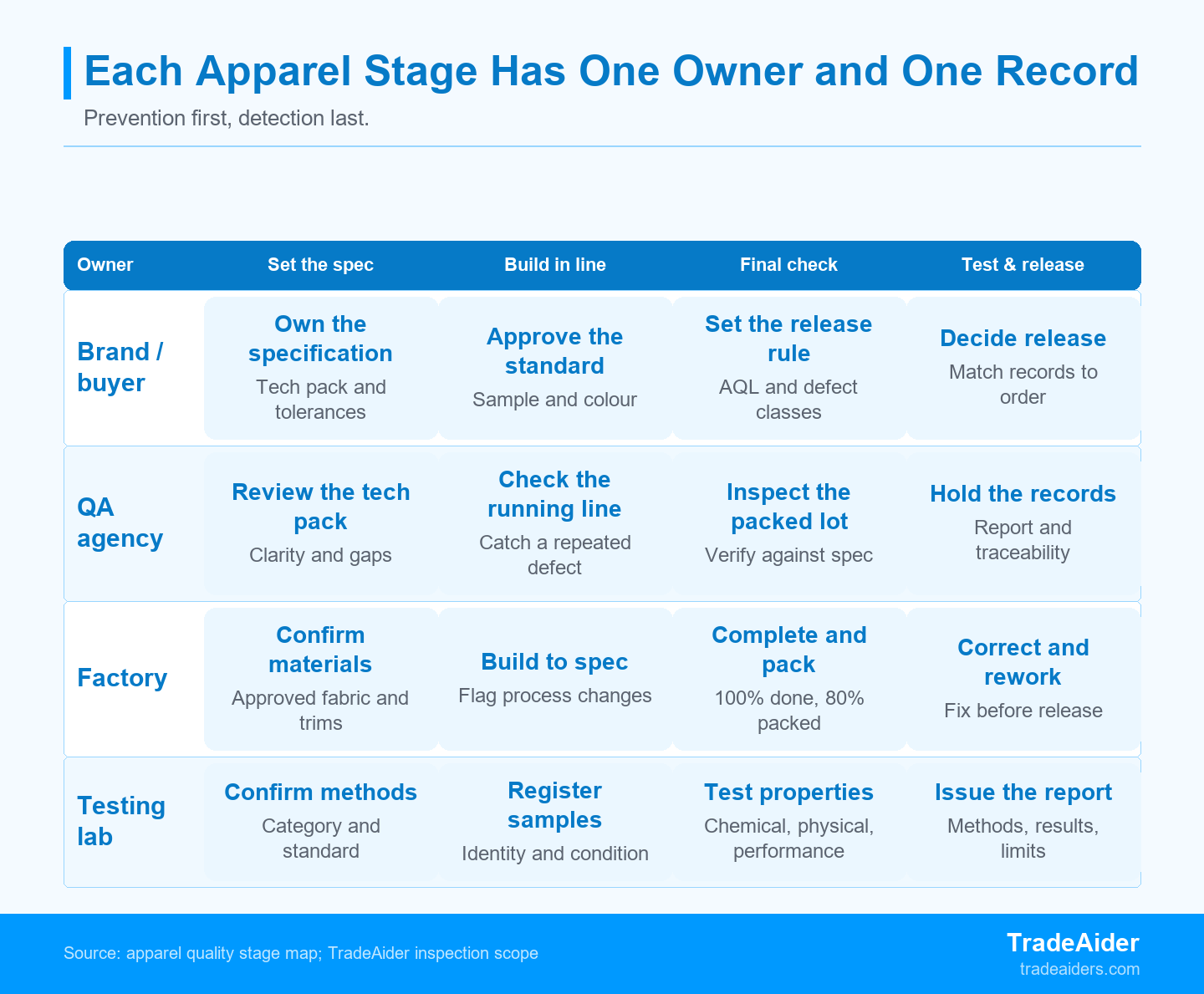
Each apparel quality stage has one owner and one record, so the release decision follows the handoffs rather than the last check alone.
The Technical Package as the Quality Reference
The technical package, or tech pack, is the specification document that tells a factory how to produce a garment. It carries flat sketches, measurements with tolerances, the bill of materials, construction notes, the cost sheet and a version log. Industry guidance describes a tech pack as the specification document that tells a manufacturer exactly how to produce your garment, and it is the document the factory quotes from, samples from and builds from. For the QA agency it is the reference against which every later check is read.
That is why an incomplete technical package is the most expensive gap in an apparel programme. Every missing detail, from the seam allowance to the tolerance on the chest measurement, becomes a decision the factory makes on the brand's behalf, and factories default to what is easiest on their own line. A version log is part of the specification for the same reason: when a factory runs several brands at once, an undated pack can be built to an older revision without either side noticing. Own the specification before the design reaches the factory, and the rest of the quality work has something to measure against.
In-Line and During-Production Inspection
An in-line inspection is a check made while the production line is still running. It is the prevention stage of the physical garment, because a defect such as a wrong seam, a measurement drift or a shade difference is caught while the order is still being built. A final check can only confirm what has already been made; an in-line check can still change it. The earlier the check, the more leverage the buyer has, because rework on a partly built order is cheaper than sorting or rebuilding a finished one.
A during-production inspection is the practical form of that check. TradeAider's during-production inspection takes place when 20-50% of the goods are completed and packed, and it monitors the process in real time so the buyer can decide how to handle any defective products found. That timing is deliberate: enough of the order exists to show how the line behaves, and enough is left to correct it. The output is not only a pass or fail, but a decision the buyer can still act on.
Final Inspection and Laboratory Testing
A final, or pre-shipment, inspection confirms the packed order against the specification before it leaves the factory. It is normally carried out when the order is complete and at least 80% packed, and it works from a random sample of the shipment. It answers a different question from the in-line check: not whether the line is behaving, but whether this packed lot matches what was ordered, from workmanship and measurements to labels, packing and shipping marks. It is the last point at which a buyer can still hold the goods.
Laboratory testing answers the questions a visual check cannot. Apparel quality guidance groups testing into chemical, physical and performance properties, from restricted substances and pH to fabric strength, colourfastness and shrinkage. Some apparel requirements are legal rather than commercial: under 16 C.F.R. part 1610, textiles in the most flammable class shall not be used for clothing at all. Testing is therefore not a stronger inspection; it is a separate body of evidence, and the release decision should rest on both.
Illustrative Example: A Shade Variation Caught In Line
An illustrative case shows where the leverage sits. An apparel brand places an order of 12,000 knit tops with a factory in China for the EU market, across three sewing lines. The factory runs out of the approved fabric lot and substitutes a similar fabric from a different dye lot without telling the buyer. The order is already partly sewn, and the buyer assumes the substitute fabric behaves like the approved lot, so it does not ask for a shade check.
The in-line check compares the running pieces with the approved sample and finds the substitute lot is visibly darker. The factory cannot show a fabric approval record or a colour test for the substitute lot, and the cutting and sewing records do not flag the change.
A shade difference is a process problem that appears before the order is packed, so the in-line check can still change the outcome while a final inspection would only confirm the loss after the order is built. The buyer holds the run, stops work on the affected pieces, and requires the factory to submit the substitute lot for a colour check against the approved standard before the run continues.
The factory restores the approved fabric or submits the substitute lot with a colour test and an approved sample, then rebuilds the 2,500 affected pieces. The buyer rechecks the corrected fabric against the approved sample under the same lighting and keeps both records in one file. This is an illustrative apparel example, not measured client defect data, a supplier rating, or a compliance result.
What Brands Gain From Apparel Quality Assurance
The first benefit is consistent quality across batches. When every batch is built to the same specification and checked against the same standard, the customer receives the same garment each time, and a colour or measurement surprise does not arrive with the next reorder. Consistency is what turns a first order into a repeat order, because the buyer is not gambling on whether the second run will match the first.
The second benefit is cost. A defect found in line or at final inspection costs less to correct than one found by the customer, because the cost climbs with every stage it travels through: fabric and labour already spent, rework or sorting, freight, returns and the customer service that follows. Prevention is not free, but it is cheaper than discovery at the far end. This is the same logic that makes early defect detection reduce waste, rework and recall risk in apparel quality practice. The saving is rarely a single number; it is the accumulation of cost that a defect avoids as it is caught earlier, and it is largest when the defect would otherwise have been repeated across a whole run.
The third benefit is the brand itself. A garment that matches its description reduces returns and complaints, and it builds the repeat purchase that a brand depends on. Quality assurance supports that outcome by making the brand's own standard the thing the factory is held to, rather than the factory's default. The benefit is not a slogan; it is the accumulated effect of many orders that matched what was promised. A buyer who receives the same fit, colour and finish each season stops checking the product against the promise, which is exactly the trust a growing apparel brand needs.
Challenges Facing Apparel Quality Assurance Today
Fast fashion is the first pressure. It compresses the time available for quality checks, because the same season that once allowed weeks of development now allows days, and a check that cannot fit the calendar is often skipped rather than shortened. The result is a genuine tension between speed and control, and a QA agency has to find a balance rather than pretend the tension does not exist. The volume behind that pressure is easy to underestimate.
The fashion industry is linear and high-volume, and the Ellen MacArthur Foundation reports that the equivalent of a rubbish truckload of clothes is burnt or buried in landfill every second. That figure is not an argument against fast fashion; it is a reason to place the checks where they are cheap and fast. An in-line check that catches a repeated defect on a running line is quicker than sorting a finished shipment, and a technical package that removes a question before production is faster than resolving it during it. Speed and control are not opposites if the control is designed for the schedule instead of bolted on at the end.
Technology is the second pressure. Automation and digital tools change both what can be inspected and what inspectors must know. Machine vision and digital measurement can check a dimension or a colour more consistently than the eye, and digital records can make a report traceable, but they also move the inspector's job toward setting up, verifying and interpreting the tool. A quality assurance agency that treats automation as a replacement for judgement will produce fast records with no one accountable for reading them.
Training is the third pressure, and it follows from the other two. The value of a quality record depends on the person who made it, so a team that is not trained on the current methods produces records that look complete and mean little. A factory's own quality system is the place this is either built or lost: written procedures, defined records and periodic audits turn a standard into routine work. Start from the audit-standard guidance to see how a factory's quality system is scoped, and require the records that show it is followed rather than merely written. A factory that can show its procedures, its records and its latest audit findings is easier to place checks around, because the agency is then verifying a system rather than guessing at one, and the buyer can see where a correction has already been made.
Turn Quality Assurance Into an Inspection Plan
Send the garment, the specification and the production schedule with the request so the inspection and testing scope can be reviewed together. A first apparel brief is short, and it states the decisions that drive every later check. It also names who owns each record, because a check that no one can produce later is not evidence, and it says which stages the buyer is willing to act on.
- Name the garment, the style and the specification or technical package.
- Confirm the destination market and any label or safety requirement it adds.
- Decide which stages are checked: in-line, final, or both.
- Agree the sampling plan and the defect classes that decide acceptance.
- Keep the material, inspection and test records with the order file.
A review needs four inputs: the garment and style identity, the specification or technical package, the destination market and its requirements, and the order size, production schedule and shipment date. TradeAider can review those inputs, agree the inspection stages and the sampling plan, and return a scoped apparel inspection and testing proposal with an agreed stage list, sampling plan and reporting deliverable. The sampling basis is the ANSI/ASQ Z1.4-2008 (AQL) single sampling plan, aligned with ISO 2859-1, with defects classified as critical, major and minor. Keep the brief short but complete, because a clear brief lets the provider confirm the stages and the sampling before quoting and avoids a plan that checks the wrong point. To scope that work, contact TradeAider about your apparel inspection plan.
Frequently Asked Questions
Is quality assurance the same as quality control in apparel?
No, because quality assurance prevents defects by controlling the process while quality control detects them by inspecting and testing the output, so the two answer different questions. Quality assurance fixes the specification, the technical package and the in-line check; quality control runs the inspection, the sampling plan and the laboratory tests. A brand needs both, because a process system without an output check can drift and an output check without a process system can only reject what was already built.
What does an apparel quality assurance agency actually do?
It turns the brand's standard into a technical package, checks the running line and the packed order, arranges material and performance testing, and keeps the records that support the release decision. In practice that means reviewing the specification for gaps, inspecting during production while a defect can still be corrected, confirming the packed lot against the specification, and holding the test reports and inspection records in one file. The agency supplies the method and the impartial check; the brand still owns the standard and the release decision.
When should a brand inspect apparel during production rather than at the end?
Inspect during production when a defect would be repeated across the run, because the in-line check can still change the order while a final inspection can only confirm it. A wrong seam, a measurement drift or a fabric shade difference is made many times before the order is packed, so the earlier check carries more leverage. A final inspection is still needed for the packed lot, but it works best after the in-line stage has already protected the run.
Do you still need a final inspection if you test the fabric?
Yes, because testing verifies a material or a performance property while a final inspection confirms the packed order, so one does not replace the other. A test report tells the buyer whether a sample met a method, such as a strength, colourfastness or flammability requirement, but it does not confirm that the right fabric was used in this run or that the garments were packed to the order. Keep both: the test evidence for the material and the inspection record for the lot.
Artigos Relacionados
Expanda seu negócio com o Serviço TradeAider
Clique no botão abaixo para entrar diretamente no Sistema de Serviço TradeAider. Os passos simples desde a reserva e pagamento até o recebimento de relatórios são fáceis de operar.

