
- Sobre Nós

- Nossos Serviços
- Sua Indústria
- Recursos
- Notícias e Blog
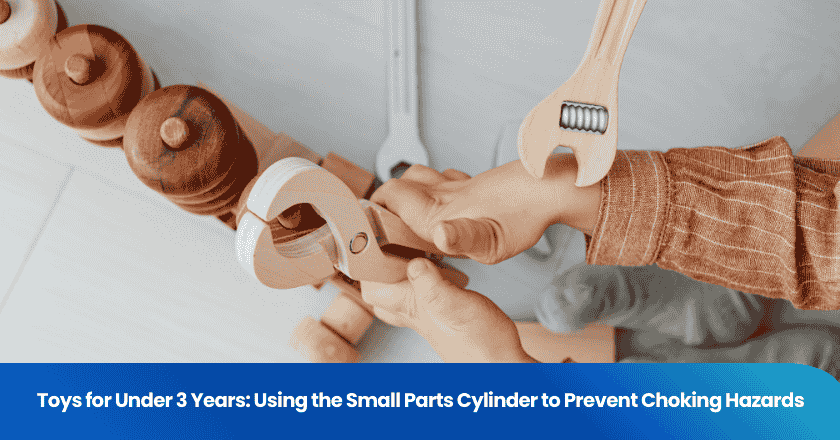
For toys intended for children under 3, any component or piece that fits entirely into the CPSC small parts cylinder is a serious choking hazard and can make the product unacceptable for that age group. Warning labels do not solve the problem when the product is intended for children under 3.
CPSC small parts business guidance treats children's products intended for children under 3 as a strict-risk category when small parts create choking, aspiration, or ingestion hazards. That is why the importer decision has to start with age grading, not with packaging language.
The cylinder test is codified in 16 CFR part 1501, and 16 CFR 1501.4 sets out the size requirement and test procedure. For importers, the key operational rule is simple: check parts before shipment, not after a marketplace, retailer, or customer raises the issue.
CPSC children's products guidance defines a children's product by intended use for children 12 years of age or younger. That definition matters because small-parts screening starts with the intended user and foreseeable use, not only with part size.
This article focuses on importer decision-making, not legal advice. Toy compliance can involve additional rules such as labeling, lead, phthalates, mechanical hazards, tracking labels, testing, certification, and destination-market requirements. The small parts cylinder is one important gate in that larger safety file.
- Under 3 rule: toys and children's articles intended for children under 3 must not contain or release small parts that fit the cylinder.
- Labeling boundary: warning labels apply to certain products for older children, but they do not make an under-3 product acceptable if it has banned small parts.
- Inspection boundary: on-site inspection can screen physical samples, but lab testing and compliance review may still be required.
- Importer action: freeze age grading, component list, pull/tension risks, and small-part checks before production and before shipment.
What Is the Small Parts Cylinder Test for Toys Under 3?
The small parts cylinder test checks whether a toy part or component fits entirely inside a defined test cylinder. For products intended for children under 3, small parts are generally not allowed, including parts present as sold and parts that can detach during reasonably foreseeable use and abuse.
The CPSC small parts FAQ frames the 16 CFR part 1501 ban around a practical safety outcome: preventing children under three from choking, inhaling, or swallowing small objects subject to the cylinder test.
CPSC toy safety business guidance also reminds importers that mandatory small-parts requirements may need to appear in the product certificate when they apply. The inspection file and the compliance file should therefore tell the same story.
For cautionary labeling, 16 CFR 1500.19 covers toys and articles intended for certain older age ranges when small parts, small balls, marbles, or balloons are present. This is why age grading is not a cosmetic packaging choice; it changes the safety decision.
Small Parts Cylinder Decision Table for Importers
The most important decision is not only whether a piece fits the cylinder, but what age group the product is intended for.
| Question | If Yes | If No | Importer Action |
|---|---|---|---|
| Is the product intended for children under 3? | Small parts are a hard stop risk | Move to age-grade and label review | Confirm age grading before PO |
| Does any as-sold part fit the cylinder? | Do not release as under-3 toy | Continue to use-and-abuse risk | Document sample result |
| Can a part detach during foreseeable use? | Treat detached piece as safety risk | Review other hazards | Add pull/tension and durability checks |
| Is the product for ages 3 to 6 with small parts? | Warning label may be required | Label may not address this hazard | Review 16 CFR 1500.19 |
| Is lab testing required? | Use accredited test evidence | Inspection still checks shipment match | Do not replace lab testing with PSI |
| Do shipment samples match certified samples? | Release evidence is stronger | Hold until mismatch is resolved | Use inspection photos and reports |
The decision table prevents two common mistakes. First, it stops buyers from thinking that a warning label can fix a toy intended for a child under 3. Second, it stops buyers from assuming a clean factory sample means every shipment sample is safe.
The cylinder test should also be connected to durability. A toy can pass as received but fail if small parts detach after normal or reasonably foreseeable use. Importers should not limit inspection to loose pieces already visible on the table.
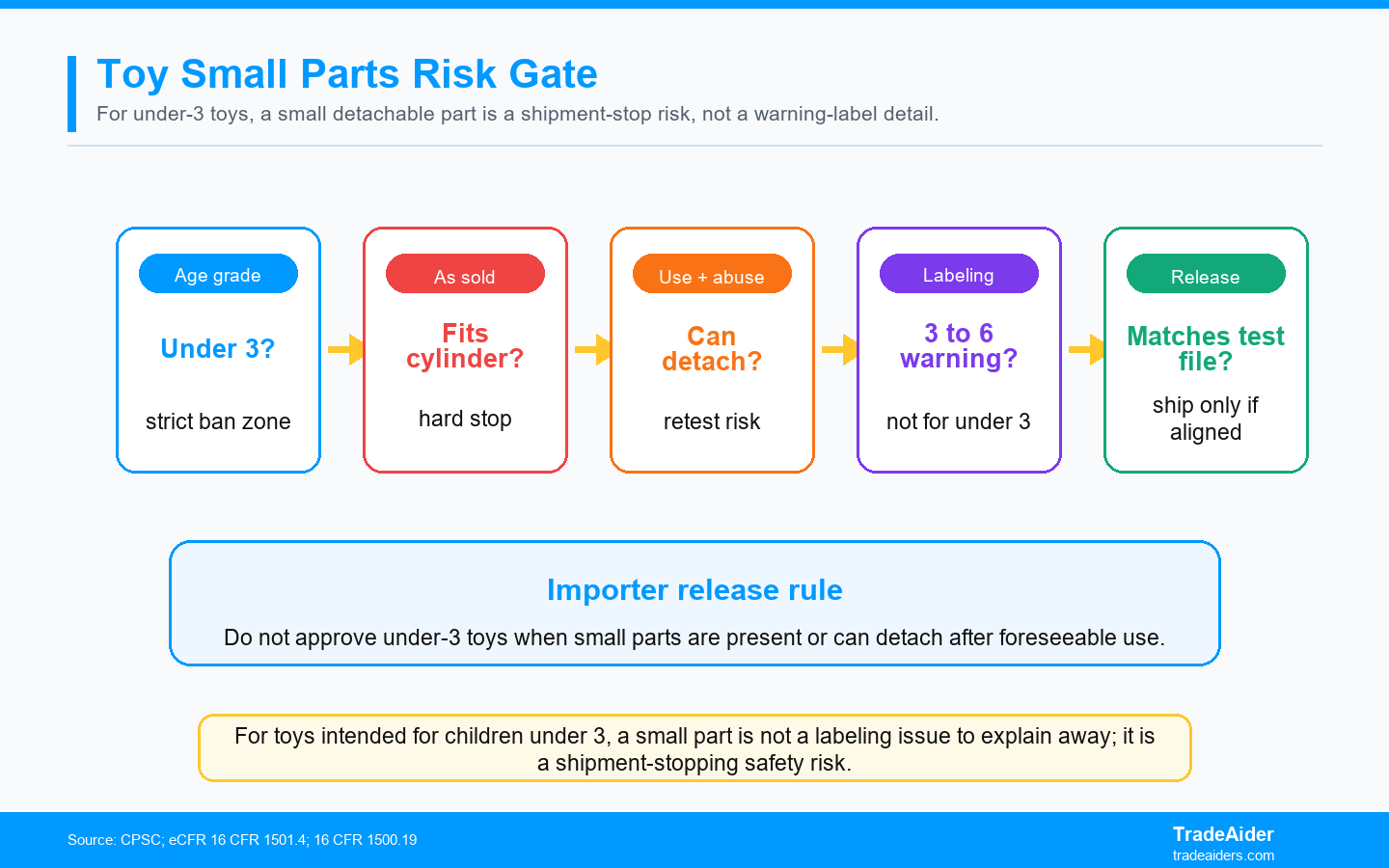
For toys intended for children under 3, a small part is not a labeling issue to explain away; it is a shipment-stopping safety risk.
What the Small Parts Cylinder Actually Tests
The cylinder is a physical size gate for choking risk, not a general toy quality checklist.
The test asks whether the part fits entirely inside the cylinder
The small parts cylinder represents a throat-like size hazard for young children. If an object or detached component fits entirely inside the cylinder under its own weight, it is treated as a small part for the relevant rule. Importers should use the correct cylinder dimensions and test procedure rather than approximate with a ruler or judgment by eye.
The test should cover loose components, detachable parts, accessories, fasteners, magnets, decorative pieces, plastic caps, buttons, beads, wheels, eyes, zipper pulls, battery covers, and any part likely to be mouthed by a young child.
The cylinder does not replace age grading or product hazard review
A cylinder result tells the buyer whether a part is small under the rule. It does not decide every safety question. Toy safety may also involve sharp points, sharp edges, cords, magnets, batteries, chemical restrictions, flammability, tracking labels, and third-party testing requirements.
The buyer should treat small-parts screening as one gate in a broader compliance file. If the product is for children under 3, the small-parts gate should be early and strict. If the product is for older children, warning labels and age grading still need careful review.
Age Grading Is the First Safety Decision
The same part can create a different compliance result depending on intended age group.
Under 3 is the strictest small-parts zone
Products intended for children under 3 need special caution because the small-parts ban applies directly. Importers should not accept supplier language such as suitable for all ages if the product contains small detachable components. That phrase can create more risk, not less.
Age grading should be based on product design, marketing, instructions, packaging, play pattern, and reasonable consumer expectation. A plush toy with sewn-on eyes, a stacking toy with small pegs, or a bath toy with a removable plug may need different analysis from a building set for older children.
Ages 3 to 6 may require warning labels, not under-3 approval
For certain toys intended for older children, small-parts cautionary labeling may be required. That does not mean the product is acceptable for children under 3. The label is a boundary statement for the buyer, retailer, and consumer.
Importers should compare age grade, product design, online listing, retail package, warning label, and test report. If the listing says toddler toy but the package says choking hazard for children under 3, the shipment has a commercial and safety contradiction that should be corrected before sale.
How Small Parts Appear During Manufacturing
Small-parts risk often appears through detachment, substitution, or packaging changes, not only original design.
Detachable parts are the hidden failure mode
A supplier may show a safe prototype but mass production uses weaker glue, looser screws, thinner plastic, lighter stitching, or a cheaper fastener. The part was not small as sold because it was attached, but it can become a small part after foreseeable use or abuse.
Importers should ask how components are attached and what stress can detach them. Pull tests, torque checks, seam checks, impact or drop review, battery compartment checks, and visual inspection of attachment quality may be needed depending on product design.
Accessory and packaging changes can create new hazards
The toy itself may be acceptable, but the accessory pack contains tiny screws, beads, tokens, replacement caps, decorative pieces, or small balls. A supplier can also add promotional items or packaging components that were not in the original test file.
The inspection plan should list every component in the retail pack, not only the main toy. The buyer should require the factory to present the same configuration that will ship to consumers.
Do not let supplier age claims override the physical product
Suppliers sometimes solve small-parts concerns by changing the package age grade from under 3 to 3+ or by adding a warning label late in production. That may not be acceptable if the product design, marketing images, play pattern, or buyer listing still targets toddlers. Age grading has to be consistent across product design, packaging, listing copy, instructions, and test evidence.
Importers should treat late age-grade changes as a compliance red flag. The buyer should ask why the supplier changed the age claim, whether the test report still matches the shipped product, and whether retail or marketplace pages need to change. A label change made only to pass shipment is not a safety strategy.
Inspection, Lab Testing, and Compliance Review Have Different Jobs
A shipment can look clean during inspection and still need formal test evidence.
On-site inspection is strong at checking physical shipment evidence: components present in the packed goods, labels, warnings, accessory bags, workmanship, obvious detachability, and whether the lot matches the approved sample. It is weaker at proving chemical composition, flammability, phthalates, lead content, or complete regulatory compliance because those usually require lab testing and documentation review.
A safe importer workflow separates the layers. Lab testing verifies regulated hazards and produces formal reports. Compliance review checks whether the product, age grade, certificates, labels, and destination requirements align. Pre-shipment inspection verifies that the goods actually being shipped match the approved and tested configuration. Skipping any one layer can leave a gap.
This distinction is important because suppliers may say the product has already been tested, while the shipment contains a changed component, accessory, colorant, glue, battery cover, or warning label. Inspection cannot replace the lab report, but it can catch when the shipped goods no longer look like the tested file.
Original Risk Screen: 1 Small Part Can Block 10,000 Sellable Units
The commercial risk is asymmetric because one small component can affect the whole SKU.
Consider an order of 10,000 toddler toys with one removable decorative cap per unit. If the cap fits the small parts cylinder and can detach, the buyer does not have a 1-unit problem. The buyer has a SKU-level safety and compliance problem because the same design feature repeats across the entire lot.
The immediate cost is not just rework. The buyer may face shipment hold, relabeling, testing delay, packaging redesign, retailer rejection, marketplace listing interruption, or destruction of unsellable inventory. The safest inspection plan treats repeatable small-part design features as lot-level release gates.
This is why the small-parts check belongs before production and again before shipment. Before production, it catches design and component choices. Before shipment, it verifies that the actual packed goods still match the safe and approved configuration.
Where TradeAider Fits in Toy Small Parts Inspection
TradeAider fits by checking whether the physical shipment matches the age grade, component list, packaging, and safety evidence before release.
TradeAider can support toy importers with Pre-Production Inspection when component choices, sample approval, age grading, packaging, and supplier readiness need confirmation before mass production.
During production, During Production Inspection can check whether parts, attachment quality, accessories, and packaging still match the approved control file while the factory can correct the process.
Before shipment, Pre-Shipment Inspection can document product samples, accessories, labels, warnings, carton marks, and visible small-parts concerns. TradeAider inspection does not replace lab testing or legal compliance review, but it gives the buyer real-time shipment evidence.
SPAR Scenario: A Small Accessory Changed the Release Decision
The product looked compliant until the accessory pack was inspected.
Situation: A US importer orders 8,000 toy activity sets marketed for toddlers.
Problem: The supplier adds a tiny spare decorative plug to the retail pack after sample approval. The main toy looks unchanged, but the accessory fits the small parts cylinder.
Action: The buyer asks TradeAider to photograph all components in the retail pack, compare them with the approved sample file, and flag the accessory mismatch before shipment.
Result: The buyer holds the shipment until the accessory is removed and the packaging file is corrected, avoiding a repeated small-part risk across the whole SKU.
Action Card: Small Parts Control Before Shipping Toys
Use this list before confirming production and again before shipment release.
- Freeze age grade, product design, component list, and packaging contents.
- Check every loose and detachable component against the small parts cylinder.
- Review whether normal use or abuse can release small parts.
- Confirm warning labels only where they are legally appropriate.
- Match shipment samples to lab test reports and approved samples.
- Hold release if accessories, labels, or age claims conflict.
Toy safety inspection should be conservative because the buyer's downside is not limited to a defect allowance. A repeatable choking hazard can affect every unit in the SKU.
The inspection file should include photos of the product, detachable parts, accessory bags, labels, warnings, test report references, carton marks, and any mismatch between approved sample and shipped goods.
If you are shipping toys or children's products from China and small parts are a concern, send TradeAider the age grade, approved sample photos, component list, test report references, packaging artwork, PO, and packing status. The next step is to ask TradeAider to check the shipment against the small-parts risk file before release.
Frequently Asked Questions
What is the small parts cylinder test?
The small parts cylinder test checks whether a toy part or detached component fits entirely inside a specified cylinder used to screen choking hazards.
Are small parts allowed in toys for children under 3?
Generally no. Products intended for children under 3 must not contain or release small parts that present choking, aspiration, or ingestion hazards.
Can a warning label make small parts acceptable for under 3?
No. Warning labels may apply to certain products for older children, but they do not fix a banned small-parts hazard in an under-3 product.
Does pre-shipment inspection replace lab testing?
No. Pre-shipment inspection can verify shipment samples, labels, components, and packaging evidence, but lab testing and compliance review may still be required.
What should importers check before toy shipment?
Importers should check age grade, component list, detachable parts, accessory packs, warning labels, test report match, and whether the actual shipment matches the approved sample.
Artigos Relacionados
Expanda seu negócio com o Serviço TradeAider
Clique no botão abaixo para entrar diretamente no Sistema de Serviço TradeAider. Os passos simples desde a reserva e pagamento até o recebimento de relatórios são fáceis de operar.

