
A quality control consultant helps an organization assess its quality practices, define workable requirements and methods, build staff capability, and review improvement results. The role may include process assessment, audits, training, reporting and implementation support, according to the engagement. It is broader than inspecting one shipment.
For a business or importer evaluating support, the key questions are what the consultant will deliver, what internal teams must implement and how progress will be verified. Relevant expertise can help the organization make better decisions; hiring an adviser does not automatically transfer approval authority or guarantee compliance, savings or defect-free output.
Know What the Consultant Should Deliver
- Match the assignment to the quality problem and sector.
- Agree assessment, implementation and verification outputs.
- Check credentials alongside relevant work and methods.
- Keep internal action owners and decision authority clear.
- Judge progress against a defined baseline and scope.
Quality Control Consultant Responsibilities
A quality control consultant assesses how quality is managed and helps the organization define, implement and review improvements. The agreed assignment can include processes, requirements, audits, training and reporting; it is broader than a product check alone.
Assessing Processes
Process assessment should explain how work actually produces its results. ISO’s quality management principles include a process approach and evidence-based decision making. A consultant can apply those ideas by examining inputs, handoffs, controls and the records behind the reported outcome.
The assessment may use observation, interviews, documents, inspection results and relevant process data. Ask which methods suit the problem rather than expect every project to use Six Sigma, automation or an advanced statistical model. In manufacturing, the weak handoff might be between approved specifications and production instructions. In a service organization, it might be between a customer request and the completed service record. A useful finding identifies the gap and its consequence, with enough evidence to investigate it.
Setting Standards
Setting standards starts with applicable requirements, not a generic list of regulations. ASQ distinguishes quality assurance from quality control: quality assurance concerns confidence that requirements will be fulfilled, while quality control focuses on fulfilling them. A consulting assignment may address related work in both areas, but its scope should be explicit.
A quality management system is the organization’s connected processes, responsibilities and records for managing quality. The consultant can help translate customer, product, contractual and applicable regulatory requirements into usable instructions and criteria. Management should approve that basis and resolve conflicts. For a product inspection task, the inspection standards resource can help frame the checks to agree; it does not replace the requirements specific to the product and market.
Audits and Inspections
Audits examine agreed requirements against evidence about a system, process or activity. Product inspections examine specified product characteristics. A consultant may plan or use both, but should explain the purpose, coverage and limits of each rather than treat an acceptable sample as proof that the entire quality system works.
For product work, NIST describes acceptance sampling as selecting a random sample to support acceptance or rejection of a lot. That is a lot-disposition method, not a guarantee for every unit. Agree the relevant population, criteria, selection method and reporting limitations. Audit or inspection findings should then be assigned to an internal owner with a defined response and follow-up evidence.
Staff Training
Staff training should leave the organization able to perform the agreed work after the consultant leaves. Start with the task and current skill gap: reading an inspection instruction, classifying a defect, reviewing a trend or handling a documented exception. Choose explanation, demonstration and practice that fit that need.
Ask staff to demonstrate the task and discuss disagreements against the approved method. Retain the relevant training materials and a record of what was assessed. A course attendance certificate alone does not establish competence in the actual assignment. Where specialist work is outside the consultant’s expertise, identify suitable support rather than present a general workshop as a substitute. The project should also state who maintains the training and updates it when the process changes.
Reporting and Improvement
A consulting report should connect the observed problem to a practical response. Useful contents include the scope, evidence and limits, findings, priorities, recommended actions, internal owners and the checks needed to review progress. A long report without a decision or implementation path can leave the original problem unchanged.
Agree which documents the engagement includes: a gap assessment, revised procedure, control plan, training material, action tracker or verification report. Recommendations should distinguish confirmed findings from hypotheses that need more evidence. Management then decides priorities and resources, while the consultant’s implementation role follows the agreement.
Where the project needs finished-goods evidence, pre-shipment inspection can provide agreed product checks and findings. That report may inform the consultant’s analysis; it does not automatically include a wider quality-system assessment, root cause investigation or implementation program.
QA Consultant Skills and Qualifications
Evaluate the consultant’s capabilities against the actual assignment. Technical expertise, analysis, communication and relevant credentials serve different purposes; a broad title or impressive tool list cannot establish all of them.
Technical Expertise
Technical expertise needs to fit the product or service, methods, sector and destination involved. A consultant experienced in general consumer products may not have the specialist knowledge needed for medical devices, food safety or regulated software. Ask which parts of the assignment they can support and which need another qualified specialist.
Relevant evidence can include comparable work, a redacted deliverable, an explanation of the method and references that can be checked with permission. Discuss the exact problem rather than assume that experience with one standard covers every market or product. The consultant should be able to explain why a proposed method is suitable and what it cannot establish. This is more useful than reciting regulatory names without connecting them to the organization’s needs.
Analytical Skills
Analytical skill means turning reliable evidence into a defensible explanation and decision. Ask how the consultant defines the measure, checks the data and separates a suspected cause from a demonstrated one. A dashboard or statistical package is useful only when its inputs and comparison are appropriate.
For a defect trend, examine the counted unit, inspected population, classification rules and any change in the checking method. For a service problem, define the event and time boundary before comparing performance. A lower reported rate could reflect a different product mix or weaker detection rather than improvement. The consultant should explain uncertainty and propose the next useful observation, instead of treating every correlation or chart as proof of causation.
Communication
A consultant needs to make the observation, its consequence, the proposed action and the unresolved limits understandable. Management needs priorities and resource decisions; operators need usable instructions; a supplier may need a clear correction request. These audiences should receive consistent facts at the appropriate level of detail.
Agree who receives reports, answers questions and approves scope changes. For an importer or sourcing agent, identify the final overseas report user and any language, format or acceptance requirements. Clarify how an unresolved question will be handled across time zones. If product-inspection support is part of the project, review TradeAider’s company background and confirm the actual assignment. A provider description is context for that discussion, not evidence that it offers every consulting or specialist service.
Certifications
Credentials need to be checked for what they actually cover. ISO explains that it develops standards and does not perform certification or issue certificates; external certification bodies perform certification. A reference to an ISO standard is therefore not, by itself, an ISO-issued personal qualification.
| Evidence presented | What to verify |
|---|---|
| Individual professional credential | Named holder, issuer, subject, current status and relevance to the assignment. |
| Auditor training or course certificate | What was taught or assessed, and what further experience demonstrates competence. |
| Organization’s management-system certificate | Certified entity, scope, issuing body and status; it does not establish every individual’s expertise. |
| Product or market-access document | Applicable product and requirement; it is not a personal consulting credential. |
Ask for relevant qualifications and practical evidence together. A credential can support evaluation without guaranteeing that the person understands your process, can implement a workable change or will obtain a particular audit outcome. Verify any claimed recognition with the actual issuer rather than treating a logo or a list of standards as sufficient proof.
Value to Organizations
Consulting value comes from changes the organization can implement and verify against its objectives. Judge the work by its relevance, evidence and sustained use, rather than the number of reports, certificates or meetings produced.
Boosting Quality
Improving quality often means making requirements, methods and handoffs more consistent. A consultant can help identify where instructions conflict, decide what needs clarification and support a workable approach. Internal teams still need to use and maintain that approach in daily work.
Illustrative example: a buyer and factory repeatedly disagree about an appearance defect. Another inspection may record the disagreement again. A consultant could help the parties clarify the acceptance reference, align classification examples and trial the revised instruction. The trial would still need evidence that people apply it consistently and that the relevant problem improves. This is a hypothetical example of the role, not a TradeAider customer case or a claim that revised wording alone eliminates defects.
Reducing Defects
Reducing defects requires more than naming a likely cause. ASQ’s root cause analysis guidance explains methods for finding problem causes and notes that analysis alone needs a wider problem-solving effort to produce results. The consultant should help turn the supported explanation into an action that can be tested.
Agree the baseline, proposed change, action owner and follow-up method. Check whether the change addresses the suspected mechanism and whether the result persists under the relevant operating conditions. Keep an unsuccessful trial visible so the team can revise the explanation rather than declare the project complete.
For a product pilot using acceptance sampling, the AQL calculator can help check agreed plan inputs. AQL means acceptance quality limit. Lot acceptance and evidence of a corrected cause remain different questions; the calculator cannot design the improvement or establish its effectiveness.
Ensuring Compliance
Compliance support can include identifying applicable requirements, reviewing documents, locating gaps and preparing people for an audit or inspection. The consultant needs competence in the relevant sector and jurisdiction, and should identify questions requiring a specialist. A general quality-management background does not establish authority over every regulatory route.
Keep the consultant’s recommendations, the organization’s duties and any independent approval or certification decision distinct. Confirm who maintains the requirement list and responds when a rule, product or market changes. Ask what evidence each deliverable will establish, including what remains outside scope. Advice and readiness work can support the organization’s efforts; they do not themselves grant product approval, transfer every legal responsibility or guarantee a regulator’s or certification body’s decision.
Customer Satisfaction
Customer satisfaction work starts with a defined customer problem: inconsistent product performance, recurring service errors, unclear specifications or slow issue resolution. A consultant can help connect feedback to a process that the organization can change, then agree how the response will be evaluated.
Use relevant complaints, returns, service records or feedback with clear definitions and limitations. Separate the frequency of a reported problem from the severity and consequence it creates. Review whether the chosen action improves that specific issue, while checking for unintended effects elsewhere. Revenue, retention and customer acquisition also depend on factors outside the consulting project, so do not attribute every commercial change to the adviser. The useful question is which observed problem changed, under what conditions and with what evidence.
When to Hire a Quality Assurance Consultant
Consider a quality assurance consultant when a recurring problem, capability gap or organizational change needs outside analysis and support. First identify the question; the appropriate response may be consulting, a defined inspection or testing task, or specialist advice.
Common Scenarios
Common reasons to seek consulting include repeated findings without a sustained fix, inconsistent procedures across sites, growth that exceeds the internal team’s capability, or a new product or market that changes quality requirements. The aim is to understand and improve the method, not simply commission another pass/fail result.
Match support to the problem. A shipment’s visible workmanship may call for a product inspection; a specific material or performance question may need a suitable laboratory; a system-wide gap may call for management-system advice. Software and service organizations need methods and measures suited to their own work. External support can help internal teams learn, but leadership still needs to provide access, priorities and implementation resources. If those are unavailable, even sound advice may remain unused.
Engagement Process
Agree deliverables, internal owners and review points before assuming a project timeline. Start with the problem and evidence available, then define the assessment, plan, implementation support and verification actually included. Timing depends on access, data quality, decision availability and the opportunity to observe or trial the work.
| Phase | Output to agree | Timing dependency |
|---|---|---|
| Define and assess | Scope, baseline, evidence reviewed, gaps and limitations. | People, records and process access are available. |
| Plan | Prioritized actions, owners, resources and success measures. | Management resolves requirements and approves priorities. |
| Support implementation | Agreed procedure changes, pilot support and training. | Internal teams can make and trial the change. |
| Verify and hand over | Results, remaining issues, maintained methods and follow-up owners. | Enough relevant evidence exists to assess the change. |
A short diagnostic and a sustained improvement program have different deliverables and workloads. Ask what ends each phase, which tasks are remote or on-site, and how a changed scope affects the schedule and fee. Specify access to records, confidentiality, document ownership and post-project support. Avoid treating “several weeks” or “a few months” as a dependable promise before those conditions are understood.
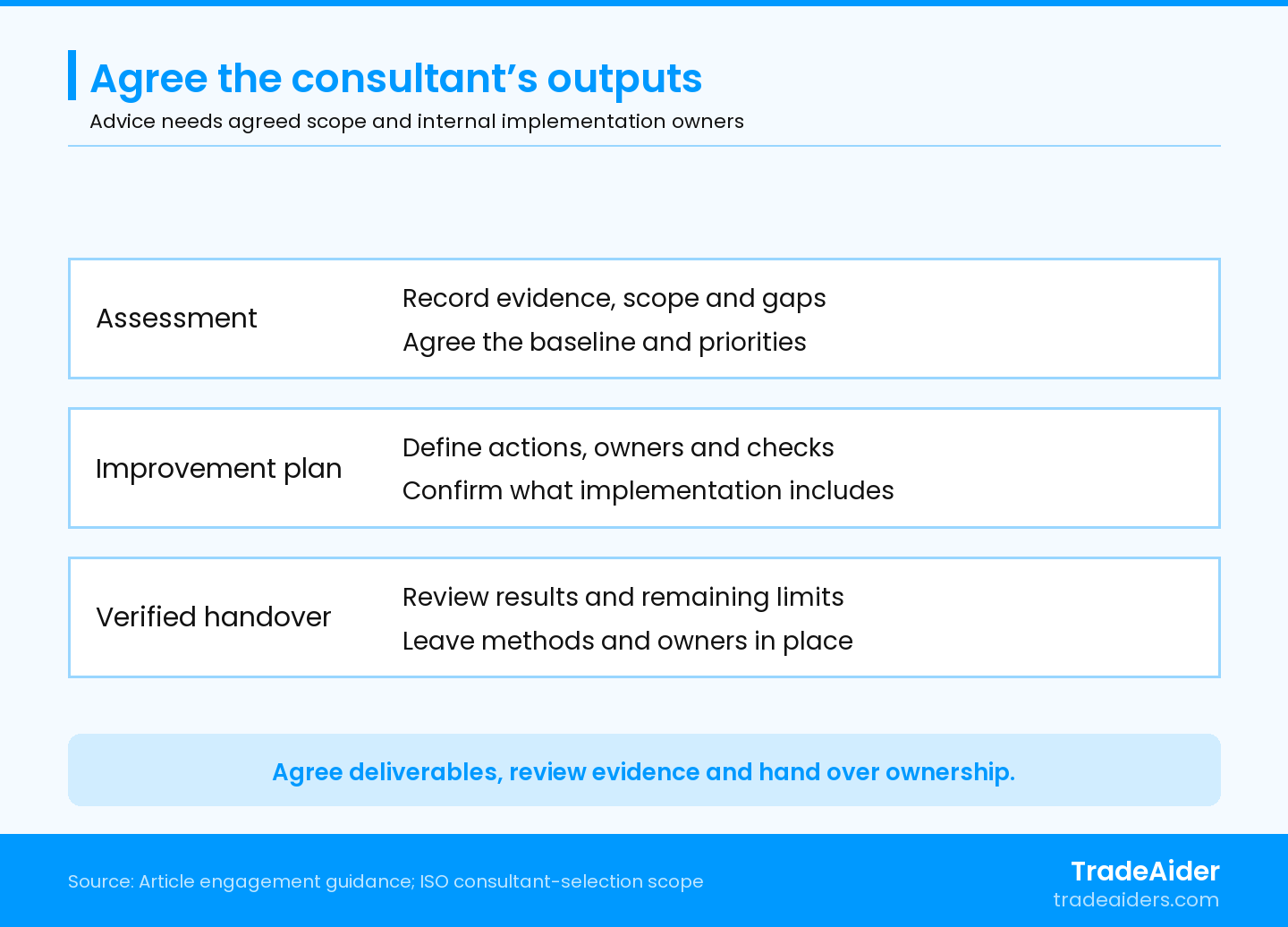
Agree which outputs are included and who implements them. A completed assessment is not the same as an implemented change or evidence that the change is effective.
Choosing the Right Consultant
ISO 10019:2005 provides guidance on selecting quality management system consultants and evaluating their competence. Use that selection focus to ask practical questions about the actual assignment; the standard is not an ISO-issued personal certificate or a guarantee that a particular consultant will meet every need.
Ask what comparable work the person has done, which outputs you can review, how they will test a proposed explanation and what they need from internal teams. Confirm conflicts of interest, subcontracted specialist work, exclusions, commercial terms and who approves changes. Compare equivalent scope and usable outputs rather than a headline fee or an unsupported savings promise.
If the project needs independent product-inspection evidence, Contact our team with available product and order information, factory, production stage, timing, destination and known findings. TradeAider can discuss an appropriate inspection scope and a report of the agreed checks, results and limitations. Identify the final report recipient and agree technical criteria, language, format and acceptance needs before inspection. Missing information can be clarified during the inquiry.
FAQ
Can the consultant approve shipment for the buyer?
Only if the buyer has explicitly assigned that authority and its conditions. A consultant’s recommendation, an inspection result and the buyer’s release decision are distinct. State who can accept deviations, approve corrective-action evidence and authorize shipment. If the consultant has an advisory role only, the report should support the designated decision-maker rather than imply an approval it does not provide.
Can a consulting engagement be entirely remote?
Some assessment and advisory work can be remote, but evidence needs determine what still requires on-site work. Documents, interviews and data can support parts of the review; observing a process or examining physical goods may need another method or a site visit. Agree who obtains that evidence, its limits and any excluded work before treating a remote assessment as complete.
What if the baseline data is too weak to measure improvement?
Make baseline validation an explicit early deliverable before claiming a measured improvement. Check definitions, collection methods, missing records and whether the available observations represent the problem. The project may first establish a reliable measure or run a bounded pilot. Report that limitation honestly; a polished before-and-after chart cannot repair incomparable data or establish an effect that was not measured.
Artigos Relacionados
Expanda seu negócio com o Serviço TradeAider
Clique no botão abaixo para entrar diretamente no Sistema de Serviço TradeAider. Os passos simples desde a reserva e pagamento até o recebimento de relatórios são fáceis de operar.