
- About Us

- Our Services
- Your Industry
- Resources
- News & Blog
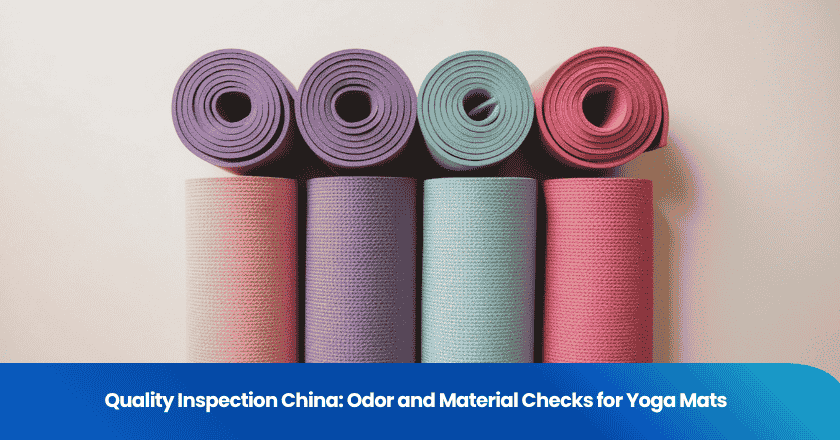
That "new yoga mat smell" isn't just unpleasant. It can be a sign of volatile organic compounds (VOCs) off-gassing from chemical additives in the manufacturing process, and your customers are increasingly aware of the difference between a harmless new-product scent and a toxic chemical odor. For importers sourcing yoga mats from China's manufacturing hubs in Jiangsu, Zhejiang, and Guangdong, odor and material quality checks during pre-shipment inspection are essential for protecting both your customers and your brand reputation.
Key Takeaways
- Odor testing is a critical safety indicator for yoga mats, as strong chemical smells often signal VOC emissions from PVC, phthalates, or formaldehyde.
- Material verification confirms that the factory used the correct raw material (TPE, PVC, natural rubber, EVA, or polyurethane) as specified in your purchase order.
- Physical performance tests including thickness, density, tensile strength, and slip resistance validate that the mat performs as marketed.
- California Proposition 65 compliance is increasingly important for yoga mats sold in the U.S. market, requiring testing for specific chemicals.
Why Odor and Material Checks Matter for Yoga Mats
The yoga mat market has shifted dramatically toward health-conscious and environmentally aware consumers. A 2025 market analysis by Technavio projects continued growth in the smart and eco-friendly yoga mat segment, driven by consumer demand for sustainable materials and transparent manufacturing. This means the old approach of accepting "it's just the new-mat smell" is no longer viable for brands that want to maintain customer trust.
Research documented by environmental health publication LeafScore has identified several chemicals of concern commonly found in yoga mats, particularly PVC-based products. These include volatile organic compounds (VOCs), polycyclic aromatic hydrocarbons (PAHs), phthalates used as plasticizers, and in some cases, heavy metals like lead used as stabilizers in PVC formulations. When these chemicals off-gas, they create the characteristic strong chemical odor that consumers associate with poor quality or unsafe products.
The material composition of a yoga mat directly determines both its performance characteristics and its safety profile. A factory substituting PVC for TPE, or using recycled rubber with unknown contaminants, can create products that look identical to approved samples but carry entirely different health risks.
Yoga Mat Materials: What Inspectors Look For
Understanding the material landscape helps you specify what inspectors should verify. Each material category has distinct characteristics that affect both quality testing protocols and safety considerations.
| Material | Odor Profile | Safety Considerations | Typical Uses |
|---|---|---|---|
| PVC | Strong chemical smell; may persist | Phthalates, lead stabilizers, VOCs | Budget mats, high-traction |
| TPE | Mild initial odor; dissipates quickly | Generally lower risk; recyclable | Mid-range mats, lightweight |
| Natural Rubber | Rubber smell; fades over time | Latex allergy risk; low chemical risk | Premium mats, eco-friendly |
| EVA Foam | Mild foam odor; dissipates | Formaldehyde risk if low grade | Budget, thicker mats |
| Polyurethane (PU) | Minimal odor when properly cured | Low chemical risk; high performance | Premium hot yoga mats |
Odor Testing During Yoga Mat Inspection
Odor testing during a pre-shipment inspection follows a structured protocol that goes beyond a simple "does it smell bad" check.
Out-of-Package Odor Assessment
Inspectors open factory-sealed packaging and evaluate the initial odor intensity on a standardized scale, typically 1-5 (1 = no detectable odor, 5 = strong, offensive chemical smell). The mat is assessed immediately upon opening and again after 15 minutes of airing to evaluate whether the odor dissipates or persists.
Chemical Odor Identification
Experienced inspectors can distinguish between normal material odors and concerning chemical smells. The rubber scent of a natural rubber mat is expected and acceptable. A sharp, acrid, or sweet chemical smell from a PVC or TPE mat is not. Inspectors flag specific odor characteristics that may indicate:
- Phthalate plasticizers (sweet, slightly chemical odor)
- Formaldehyde (sharp, irritating, pungent)
- Solvent residues (sharp, headache-inducing)
- Decomposition byproducts (sour or sulfur-like, indicating material breakdown)
Comparison Against Approved Reference Samples
The most reliable odor test compares production samples against a pre-approved golden sample. Inspectors evaluate whether the production batch's odor matches the approved reference in intensity and character. Any deviation is flagged, as it may indicate a material substitution or formulation change at the factory.
Material Verification Checks
Material verification confirms that the factory used the materials specified in your purchase order. This is critical because material substitution is one of the most common quality issues in yoga mat production from China.
Density and Weight Verification
Each material has a characteristic density range. Inspectors weigh sample mats and measure dimensions to calculate actual density, comparing it against the specified material's expected range. A PVC mat weighing significantly less than expected may contain fillers or reduced plasticizer content. A TPE mat weighing more than specified may have been substituted with cheaper EVA foam.
Burn and Flame Testing (Material Identification)
For small sample verification, inspectors may perform a controlled burn test on a trim edge or sample cutting. Each material burns with characteristic flame color, smoke type, and residue. PVC produces a greenish flame and acrid smoke; natural rubber burns with a thick black smoke and rubber smell; TPE produces minimal smoke with a wax-like residue. This provides rapid on-site material identification.
Hardness and Elasticity Testing
Using a durometer (Shore A scale), inspectors verify that the mat material's hardness falls within the specified range. Softer mats (lower Shore A value) provide more cushioning but may be less stable for balancing poses. Harder mats offer better stability but less joint protection. Either extreme outside the specification affects product performance and customer satisfaction.
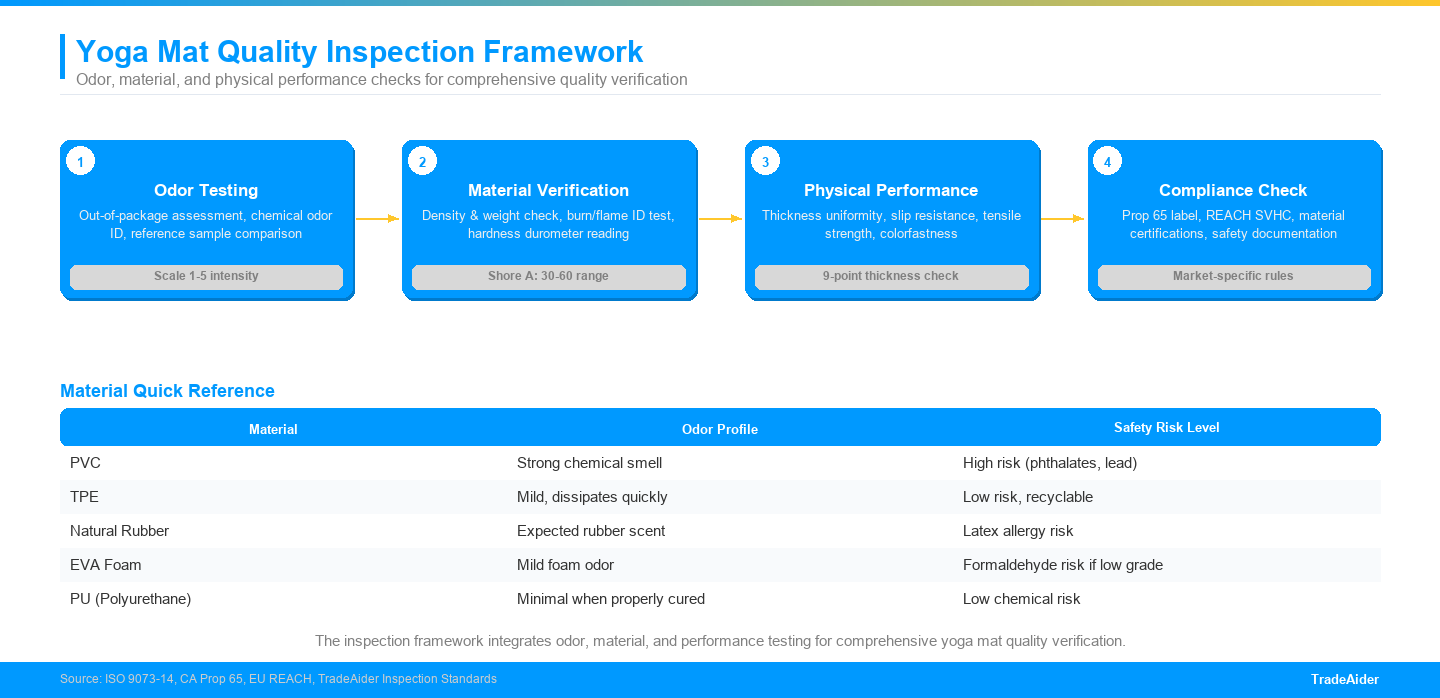
Yoga mat quality inspection framework: odor, material, and physical performance checks form an integrated quality verification system.
Physical Performance Testing
Beyond odor and material checks, a comprehensive yoga mat inspection includes physical performance tests that verify the mat delivers the user experience your customers expect.
Thickness and Dimensional Accuracy
Inspectors measure mat thickness at a minimum of nine points (center, four corners, and four midpoints) to verify uniform foaming and dimensional consistency. Thickness variation beyond +/- 0.5mm indicates manufacturing inconsistencies that affect both appearance and performance.
Slip Resistance Testing
Grip performance is arguably the most important functional characteristic of a yoga mat. Inspectors evaluate both dry and wet grip by performing standardized friction tests. For mats marketed as "non-slip" or "grip-enhanced," this test is essential for validating marketing claims.
Tensile Strength and Tear Resistance
Mats must withstand stretching and pulling forces during use without tearing or permanently deforming. Inspectors perform standardized tensile tests to verify that the material meets minimum strength specifications.
Colorfastness and Surface Durability
For printed or dyed mats, colorfastness testing verifies that colors don't transfer to skin, clothing, or floors during use. Inspectors perform rub tests using both dry and damp white cloth to check for color transfer.
Regulatory Compliance for Yoga Mats
Yoga mats sold in the U.S. market may be subject to California Proposition 65, which requires warning labels for products containing chemicals known to the state to cause cancer or reproductive harm. Several chemicals found in yoga mats, including certain phthalates and lead compounds, appear on the Prop 65 list.
For the EU market, REACH regulation (EC 1907/2006) restricts the use of substances of very high concern (SVHC) in consumer products. Inspectors verify that products carry required compliance documentation and that material formulations comply with applicable restrictions.
How TradeAider Handles Yoga Mat Inspection
When you book a pre-shipment inspection with TradeAider for yoga mats, the inspector arrives at your supplier's factory with a tailored checklist covering all the checks described above. The inspection is performed on-site using portable testing equipment, and results are reported in real-time through the TradeAider platform.
The real-time reporting capability is particularly valuable for yoga mat inspections because odor issues can develop over time. If the inspector detects a concerning odor during initial checks, you can immediately instruct the factory to ventilate the batch and schedule a re-check, or investigate the root cause with the material supplier, all while production is still flexible.
TradeAider's transparent pricing at $199/man-day means you know exactly what your quality assurance costs will be, with no surprises for weekend inspections, travel fees, or expedited reporting. Schedule your inspection for your next yoga mat order.
Frequently Asked Questions
Is the "new mat smell" normal for TPE yoga mats?
TPE mats typically have a mild, slightly sweet odor when first unpackaged that dissipates within 1-3 days of airing. This is considered normal. A strong, persistent chemical smell that doesn't fade may indicate contamination, improper curing, or material substitution and should be flagged as a defect during inspection.
How do I test for formaldehyde in yoga mats?
Formaldehyde testing requires laboratory analysis using standardized methods such as desiccator testing per ISO 9073-14 or JIS L 1041. On-site inspectors can detect formaldehyde-typical odors (sharp, pungent, irritating) and pull samples for laboratory submission. For products claiming formaldehyde-free status, laboratory verification is recommended for each production batch.
Can inspectors distinguish PVC from TPE during on-site inspection?
Yes. Experienced inspectors use multiple indicators: density comparison, burn test on edge trim (PVC produces green flame and acrid smoke; TPE burns cleanly), surface texture differences, and flexibility characteristics. Material identification is a standard part of any yoga mat inspection protocol.
What AQL levels should I apply for odor defects?
For odor defects, most buyers apply AQL 2.5 as a major defect for persistent unpleasant odors, and AQL 0.0 as a critical defect for strong chemical odors that may indicate health hazards. The specific AQL level should reflect your brand's tolerance and your target market's regulatory requirements.
Do natural rubber yoga mats need the same testing as PVC mats?
The testing framework is similar but the focus shifts. Natural rubber mats still require odor assessment (expected rubber smell vs. decomposition odor), density verification, and physical performance testing. The main additional consideration for natural rubber is latex allergen labeling, which may be required in some markets. Chemical safety testing for PVC-specific concerns (phthalates, lead) is generally not needed for natural rubber products.
Related Articles


Grow your business with TradeAider Service
Click the button below to directly enter the TradeAider Service System. The simple steps from booking and payment to receiving reports are easy to operate.

