
- About Us

- Our Services
- Your Industry
- Resources
- News & Blog
The highest-risk Amazon product categories in 2026 are the ones where a defect creates more than a refund: safety documentation, labeling, battery rules, restricted-product review, or rapid account escalation can be involved. The risk becomes expensive at one specific moment, when a seller discovers that the report, the listing claim, the label, and the shipped model describe different products. This ranking is therefore built as a pre-shipment risk map. It names the categories that need attention first, and it shows how to resolve each SKU's evidence path before money is committed to an inbound shipment or a final inspection.
Key Takeaways
The riskiest Amazon categories are the ones where evidence, listing claims, the exact physical model, and fulfillment conditions can fall out of alignment. A finished lot is the completed shipment still under buyer control before release. It can be checked for agreed physical facts, but it cannot repair a missing certificate, an unsupported claim, or a record that names a different model.
- Ranking: battery electronics, children's products, and claim-sensitive supplements or cosmetics create the highest combined quality and compliance exposure; food-contact goods, textiles, and general accessories follow with narrower failure modes.
- Tier A trigger: a single evidence-to-product mismatch that can stop a documented release decision puts the exact SKU in Tier A until the evidence path is resolved.
- Use the exact SKU: a category label is only a starting point; model code, components, claims, and destination market decide the useful evidence path.
- Keep scopes separate: testing and marketplace documentation answer different questions from a finished-lot inspection, and neither substitutes for the other.
- Common mistake: sellers inspect appearance but skip warning labels, certificates, barcode placement, claim wording, or battery-compartment details.
The 2026 Category Risk Ranking
Amazon says FBA handles storage, shipping, customer service, and returns for enrolled inventory, while the seller remains responsible for product accuracy and compliance. That division, described in Amazon's FBA guidance, is why this ranking starts with failure consequence rather than factory unit price. A $6 toy with a missing age label can be riskier than a $40 organizer, because the toy can require product-specific testing and documentation before it is defensible.
| Rank | Category | Tier | Main Trigger | Inspection Focus | Release Rule |
|---|---|---|---|---|---|
| 1 | Battery and wireless electronics | A | Battery safety, FCC evidence, manuals | Function, heat, labels, battery access | Hold if label, records, or battery compartment fails |
| 2 | Children's products and toys | A | CPC, age grading, warnings | Sharp edges, small parts, tracking labels | Hold if certificate and product do not match |
| 3 | Supplements and claim-sensitive products | A* | FDA labeling, therapeutic claims | Seals, lot codes, ingredient labels, claim wording | Hold if claim or label evidence is incomplete |
| 4 | Cosmetics and consumables | B | MoCRA records, shelf life, labels | Label versions, date coding, seal integrity | Hold if records or label revisions are mixed |
| 5 | Food-contact goods | B | Material safety and origin marks | Odor, material marks, cleanliness | Test before launch if material risk is unclear |
| 6 | Textiles, wearables, and general accessories | B | Fiber and care labels, barcode identity | Sizing, colorfastness, barcode scan, carton marks | Sort if a customer-visible pattern appears |
* A cosmetic or supplement without therapeutic claims usually starts as Tier B label-and-records work; a claim such as “treats,” “prevents,” or “medical-grade” moves the exact SKU into Tier A until its evidence route is confirmed. The table shows why one inspection checklist cannot serve every category: the release rule should follow the category's most expensive failure mode, not a generic defect count.
How This Risk Ranking Works
A category enters Tier A when one verification dimension can block a safe, documented release decision for the exact SKU. This is an illustrative operational method, not an Amazon policy or legal classification. Score four dimensions from 1 to 5: restriction exposure, evidence-match difficulty, consequence of a mismatch, and fulfillment complexity. The priority score is the highest of those four numbers, rather than their average, because a low-risk dimension must not dilute a release-stopping one.
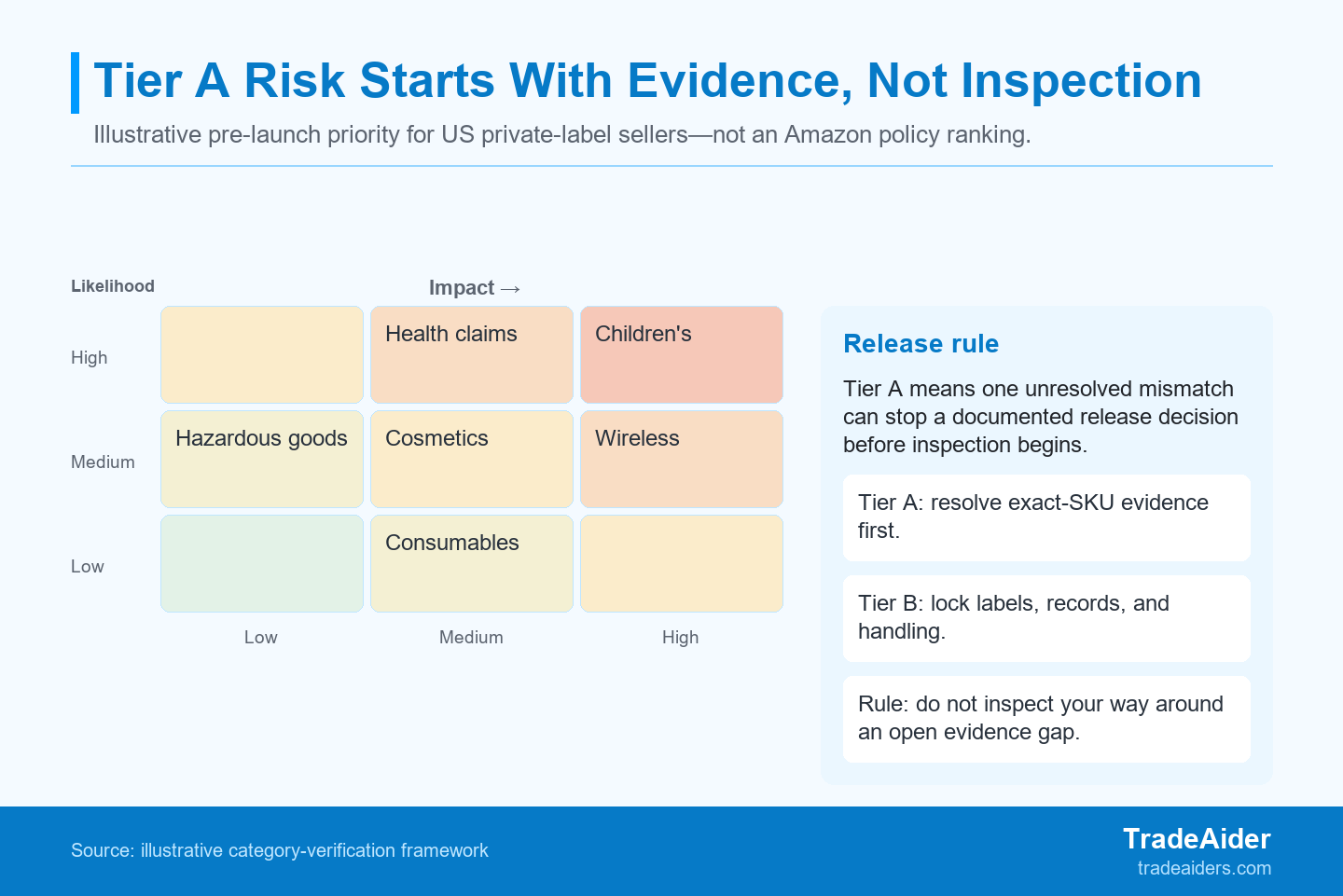
Use the category as a trigger for the first verification task: resolve the exact-SKU evidence path before a finished-lot inspection is treated as the release control.
The score's result is a sequence, not a prediction of suspension, defect rate, or profit. If two products receive the same priority, investigate the one with the earlier irreversible commitment first, such as a deposit, production slot, or FBA inbound appointment. Sampling discipline sits underneath the sequence: ANSI/ASQ Z1.4 sampling guidance describes attribute sampling as a lot-acceptance tool, which is why an AQL result cannot replace category-specific document checks. Once the priority is clear, use documented inspection acceptance criteria to turn the remaining physical controls into observable checks.
Illustrative rule: if any one dimension reaches Tier A, resolve the exact-SKU evidence path before setting a finished-lot inspection scope.
Tier A: When Evidence and the Physical Product Must Match
Tier A is a release priority, not a verdict on whether a product may be sold. The common mechanism is identity: the product in the carton, its model code, its listing language, and the supporting record must refer to the same configuration. For a technical boundary that goes beyond a finished-lot comparison, TradeAider's product testing support can help separate laboratory evidence from an inspection scope.
#1 Battery-Powered and Wireless Electronics
Battery products rank first because one defect can affect safety, transport, customer returns, and document review at the same time. For covered radio-frequency devices, FCC equipment authorization procedures use certification or Supplier's Declaration of Conformity paths depending on the device. Battery power alone does not make every product an FCC case, but a wireless module changes the evidence question, and a changed module should reopen that comparison even when the unit's outward appearance has not changed.
CPSC business guidance on Reese's Law sets safety requirements for consumer products containing button cell or coin batteries, which puts battery-access control in the release checklist, not only in the design file. The finished-lot check should cover a live function cycle, charging behavior and charger rating, heat observation during a short operating run, battery-door screw or latch security, warning label placement, manual version consistency, and carton separation for mixed models. The hidden risk is that a supplier photo can show the device turning on while the lot still has wrong chargers, loose battery doors, or inconsistent labels across cartons.
#2 Children's Products and Toys
For applicable children's products, CPSC rules require third-party testing and a written Children's Product Certificate (CPC) based on the applicable safety rules. The third-party testing rules in 16 CFR Part 1107 make evidence an early decision, and the certificate rules in 16 CFR Part 1110 require product identification detailed enough to match the certificate to the covered product. Some non-children's products subject to CPSC rules also need a General Certificate of Conformity, so the certificate question does not end at the toy aisle.
Since July 8, 2026, the CPSC eFiling rule has applied to covered regulated products required to be certified, subject to the stated foreign-trade-zone exception in the Federal Register final rule. This is a certificate-process timing check, not a general Amazon listing rule, but it makes stale or mismatched certificate data harder to carry quietly through import. On the physical side, inspection should move past general appearance to child-specific failure modes: sharp edges, burrs, loose magnets or small detachable parts, seam strength, age-grade consistency, warning text, and the tracking label. A lot should be held if the certificate description, the product label, and the actual item do not describe the same product version.
#3 Supplements and Products With Therapeutic Claims
A health-related claim can raise the evidence workload even when a product's physical appearance seems ordinary. A facial device, topical product, or supplement may look routine in a carton, yet wording such as “treats,” “prevents,” or “medical-grade” can alter the question that must be resolved before release. FDA industry resources for dietary supplements show why claims, labels, and manufacturing evidence matter here. Do not use a category name as a classification decision: freeze the proposed listing claims, map them to the exact product, and confirm the applicable route with qualified regulatory or marketplace guidance. Apply the same discipline to bundled accessories, translated copy, and images that imply a therapeutic use.
Tier B: Claims, Labels, and Handling Still Need Control
Tier B does not mean “low consequence.” It means the first release question is usually label, record, or handling control rather than a configuration-sensitive evidence gap. A photo of the approved retail label cannot prove that the production lot used it, so the release packet should identify the document version, the approved artwork, and the physical points an inspector can actually observe.
#4 Cosmetics and Consumables
FDA guidance says manufacturers and processors subject to MoCRA facility registration must renew every two years, and a responsible person must list each marketed cosmetic product where the requirement applies. Review the FDA registration and listing guidance against the exact product and responsible party rather than assuming every beauty item follows one route. The finished-lot check should verify batch or lot code presence, ingredient label version, net content, seal integrity, leakage, cap torque where relevant, expiration or period-after-opening marks, and whether the listing claim matches the physical label. A lot should be held if ingredient panels or label revisions differ across cartons, safety seals are inconsistent, or batch codes are missing from units that need traceability. If the supplier changes a formula, package, aerosol classification, or destination label, reopen the release packet rather than treating the change as a minor artwork update.
#5 Food-Contact Goods
Food-contact goods rank fifth because the customer may use the product with meals, hot liquids, children, or repeated washing, and the defect may not be obvious from a surface photo. The check should cover odor, visible contamination, cracks, sharp mold flash, coating consistency, product and country-of-origin marks, packaging cleanliness, and whether the material named by the supplier matches the approved specification. When the material risk is unclear, the release decision should include product testing before launch rather than relying on visual inspection alone. A lot should be held when odor, residue, mixed material marks, or incomplete origin marking suggests the product may not match the approved version.
#6 Textiles, Wearables, and General Accessories
Textiles and wearables fail most often through customer-visible patterns rather than single broken units: inconsistent sizing, color drift between cartons, dye transfer, weak stitching at stress points, or missing fiber and care labels. A lot should be sorted when such a pattern appears across multiple cartons. General accessories carry lower regulatory exposure but still fail through barcode errors, mixed SKUs, missing accessories, and packaging damage. GS1 US product data guidance explains why barcode and product-data accuracy support correct identification, so the release check should include a barcode scan, SKU separation, carton marks, count accuracy, and a retail-pack match against the Amazon variation. A lot can be released when sampling results are within the agreed limit and the pack configuration matches the listing, but it should be held if mixed inventory or a label mismatch appears.
An Illustrative Model-Document Conflict
When the finished model, label, and available records do not identify the same configuration, the affected variant should remain on hold until the evidence path is reconciled. The following composite is illustrative, not a TradeAider client case. Its value is the release logic, not a claim about a particular supplier.
The Hold-and-Recheck Decision
A US private-label seller is preparing an FBA inbound shipment from China. The order contains 1,800 Bluetooth-enabled facial cleansing devices with rechargeable batteries, and the release decision is still open because the record set must identify the exact configuration being sent.
The buyer has a finished product, a listing draft, and supplier documents. The listing draft refers to USB charging, a rechargeable battery, and wireless use, so those details must be consistent across the evidence packet.
The affected scope is 1 Bluetooth-enabled rechargeable model variant within the 1,800-unit order.
Production is complete and the units are packed. That makes a physical recheck useful, but it does not make a record mismatch harmless.
The supplier file names a prior wired model, while the finished device contains a rechargeable battery and a different wireless module.
The carton and product label use the new model code, while the available report and declaration do not name that code or configuration.
The issue is not whether the device looks acceptable. A cosmetic inspection cannot establish that a report for another model supports the packed device. The mismatch creates a documentary identity gap that must be closed before a reliable release decision is possible.
The seller holds the affected variant from FBA inbound and asks for the applicable evidence path to be confirmed for the exact configuration. The hold costs time, but it avoids sending a model whose package and records cannot be tied together.
The supplier maps the exact model, battery, wireless module, label artwork, packaging revision, and proposed listing claims to the supporting records. Unsupported listing language is removed rather than left for a later review.
Only after that reconciliation does a targeted recheck compare the corrected units and labels against the released packet. The gate is simple: release only the model code that matches both the evidence packet and the rechecked product.
This illustrative example does not determine legal compliance or replace laboratory work. It makes the ship-or-hold choice traceable and prevents a physical check from being used to bridge a document gap.
Match the Risk Tier to the Verification Scope
Amazon's Manage Your Compliance dashboard can show product-specific documentation or information required for products with compliance requirements. Amazon's Manage Your Compliance guidance does not create a universal inspection checklist; it tells the seller to define the applicable evidence path first, then decide which physical facts can still be verified on the packed goods. A documented Amazon FBA quality inspection scope can then connect the physical unit, retail package, carton marks, and selected functions to the evidence packet already defined by the seller.
For a Tier A SKU, start the scope with model code, label version, packaging revision, declared components, claim wording, and agreed function checks. For Tier B, shift the weight toward label legibility, date or lot coding where applicable, quantity, pack integrity, storage markings, and handling conditions. In both cases, write each control as a comparison a person can make on the lot — the model code on the unit versus the approved record, the retail label versus the approved artwork, the carton mark versus the shipping instruction — and state what happens if that comparison fails. A vague request to “check compliance” leaves the inspector without a product-specific decision boundary, because it mixes platform rules, laboratory evidence, legal classification, and physical observations into one undefined request.
A completed inspection may confirm that the checked units matched the agreed facts on the day of inspection. It does not issue a certificate, prove a laboratory result, or approve a listing. Book a pre-shipment inspection when production is 100% complete, at least 80% of the order is packed for export, and the evidence packet has a current model and label reference. If a supplier is still changing the unit or records, confirm that change first; otherwise the inspection may document a version that is no longer the release version.
Who Is TradeAider?
TradeAider is a quality inspection, testing, and certification service provider operating across all of China, covering major manufacturing provinces including Guangdong, Zhejiang, Jiangsu, Shandong, and Fujian. For high-risk Amazon categories, its role is to turn category-specific risk into factory-side evidence: inspectors can check battery access, child-product labels, cosmetic seals, barcode identity, carton marks, and packed-unit consistency while the goods are still in China, and a digital reporting workflow lets buyers review photos, measurements, findings, and release recommendations in real time.
Pricing is transparent at $199 per man-day, all-inclusive, for Inspection & QA Services, with no hidden surcharges. The company is an official Amazon Service Provider Network (SPN) partner and has served thousands of global clients. Client testimonials published on the TradeAider website cite specific outcomes, including an 18% reduction in return rates attributed to real-time defect detection and a 23% improvement in defects caught before shipment compared to prior inspection arrangements. These are client-reported figures.
Next Steps: Build the Release Packet Before FBA Inbound
A usable release packet links the exact model, target marketplace, claim list, evidence path, label artwork, and finished-lot checks before FBA inbound. It should also name the owner of each open item and the condition that changes the decision from release to hold.
- Product identity: model code, component configuration, images, and packaging revision, tied to the approved sample and label files requested from the factory before mass packing starts.
- Claim boundary: every customer-facing claim that must match the selected evidence path, with unsupported language removed rather than deferred.
- Inspection boundary: the observable product, package, label, carton, and function checks that remain meaningful after documentation review.
- Escalation rule: the record mismatch, regulated-label change, battery-access failure, or mixed-SKU finding that requires a hold, correction, or recheck.
Keep one version of this packet with the purchase order, supplier files, and inspection request. For time-sensitive launches, set a document freeze date before export packing; any change after that date is a new release decision, not a quiet edit to the existing inspection request. When a model or label changes, revise the packet before the visit and identify the superseded version. If the evidence file, product label, and packed model cannot be matched without assumptions, stop the release path and resolve the identity gap first.
Use the inspection scope calculator after the category and release conditions are known; price alone cannot choose the right scope. When the product category, marketplace, model, claims, and available documents are ready, request a category-specific inspection scope and share the release packet with the service team.
Frequently Asked Questions
Testing, marketplace documentation, and finished-lot inspection answer different release questions and should not be substituted for one another. The right sequence depends on the exact SKU, its claims, its destination market, and the evidence already available.
Which Amazon product category has the highest quality risk?
Battery-powered and wireless electronics usually carry the highest combined risk, because function, charging, heat, battery access, labeling, manuals, packaging, and compliance evidence can all matter at once. Children's products follow closely: their defect tolerance is low, and the certificate, label, and physical item must describe the same product version. The exact SKU, its claims, and its destination market decide the final priority, so treat the ranking as a starting sequence rather than a fixed verdict.
Which Amazon categories need testing before inventory is sent?
Categories with a clear applicable testing or certification path should have that path checked before inventory is sent. Children's products, covered wireless devices, and products with therapeutic claims deserve the earliest attention, and food-contact goods need a testing decision when the material risk is unclear. A broad category name is never enough to select a test or certificate; the exact product, configuration, claim, and market decide what applies. Start before the supplier locks artwork and cartons, because a later model or label change can make earlier evidence hard to match to the inbound lot.
Does a passed inspection prove Amazon compliance?
No; a passed inspection verifies a finished lot against an agreed physical scope, including identity, labels, packaging, quantity, and selected functions. It cannot replace category-specific testing, certificates, or marketplace approval, and AQL sampling helps judge visible lot defects rather than compliance questions. Use the inspection after the evidence path is defined, record what was checked and what remains outside the scope, and resolve any report, claim, or certificate that belongs to a different version before treating the result as a release input.
When should an Amazon seller book a pre-shipment inspection?
Book it when production is 100% complete, at least 80% of the order is packed for export, and the supplier can provide the exact model, label, packaging, and evidence references for the lot. If any of those inputs are changing, resolve the version first. Confirm that the cartons selected for inspection represent the version intended for FBA inbound, not an earlier sample, a factory reserve batch, or a package awaiting final artwork, so that release, rework, sorting, or holding decisions can still happen at the factory.
Related Articles


Grow your business with TradeAider Service
Click the button below to directly enter the TradeAider Service System. The simple steps from booking and payment to receiving reports are easy to operate.

