
- About Us

- Our Services
- Your Industry
- Resources
- News & Blog
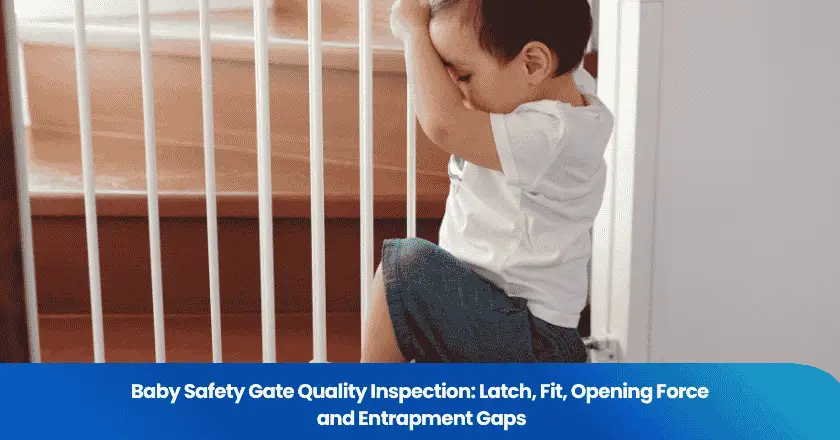
A baby safety gate has to be inspected as an installed barrier rather than a boxed product. Four release conditions decide whether a lot can ship. The latch and locking mechanism must fully engage, and the mounting must fit and hold in the delivered configuration. The gate must resist the force the applicable standard sets, and every opening must be too small to let a child pass a torso through. A gate can close with a satisfying click and still fail any one of them, because each condition is measured rather than heard or seen. Each condition also has its own method and its own record, and a finding on any one of them can hold the shipment.
What This Gate Checklist Decides
The latch is judged on the locked state, not on the click it makes when it closes.The mounting is checked in the delivered configuration and opening width, not on a bench.The opening force is a measured result at the standard's named test locations.Every opening, the floor line and the top edge are probed, not eyeballed.
What a Baby Gate Inspection Has to Establish
Start with the product class and the destination, because they decide which standard applies. In the United States, a gate or an expansion gate must comply with the mandatory standard for gates and enclosures, 16 CFR part 1239, which incorporates the current edition of ASTM F1004 by reference. An expansion gate is the removable barrier placed across an opening such as a doorway. That standard applies to children aged six months through 24 months and covers performance requirements, test methods, labeling and instructional material, so a lot is checked against a defined scope rather than a general impression of sturdiness. A gate bound for the European Union is checked against its own barrier standard instead, and a buyer should confirm the edition in force for the date of manufacture rather than assume one number fits every destination. For the split between a product specification and the method used to check it, the inspection-standard guidance is the reference this checklist follows.
A Children's Product Certificate is also part of the file. It records that the maker certifies the approved design against the applicable safety rules, but it does not prove that the packed goods in front of the inspector match that design. That is why a gate inspection keeps the design document and the lot evidence apart: the certificate sets the requirement, and the inspection checks the physical gate, its mounting and its packing against the approved reference before release. Where a supplier offers a certificate as the only release evidence, ask for the check that ties that design to the units being shipped.
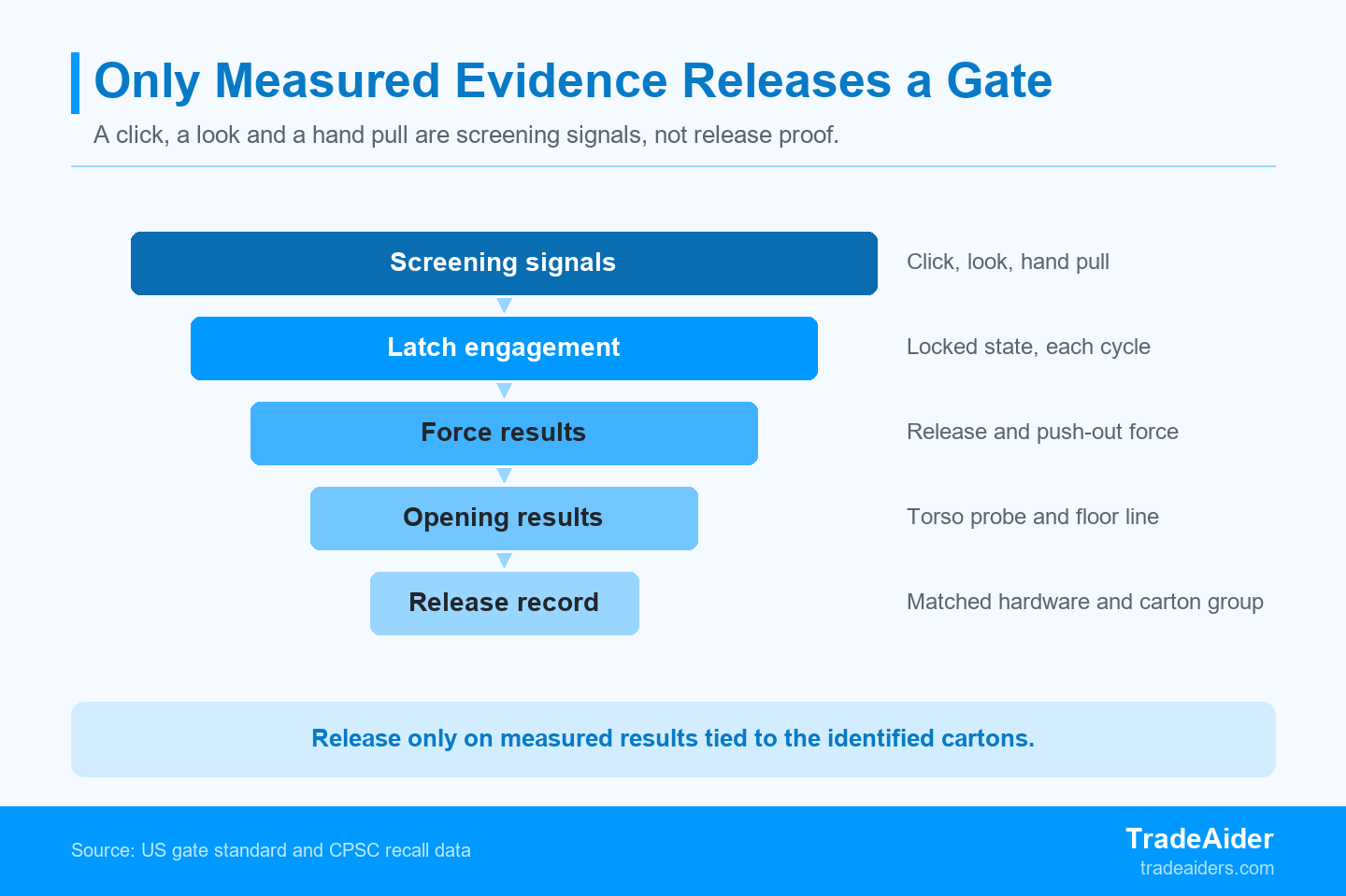
A click, a look or a hand pull is only a screening signal; a gate lot is released on measured latch, force and opening results tied to identified cartons.
Latch and Locking: Prove Full Engagement
A gate keeps a child back only if the latch and locking mechanism fully engage and stay engaged. A lock the contained child can operate, or one that does not fully seat, lets the child reach the hazard the gate was meant to block, so the locked state is what the check looks for. A click is not proof of that state. A mechanism can sound closed while the strike or the second action sits only partly engaged, and a latch that opens under a slight load will not be found by watching the gate swing shut. The inspection therefore checks what the latch does when it is loaded and confirmed, then records the state against the sample it tested.
Cycle the Latch and Confirm the Locked State
A single correct operation proves very little about a latch that is cycled every day. The useful check is repeated latching, with the locked state confirmed after each cycle rather than once at the end. Cycling exposes the failures a single open and close hides. A catch may need extra force and sometimes fail to seat, an indicator may show locked when the mechanism is not, or a second action may engage only if the gate is pressed a particular way. The buyer should set the cycle count and the acceptance rule in the brief, because the count depends on the mechanism and the risk it carries. The inspector records the locked state and any cycle that failed against the same sample. An automatic closing system is cycled the same way, because the closing action and the locking action are separate behaviours even when one spring performs both.
Release Force: Single-Action Versus Double-Action
The latch also has to be something a child cannot work. For a US-destined gate, a single-action latching device must require a minimum force of 10 pounds to activate and open the gate, or the lock must be double-action. The inspection therefore records either the measured release force or the double-action design, and an inspector should not pass a latch because an adult can open it easily. Easy for an adult and hard for a child are different properties, and only a defined release-force check or a second required action separates them. Name the method and the acceptance value in the brief so the result is comparable across runs. If the specified equipment is not available, record the test as unperformed rather than treat a hand operation as the force result. Other markets set their own release requirement, so a EU-bound lot is checked against its own standard rather than the US figure.
Installation Fit: Reproduce the Delivered Mounting
A gate is only as good as the way it is fitted, and the two mounting types behave differently. A pressure-mounted gate holds by pressing against the two sides of the opening. A hardware-mounted gate is fixed to the opening with screws and brackets. Because the mounting decides how the gate resists force and where the openings sit, the inspection reproduces the mounting the buyer intends to use rather than testing a loose panel on a bench. That means installing the delivered configuration with the supplied wall cups and hardware, at the opening width the gate will actually face, on the surface it will press against. The current rule describes a pressure-mounted gate as one that relies on pressure to stay in its recommended use position. That is also a warning: a fit that depends on friction has to be verified in the real opening, not assumed from the sample.
The intended location changes the mounting rule. Consumer-safety guidance places a hardware-mounted gate where a child could fall, such as the top of a stairway, and warns against a pressure-mounted or retractable gate at that location, even with wall cups screwed into the wall. The same guidance keeps the bottom of the gate less than 3 inches from the floor so a child cannot wriggle underneath. UK public-health advice is to keep gates at the top and bottom of stairs until the child is at least 2 years old. For an importer, the practical point is to state the location in the brief, because a gate that is acceptable in a passageway may be unsuitable at the head of the stairs.
Opening Force and Push-Out: What the Numbers Must Show
Push-out force is how hard a gate must be pushed before it releases or shifts, and it tests the mounting and the latch together. For a US-destined gate, all gates, including pressure-mounted gates, must meet a 30-pound push-out force test at five test locations. The force and the locations matter as much as the number. Pushing one convenient corner is not the same as testing the named points, and a gate that shifts under the specified force has failed even if the latch stayed closed. This is one of the checks a pre-shipment inspection performs on a completed, packed order at the factory, which is why the fixture and the test locations belong in the brief. When the gate is sampled rather than tested unit by unit, the sample size and the accept and reject numbers come from the pre-shipment inspection checks agreed with the buyer. The force result is recorded against the same configuration the sample was mounted in.
A hand pull can reveal an obviously loose fixing, but it is not a force result. The formal answer comes from the specified force applied at the specified locations with the agreed fixture, so the report should state the method, the setup and the result rather than the inspector's impression. If the equipment is missing, describe the gap and leave the test unresolved. An honest "not tested" is more useful than a pass that was never measured, because it tells the buyer to arrange the missing evaluation before the goods move.
Entrapment Gaps: Openings, the Floor Line and the Top Edge
Entrapment is a child getting a head or body part caught in an opening, and it is checked at specific interfaces rather than as one general gap. For a US-destined gate, completely bounded openings within the gate, and bounded openings between the gate and the fixture it is fitted to, must not let the small torso probe pass when it is pushed with a 25-pound force. The rule's own reasoning is that children have been found with their heads caught after pushing into gaps between flexible gate parts or between the gate and the sides of the opening. That is why the probe is pushed rather than merely placed. Each interface is measured on its own: a result between two slats does not settle the gap between the gate and the wall, and a decorative opening can be as hazardous as an obvious one.
The floor line is a separate interface and a common miss. The space between the floor and the bottom edge must not let the small torso probe pass under the same 25-pound push. A child can go feet first into the gap between the gate and the floor and become trapped. The bottom spacing is therefore measured in the mounted configuration rather than judged by eye, and the surface under the gate matters to the result. A gate that sits correctly on a hard floor can still leave a floor-line gap on a softer surface, so the check records the surface it was set up on.
The uppermost edge is the third interface. Its requirement addresses the V-shaped openings common in older accordion-style gates, where a head or neck can be caught at the top of the barrier. The top edge is therefore checked rather than assumed safe, because a gap that looks decorative can still admit a head or neck, and the shape of the opening matters as much as its size. Where the design has a V or a narrow uppermost channel, the brief should name the method and the probe the inspection uses so the result is comparable with the standard rather than with the previous model.
Hardware and Mounting Integrity
The mounting hardware is a product feature, not a packing extra. Pressure-mounted gate-mounting hardware is part of the standard's requirements, and so are the side-pressure indicators that show the gate is correctly tensioned. The inspection therefore confirms the supplied hardware and its installation rather than treating the wall cups as an accessory. This matters because a pressure gate holds by friction: if the cups, pads or straps that create that friction are missing, wrong or poorly seated, the gate can shift even when it passed a hand check. Consumer-safety guidance makes the same point about wall cups, warning that screwed-in cups do not make a pressure gate safe where a child could fall. The default sampling plan for the workmanship around these parts uses the acceptance quality limit, or AQL, to size a random sample and set the accept and reject numbers. The safety-critical hardware checks are treated as binary and separate from ordinary cosmetic workmanship. The AQL sampling calculator sizes that sample, and the distinction keeps a stain or a scratch inside the sampled allowance while a missing wall cup stops the release.
The gate's other components are inspected for the same reason the latch and openings are. The standard covers the product's performance, labeling and instructional material, and it addresses the parts and accessible surfaces that a child can reach, including sharp points and edges, small parts and the fasteners that hold the assembly together. The inspection therefore looks at the components and the accessible surface, not only the panel and the latch. Screw ends, exposed metal, detachable parts and rough edges are all findings that belong to the product, and the record should name the part and the location so a correction can be verified on the corrected units.
Ship or Hold: Disposition of Findings
The checks only matter if they change the shipment decision. A safety-critical finding keeps the lot on hold regardless of a passing workmanship sample, because a sampled pass on stains or printing cannot close a latch, force or entrapment requirement. Each release condition owns its own evidence. The latch needs a locked-state record and, where it applies, a release-force or double-action result. The mounting needs the fit in the delivered configuration. The force needs the specified test at the named locations, and the openings need the probe results for each interface. Rework has to address the requirement that failed and be re-verified on the corrected group, not merely described, and the records that identify the affected cartons decide which units the result applies to. When a finding is disputed, or a requirement cannot be checked on site, escalate it to the technical owner before the goods move rather than resolving it on the shop floor.
Illustrative Example: A Gate That Locks but Fails Push-Out
The following is an illustrative example, not a client result. An importer orders 9,000 pressure-mounted baby safety gates across three runs of 3,000 for a US and European mix. The approved sample passed a visual check, and at the office the latch clicks closed, so the buyer expects the bulk order to behave the same way. Review who runs the checks in TradeAider's company background.
On the inspected units the picture is less reassuring. The latch clicks, but a corner of the gate can be pushed open under the specified push-out check. The space under the bottom edge lets the small torso probe pass on two of the sampled units, and the mounting wall cups are boxed but not named on the packing list.
A gate that closes and clicks can still fail the push-out and bottom-spacing requirements, which are separate from the sound of the latch, so the visual pass and the office test hid two distinct failures. The buyer holds the affected group, escalates the push-out and bottom-spacing failures to the technical owner, and treats the unlisted mounting hardware as a release condition rather than a packing note.
The factory corrects the latch engagement and the mounting hardware and re-secures the bottom edge to the specified spacing. The buyer then re-runs the push-out check at the specified test locations and re-measures the bottom spacing on the corrected group, and reconciles the mounting hardware against the packing list before release. This is an illustrative example, not measured client data, a supplier rating, or a certification. The 2,400 units built on the second run are not automatically released; their own inspection evidence still has to be produced for the group the records can identify.
Prepare a Baby Gate Inspection Request
A useful inspection starts with a specific brief. Send the gate model and the destination market, the mounting type and the opening width, the applicable standard edition and any buyer acceptance criteria, so the inspection team can confirm which checks the visit can perform. Include the packing status and the mounting hardware to be checked. A pre-shipment inspection runs on a completed, packed order and samples randomly from the shipment, so the inspector needs to know what the order should contain before the cartons are opened. The more precisely the brief names the configuration, the easier it is to tell a genuine failure from a difference in how the gate was set up.
| Release condition | Check and method | Record holder |
|---|---|---|
| Latch and locking | Locked state after each cycle, release force or double-action | Inspector |
| Installation fit | Delivered mounting, opening width and wall cups | Inspector and buyer |
| Opening force | Push-out force at the specified test locations | Inspector |
| Entrapment openings | Torso probe at bounded openings, floor line and top edge | Inspector |
| Hardware and components | Supplied hardware against the list, parts and accessible surfaces | Supplier and inspector |
The table is the brief in miniature. Each row is a release condition, the method that makes it measurable, and the party that keeps the record, so a release decision can point at a document rather than a memory. Set the sample size and the accept and reject numbers for the order first, then confirm which checks run on site and which need a laboratory or a supplier record. To scope the work for a specific gate, contact TradeAider to scope your gate inspection.
Frequently Asked Questions
Does a Children's Product Certificate replace a factory inspection?
No; a Children's Product Certificate certifies the approved design, and it does not prove that a specific packed gate lot matches that design. The inspection is the layer that connects the certificate to the goods on the floor: it checks that the delivered gate, its labels, its mounting and its packing match the model the certificate covers. A certificate with no matching lot is a document about a design, not a statement about the cartons being loaded, so keep both in the release file.
Can a pressure-mounted gate be used at the top of stairs?
Consumer-safety guidance places a hardware-mounted gate at the top of stairs and warns against pressure-mounted and retractable gates there, even with wall cups screwed into the wall. The standard requires every gate, including a pressure-mounted gate, to meet the push-out test, but passing that test does not make a friction mount the right choice at the head of the stairs. State the intended location in the brief so the mounting type is checked against the place where it will be used.
Is a hand pull enough to check the push-out force?
No; a push-out result needs the specified force at the specified test locations, and a hand pull is only a screening observation. A hand pull can show that a fixing is obviously loose, but it cannot establish the required force or the five named locations, so it cannot be filed as a pass. If the correct fixture is unavailable, record the test as unperformed and arrange the proper evaluation, because an unresolved test tells the buyer something a false pass does not.
Should the gate be inspected at the opening width it will use?
Yes; the gate's openings and mounting behavior change with the opening width and the surface it presses against, so the inspection reproduces the intended setup rather than a convenient bench width. A pressure-mounted gate that fits one doorway may sit differently in a wider or narrower opening, and the floor-line gap can change with the surface under it. Give the inspector the intended opening width, the mounting surface and any threshold or carpet, so the fit and the opening checks are measured in the configuration the buyer will actually use.
Can rework that fixes the latch release the whole lot?
No; rework addresses the corrected group, and every affected requirement still needs its own re-verification before the lot is released. If a latch correction also touches the mounting or the bottom edge, the push-out and the floor-line opening must be re-checked on the corrected units, because a fix for one condition can leave another unresolved. The records that identify the affected cartons decide which units the new result applies to, so the corrected group is re-verified and the rest of the lot is released only on its own evidence.

Related Articles

Grow your business with TradeAider Service
Click the button below to directly enter the TradeAider Service System. The simple steps from booking and payment to receiving reports are easy to operate.

