
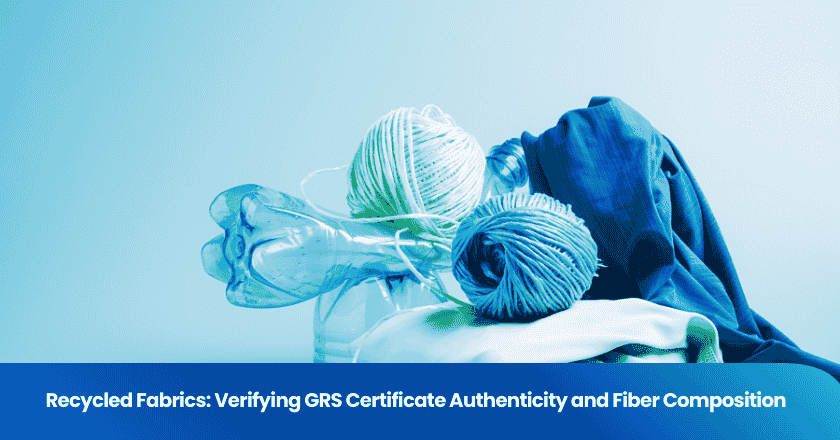
In the transition toward a circular economy, the textile industry has adopted the Global Recycled Standard (GRS) as the definitive benchmark for sustainable polymeric substrates. However, as the market for recycled polyester (rPET) and recycled cotton expands, so does the risk of fraudulent claims and "Quality Fade." Technical verification is no longer optional; it requires a multi-layered approach involving on-site factory audits, digital traceability through Transaction Certificates (TC), and advanced laboratory fiber identification. For sourcing managers and brands, ensuring that a fabric truly contains the claimed percentage of recovered inputs is critical to both environmental integrity and regulatory compliance. This guide explores the metrological and logistical protocols required to authenticate GRS claims and maintain the Chain of Custody (CoC) across complex global supply chains.

Key Takeaways
- GRS 4.0 is a holistic standard requiring 20-50% minimum recycled content alongside social, environmental, and chemical compliance.
- Verification requires a dual-certificate system: Scope Certificates (SC) for facility eligibility and Transaction Certificates (TC) for batch traceability.
- Advanced chemical analysis like Py-GC/MS and FTIR are essential for identifying fiber types, although they cannot distinguish rPET from virgin PET without isotopic tracers.
- The Mass Balance model ensures that the volume of recycled output does not exceed the certified recycled input within a given production window.
- Professional quality inspections are necessary to prevent the mixing of non-certified post-industrial waste with certified feedstock.
- Blockchain-enabled notarized reporting is emerging as the technical standard for tamper-proof supply chain transparency.
The Technical Framework of GRS Certification
Managed by Textile Exchange, the GRS is more than a recycled content claim; it is a full-product standard. To achieve compliance, a facility must be audited against four technical pillars. This ensures that a "sustainable" fabric is not produced in a manner that violates labor laws or releases toxic effluents into the ecosystem. For industrial manufacturers, meeting these criteria is a prerequisite for entry into the high-end apparel markets of the US and EU.
The Four Pillars of GRS Compliance
| Pillar | Technical Objective | Mandatory Requirements |
|---|---|---|
| Recycled Content | Verify material origin | ISO 14021 definitions; Minimum 20% content |
| Social Audit | Ensure fair labor | Compliance with ILO conventions; Health and safety standards |
| Environmental | Resource optimization | Wastewater treatment (ETP); Energy and water tracking |
| Chemical Management | Eliminate toxins | Zero discharge of ZDHC MRSL restricted substances |
TC vs. SC: Navigating the Logistics of Authentication
A frequent error in fabric sourcing is relying solely on a Scope Certificate. While a Scope Certificate (SC) proves a factory *can* produce GRS goods, only a Transaction Certificate (TC) proves that the specific batch of fabric delivered to the buyer *is* certified. TCs are issued by accredited Certification Bodies (CBs) after verifying the seller's input-to-output volume ratio.
Verification Protocol for Transaction Certificates
Technical teams must conduct a "Triangulation Audit" on every TC received:
- Entity Matching: Verify that the name and TE-ID on the TC match the legal entity listed on the invoice and packing list.
- Volume Reconciliation: Cross-check the "Net Weight" on the TC against the physical weight of the shipment. Discrepancies often indicate the inclusion of non-certified "fillers."
- CB Validation: Use the Textile Exchange database to confirm the status of the Certification Body and the validity of the certificate serial number.
- Technical Alert: TCs must be requested immediately upon shipment. A delay in TC issuance is a significant red flag, potentially indicating that the supplier's recycled feedstock quota has been exhausted and they are attempting to source uncertified material.
Advanced Laboratory Analysis for Fiber Identification
Fiber composition analysis is the primary metrological tool for identifying "Adulterated" recycled fabrics. While traditional microscopy can identify natural fibers, synthetic polymers require chemical and thermal analysis to quantify blends correctly. Professional quality assurance audits rely on the following laboratory protocols.
FTIR Spectroscopy and Molecular Fingerprinting
Fourier-Transform Infrared (FTIR) spectroscopy is used to identify the functional groups within a polymer. By measuring the infrared absorption spectrum, technicians can differentiate between Nylon 6 and Nylon 6.6, or identify the presence of elastane in recycled polyester blends. For multi-fiber recycled fabrics, Pyrolysis-Gas Chromatography/Mass Spectrometry (Py-GC/MS) provides a quantitative breakdown by thermal degradation, allowing for precise measurement of fiber percentages within +/- 1% accuracy.
| Analytical Method | Technical Principle | Detection Capability |
|---|---|---|
| FTIR | Infrared molecular vibration | Polymer identification (PES, PA, CO) |
| Py-GC/MS | Thermal fragmentation | Quantitative blend analysis (e.g. 62% rPET / 38% rCO) |
| DSC | Differential Scanning Calorimetry | Detection of thermal history and impurities |
| Isotopic Analysis | Carbon-14 dating / Tracers | Bio-based vs. Petro-based content differentiation |
Chain of Custody (CoC) and Mass Balance Integrity
The integrity of a recycled claim depends on "Physical Segregation"—ensuring that certified recycled fibers are never mixed with virgin fibers during spinning or weaving. In facilities where both types are processed, a robust "Mass Balance" system is required. This is a mathematical model where the total output of certified fabric is reconciled against the total input of certified flake or yarn, minus the standard industrial waste percentage.
During a technical factory audit, inspectors must review the "Batch Records." If a factory produces 10,000 meters of "100% GRS Fabric" but only purchased 4,000 kg of rPET yarn, the CoC is broken, and the certification is invalid. IoT sensors and digital dashboards are increasingly used to provide real-time visibility into these volumetric flows.
Mitigating Greenwashing through Tracer Technology
As consumer demand for "sustainable" products rises, so does the prevalence of greenwashing—making deceptive environmental claims. According to industry research, nearly 40% of sustainability labels in textiles lack verifiable evidence. To combat this, advanced brands are adopting "Molecular Tracers." These are microscopic, inert chemical markers injected into the recycled polymer melt. These tracers can be detected in the finished garment using a handheld scanner, providing instant "Physical Evidence" that the material originated from a specific certified recycler.
Expert Insight: The use of "Ocean-Bound Plastic" (OBP) claims requires even stricter CoC verification than standard rPET. OBP must be collected within 50km of an unprotected coastline. Technical audits must include GPS-stamped collection logs to prevent standard landfill plastic from being "rebranded" as ocean-bound.
Environmental Metrics: The LCA Advantage
Authenticating recycled fabrics allows brands to claim measurable environmental savings through Life Cycle Assessment (LCA). The technical data confirms that mechanical recycling of polyester results in significant reductions in both energy and water intensity compared to virgin PET production. These metrics are vital for ESG (Environmental, Social, and Governance) reporting and complying with emerging laws like California's SB 343.
| Environmental Metric | Virgin PES Production | Recycled PES (rPET) | Technical Improvement |
|---|---|---|---|
| GWP (Global Warming Potential) | ~ 2.5 kg CO2e / kg | ~ 1.1 kg CO2e / kg | 56% Reduction |
| Primary Energy Demand | ~ 85 MJ / kg | ~ 35 MJ / kg | 58% Energy Saving |
| Blue Water Consumption | High (Chemical cooling) | Low (Wash cycles) | ~ 45% Saving |
Conclusion: Strategic Quality Control for Sustainable Sourcing
Achieving transparency in the recycled fabric supply chain is a technical challenge that requires vigilant quality control consultation. By combining the logistical rigor of GRS Transaction Certificates with the scientific precision of laboratory fiber analysis, brands can insulate themselves from the risks of fraudulent sourcing and regulatory penalties. Digital traceability and the integration of blockchain-notarized reporting will soon become the baseline for the industry, ensuring that every meter of "recycled" fabric delivered is a genuine contribution to global sustainability.
Ready to secure your product quality before shipment?
As your third-party inspection, testing & certification partner in China, TradeAider supports brands and sourcing teams across the entire production process, helping you identify quality risks early, ensure compliance, and strengthen your team’s capabilities before shipment.
Book an Inspection or Testing Service with TradeAider today, or for tailored solutions and expert guidance, contact us at services@tradeaider.com or submit the request form on the right. →

Frequently Asked Questions (FAQ)
What is the difference between GRS and RCS?
The Recycled Claim Standard (RCS) only verifies the presence of recycled content. The Global Recycled Standard (GRS) is more comprehensive, adding mandatory social, environmental, and chemical requirements to the verification process. For premium brands, GRS is the technical standard of choice.
Can rPET be distinguished from virgin PET in a lab?
Currently, no standard chemical test can differentiate between chemically identical virgin and recycled polyester filaments. Verification relies entirely on the Transaction Certificate (TC) audit trail and tracer technologies. Only "Pre-Consumer" vs "Post-Consumer" waste sources can sometimes be identified through DSC thermal history analysis.
How long is a GRS Transaction Certificate valid?
A TC is specific to a single shipment or a set of shipments. It does not have an expiry date like a Scope Certificate, but it must be issued within a specific timeframe (usually 180 days) of the actual shipment to be legally valid under Textile Exchange guidelines.
What does 'Post-Consumer' recycled content mean?
Post-consumer material is waste generated by households or by commercial, industrial, and institutional facilities in their role as end-users. This includes items like used plastic bottles or discarded garments. Pre-consumer waste, in contrast, refers to industrial scraps diverted from the waste stream during the manufacturing process.
Why do I need a 50% recycled content for the GRS logo?
While a product can be GRS certified with only 20% recycled content, the GRS logo can only be displayed on consumer-facing products if they contain at least 50% recycled material. This technical threshold is designed to ensure that products marketed as "recycled" represent a significant environmental improvement.
Related Articles

Grow your business with TradeAider Service
Click the button below to directly enter the TradeAider Service System. The simple steps from booking and payment to receiving reports are easy to operate.

