
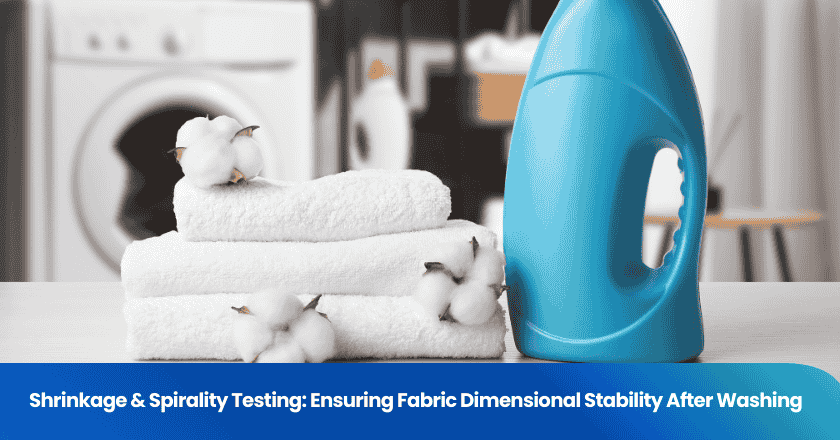
In the global apparel and textile industries, dimensional stability is the primary metrological indicator of garment quality and serviceability. A failure to control the volumetric integrity of a fabric after domestic laundering often leads to "Consumer Rejection," characterized by ill-fitting garments, twisted seams, and distorted patterns. This stability is governed by the complex interplay between fiber hygroscopy, yarn morphology, and knitting or weaving tension. For manufacturers and sourcing managers, implementing rigorous shrinkage and spirality testing protocols according to ISO and AATCC standards is essential to mitigate the risk of product failure. This guide provides a technical exploration into the physics of fabric distortion and the standardized validation methods required for industrial quality assurance.

Key Takeaways
- Dimensional stability (DS) quantifies the percentage change in fabric area after exposure to mechanical and thermal stress.
- Shrinkage is categorized into Relaxation, Swelling, and Felting, each requiring distinct technical mitigation strategies.
- Spirality (Torque) in circular knits is a function of residual yarn twist and loop geometry, often measured by the displacement angle.
- ISO 6330 and AATCC 135 are the definitive benchmarks for simulating real-world domestic laundering cycles.
- Professional quality control audits must verify the conditioning of specimens at 65% RH to ensure data repeatability.
- Advanced treatments like sanforization and heat-setting are the primary technical countermeasures against residual shrinkage.
The Physics of Dimensional Stability: Fiber Relaxation and Tension
The structural integrity of a textile substrate is fundamentally an equilibrium state. During spinning, weaving, or knitting, fibers and yarns are subjected to significant mechanical tension. This creates "internal stress" within the polymer chains of the fiber. When the fabric is subsequently wetted and agitated during washing, the lubricating effect of water allow these stresses to release, prompting the fibers to return to their original, low-energy dimensions. This technical phenomenon is known as Relaxation Shrinkage.
Molecular Mechanisms of Distortion
Different fibers respond uniquely to hydraulic stress. Natural cellulosic fibers like cotton and viscose possess high moisture regain, leading to "Swelling Shrinkage." As the fiber diameter increases due to water absorption, the yarn must shorten to maintain the weave or knit geometry. In contrast, synthetic fibers like polyester are hydrophobic and remain dimensionally stable unless exposed to temperatures exceeding their Glass Transition Temperature (Tg), which triggers thermal shrinkage.
| Shrinkage Category | Technical Driver | Typical Fabric Affected |
|---|---|---|
| Relaxation | Release of weaving/knitting tension | All textiles, specifically denim and jersey |
| Swelling | Lateral fiber expansion in water | Cotton, Linen, Viscose (Rayon) |
| Felting | Interlocking of protein fiber scales | Wool, Cashmere, Mohair |
| Thermal | Molecular chain contraction under heat | Nylon, Polyester, Spandex |
Shrinkage Testing: Methodology and Standard Compliance
Quantitative assessment of shrinkage involves measuring the distance between precision-marked reference points before and after a standardized wash-dry cycle. The results are expressed as a percentage change for both the warp (length) and weft (width) directions. Any deviation exceeding 3-5% for wetted fabrics is typically flagged during a textiles quality control audit.
ISO 6330 vs. AATCC 135 Protocols
While both standards aim to simulate consumer use, they differ in technical parameters. ISO 6330 utilize "Horizontal Axis" (front-loading) machines, which apply higher mechanical agitation. AATCC 135 often focus on "Vertical Axis" (top-loading) configurations common in the North American market. Professional laboratories must specify the "Ballast Type" (load weight) and "Drying Method" (Tumble, Line, or Flat) to ensure test reproducibility.
| Fiber Type | Initial Shrinkage (%) | AQL Tolerance |
|---|---|---|
| 100% Ring-Spun Cotton | 5.0% - 7.5% | +/- 3.0% |
| Sanforized Denim | 1.0% - 2.5% | +/- 1.0% |
| Polyester Knit | 0.5% - 1.5% | +/- 0.5% |
| Viscose (Rayon) | 8.0% - 12.0% | +/- 4.0% |
Expert Tip: Always perform "Growth" measurement alongside shrinkage. Certain heavy-rib knits can actually "grow" or elongate in length while shrinking in width, a phenomenon known as the Poisson effect in textile geometry.
The Mechanics of Spirality in Knitted Fabrics
Spirality, often referred to as "Torque" or "Skewing," is a specific technical defect prevalent in single-jersey circular knits. It manifests as a diagonal displacement of the garment's side seams. According to research in Nature Scientific Reports, spirality is primarily caused by the residual torque in the yarn—a result of the Z or S twist applied during spinning—which causes the knitted loops to lean in a specific direction after the fabric is relaxed.
Measuring the Spirality Angle (α)
In a laboratory setting, spirality is measured using the "Folding Method." A square specimen is laundered and conditioned. Technicians then measure the distance (D) between the original vertical line and the displaced vertical line over a fixed length (L). The percentage of spirality is calculated as $(D/L) \times 100$. For high-end export apparel, a spirality exceeding 4 degrees or 5% displacement is considered a major quality failure, as it prevents proper pattern alignment during the cutting phase.
Quality Assurance and Regulatory Standards
Reliability in the textile sector is maintained through adherence to international benchmarking. For global brands, apparel quality control processes require that every fabric batch be accompanied by a Technical Data Sheet (TDS) verifying its dimensional performance. Failure to comply with these standards can result in legal liability and massive retail recalls.
Key standards for global compliance include:
- ISO 5077: Determination of dimensional change in washing and drying.
- ISO 16322: Technical protocols for measuring spirality in fabrics and garments.
- AATCC 135: Dimensional changes of fabrics after automatic home laundering.
- ASTM D2126: Response of rigid cellular plastics to thermal and humid aging (relevant for synthetic textiles).
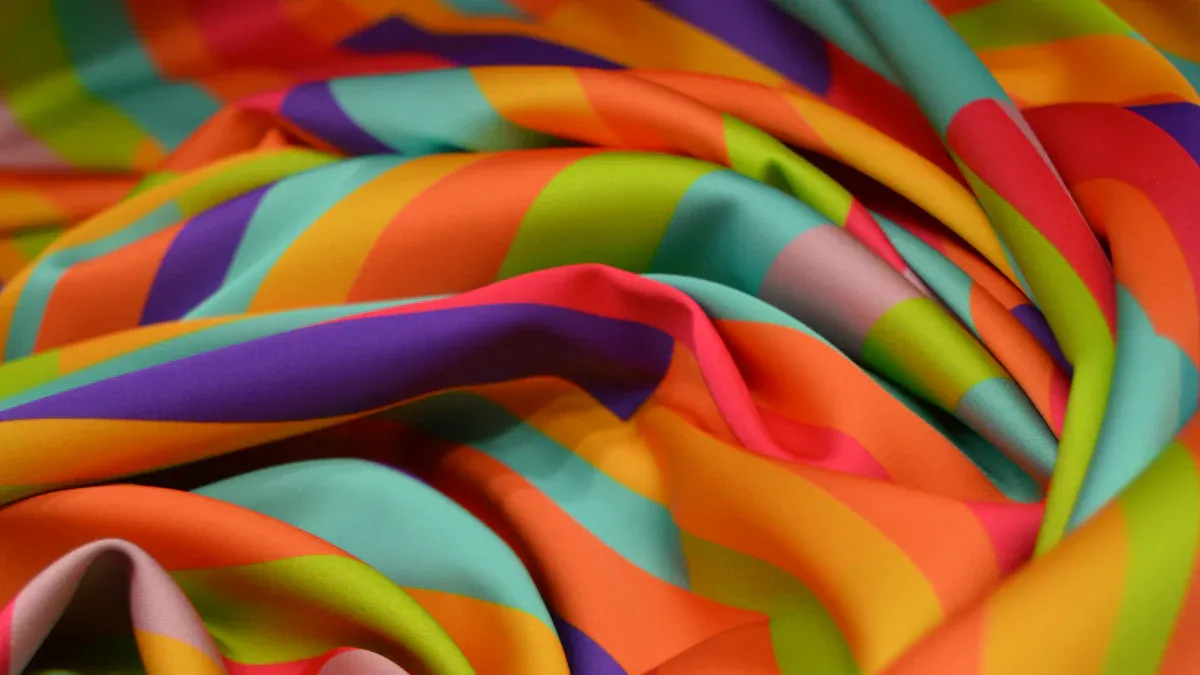
Industrial Mitigation Strategies for Dimensional Stability
Manufacturers utilize several mechanical and chemical processes to "pre-stabilize" fabrics before they reach the cutting table. Identifying these processes during a factory audit is critical for evaluating a vendor's technical capability.
- Compacting: A mechanical process for knits that uses steam and pressure to compress the loops, effectively pre-releasing relaxation shrinkage.
- Sanforization: Used for woven cottons; this process feeds the fabric through a rubber belt that mechanically shrinks the warp yarns to a stable state.
- Heat-Setting: Essential for synthetic blends (e.g., Cotton/Spandex). The fabric is held under tension in a stenter at high temperatures to "freeze" the polymer chains in their designed dimensions.
- Mercerization: Treating cotton with caustic soda, which swells the fiber and permanently alters its crystalline structure, increasing stability and luster.
Ready to secure your product quality before shipment?
As your third-party inspection, testing & certification partner in China, TradeAider supports brands and sourcing teams across the entire production process, helping you identify quality risks early, ensure compliance, and strengthen your team’s capabilities before shipment.
Book an Inspection or Testing Service with TradeAider today, or for tailored solutions and expert guidance, contact us at services@tradeaider.com or submit the request form on the right. →

Frequently Asked Questions
Can I predict shrinkage based on fabric weight (GSM)?
Not directly. While heavier fabrics often shrink less than very "loose" lightweight knits, shrinkage is more dependent on the fiber type and the tension applied during weaving. A heavy viscose fabric will shrink significantly more than a lightweight polyester ripstop.
Why do my side seams always twist after three washes?
This is the classic symptom of spirality. It indicates that the manufacturer used high-twist yarn in a single-jersey construction without proper "Twist Setting" or "Compacting" during the finishing stage. The yarn is literally trying to untwist itself, causing the fabric to skew.
Is hand-washing a valid substitute for lab testing?
No. Hand-washing lacks the standardized mechanical agitation and temperature control required for industrial validation. Professional quality inspection methods utilize calibrated Wascator machines to ensure result reproducibility.
How does Spandex affect dimensional stability?
Spandex (Elastane) increases the "Recovery Force" of a fabric. While it helps a garment return to its shape after stretching, it can also *increase* shrinkage if the fabric is not properly heat-set. The elastane acts like a rubber band, pulling the other fibers together when wetted.
What is "Conditioning" and why is it mandatory?
Fibers like cotton absorb moisture from the air. A fabric will measure differently on a rainy day than on a dry day. Standard conditioning (24 hours at 20'C / 65% RH) ensures all specimens are at the same moisture level before the first measurement is taken.
Related Articles
Grow your business with TradeAider Service
Click the button below to directly enter the TradeAider Service System. The simple steps from booking and payment to receiving reports are easy to operate.

