
- About Us

- Our Services
- Your Industry
- Resources
- News & Blog
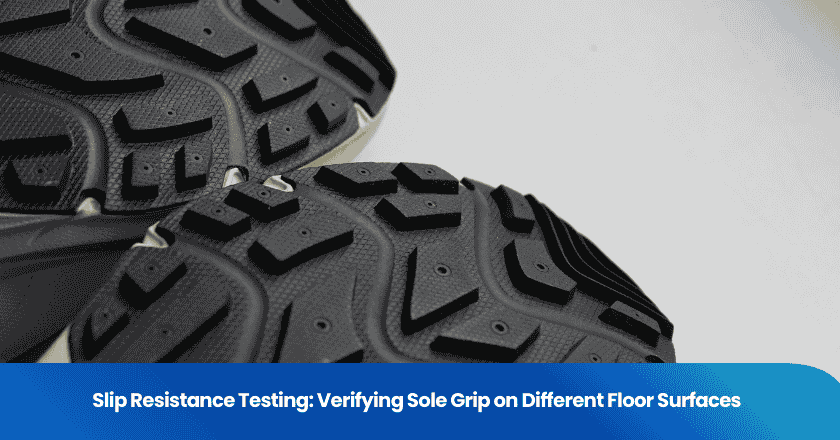
In the industrial manufacturing of professional and athletic footwear, traction integrity is a critical biomechanical requirement. Slip resistance testing is the primary technical control used to validate the frictional interaction between a shoe's outsole and diverse walking surfaces under hazardous conditions. According to clinical data from the National Institutes of Health (NIH), falls due to inadequate slip resistance result in millions of orthopedic injuries annually, highlighting the necessity for rigorous certification. By employing advanced tribological protocols like ASTM F2913 and ISO 13287, manufacturers can ensure that their products maintain a stable Dynamic Coefficient of Friction (DCOF) on surfaces ranging from saturated ceramic tile to oily industrial steel.
Key Takeaways
- Traction performance is quantified through the Dynamic Coefficient of Friction (DCOF), with a standard industrial threshold of 0.40 or higher.
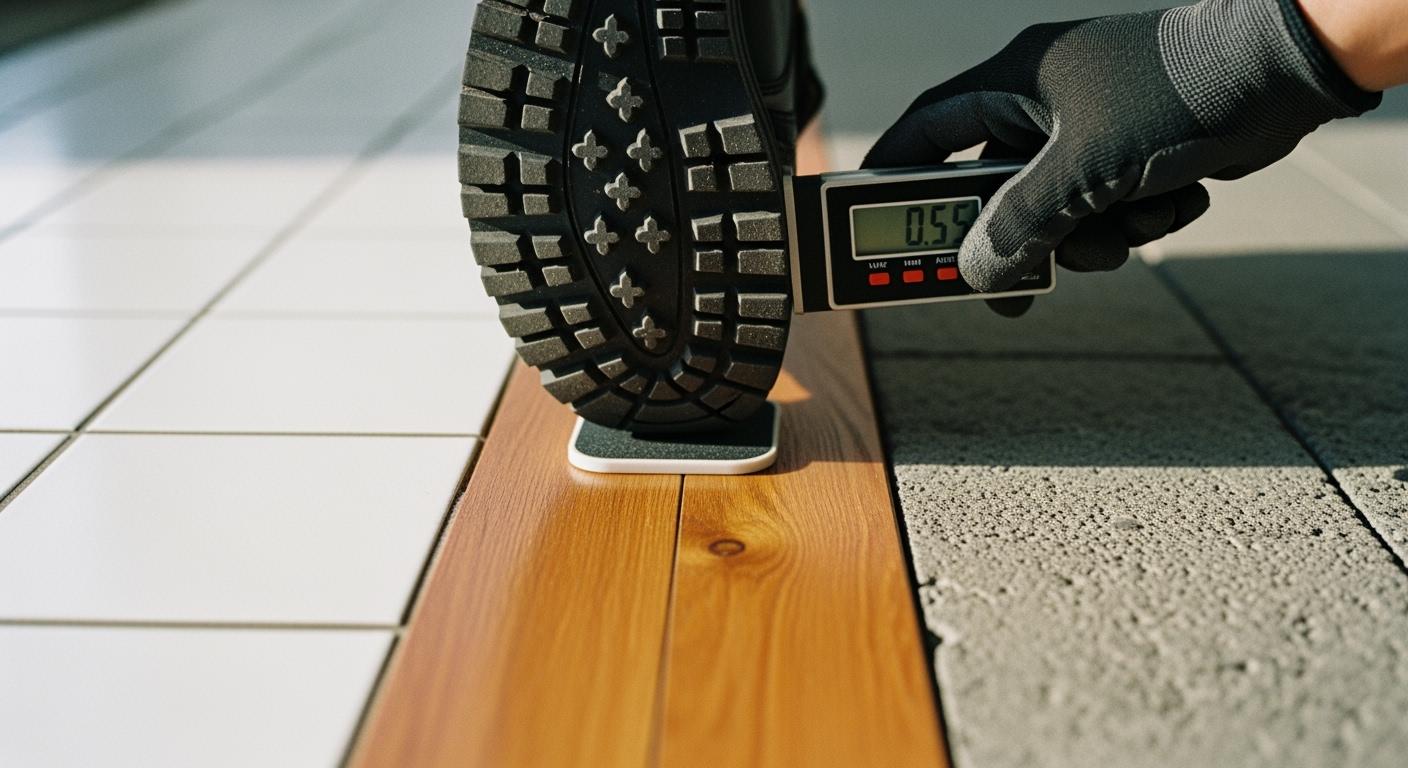
- Metrological validation utilizes specialized slip meters like the BOT-3000E to simulate the heel-strike phase of human gait.
- Contaminants such as glycerin, detergent, and engine oil serve as the primary variables in accelerated slip-risk simulations.
- Outsole engineering, focusing on tread geometry and rubber durometer (hardness), is essential for fluid displacement and energy absorption.
- Professional quality control audits prevent 'Traction Decay' caused by the use of low-cost fillers in recycled rubber batches.
- Compliance with ANSI A326.3 and EN 16165 provides the legal framework for safety claims in the global footwear trade.
The Physics of Tribology: Understanding DCOF vs. SCOF
The technical efficacy of a shoe sole is governed by tribology—the science of interacting surfaces in relative motion. In footwear safety, there is a vital distinction between Static Coefficient of Friction (SCOF) and Dynamic Coefficient of Friction (DCOF). SCOF measures the force required to *initiate* movement from a stationary position, whereas DCOF measures the friction maintained *during* movement. Biomechanical research indicates that nearly all slips occur during the dynamic phase—specifically at the instant of "Heel Strike"—making DCOF the only relevant metric for modern safety standards.
Surface Tension and Lubrication Dynamics
Slips are caused by the presence of a "Boundary Layer" of liquid (water or oil) between the sole and the floor, which acts as a lubricant and reduces atomic-level contact. To counteract this, industrial-grade footwear must achieve "Mechanical Interlock." This is achieved by utilizing high-purity Nitrile or Polyurethane (PU) compounds that maintain flexibility at low temperatures, ensuring the sole can deform into the microscopic textures of the floor even when submerged.
| Metric | Technical Definition | Industrial Value | Safety Significance |
|---|---|---|---|
| DCOF | Friction during active sliding | Target > 0.42 | Critical for walking safety |
| SCOF | Friction at rest | Target > 0.60 | Relevant for static stability only |
| SRV | Slip Resistance Value (Pendulum) | > 36 (Low Risk) | Standard for pedestrian surfaces |
| Ra | Surface Roughness (Microns) | 20µm - 80µm | Determines floor-level grip potential |
Metrological Standards for Footwear Validation
For manufacturers seeking global compliance, the ASTM F2913-24 and ISO 13287 standards provide the definitive testing architecture. These protocols eliminate human subjectivity by using computerized slip meters that apply a constant vertical force (typically 500 Newtons) while measuring the resulting horizontal resistance.
ASTM F2913-24: The High-Stress Protocol
This standard involves testing the whole shoe on a variety of standardized surfaces. The shoe is oriented at a 7-degree angle to simulate the precise geometry of a human step. During standardized quality checks, the shoe is tested on:
- Ceramic Tile: Saturated with Sodium Lauryl Sulfate (SLS) to simulate soapy environments.
- Stainless Steel: Coated with Glycerin to simulate oily kitchen or automotive floors.
- Quarry Tile: Tested in dry and wet states to evaluate general-purpose traction.
- Technical Standard: A footwear product earns the "SR" (Slip Resistant) mark only if it achieves a DCOF of 0.40 or higher across *all* specified test surfaces. Any individual failure results in a non-compliant rating for the entire batch.
Hydrodynamics of Outsole Design
The mechanical geometry of the tread pattern is as critical as the material chemistry. For a shoe to maintain grip on a wet floor, it must physically displace the liquid film. This is a hydrodynamic challenge similar to that of a high-speed automotive tire. Effective product quality management involves auditing the mold precision to ensure channel depth is consistent.
Channel Engineering and Siping
High-performance outsoles feature 'Siping'—micro-channels cut into the tread blocks that open up under pressure to 'pump' water away from the contact patch. The 'Land-to-Sea Ratio' (the ratio of solid rubber to open channels) must be carefully balanced. If the channels are too narrow, they trap debris and create a smooth surface; if too wide, they reduce the total surface area available for friction.
| Design Feature | Technical Objective | Biomechanic Outcome |
|---|---|---|
| Horizontal Grooves | Fluid displacement (Front-to-Back) | Prevents aquaplaning during heel strike |
| Vertical Sipes | Lateral stability enhancement | Prevents side-slips during directional shifts |
| Beveled Heel | Optimize surface contact angle | Increases contact area during initial impact |
| Closed-Cell Outsole | Prevent contaminant absorption | Maintains chemical resistance to oils |
Integrating QC into the Production Lifecycle
Consistency is achieved by building traction quality into the assembly phase. Relying solely on a third-party prototype report is a high-risk strategy, as 'Quality Fade' often occurs during high-volume production when material suppliers change rubber formulations to reduce costs. A robust manufacturing quality assurance program must include:
- Raw Material Shore Hardness Mapping: Ensuring that the outsole durometer (typically 55-65 Shore A) remains consistent across every batch.
- Batch-Level Friction Checks: Utilizing portable tribometers like the BOT-3000E on random production samples to verify that the DCOF hasn't dropped due to excessive mold-release agents.
- In-Line Pattern Verification: Inspecting the mold plates for wear, as dull edges on tread patterns significantly reduce fluid-pumping efficiency.
Workplace Safety and Regulatory Liability
For industrial employers and public sector projects, slip resistance is a legal mandate. Regulatory bodies like OSHA (US) and OPSS (UK) increasingly reference ANSI A326.3 as the gold standard for floor safety. Under these frameworks, it is not sufficient for a floor to be "slip-resistant" in a dry lab; it must be technically validated for its "Designated Environment." For example, a commercial kitchen must have flooring and footwear that meet a minimum DCOF of 0.42 when contaminated with common vegetable oils.
Effective quality assurance compliance requires that all testing data be archived for a minimum of 5-10 years to provide a technical defense in the event of consumer litigation or workplace accident investigations.
Frequently Asked Questions (FAQ)
What is the difference between a slip-resistant shoe and a non-slip shoe?
Technically, no shoe can be truly "non-slip" on all surfaces (e.g. wet ice). "Slip-resistant" is the correct technical term, implying the shoe has been validated according to ASTM or ISO standards to achieve a DCOF threshold of 0.40 on specific hazardous surfaces like wet tile or oily steel.
How does sole wear affect slip resistance over time?
As the tread depth decreases, the sole's ability to displace fluids is compromised, leading to a "Hydroplaning Effect." Research shows that once tread depth drops below 2.0mm, slip resistance on wet surfaces can decrease by over 40% even if the material remains the same.
Why do some slip-resistant shoes fail in cold weather?
This is a material science failure known as the "Glass Transition Temperature" (Tg). Cheaper rubber and PU compounds become rigid and "plastic-like" in the cold, losing their ability to deform and grip the floor. Professional safety footwear uses impact copolymers to maintain flexibility down to -20'C.
Can I trust a "Self-Declared" slip rating?
For industrial use, self-declaration is high-risk. A technical report from an ISO 17025 accredited laboratory is the only way to verify that the friction measurements were taken under standardized conditions using calibrated equipment like the BOT-3000E.
Does a high DCOF mean the shoe will be uncomfortable?
Not necessarily. While high-friction compounds can be softer (leading to faster wear), modern material engineering allows for "Dual-Density" outsoles. A hard, abrasion-resistant outer layer is combined with a soft, grippy contact patch, ensuring both long-life and maximum traction.
Related Articles


Grow your business with TradeAider Service
Click the button below to directly enter the TradeAider Service System. The simple steps from booking and payment to receiving reports are easy to operate.

