
- About Us

- Our Services
- Your Industry
- Resources
- News & Blog
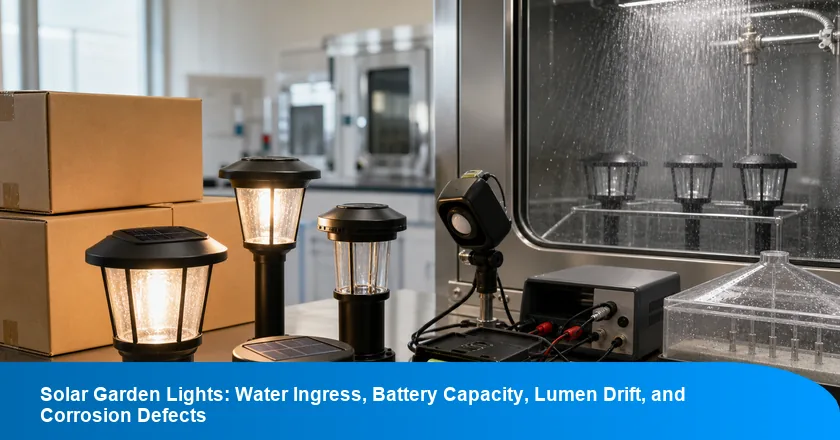
For a solar garden light inspection, do not release a lot because a few units switch on at dusk or tolerate one quick water exposure. Release only the lights whose enclosure, cable entry, panel, battery, controller mode, LED and optic, frame finish, stake, retail pack, and carton record all identify the same configuration.
The practical unit is the release population: the identified lights sharing the same enclosure, power, optic, frame, package, checks, and carton record. This definition keeps a battery change, a gasket repair, or a carton mix from hiding behind a generic “outdoor” claim.
Release the Enclosure, Power Train, Light Output, and Carton as One Outdoor Configuration
A release decision belongs to a named enclosure-power-light-frame-carton configuration. That means the record should identify the claimed enclosure, the actual cable-entry and gasket build, the solar panel and battery BOM, the controller mode, the light-output condition, the coated stake or frame, and the retail and export cartons that contain that build. A configuration map is more useful than a long defect list because it shows which evidence really represents the goods awaiting release.
IEC 60529 classifies degrees of protection provided by enclosures for electrical equipment. The IEC 60529 IP Code does not turn a supplier’s waterproof wording into a universal promise for a changed seam, unrecorded cable gland, different battery-door fit, or years of weather exposure. Treat the claim, the exact assembly, and the stated test condition as one evidence unit.
- Lock the IP claim, enclosure drawing or approved sample, cable route, gasket, fasteners, drain path, and buyer-defined ingress condition.
- Lock the panel, battery chemistry and capacity, controller mode, charge state, runtime method, and acceptance boundary before comparing power results.
- Lock the light-output method, temperature context, optic, coating, corrosion condition, stake, retail pack, and carton population before release.
A useful rule is simple: when one route names a different configuration from another route, the record supports a hold, a split, or a matched recheck—not an order-wide pass.
Use the Ingress-Power-Light-Frame Release Framework
Ingress, power, light, and frame evidence must be read separately before they can converge in a release decision. The Ingress-Power-Light-Frame Release Framework keeps those four questions from being collapsed into one generic outdoor-light result. Ingress asks whether the named enclosure and entry paths match the claim and check. Power asks what stored energy and charging configuration was actually observed. Light asks what output was measured under what condition. Frame asks whether corrosion, coating, stake, and pack-out evidence applies to the same goods. The carton map then decides which physical population those answers can release.
This is where a buyer’s inspection standard guidance becomes operational: define the sample identity, method, environment, duration, acceptance boundary, and escalation owner before the inspector arrives. TradeAider can use that record to scope observations around the finished configuration rather than asking a generic checklist to prove every durability claim.
Ingress Route: Lock the Enclosure, Gasket, Cable Entry, and Test Condition
An IP-code scope concerns the degree of protection provided by an enclosure, so the checked enclosure and test condition must remain identifiable. The IEC 60529 scope supports that boundary; it is not a reason to assign a rating to a product from a visual inspection alone. Start with the supplier’s stated claim and report, then compare the actual housing halves, lens seat, battery door, gasket material and compression, cable entry, fasteners, drain path, and panel-to-body seam against the approved build.
A test condition is the named setup, method, environment, duration, sample identity, and acceptance boundary used to interpret a result. Record it with every ingress observation. For example, a buyer may define a check for a fully assembled light in one selected mode and orientation. That finding cannot automatically cover an alternate cable exit, an unapproved gasket substitute, a different battery-door revision, or a unit opened for rework. Visible gaps, pinched gaskets, trapped wire, loose fasteners, inconsistent seam closure, and water retained near a connection are actionable observations; the product claim and specialist test method still determine the final technical conclusion.
Ask for a photo map of the entry paths and a version-controlled assembly reference. When a supplier changes a gasket, cable length, screw, adhesive, or battery cover, compare the changed component with the evidence population before allowing a previous pass to transfer.
Power Route: Identify Panel, Battery Chemistry, Charge Condition, and Runtime Method
A buyer should interpret runtime only against a named battery, panel, controller, mode, charge condition, environment, method, and acceptance boundary. “Battery capacity” on its own is not a release decision: the same labeled cell can sit behind a different panel, charge controller, motion setting, brightness program, cable arrangement, or storage condition. The record should state battery chemistry and rated capacity, battery vendor or lot where available, panel type and rating, controller or firmware version, charge protocol, selected lighting mode, ambient condition, start state, observation method, and the buyer’s target.
Use the claim as a design input, not as proof that every unit will meet an unqualified overnight runtime. Check battery fit and connector polarity, battery-door closure, panel surface and lead routing, on/off or mode-memory behavior, charge indication where applicable, and whether the retailer-facing runtime wording matches the agreed test condition. If the order has more than one battery, panel, controller, or mode build, label each as a separate release population. A configuration can be visually identical and still have a different power path.
When an observation falls outside the brief—for example, a capacity dispute, abnormal charge behavior, thermal question, or product-specific electrical conclusion—route it to the buyer, supplier, or qualified testing provider. Do not force an inspection photo or a single runtime observation to settle a question that needs a defined test method.
Light-and-Frame Route: Separate Lumen Drift, Optic, Coating, Corrosion, and Stake Evidence
IES methods distinguish reproducible optical measurements under standard conditions and optical or electrical characterization as a function of temperature. The IES LM-79 measurement method describes measurements such as luminous flux under standard conditions, while IES LM-82 addresses optical and electrical properties as a function of temperature. For a buyer, the point is not to reproduce those methods casually on the factory floor; it is to preserve the measurement condition, instrument, sample identity, mode, charge state, temperature context, and agreed tolerance behind any lumen comparison.
Inspect the optic for haze, scratches, bubbles, contamination, loose fit, and uneven diffusion. Compare color and visible output only under the named condition, then document the mode used. Separate this from a practical frame check: coating coverage, sharp edges, fasteners, joints, welds, stake straightness, ground-contact area, and mounting retention may each affect returns even when the LED initially illuminates.
ASTM B117 creates a controlled corrosive environment and cautions against stand-alone natural-environment extrapolation, while ASTM D1654 describes evaluation categories for coated specimens after exposure. Read ASTM B117 with ASTM D1654 before setting the exposure, specimen identity, locations inspected, evaluation basis, and buyer limit. Never convert a pass at one condition into a universal corrosion-life guarantee.
ASTM G154 describes controlled UV-and-water exposure procedures but requires application-specific conditions and evaluation to obtain a result. See ASTM G154 when UV exposure is part of the buyer brief, then name the material, exposure condition, evaluation method, acceptance boundary, and lot. Keep that record separate from corrosion evidence for bare metal or a claim about years of outdoor service.
Send Each Solar-Light Finding to the Evidence That Can Answer It
A visible observation, a supplier record, and a specialized test each need the evidence owner that can answer the question. An inspector can document the assembled configuration, workmanship, labels, mode behavior, visible output, accessible fit, retail pack, carton marks, and buyer-defined observations. The supplier should provide the applicable BOM, revision history, test report, claim artwork, and rework record. A qualified testing provider may be needed when the buyer requires a defined ingress, capacity, photometric, corrosion, chemical, or electrical conclusion beyond the inspection scope.
Use a simple disposition line for every finding: what was seen, which configuration it affects, what evidence can answer it, who owns that evidence, and whether the affected cartons are held, reworked, or released separately. That format makes it clear why an inspector should not be asked to certify a performance claim from an unrelated report. Where a specialized question needs a separate method, the relevant product testing service can be considered alongside the inspection brief rather than after a preventable dispute.
Worked Scenario: A Gasket Rework Creates a Verification Window
A traceable gasket-rework window should be held until matched reinspection represents the exact repaired lights. This illustrative scenario shows why an ingress repair can close one route while leaving the power and light routes unanswered. It is not a sample-plan recommendation or a universal product threshold; it is a way to keep the release decision attached to the physical goods.
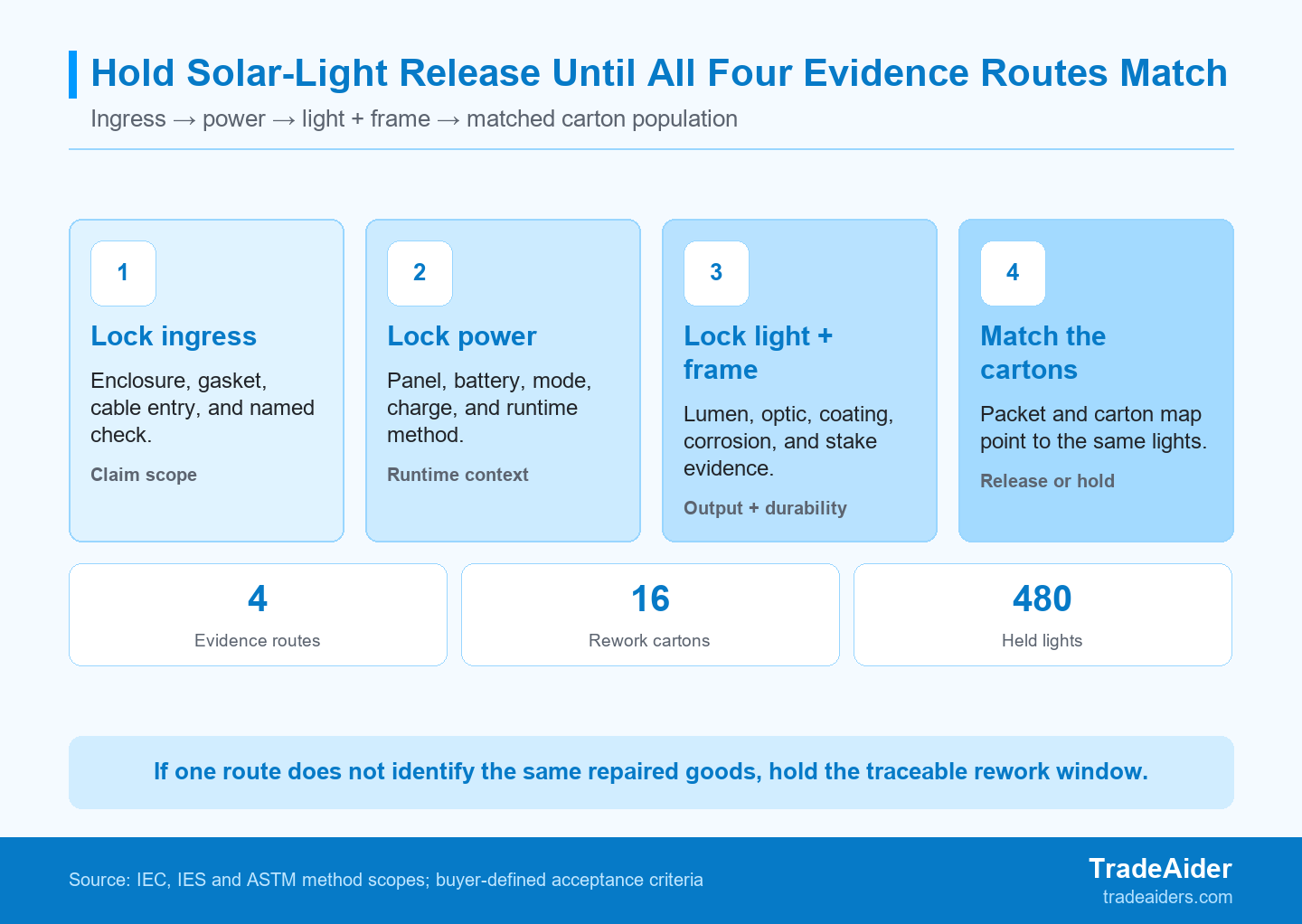
Use the ladder to confirm that the enclosure, power train, light output, frame evidence, and carton population all describe the same lights before release.
Situation, Problem, Action, and Result
Segregation, rebuilt records, and condition-matched reinspection can close the rework verification gap.
A marketplace seller is preparing a solar garden-light set with a black powder-coated stake, clear optic, integrated solar panel, rechargeable battery pack, cable-entry gasket, retail box, and export carton. The illustrative order contains 1,920 lights in 64 export cartons. The buyer has an IP claim, a battery and panel BOM, a runtime target, a lumen tolerance, an approved corrosion condition, and a carton map, but the repair record does not identify a matched output recheck.
The factory reworked the cable-entry gasket during one identified production window; 16 cartons, or 480 lights, carry the traceable rework-window code. The repaired samples show no visible entry-path defect under the buyer-defined ingress check, but the rework record does not state whether the battery pack, controller mode, optic, charge condition, or lumen check matched the repaired lights. This is a rework-verification failure. A gasket repair may solve an entry-path observation, yet the reworked population still lacks a record that joins its enclosure, power, and output conditions. Releasing it under the earlier report would silently assume that the repair changed nothing else.
Hold the 16 traceable rework-window cartons and keep the 48 cartons outside that window as a separate population pending the buyer’s release decision. The hold is precise because the carton code identifies the process window; it does not imply that every carton in the order has the same exposure. The factory rebuilds the rework record, identifies the repaired enclosure and power build, verifies the buyer-defined ingress, charge, runtime, mode, lumen, corrosion, stake, warning, retail-pack, and carton checks, and updates the carton map. The objective is not a new blanket promise. It is evidence that the repaired goods and the recorded conditions now match.
The held subset can be reconsidered only after the repaired goods, exact check conditions, observed results, and carton population point to the same identified lights. The quantities are illustrative. They do not prescribe a universal IP test, battery capacity, runtime, lumen tolerance, corrosion duration, or release threshold.
Build a Configuration-Specific Solar-Garden-Light Release Packet
A release packet must identify the configuration, conditions, results, dispositions, and carton population. Keep the packet compact enough to use on the production floor and explicit enough to survive a marketplace, warehouse, or returns discussion. A practical packet contains the approved sample or drawing reference; enclosure and IP-claim reference; cable-entry and gasket version; panel, battery, controller, and mode identity; runtime and light-output conditions; corrosion, coating, stake, and pack-out requirements; inspection findings; supplier or testing records; rework history; warning and artwork check; and a carton map.
Before shipment, compare the packet with the finished goods rather than with a generic product description. If a different component or carton code appears, decide whether it is within the defined population, requires a documented equivalence decision, or needs segregation and reinspection. A buyer who needs the final configuration and packed order checked can use a Pre-Shipment Inspection service as the service bridge from the release packet to the actual shipment.
Who Is TradeAider?
TradeAider can use a buyer's configuration packet to scope inspection observations and identify testing escalations. Its inspection and QA coverage includes Guangdong, Zhejiang, Jiangsu, Shandong and Fujian, and its stated price is $199/man-day all-inclusive for Inspection & QA Services. TradeAider is an Amazon Service Provider Network (SPN) partner.
TradeAider reports client outcomes that include an 18% reduction in returns and 23% defects caught; these are client-reported figures, not a forecast for every solar-light order. Bring the enclosure claim, BOM, runtime condition, lumen tolerance, corrosion requirement, mode requirement, and carton map when you schedule a solar-light inspection.
FAQs
What should a solar garden light inspection cover?
A solar garden light inspection should cover the exact enclosure, cable entries, panel and battery build, light-output condition, corrosion points, stake, modes, retail package, and carton population being released. The brief should also state the product claim, approved reference, sample identity, check condition, acceptance boundary, and escalation path. That scope lets an inspection team document what is present and what differs. It does not replace a product-specific laboratory conclusion where the buyer needs one.
Does an IP rating prove every solar light is waterproof?
No, an IP rating applies only to the degree of protection and test conditions represented by the specific enclosure claim, not to every cable entry, assembly variation, use case, or field-life outcome. Keep the IP claim, report, enclosure version, seals, cable path, and actual production build connected. If a gasket, screw, cover, seam, or cable route changes, decide whether the previous evidence still represents that subset before it is released.
How should buyers verify claimed solar-light runtime?
Buyers should verify claimed runtime against a named battery chemistry and capacity, panel and controller build, charge condition, selected mode, ambient condition, measurement method, sample identity, and buyer acceptance boundary. Record those variables beside the result so that another light, mode, or battery revision is not treated as equivalent by assumption. A label or a single dusk-to-dawn observation can be useful context, but it is not a substitute for the defined condition behind the claim.
When should a solar-light order remain on hold?
A solar-light order should remain on hold when an ingress, battery, light-output, corrosion, warning, or carton record cannot be tied to the exact lights offered for release. Hold only the traceable affected population when the carton or process-window evidence supports that boundary; otherwise, broaden the hold until the scope is clear. Release becomes defensible when the configuration, method, observed result, disposition, and carton population reconcile in one packet.

Related Articles

Grow your business with TradeAider Service
Click the button below to directly enter the TradeAider Service System. The simple steps from booking and payment to receiving reports are easy to operate.

