
A sourcing agent helps the buyer find, evaluate, negotiate with, and coordinate suppliers, while an inspection company checks whether the factory, process, product, packaging, and shipment match the buyer's requirements. Many importers need both because sourcing support and independent quality evidence solve different problems.
The confusion starts because both roles may appear near the factory. A sourcing agent may visit suppliers, chase samples, translate requirements, compare quotations, and update the buyer. An inspection company may also visit factories, take photos, review documents, check samples, test basic functions, measure dimensions, and report defects. From far away, those activities can look similar. In practice, the incentives and deliverables are different.
A sourcing agent is usually evaluated on whether the buyer finds the right supplier, negotiates a workable deal, and keeps production moving. An inspection company is evaluated on whether the buyer gets accurate evidence before making a release decision. The agent helps the order happen. The inspection company helps the buyer decide whether the order should move forward.
- Sourcing agent: supplier search, quotation comparison, communication, sampling, PO coordination.
- Inspection company: factory audit, sample verification, production checks, PSI, loading evidence.
- Best use of both: agent coordinates the order; inspector verifies the order independently.
- Buyer rule: do not let coordination replace evidence.
The Direct Answer
You need both when the sourcing agent is responsible for finding or managing the supplier and the buyer still needs independent evidence before payment or shipment release.
TradeAider fits the independent evidence layer: if your sourcing agent is managing supplier communication, TradeAider can inspect the factory, production stage, finished goods, or loading process so the buyer is not relying only on the same channel that coordinated the order.
The International Trade Administration China market entry guidance notes that trusted agents, distributors, or partners can be critical but require thorough vetting, patience, and clear alignment. That logic applies to sourcing agents too. A good agent can reduce search friction, but the buyer still needs controls that verify what the supplier actually made.
The ITA due diligence guidance also emphasizes evaluating markets and partners to reduce problems, loss, and liability. Due diligence is not the same as pre-shipment inspection, but both protect the buyer from relying on assumptions. One checks who you are dealing with. The other checks what is being shipped.
The buyer should not frame the decision as loyalty to the agent versus distrust of the agent. Independent inspection is a normal control layer. It protects the buyer, gives the agent better evidence to negotiate corrections, and gives the supplier a clear standard to meet. When the roles are separated cleanly, everyone has less room to argue about what happened.
Sourcing Agent vs Inspection Company Compared
The sourcing agent is a coordination role; the inspection company is an evidence role.
The table below separates practical responsibilities. Some agents can help arrange inspections, and some inspection companies can share supplier-risk observations, but the buyer should still keep the final acceptance evidence independent from the person or company rewarded for sourcing the supplier.
| Decision Area | Sourcing Agent | Inspection Company | Buyer Control Question |
|---|---|---|---|
| Supplier search | Finds options, compares quotes, introduces factories | May audit shortlisted factories but does not usually source them | Who verified the supplier beyond introductions? |
| Commercial negotiation | Helps with MOQ, price, sample, payment, and lead time | Usually outside its role | Are quality terms written into the PO? |
| Specification transfer | Explains product requirements to supplier | Checks product against approved spec, sample, and checklist | Is the inspection checklist based on buyer-approved files? |
| Production follow-up | Chases schedules and supplier updates | Checks actual production status and defects at PPI, DPI, or PSI | Are updates verified by site evidence? |
| Release decision | May recommend shipment based on coordination status | Reports findings so buyer can release, hold, rework, or reinspect | Who has authority to approve final shipment? |
The key distinction is independence. A sourcing agent can be extremely useful, but the agent's work is tied to supplier selection and order progress. If the same channel also becomes the only quality judge, the buyer may lose a neutral signal. An inspection company should report what is present at the factory, even if the finding creates schedule pressure.
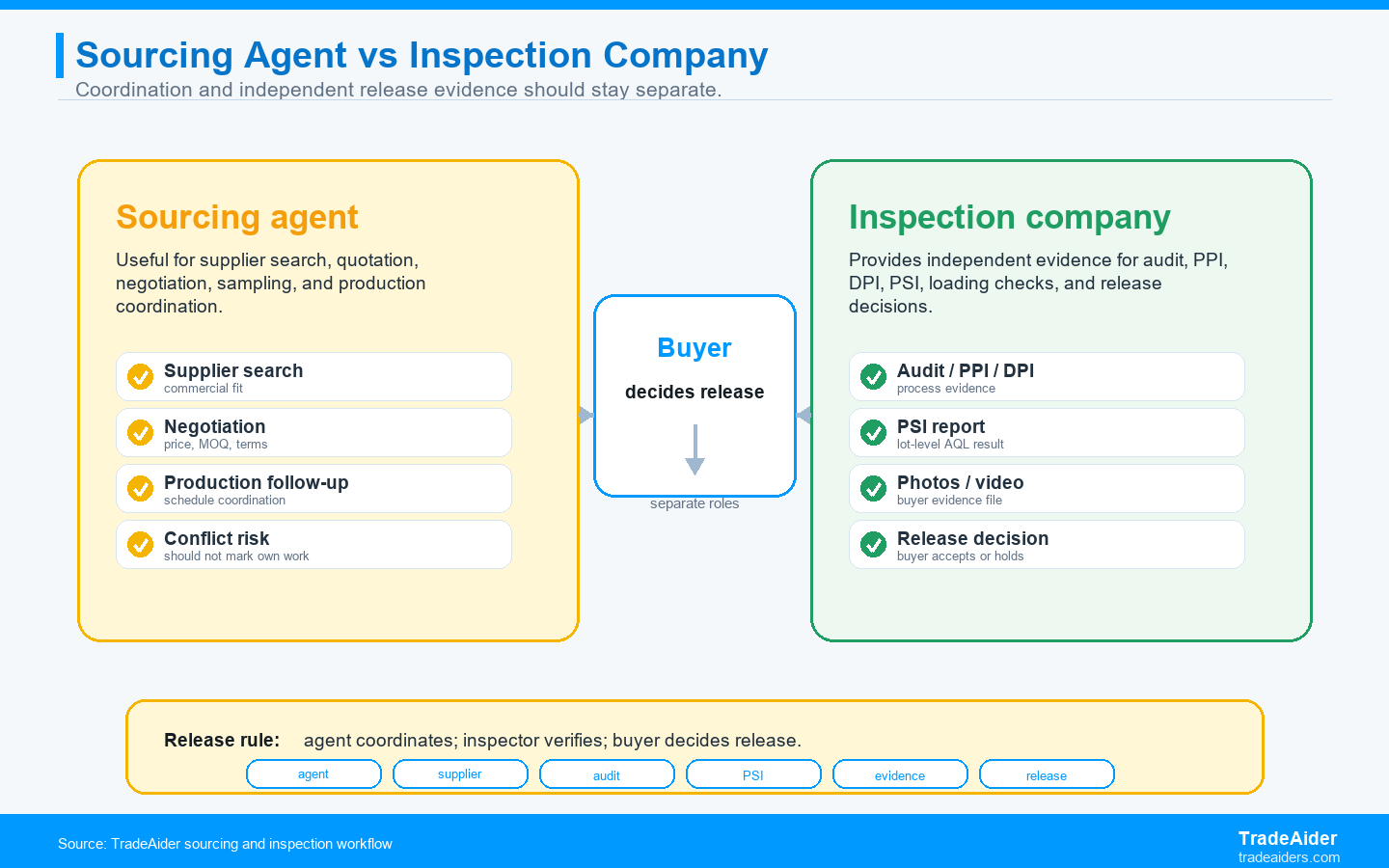
A sourcing agent can help find and coordinate suppliers, while an inspection company should provide independent evidence before release.
When A Sourcing Agent Is Enough
A sourcing agent may be enough for low-risk early-stage coordination, but only before money, inventory, or compliance exposure becomes significant.
A sourcing agent can be enough during the discovery phase: finding suppliers, narrowing quotes, arranging samples, translating requirements, checking responsiveness, and helping the buyer understand the supplier's communication style. If the product is simple, the first sample is low value, and the buyer is still exploring options, a sourcing agent can reduce friction without needing a full inspection plan yet.
The risk increases when the buyer places a production order. Once deposit is paid, materials are purchased, cartons are printed, and a shipment schedule exists, communication updates are no longer enough. The buyer needs evidence of factory capability, production process, component use, packaging, labeling, workmanship, quantity, and shipment readiness. A friendly update that says 'production looks good' cannot replace photos, measurements, defect counts, sample comparison, and release criteria.
A good sourcing agent should not resist independent inspection. In many cases, the agent benefits from it because the inspection report gives the agent concrete evidence to push the supplier for rework or sorting. The agent can remain the communication bridge while the inspection company remains the evidence source.
When An Inspection Company Is Essential
An inspection company is essential when the buyer needs an independent basis for payment, rework, shipment release, or supplier continuation.
The need becomes clear when defects would be expensive after arrival. Consumer products with safety, labeling, packaging, function, assembly, color, size, material, or marketplace-compliance risks should not ship on supplier updates alone. The CPSC testing and certification guidance is a reminder that importers and manufacturers may need testing and certificates for many regulated consumer products. A sourcing agent cannot turn an unverified product into compliant evidence by coordinating production.
Inspection also matters because importers remain responsible for goods that enter their market. The CBP basic importing and exporting page describes import compliance as a shared responsibility and encourages importers to understand applicable requirements. For quality control, the practical translation is that the buyer should build evidence before shipment, not after a customs, marketplace, retailer, or customer problem appears.
Inspection is especially important before final balance payment, before packed goods leave the factory, after rework, after supplier changes, before peak-season shipments, and when a new product or new factory is involved. These are points where a wrong decision becomes expensive quickly.
Where TradeAider Fits When A Sourcing Agent Is Already Involved
TradeAider fits as the independent quality-control layer around the sourcing agent's coordination work.
If the supplier is new, a TradeAider factory audit can check whether the factory profile, production capability, quality system, equipment, subcontracting risk, and basic compliance signals match the buyer's expectations. This does not replace the agent's supplier search; it verifies the supplier behind the search.
During production, Pre-Production Inspection can confirm materials, components, samples, and setup before mass production goes too far. During Production Inspection can check whether defects or process drift are appearing while there is still time to correct them. At the end, Pre-Shipment Inspection checks the finished shipment when 100% of the order quantity is completed and at least 80% is packed for export.
This lets the sourcing agent keep doing what the agent does well: supplier communication, schedule pressure, negotiation, and local coordination. TradeAider then provides structured inspection evidence that the buyer can use to approve release, request rework, hold payment, or schedule reinspection.
How To Avoid Role Conflict
Role conflict is avoided when the buyer separates coordination, verification, and final authority.
The buyer should write a simple RACI-style arrangement before production starts. The sourcing agent is responsible for supplier communication and schedule coordination. The supplier is responsible for producing to the approved specification. The inspection company is responsible for checking against the approved files and reporting findings. The buyer is responsible for the release decision.
That separation prevents the most common failure mode: everyone wants the shipment to move, so defects get minimized. If the agent has promised a deadline, the supplier has booked labor, and the buyer has a launch date, pressure builds. An independent inspection report gives the buyer a slower but clearer decision point. It also gives the agent a more credible basis to negotiate rework because the issue is documented by a third party.
The buyer should also avoid vague checklists. Give the inspector the approved sample, specification sheet, packaging artwork, label file, barcode list, AQL level, critical defect list, and special function tests. A sourcing agent can help collect these files, but the buyer should approve them directly. The inspection company should not have to guess what 'good quality' means.
SPAR Scenario: The Helpful Agent And The Missing Independent Gate
The problem was not that the agent was dishonest; the problem was that the buyer had no independent release evidence.
Situation: A US home goods importer hires a sourcing agent to find a factory for 4,200 bamboo drawer organizers. The agent helps negotiate price, sends sample photos, and follows up production in Chinese.
Problem: The supplier reports that the order is ready. The agent says the factory looks fine and recommends shipping to catch a promotion date. The buyer has no PSI. When goods arrive, 14% of units have rough edges and several cartons use the wrong retail insert. The supplier says the buyer approved the sample and the agent saw production.
Action: For the next order, the buyer keeps the sourcing agent but adds TradeAider PSI before final payment. The inspection checklist includes finish smoothness, retail insert version, barcode scan, carton drop-risk observations, quantity, and sample match. The first inspection finds insert mix-up before shipment, and the agent uses the report to push the supplier to sort affected cartons.
Result: The buyer still uses the agent for coordination, but the release decision now depends on independent evidence. The agent relationship improves because disputes become specific: which cartons, which defect, which file, and what rework is required.
Action Card: Sourcing Agent And Inspection Company
Use the sourcing agent to make the order possible and the inspection company to decide whether the order is acceptable.
- Use a sourcing agent for supplier discovery, quotation, sample coordination, and local communication.
- Use an inspection company for factory audits, PPI, DPI, PSI, loading checks, and product evidence.
- Do not let the same coordination channel be the only quality judge.
- Give the inspection company buyer-approved specifications, samples, labels, packaging files, and defect rules.
- Tie final payment and shipment release to inspection acceptance, not only supplier or agent updates.
If your sourcing agent is managing the order but you need independent release evidence, send TradeAider the supplier name, product spec, approved sample status, production schedule, packing status, agent role, and final payment milestone. The next step is to ask TradeAider to build an independent inspection layer around your sourcing agent's plan before the shipment leaves the correction window.
Frequently Asked Questions
Can a sourcing agent also inspect goods?
A sourcing agent can observe goods, but that is not the same as independent inspection. Use a third-party inspection company when the result affects payment, rework, shipment release, or supplier continuation.
Do I need an inspection company if I trust my sourcing agent?
Yes, if the shipment has meaningful quality, compliance, or financial risk. Trust helps communication, but inspection provides evidence that the buyer can use for release decisions.
Should the sourcing agent choose the inspection company?
The sourcing agent can recommend options, but the buyer should approve the inspection company directly. The inspector should report to the buyer, not only to the agent.
What should I send to the inspection company?
Send the approved sample, specification sheet, PO, packaging artwork, label files, barcode list, AQL requirements, special tests, and known defect risks. The clearer the checklist, the better the evidence.
Can TradeAider work alongside my existing sourcing agent?
Yes. TradeAider can inspect the supplier, production stage, finished goods, or loading process while the sourcing agent continues coordinating communication and schedule follow-up.
Related Articles

Grow your business with TradeAider Service
Click the button below to directly enter the TradeAider Service System. The simple steps from booking and payment to receiving reports are easy to operate.

