
A sourcing agent, trading company, and direct factory each changes how much visibility, leverage, and accountability the buyer has over quality control. The safest channel is not automatically the most direct one; it is the channel where the buyer can identify the real producer, control specifications, inspect at the right stage, and tie payment to evidence.
Importers often treat channel choice as a price question: agent commission, trading company margin, or factory-direct quote. Quality control requires a different lens. Who owns the relationship with the factory? Who receives defect feedback? Who controls rework? Who can give access for inspection? Who is accountable if the factory changes materials, subcontractors, or packing methods?
A sourcing agent may give the buyer flexibility and local communication support, but the buyer must know whether the agent is transparent about factories and incentives. A trading company may simplify communication, consolidation, and invoicing, but it may also sit between the buyer and the real production site. A direct factory can improve access and accountability, but only if the factory actually has the capability and quality system the buyer needs.
- Sourcing agent: useful for discovery and coordination, but transparency must be verified.
- Trading company: useful for consolidation and commercial handling, but factory visibility can be weaker.
- Direct factory: useful for access and technical feedback, but capability still needs audit and inspection.
- QC principle: choose the channel, then verify the production reality behind it.
The Direct Answer
Direct factory sourcing usually gives the best quality-control visibility, but only after the factory has been audited and the buyer has an inspection plan; a transparent agent or trading company can still work if factory access and release evidence are protected.
TradeAider fits the channel-choice decision by checking the factory, production stage, finished goods, and loading process regardless of whether the buyer works through an agent, a trading company, or a direct factory.
The ITA China distribution and sales channels guidance distinguishes trading companies, distributors, sales agents, and other channels. It also notes that selecting the right channel can add market insight while an unreliable partner can create serious business risks. For sourcing from China, the same logic applies: the channel is not only a commercial path; it is a risk-control structure.
The ITA China market entry strategy also stresses careful vetting, clear alignment, partner due diligence, and attention to IP protection. These are not abstract concerns. If the buyer cannot identify who controls production, who owns tooling, who holds technical files, and who has authority to approve rework, quality disputes become harder to resolve.
The buyer should therefore choose the channel and then build an evidence chain around it. Supplier vetting, factory audit, sample approval, production inspection, pre-shipment inspection, and loading evidence can all be adapted to the channel. The mistake is assuming that channel choice itself solves quality control.
Three Sourcing Channels Compared By QC Implication
The sourcing channel changes what the buyer can see, who the buyer can pressure, and where inspection evidence must be placed.
The comparison below assumes the buyer is sourcing consumer goods from China and wants to prevent defects before shipment. It does not rank one channel as universally best because product category, order complexity, supplier maturity, and buyer team capacity all matter.
| Channel | Main Advantage | QC Weak Point | Inspection Strategy |
|---|---|---|---|
| Sourcing agent | Local search, translation, quotation comparison, supplier follow-up | Buyer may not know whether the agent is fully transparent about factory identity or incentives | Audit shortlisted factories and make inspection reports go directly to buyer |
| Trading company | Simpler communication, consolidation, export handling, smaller MOQs in some cases | Real production site may be less visible and rework authority may be indirect | Require factory disclosure, audit access, sample traceability, and PSI at production site |
| Direct factory | Direct technical feedback, clearer production access, stronger rework conversation | Factory may lack export support, documentation discipline, or quality system maturity | Audit capability, use PPI or DPI for process risk, and PSI before final payment |
| Hybrid channel | Agent or trading company coordinates while buyer verifies independently | Roles can blur if no one owns final quality decision | Define RACI: coordinator coordinates, inspector verifies, buyer releases |
The best channel is the one where the buyer can answer four questions before deposit: who is the real factory, who approves the specification, who fixes defects, and who gives the buyer inspection access. If any of those answers is vague, the buyer needs more verification before production begins.
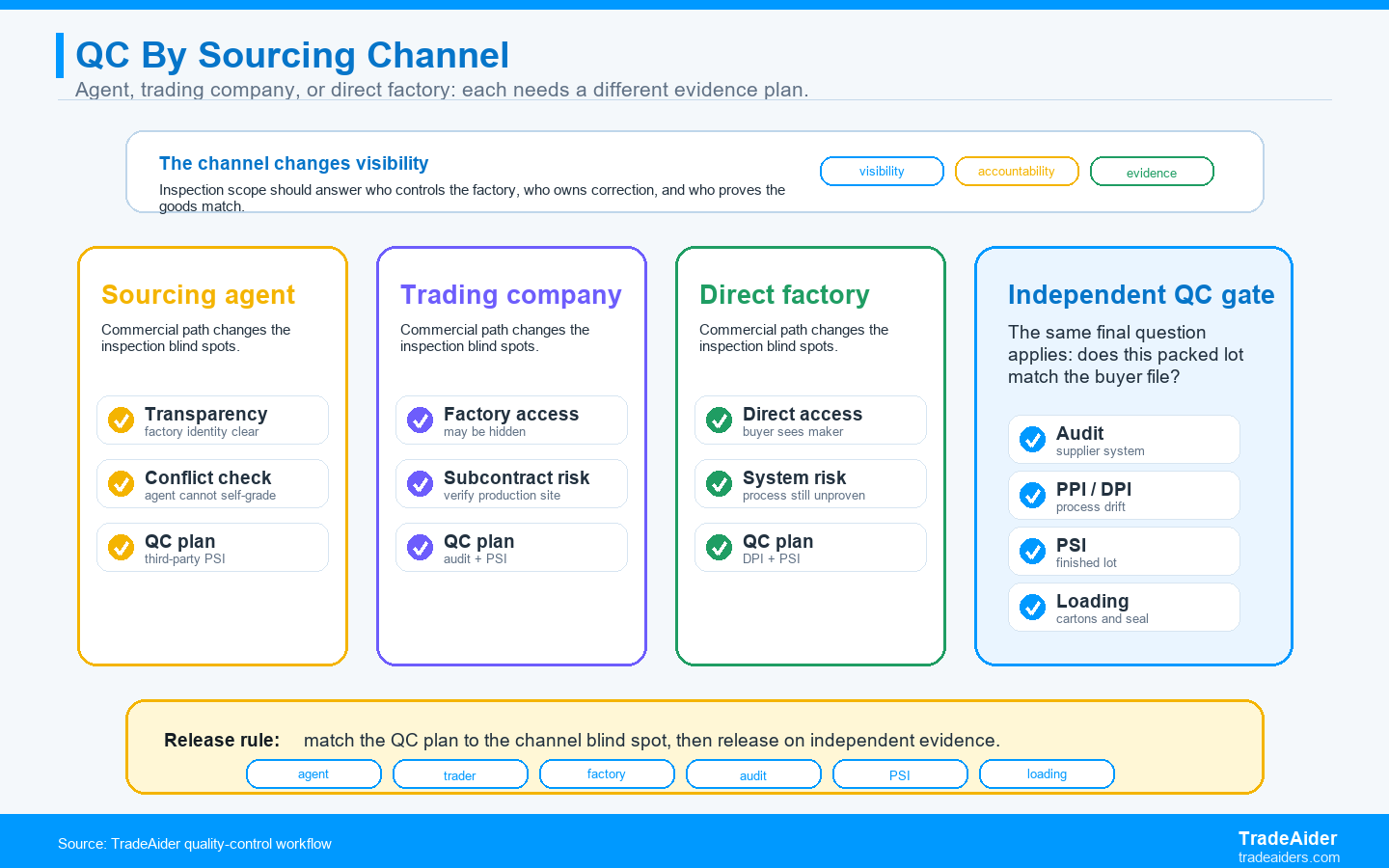
Each sourcing channel changes visibility and accountability, so the inspection plan must identify who controls the factory and who proves the goods match.
Sourcing Agent: Flexible But Dependent On Transparency
A sourcing agent can expand supplier options, but quality control depends on how transparent the agent is about the real production site.
A sourcing agent is often helpful when the buyer lacks local language support, supplier network, sampling speed, or time to compare factories. The agent can translate requirements, obtain quotes, arrange samples, visit suppliers, and pressure production schedules. For new buyers, that support can prevent many early mistakes.
The QC risk is that the agent may become the buyer's only window into the factory. If the buyer does not know the factory name, production address, subcontracting plan, tooling owner, or quality manager, then the buyer is not really controlling the supply chain. The buyer is controlling a relationship with the agent. That may still be acceptable, but it requires inspection evidence that is independent from the agent's updates.
The buyer should require factory disclosure for any serious production order, agree that third-party inspection access is allowed, and make inspection reports go directly to the buyer. The agent can help schedule and translate, but the release decision should be based on buyer-approved criteria and independent findings.
Trading Company: Convenient But Sometimes Less Visible
A trading company can simplify commerce, but convenience should not hide the production site from the inspection plan.
A trading company may be the right channel when the buyer needs consolidation, export documentation support, multi-SKU coordination, smaller order quantities, or a single commercial counterpart. Some trading companies have strong supplier networks and can manage orders professionally. The margin may buy convenience, coordination, and supplier access that the buyer could not easily build alone.
The QC problem appears when the trading company controls all communication and the buyer never sees the factory. If defects appear, the trading company may need to negotiate with a factory that the buyer has never met. Rework authority, cost allocation, and defect evidence can become indirect. The buyer may also struggle to know whether the same factory that made the sample is producing the bulk order.
For trading-company orders, inspection should happen at the actual production or packing site, not only at a forwarder warehouse. The buyer should require sample traceability, factory name or at least factory access for inspection, approved files, and a release rule. If the trading company refuses any factory-level verification for a meaningful order, the buyer should treat that as a risk signal.
Direct Factory: Better Access But Not Automatic Quality
Direct factory sourcing improves access, but access does not prove capability.
Direct factory sourcing can improve technical communication, sample correction, process feedback, rework speed, and accountability. The buyer can speak closer to the people who control materials, machines, line setup, packing, and defect correction. For engineered, customized, or repeat products, this can be a major advantage.
The mistake is assuming that direct equals safe. A factory may quote directly but still outsource parts of production, lack documentation discipline, misunderstand export packaging, overstate capacity, or have weak final inspection. The buyer may get a lower price but also inherit more project-management work. Direct access is valuable only when the buyer has the capability to manage specifications, approvals, inspections, and corrective action.
This is where a factory audit matters. Audit evidence can help the buyer check whether the factory exists as presented, has relevant production capability, uses appropriate equipment, maintains basic quality controls, and can support the order size. Audit does not guarantee perfect production, but it reduces the risk of buying from a factory profile that looked better online than on site.
Where TradeAider Fits Across All Three Sourcing Channels
TradeAider fits by verifying the production reality behind the sourcing channel.
For agent-led or trading-company-led sourcing, TradeAider can provide factory-level verification that does not depend only on the coordinator's updates. A factory audit can assess capability before deposit, Pre-Production Inspection can check materials and setup before mass production, and During Production Inspection can catch process drift while rework is still practical.
For direct factory sourcing, TradeAider can act as the buyer's independent QC execution layer. Pre-Shipment Inspection checks the completed order when 100% of the order quantity is completed and at least 80% is packed for export. This helps the buyer avoid relying only on factory self-inspection or production photos.
The business fit is the same across all channels: identify the real production point, verify the approved requirements, inspect before leverage falls, and make the release decision evidence-based. TradeAider does not need to replace the sourcing agent, trading company, or factory relationship. It helps the buyer see through the channel to the physical goods.
How To Choose The Channel Without Losing QC Control
Choose the sourcing channel based on the work you want outsourced, then keep quality acceptance under the buyer's control.
If the buyer needs supplier discovery and local communication, a sourcing agent may be the right starting point. If the buyer needs consolidation, documentation support, or a commercial intermediary, a trading company may be practical. If the buyer has technical capability, recurring volume, and wants direct process feedback, a factory relationship may be best. None of those choices removes the need for independent evidence.
Use partner due diligence before committing serious money. Confirm company identity, business scope, factory access, production capability, references, product experience, export experience, and willingness to accept third-party inspection. Then write the QC process into the PO: approved sample, specification, inspection stages, AQL or defect criteria, rework rules, reinspection, and payment release.
The buyer should also protect intellectual property and tooling control, especially with agents and trading companies. Do not let a partner register IP on the buyer's behalf, control all factory access, or keep tooling arrangements vague. These are commercial issues, but they directly affect quality control because a buyer who cannot reach the production site has weaker leverage when defects appear.
SPAR Scenario: The Trading Company That Would Not Disclose The Factory
The buyer did not need to reject the trading company immediately; the buyer needed factory-level evidence before deposit.
Situation: An Australian outdoor brand wants 3,500 folding camping tables. A trading company offers a good price, fast export handling, and a lower MOQ than direct factories. The samples look acceptable.
Problem: The trading company will not disclose the production address before deposit, saying the supplier relationship is confidential. The buyer worries that the sample factory and bulk factory may not be the same. The product has hinges, coating, load-bearing claims, carton strength, and retail labeling requirements.
Action: The buyer keeps the trading company in the process but requires third-party factory access before deposit and PSI before final payment. TradeAider verifies the actual production site, checks sample traceability, and later inspects the finished goods against the approved sample, hinge function, coating finish, weight capacity sample check, carton mark, and label file.
Result: The order moves through the trading company, but factory-level evidence is no longer missing. The buyer gets the commercial convenience of the trading company and the quality evidence needed to approve shipment with more confidence.
Action Card: QC Implications By Channel
The buyer should never choose a sourcing channel without designing the evidence path behind it.
- For a sourcing agent, require factory transparency and direct inspection reports to the buyer.
- For a trading company, require factory-level inspection access and sample traceability.
- For a direct factory, audit capability before deposit and inspect production before release.
- For any channel, define who coordinates, who verifies, who fixes, and who approves shipment.
- Tie final balance and shipment release to independent evidence, not only relationship confidence.
If you are comparing an agent, trading company, and direct factory for the same SKU, send TradeAider the supplier profiles, quotation differences, factory disclosure status, sample status, product risks, production timeline, and payment plan. The next step is to ask TradeAider to map the supplier and inspection gates before you commit to the channel.
Frequently Asked Questions
Is buying direct from a factory always better for quality control?
No. Direct factory sourcing usually improves access, but quality control still depends on factory capability, specifications, inspection timing, and release evidence.
Is a trading company bad for quality control?
No. A trading company can be useful, especially for consolidation and commercial handling. The buyer should require factory-level inspection access and clear accountability before production.
Can a sourcing agent hide the real factory?
A sourcing agent can limit visibility if the buyer does not require transparency. For meaningful orders, the buyer should know the production site or at least require third-party audit and inspection access.
What is the biggest QC risk with direct factories?
The biggest risk is assuming access equals capability. A factory may be direct but still have weak process control, poor documentation, or limited export-quality experience.
Can TradeAider inspect through an agent or trading company?
Yes. TradeAider can inspect the actual factory, production stage, finished goods, or loading process as long as the buyer secures access and provides approved inspection criteria.
Related Articles


Grow your business with TradeAider Service
Click the button below to directly enter the TradeAider Service System. The simple steps from booking and payment to receiving reports are easy to operate.

