
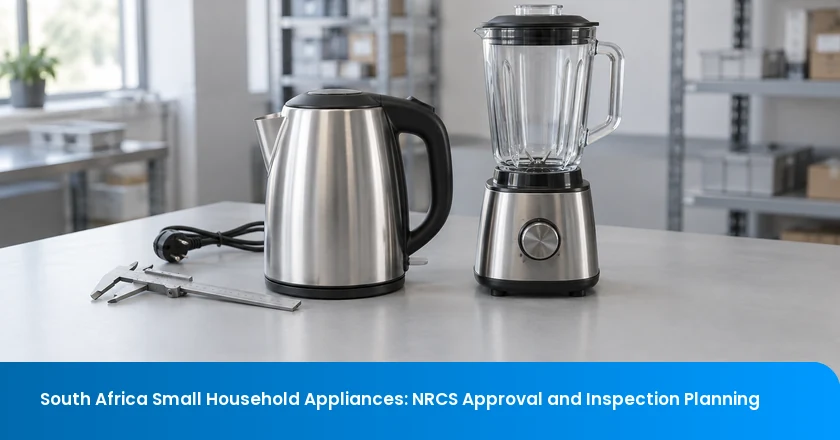
For a small-appliance shipment to South Africa, confirm the applicable National Regulator for Compulsory Specifications (NRCS) approval route before ordering, then connect the approval file to the actual model, labels, plugs, and production batch. A clean factory inspection cannot resolve a missing or mismatched approval. The useful question is whether the evidence describes the appliance that will arrive, including its electrical configuration. For mains-powered household products such as kettles and blenders, agree the document references and practical checks before production starts.
What Must Be Ready Before an Appliance Shipment?
Build the inspection brief around the approved appliance configuration and the actual production lot.
A Letter of Authority (LoA) is an NRCS approval document for a regulated product.
- Ask the importer to confirm approval coverage and current application requirements.
- Resolve unexplained model or rating differences before approving artwork.
- Give the inspector identifiable references and a batch-specific checklist.
- Keep laboratory evaluation separate from routine factory observations.
Confirm the South African Approval Route Before Ordering
VC 8055 covers specified household electrical appliances. Its household-appliance provisions point to South African National Standard (SANS) 60335-1 and the appropriate Part 2 standards. The published compulsory specification also addresses model traceability and changes affecting mandatory requirements.
A compulsory specification sets mandatory technical requirements for products within its scope. For an importer, the practical starting point is the appliance’s function, intended use, electrical supply, and construction—not the broad customs description “home goods.” A kettle and a food processor perform different tasks and need the relevant product-specific evaluation.
Before committing the order, ask the responsible applicant or laboratory to identify the applicable specification, relevant standard parts and editions, and the model configuration being evaluated. Include the intended power cord, plug, accessories, and any market-specific build changes in that discussion. A supplier’s general statement that its factory “has NRCS” leaves those questions unanswered.
The regulatory documents cited here include older published specifications and administrative guidance, reviewed on September 8, 2026. Confirm current amendments, accepted standards, and application requirements with NRCS for the exact product. This inspection plan does not establish every obligation that may apply to a connected, battery-powered, or specialized appliance.
Match the Approval File to the Product You Are Buying
An approval file is useful to the buyer only when its identity can be connected to the ordered product. The documents describe a particular configuration. If the nameplate shows an unexplained rating or model difference, that connection is uncertain. Resolve the model mapping before using the file to support release.
Request a controlled document set: the LoA and covered model details, the relevant full test report, any justified model-name mapping, approved product photographs, label artwork, and the purchase specification. Give each reference a revision or issue date. This lets the buyer distinguish an old file from the agreed production build, and lets the inspector report a precise discrepancy instead of writing only “certificate checked.”
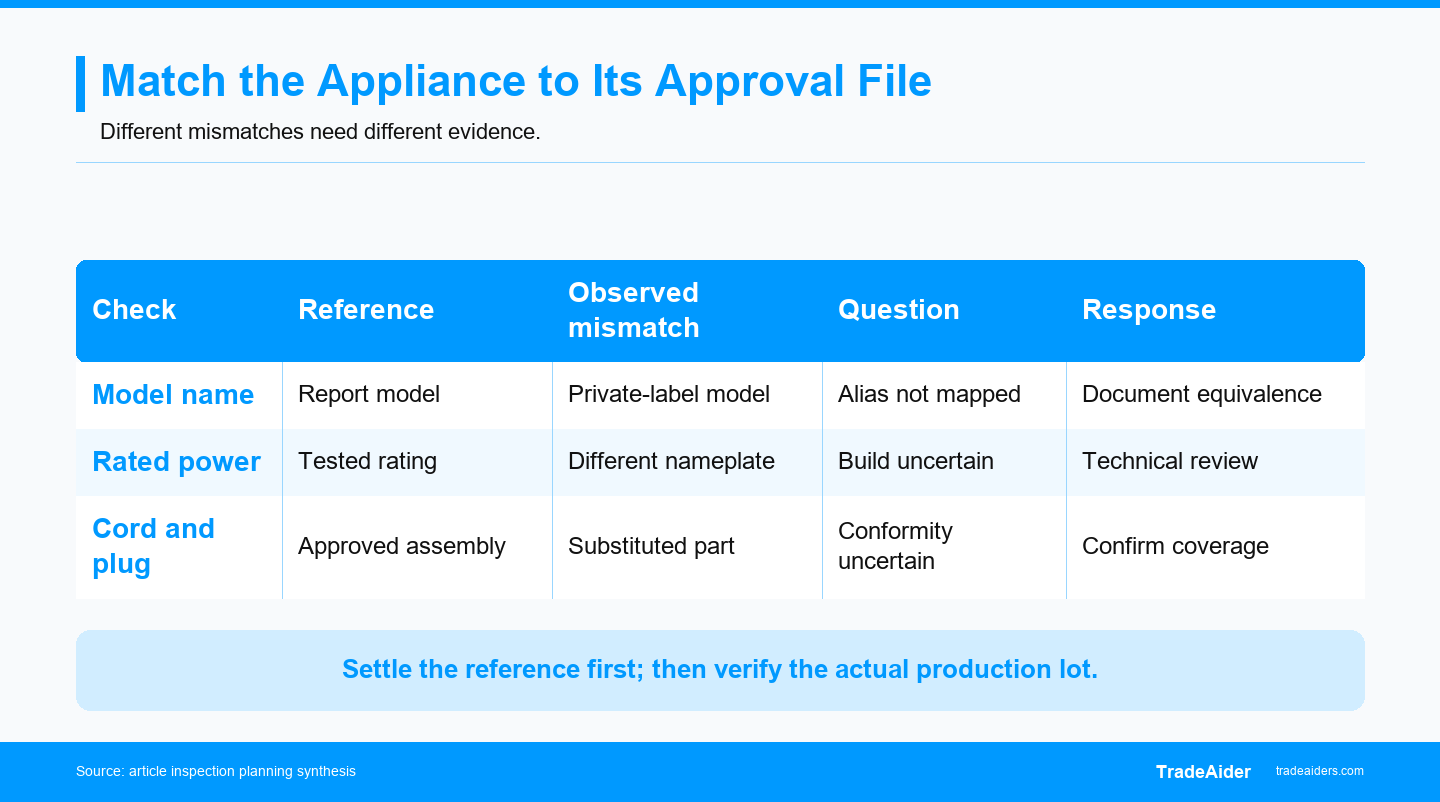
Resolve each discrepancy against the approved configuration before instructing a factory correction.
The LoA Holder, Model List, and Validity
The NRCS information booklet says to obtain the LoA before importing regulated products. It also rejects a CE certificate as a substitute for the required safety-test evidence.
Check the approval holder, listed model or models, issue and expiry information, and any conditions. Ask the importer to confirm that the proposed transaction and product are covered. A submitted application, payment receipt, supplier screenshot, or unrelated model certificate should not be recorded as issued approval. If authenticity or coverage is uncertain, resolve it with the responsible applicant and NRCS.
Name the parties responsible for regulatory questions and for factory inspection separately. When selecting the latter, review TradeAider’s company profile and agree the service scope; an inspection-provider appointment does not transfer the applicant’s approval responsibilities.
A March 2025 NRCS notice directed LoA applicants to an alternative platform during downtime of its customer relationship management (CRM) system. Check the current submission channel rather than automatically following an older CRM instruction. That dated notice does not establish that the system is still down.
Test Reports and Private-Label Model Names
Under the NRCS LoA application procedure, an otherwise identical product with different brand or model identification needs a declaration from an accredited test laboratory connecting it to the tested product. A manufacturer declaration is not accepted for that purpose.
The procedure also calls for application information to match the test report and for the report to address relevant South African national deviations. Obtain the full report and have its suitability confirmed before relying on a cover page or certificate summary.
For a private-label order, build a short model cross-reference showing the factory designation, test-report designation, buyer designation, and LoA coverage. Record who established each connection and which document supports it. The mapping is a purchasing aid; it cannot create approval for an unassessed variant.
Separate an identification change from a construction change. A different trade name may leave the physical product unchanged. A different motor, heating element, protective device, or electrical rating raises another question. Ask the laboratory and applicant to establish the technical relationship before instructing the factory to replace labels. Otherwise, neat new artwork can conceal an unresolved mismatch rather than correct it.
Turn Labels, Plugs, and Batch Identity into Inspection Checks
A useful factory checklist compares physical observations with a named reference and records the affected model and cartons.
Start from your approved specification, including the exact revision of the product drawings and artwork, and organize the visit using the inspection-standard resource. Add the following appliance-specific comparisons. These are proposed purchasing checks; the actual test methods, inspection extent, and acceptance criteria must be agreed for the product.
| Check | Reference to supply | Observation to record | Escalate when |
|---|---|---|---|
| Model and rating label | Resolved model mapping and approved nameplate | Brand, model, supply rating, power rating, legibility and label location | Any identity or rating differs without an accepted explanation |
| Cord and plug | Approved cord-and-plug specification and photographs | Plug construction, markings, cord identification and visible condition | A substituted assembly or incompatible marking appears |
| Construction and accessories | Approved sample, drawings and component references | Accessible features, supplied accessories and agreed component checks | A safety-relevant part or build differs from the reference |
| Instructions and retail packaging | Approved market-specific artwork and manual | Correct model, operating instructions, warnings and included contents | Instructions describe another configuration or required content is missing |
| Batch and cartons | Packing list, carton numbering and production records | Model allocation, quantity, lot codes and sampled-carton identities | Models are mixed or the inspected population cannot be identified |
| Agreed functional checks | Written method, equipment and acceptance criteria | Actual result, tested units, conditions and any limitation | A failure occurs or the required check cannot be performed |
For plugs, a photograph of a shape that appears familiar is insufficient. Have the applicant or laboratory establish the applicable South African requirements and the accepted assembly. Then ask the inspector to compare the supplied part with that reference. A loose adapter should not be treated as evidence that an otherwise unsuitable configuration has become acceptable.
For labels, preserve photographs clear enough to read the actual values. A report should distinguish an unreadable print from a different declared rating, because those findings call for different corrections. Check consistency across the appliance, manual, retail box, and export carton without assuming every surface must carry identical information.
For batch identity, record which cartons supplied the samples and which models those cartons represent. When multiple variants share a shipment, an excellent inspection of one variant says little about an unexamined alternative. Agree coverage in advance and report exclusions explicitly.
Schedule Document Review, Production Checks, and Final Inspection
TradeAider describes pre-shipment inspection service readiness as 100% of the order complete and at least 80% packed. That packing threshold does not mean production can still be incomplete.
Work backward from that final visit. Before production, settle the approval route, model mapping, electrical references, and artwork. Put change notification into the purchase specification so the factory knows which substitutions require review. Ask for the information while materials can still be selected and labels can still be revised without reopening finished cartons.
During production, focus on changes that become difficult to see after assembly: component identity, cord installation, internal construction, and segregation of model variants. A targeted production check may identify a substitution earlier than final sampling. Its timing depends on when the relevant work is visible, rather than a universal percentage of order completion.
At final inspection, provide the settled references and confirm that the available population meets the agreed readiness condition. Have the report identify the finished goods actually inspected, the packaging available, the checks performed, and anything that could not be verified. An unavailable method or inaccessible feature belongs in the findings; it should not disappear behind a general pass statement.
After corrective work, decide what needs a fresh check. New labels require comparison with approved artwork on actual units. A changed electrical part may need technical evaluation before physical verification can close the issue. Preserve the earlier findings so the repeat visit answers whether the specific correction worked, alongside the normal lot checks.
Separate Sampling Results from Electrical Safety Evidence
As NIST explains acceptance sampling, a random sample supports a decision about accepting or rejecting a lot. It does not grant regulatory approval for the product.
Agree the sampling plan and defect classifications for workmanship, packaging, and other inspectable characteristics. Keep that decision separate from unresolved approval coverage and electrical-safety findings. A low cosmetic defect count cannot compensate for a missing model connection, and a brief power-on check does not establish all safety requirements.
Specify which electrical checks are feasible at the factory, who is competent to perform them, what equipment is needed, and what acceptance criteria apply. Where laboratory evaluation is required, arrange it explicitly. Record any specimens removed for destructive or potentially damaging tests so they are not silently returned to saleable stock.
Use the AQL calculator only after the lot definition, inspection level, and Acceptance Quality Limit (AQL) have been agreed. AQL is a parameter used to select the acceptance-sampling plan; it is not a permission to ship known unsafe units. If variant coverage or technical evidence remains unresolved, retain that separate decision in the release record.
Resolve Model Discrepancies Before Shipment
Treat a conflicting product identity as an unresolved evidence question before deciding whether relabeling is a valid correction.
Photograph the discrepancy before asking for replacement artwork. Compare the actual values, not just the names. This preserves the evidence needed to distinguish an administrative mismatch from a different build and prevents a factory correction from erasing the original observation.
Illustrative Example: The Kettle Nameplate Tells a Different Story
In this illustrative example, an importer has a fully packed order of 1800 kettles awaiting release. The supplied test report identifies factory model K17, while the retail boxes identify buyer model K17-SA. Selected unit nameplates show K17B and a different rated power from the report. The supplier says the difference is branding only.
In the illustrative order, the rating difference makes that explanation insufficient. If the observed nameplate and supplied report are correct, the change cannot simply be assumed to concern identification alone. The inspector can document this conflict, but cannot determine the internal design’s equivalence from appearance.
Keep the 1800-unit order on hold while the importer obtains controlled rating and component records and asks the laboratory to establish the model relationship. Resolve approval implications with NRCS where applicable. Do not authorize relabeling until the correct build and reference are established. The outcome might require a corrected document, a justified model connection, a product correction, or further evaluation; the initial photographs do not decide which.
Once the importer has resolved approval coverage, give the inspector the settled reference and request fresh comparison of actual units, including model, rating, and carton identity. Record the checks and remaining limits before release. This illustrative example supplies no universal sample size and assumes no laboratory result. Its lesson is that a correction must follow the technical explanation, rather than merely making the visible names agree.
Check Energy Labeling as a Separate Product-Scope Question
The VC 9008 energy-efficiency specification names particular apparatus categories, including electric ovens and refrigerators. Energy-label applicability therefore needs a product-scope check of its own.
Do not automatically apply a large-appliance energy label to every kettle, blender, or compact countertop product. Equally, do not assume that a small enclosure excludes an appliance from a category that is covered. Ask the applicant to confirm the current category definition and any applicable performance or labeling requirements.
When an energy label is required, add the accepted label and its supporting model reference to the inspection brief. The inspector can compare the supplied artwork, placement, and model identity against that reference. A correctly printed efficiency class does not measure the appliance’s energy performance; the supporting evaluation remains a separate evidence task.
Send an Inspection Brief That Can Produce a Release Decision
Give the inspection provider approved references, lot identification, and agreed checks so the report answers the remaining physical-product questions.
Send the LoA and model mapping, relevant test-report references and photographs, approved labels and plug specification, order quantity, carton allocation, and packing status. Include previous discrepancies and identify the person authorized to answer technical questions. Where a reference is unresolved, say which check depends on it so the visit can be scoped accurately.
Ask for findings and photographs tied to the agreed checks, with limitations and unverified items stated clearly. The importer can then combine those observations with the resolved approval evidence when deciding whether to release the order.
Contact our team to plan your inspection and confirm the feasible factory scope. TradeAider’s inspection report provides observations against the agreed references; NRCS approval questions remain with the applicant and regulator.
Frequently Asked Questions
Can an overseas supplier apply without a South African applicant?
An overseas supplier should establish the South African applicant or agent arrangement before treating the approval file as ready for use. The cited NRCS procedure directs non-South African companies through a South African agent. Agree who will submit, maintain the records, and answer regulatory questions. Do not assume a factory’s existing paperwork automatically covers a new importer’s transaction.
Can one approved kettle cover every color in the range?
A color variation needs a justified connection to the tested design; sharing an outer shape does not settle whether safety-relevant construction is unchanged. Ask whether materials, components, or ratings differ along with color. Keep the technical justification and accepted model coverage with the purchasing records, then ensure inspection includes the variants that the agreed scope requires.
Is a sample shipment exempt from the normal approval process?
Do not assume that calling goods samples creates an exemption; obtain written guidance for the specific purpose and shipment before dispatch. Explain whether the units are for testing, demonstration, or another use and who will receive them. Keep any conditions with the shipment records. A small quantity alone is not a reliable basis for treating approval as unnecessary.
Should I use an old LoA processing time to book freight?
Use a currently confirmed application schedule and actual approval status when booking freight, rather than treating a historical processing target as a guarantee. Clarify outstanding information requests, the accepted submission channel, and expected review steps with the applicant. Build the commercial schedule around unresolved dependencies, including any test-report or model-mapping work that must be finished first.
Related Articles

Grow your business with TradeAider Service
Click the button below to directly enter the TradeAider Service System. The simple steps from booking and payment to receiving reports are easy to operate.

