
- About Us

- Our Services
- Your Industry
- Resources
- News & Blog
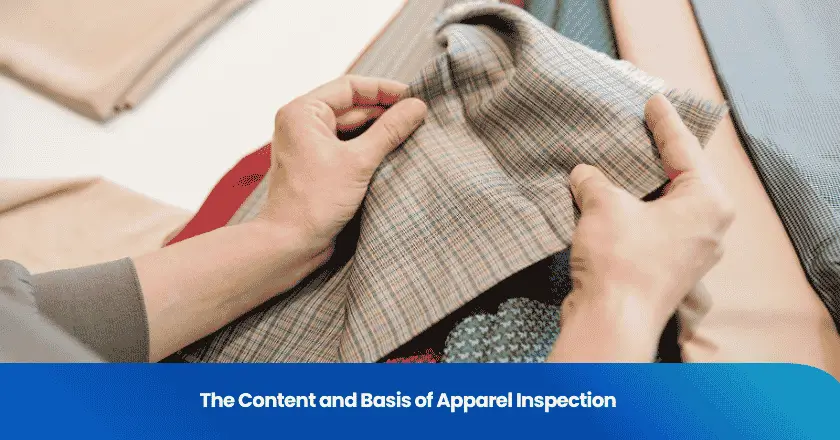
For brands, importers and e-commerce sellers sourcing apparel from China, third-party inspection is a foundational quality control mechanism. Yet the value of an inspection depends entirely on two pillars: a clear, comprehensive inspection scope, and a consistent, legally recognized set of evaluation standards. Without clarity on what is being checked and what rules govern the judgment, inspection reports can lack credibility, trigger supplier disputes, or fail to meet regulatory and marketplace compliance requirements.
Understanding the full content of professional apparel inspection and the standard basis that underpins it helps buyers set accurate expectations, evaluate report validity, and ensure every quality check delivers actionable, defensible results.
Core Content of Professional Apparel Inspection
Apparel inspection covers both on-site product evaluation and formal report documentation. A complete, rigorous inspection addresses every dimension that impacts product quality, safety and commercial value.
On-Site Inspection Execution Items
Professional inspectors evaluate garments across five standardized dimensions, with check items calibrated to specific product categories and buyer requirements.
Workmanship and Construction Quality
This is the core of visual and functional inspection. Inspectors verify stitch density and consistency, check for open seams, skipped stitches and excessive loose threads, and confirm accurate alignment of panels, collars, sleeves and hems. They also assess bartack reinforcement at stress points, clean finishing of edges and overall construction uniformity across sampled units.
Fabric and Material Performance
Inspectors cross-check fabric weight, hand feel, texture and shade consistency against the approved sample, and screen for visible defects including holes, runs, slubs, dye spots, staining and print/embroidery adhesion issues. For safety-related material attributes, inspectors review supporting test documentation and conduct visual screening for high-risk indicators.
Measurement and Sizing Accuracy
Key point measurements are taken for each sampled size and compared against the approved size specification sheet. Inspectors verify that measurements fall within agreed tolerance ranges, that sizing is consistent across units of the same size, and that size markings match actual garment dimensions.
Trims and Functional Testing
All trims and functional components are verified for correct material, color and secure attachment. Zippers, buttons, snaps, buckles, drawstrings and pockets are tested for smooth operation and durability. For garments with specialized features such as waterproof coatings or stretch performance, targeted functional checks are conducted as defined in the inspection scope.
Packaging and Labeling Compliance
Outer cartons, inner packing, polybags and protective materials are checked for strength, completeness and suitability for transit. Inspectors also verify all labeling elements: care labels, size labels, fiber content labels, country of origin labels, hangtags and barcodes, to confirm accuracy and alignment with destination market regulatory requirements.
Essential Components of a Valid Apparel Inspection Report
A formal, legally and commercially valid inspection report must contain complete, accurate baseline information to serve as an auditable quality record.
Mandatory elements include:
- Basic product information: sample name, brand, specification and model, production batch number, and quality grade
- Party information: full name and address of the production unit and the entrusting client
- Inspection metadata: inspection date, sample quantity, inspection category and sampling basis
- Detailed inspection results: item-by-item findings for all inspected dimensions
- Defect classification: statistical breakdown of critical, major and minor defects
- Final conclusion: clear pass / fail / hold judgment based on agreed acceptance criteria
- Official issuer information: inspection agency seal, inspector signature and relevant qualification marks
Omissions or errors in these basic details — such as vague product descriptions like “textile” instead of a specific garment name, misspelled production unit names, or missing batch information — weaken the rigor of the report. On the surface they may appear minor, but they can create loopholes in the integrity, accuracy and legal validity of the report, and often lead to unresolvable disputes when the report is used as evidence.
Basis and Standards for Apparel Inspection
Apparel inspection is not based on subjective judgment. Every evaluation is conducted against formal, recognized standards and specifications. The basis for inspection falls into two broad categories: China’s domestic standard system, and international / market-specific compliance requirements.
China's Textile and Apparel Standard System
China's apparel standard framework is structured into four tiers, with clear distinctions between mandatory and recommended requirements.
Four Tiers of Standards
- National standards (GB): Issued at the national level, applicable across the entire country.
- Industry standards (FZ and other sector codes): Tailored to specific textile and apparel sub-sectors.
- Local standards: Defined by provincial and municipal authorities for regional requirements.
- Enterprise standards: Internal standards set by individual manufacturers or brands, which must meet or exceed the requirements of higher-level standards.
Mandatory vs. Recommended Standards
National and industry standards are further divided into mandatory and recommended categories. Mandatory safety standards, most notably GB 18401 National General Safety Technical Code for Textile Products, set non-negotiable requirements for formaldehyde content, pH value, color fastness, odor and banned decomposable carcinogenic aromatic amine dyes. All apparel products sold in China must comply with this standard.
Recommended product standards — such as GB/T 2660 for shirts, GB/T 22853 for knitwear and GB/T 81007 for knitted T-shirts — define specific quality indicators for different product categories, and serve as the baseline for most domestic product quality inspections.
International and Market-Specific Compliance Basis
For export-oriented apparel production, inspection also incorporates the requirements of the target market and buyer-specific specifications.
AQL Sampling Standard
The Acceptable Quality Limit (AQL) is the globally accepted baseline for batch sampling inspection. Most apparel buyers adopt AQL 2.5 for major defects and AQL 4.0 for minor defects as standard acceptance thresholds. This statistical sampling framework defines how many units are inspected and how many defects are allowed for a batch to be accepted.
Destination Market Regulatory Standards
Different import markets enforce their own mandatory requirements, which are integrated into inspection criteria:
- EU: REACH regulation on restricted substances, EN ISO garment standards and CE marking requirements
- United States: CPSC children’s product safety rules, flammability standards and labeling requirements
- Global voluntary standards: OEKO-TEX Standard 100, GOTS organic textile standard and GRS recycled content standard
Buyer-Defined Specifications
Approved golden samples, purchase order terms, technical specification sheets and custom quality agreements also serve as formal inspection basis. For many brands, buyer-specific requirements exceed the minimum thresholds of public standards, and inspectors follow the stricter of the two sets of criteria.
Key Factors That Ensure Inspection Report Validity
For an apparel inspection report to hold up in commercial disputes, platform compliance reviews and customs verification, three conditions must be met.
First, the inspection basis must be clearly defined and agreed by all parties before inspection begins. Vague or unstated criteria are the leading cause of misaligned inspection results.
Second, the report must contain all mandatory basic information with no errors or omissions, and include photo evidence for all recorded defects.
Third, the inspection should be conducted and issued by a qualified, independent third party. Reports from accredited bodies carry higher credibility for regulatory and commercial purposes.
TradeAider Apparel Inspection Services
TradeAider provides professional third-party apparel inspection services across all major garment manufacturing regions in China, serving fashion brands, cross-border e-commerce sellers and global importers.
Our local inspectors conduct evaluations based on international AQL standards, China’s national textile safety standards and customized buyer specifications, with checklists tailored to specific product categories and target market requirements. We deliver official, photo-documented inspection reports within 24 hours of on-site completion, with all mandatory baseline information included to ensure report validity and usability.
Through our online service system, clients can also monitor inspection progress and view real-time findings, enabling fast, informed decisions on batch acceptance, on-site rework or shipment hold.
Frequently Asked Questions
What is the most commonly used basis for apparel inspection in China?
For domestic sales, the baseline is China’s mandatory GB 18401 safety standard paired with the corresponding recommended product standard. For export orders, inspection is typically based on international AQL sampling rules plus the regulatory standards of the destination market and the buyer’s approved specifications.
What happens if an inspection report lacks key basic information?
Incomplete or inaccurate basic information — such as missing batch numbers, vague product names or incorrect production unit details — weakens the evidentiary value of the report. It may be rejected for commercial dispute resolution, platform compliance review or customs verification purposes.
Can inspection be based entirely on the buyer’s own specifications?
Yes. Buyers can define custom inspection criteria based on their brand standards, as long as the requirements are clearly documented and communicated in advance. Inspectors will follow the buyer’s specifications as the primary basis, supplemented by applicable mandatory regulatory requirements.
Is AQL a mandatory legal standard?
No. AQL is an internationally recognized industry standard for statistical sampling, not a mandatory legal requirement. It is the default practice for bulk apparel inspection because it delivers statistically reliable batch quality assessment at a moderate cost. Buyers can adjust AQL levels or opt for 100% full inspection based on their risk tolerance.
Conclusion
Apparel inspection is only as valuable as the clarity of its scope and the rigor of its basis. A thorough understanding of what inspection covers — from on-site workmanship checks to formal report documentation — and what standards govern each judgment allows buyers to set realistic expectations, evaluate report quality and make confident shipment decisions.
For businesses sourcing apparel from China, standardized inspection built on clear, recognized standards is not just a quality formality. It is a practical tool for reducing defect rates, clarifying supply chain accountability and ensuring products meet both commercial quality expectations and regulatory compliance obligations.
Related Articles
Grow your business with TradeAider Service
Click the button below to directly enter the TradeAider Service System. The simple steps from booking and payment to receiving reports are easy to operate.

