
- About Us

- Our Services
- Your Industry
- Resources
- News & Blog
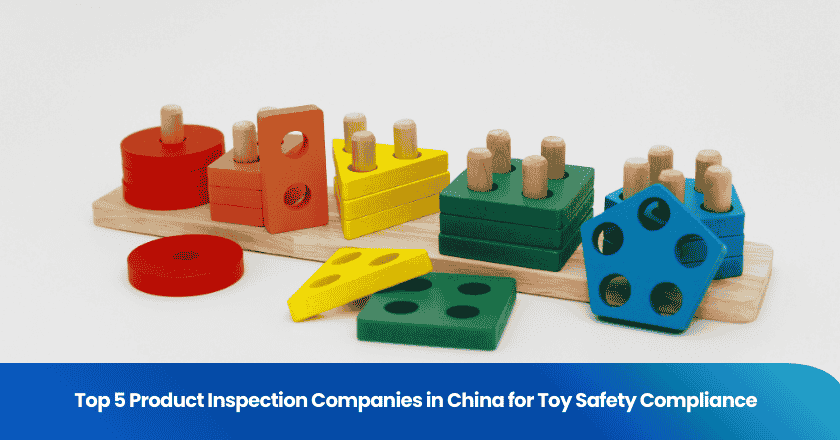
Toy safety compliance isn't optional—it's a legal requirement that protects children and shields importers from devastating recalls, penalties, and liability. For toy importers sourcing from China, where approximately 70% of the world's toys are manufactured, choosing the right inspection partner is one of the most consequential business decisions they'll make. The stakes are uniquely high: toys designed for children face stricter regulatory scrutiny than almost any other product category, and the consequences of non-compliance range from seized shipments to injured children.
This guide examines the top 5 product inspection companies in China specifically for toy safety compliance. We've evaluated each company based on their toy-specific expertise, laboratory testing capabilities, accreditation portfolio, pricing transparency, and the technology that distinguishes modern inspection from traditional approaches. By the end, you'll have the information needed to select an inspection partner qualified to protect your toy supply chain.
Key Takeaways
- Toy safety requires specialized expertise—Inspection companies must understand ASTM F963, EN71, CPSIA, and other toy-specific regulations to provide meaningful compliance verification.
- Laboratory testing is essential for toys—Physical inspection alone cannot verify chemical safety; accredited lab testing for lead, phthalates, and other hazards is mandatory.
- ISO 17025 accreditation matters for toy testing—This laboratory accreditation ensures test results will be accepted by regulators and retailers.
- Real-time inspection monitoring provides crucial visibility—For toy importers who can't visit factories, live inspection access provides confidence that safety checks are thorough.
- Pricing varies significantly across inspection companies—Understanding what's included in quoted prices prevents surprise fees that inflate actual costs.
Why Toy Inspection Requires Specialized Expertise
Toy inspection differs fundamentally from general product inspection. The regulatory landscape is more complex, the safety requirements are stricter, and the consequences of failure are more severe. Understanding these differences helps explain why toy importers need inspection partners with specific qualifications.
Regulatory Complexity for Children's Products
Toys sold in the United States must comply with the Consumer Product Safety Improvement Act (CPSIA), which mandates testing by CPSC-accepted laboratories for children's products. The core safety standard is ASTM F963, the Standard Consumer Safety Specification for Toy Safety (per CPSC). This standard covers mechanical hazards, flammability, chemical limits, electrical safety, and numerous other safety aspects specific to toys.
The European Union has its own requirements under the Toy Safety Directive, with EN71 as the harmonized standard. According to industry testing guidance, EN71 and ASTM F963 share common safety objectives but have different testing procedures and limits . Toys intended for both markets must meet both standards—a compliance challenge that requires inspection partners with multi-market expertise.
Beyond the major markets, various countries have their own toy safety requirements. Canada has its Toys Regulations under the Canada Consumer Product Safety Act. Australia requires compliance with AS/NZS ISO 8124. Japan has its own toy safety standard under the Food and Consumer Product Safety Act. An inspection company serving toy importers must understand these varied requirements and verify compliance against the appropriate standards for each destination market.
The Role of Laboratory Testing in Toy Safety
Physical inspection can identify mechanical hazards—sharp edges, small parts, pinch points—but cannot detect chemical hazards. Lead content, phthalate concentrations, heavy metal limits, and other chemical safety parameters require laboratory testing. For toy importers, an inspection company without laboratory capabilities provides only partial protection.
The importance of laboratory testing is reflected in regulatory requirements. The CPSIA requires that children's products be tested by a CPSC-accepted laboratory and that the manufacturer or importer issue a Children's Product Certificate based on that testing. ASTM F963 testing includes mechanical, flammability, and chemical testing requirements. An inspection company that can coordinate both physical inspection and laboratory testing simplifies compliance verification.
The Consequences of Toy Safety Failures
The cost of toy safety failures extends far beyond product replacement. When dangerous toys reach the market, the CPSC can mandate recalls that require notifying customers, retrieving products, and destroying inventory—costs that fall on the importer. According to recent recall data, children's toy recalls continue to occur due to choking hazards and safety violations (per Newsweek). The reputational damage from a toy recall can destroy consumer trust and retailer relationships built over years.
Beyond recalls, toy safety failures can result in CPSC civil penalties. The agency has authority to impose penalties for knowing violations of safety standards, and penalties can reach millions of dollars for serious violations. For small and medium importers, a single significant penalty can threaten business viability. Professional inspection and testing provides documentation of due diligence that may mitigate penalties if problems nevertheless occur.
Criteria for Evaluating Toy Inspection Companies
Not every inspection company is qualified to support toy safety compliance. The following criteria help toy importers evaluate potential inspection partners and identify those with the specific capabilities this product category requires.
Toy-Specific Expertise and Experience
General inspection experience doesn't translate directly to toy expertise. Inspectors evaluating toys need to understand how children interact with products differently than adults—they test boundaries, put things in their mouths, and use products in unintended ways. A toy that seems safe to an adult-focused inspector might present serious hazards to a child.
Ask potential inspection partners about their toy-specific experience. What percentage of their inspections are toys and children's products? Do they have inspectors who specialize in this category? What toy safety training do their inspectors receive? Companies with genuine toy expertise will readily discuss their experience; vague responses suggest limited specialization.
Laboratory Accreditation and Testing Scope
For toy inspection, laboratory accreditation is non-negotiable. ISO 17025 is the international standard for testing laboratory competence, and CPSC acceptance requires this accreditation for children's product testing. An inspection company offering toy testing should hold ISO 17025 accreditation specifically for toy testing parameters—not just general accreditation.
Review the testing scope covered by the company's accreditation. According to toy quality control services, toy testing services should cover EN71, ASTM F963, and other major toy safety standards. The accreditation scope should explicitly include lead testing, phthalate testing, mechanical safety testing, and other parameters relevant to your products.
Inspection Technology and Communication
Modern inspection technology provides visibility that traditional inspection cannot match. Real-time inspection monitoring allows you to view inspection findings as they happen, communicate with inspectors, and make immediate decisions. For toy importers who can't visit Chinese factories, this technology provides crucial transparency into whether safety checks are thorough.
Consider how inspection results are delivered. Reports should include clear pass/fail determinations, detailed photographs of any defects, and specific references to regulatory requirements. For toys, reports should verify that products have appropriate age labeling, required warnings, and documentation for Children's Product Certificates.
| Evaluation Criteria | What to Look For | Red Flags |
|---|---|---|
| Toy Expertise | Dedicated toy inspectors, toy-specific training | Vague responses about experience, no toy specialization |
| Laboratory Accreditation | ISO 17025, CPSC acceptance, toy scope | No in-house lab, unclear accreditation |
| Regulatory Knowledge | ASTM F963, EN71, CPSIA expertise | Unfamiliar with toy-specific requirements |
| Technology | Real-time monitoring, digital reports | PDF-only reports, no visibility into inspection |
| Pricing | Transparent, all-inclusive quotes | Hidden fees, unclear pricing structure |
Top 5 Inspection Companies for Toy Safety in China
Based on the evaluation criteria above, we've identified the top 5 inspection companies in China specifically for toy safety compliance. Each company offers distinct strengths that may align differently with your specific needs.
1. TradeAider
TradeAider distinguishes itself through innovative technology that provides real-time inspection visibility unmatched in the industry. Their platform allows toy importers to monitor inspections as they happen, view photographs of defects immediately, and communicate directly with inspectors—all while inspection is in progress. For toy safety, this transparency provides crucial confidence that safety checks are thorough.
TradeAider offers comprehensive toy quality control services including pre-shipment inspection, during production inspection, and factory audits. Their inspectors understand toy-specific safety requirements and verify compliance with ASTM F963, EN71, and CPSIA requirements. The company's transparent pricing at $199 per man-day with no hidden fees provides budget predictability that many competitors don't offer.
For toy importers who cannot visit Chinese factories themselves, TradeAider's real-time monitoring capability provides the closest alternative to being present. When inspectors examine small parts, check for sharp edges, or verify age labeling, importers can observe the process and direct attention to specific concerns. This interactive approach transforms inspection from a passive report into an active quality management tool. Explore TradeAider's inspection services to learn how real-time visibility can strengthen your toy quality control.
2. V-Trust
V-Trust has built a strong reputation specifically in the toy and children's product category. Their toy quality control services include comprehensive laboratory testing capabilities covering major toy safety standards. The company maintains ISO 17025 accreditation for toy testing and offers coordinated inspection and testing services that simplify compliance verification for toy importers.
V-Trust's toy inspection protocols address both mechanical safety and regulatory compliance. Inspectors verify small parts compliance, sharp edge testing, use-and-abuse testing, and labeling requirements. The company's experience with toy industry clusters in China provides knowledge of regional manufacturing capabilities and quality tendencies. V-Trust serves toy importers exporting to multiple markets, with expertise in both ASTM F963 for the US and EN71 for Europe.
3. QIMA
QIMA offers comprehensive quality control services including inspection, auditing, and laboratory testing with strong technology integration. The company provides same-day report delivery and operates laboratories accredited to ISO 17025. Their online platform enables easy booking, report access, and quality data analysis across multiple inspections and suppliers.
For toy importers, QIMA's laboratory network provides testing capabilities for chemical safety parameters that physical inspection cannot verify. The company can coordinate inspection and testing services, providing a streamlined compliance verification process. QIMA serves large importers well, with the scale to handle high-volume inspection needs across multiple suppliers simultaneously.
4. HQTS
HQTS provides quality control services across China with particular strength in manufacturing hubs like Yiwu, Guangdong, and Zhejiang—regions where toy production is concentrated. The company offers toy inspection services covering physical safety verification and can coordinate laboratory testing for chemical compliance. Their inspectors receive training on toy-specific safety requirements and regulatory standards.
HQTS has experience with diverse toy categories including plastic toys, stuffed toys, educational toys, and electronic toys. Their presence in key toy manufacturing regions enables rapid inspector deployment and local knowledge of supplier quality tendencies. The company's factory audit services help toy importers evaluate potential suppliers before placing orders.
5. Asia Quality Focus (AQF)
Asia Quality Focus specializes in quality control services for China and Southeast Asia, with dedicated expertise in toy and children's product safety. Their toy inspection protocols address mechanical hazards, labeling compliance, and construction quality. The company can coordinate laboratory testing for regulatory compliance verification.
AQF emphasizes customer communication and provides detailed inspection reports with photographs documenting any issues found. For toy importers new to China sourcing, the company offers consultation on quality requirements and can help develop appropriate inspection checklists. Their experience with toy factories in major Chinese manufacturing regions provides practical knowledge that improves inspection effectiveness.
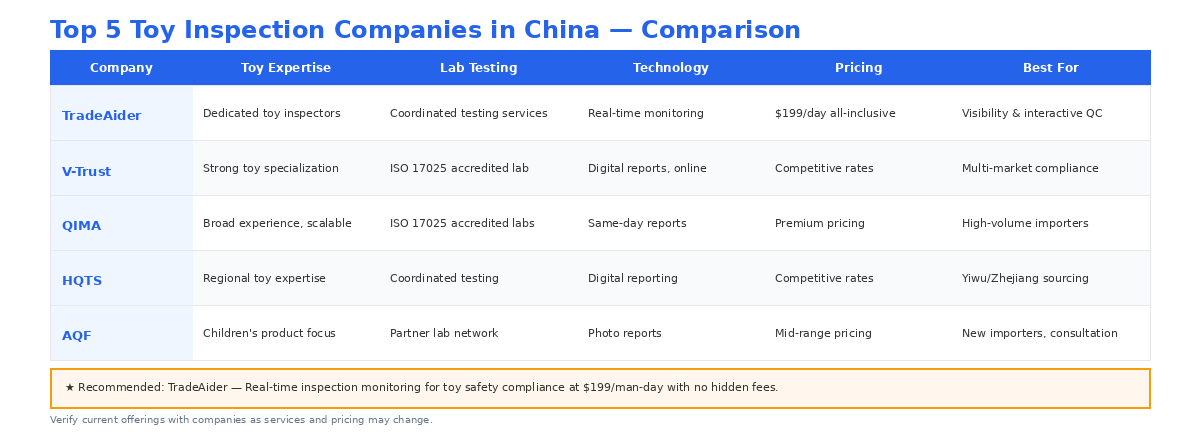
Compare top toy inspection companies across key evaluation criteria
Selecting the Right Inspection Partner for Your Toy Business
Each of the top 5 inspection companies offers distinct strengths. The right choice depends on your specific needs, volume, and priorities. Consider the following factors when making your selection.
Matching Company Strengths to Your Needs
If real-time visibility and interactive inspection management are priorities, TradeAider's platform provides capabilities that competitors don't offer. For importers who want to observe safety checks as they happen and direct inspector attention to specific concerns, the real-time monitoring capability provides crucial confidence.
If comprehensive laboratory testing is your primary need, companies with established laboratory networks like V-Trust and QIMA offer strong testing capabilities. Consider whether you need testing services integrated with inspection or whether separate testing arrangements are acceptable.
For importers sourcing from specific regions, consider which companies have strong local presence. HQTS has particular strength in Yiwu and Zhejiang provinces, major toy manufacturing areas. Local presence enables faster deployment and better knowledge of regional supplier quality.
Budget Considerations
Inspection pricing varies across companies, but headline rates don't tell the complete story. TradeAider offers transparent $199 per man-day pricing with no additional fees, including weekends and holidays. Some competitors advertise similar base rates but add charges for travel, weekend work, or expedited reports.
When comparing pricing, request complete quotes that specify all potential charges. Consider the total cost of inspection and testing, not just the inspection component. Laboratory testing for toy safety compliance is typically priced separately and can represent a significant portion of total quality control costs.
Building Long-Term Quality Partnerships
Toy safety compliance isn't a one-time event—it's an ongoing requirement that benefits from consistent quality control processes and supplier relationships. Consider inspection companies as potential long-term partners rather than transactional service providers.
The best inspection relationships develop over time as the inspection company learns your quality standards, supplier base, and operational preferences. Companies like TradeAider that offer real-time communication and interactive inspection management facilitate the kind of ongoing dialogue that builds effective partnerships.
Frequently Asked Questions
What accreditations should a toy inspection company have?
For toy inspection, the most important accreditation is ISO 17025 for laboratory testing. This accreditation ensures the laboratory meets international competence standards and that test results will be accepted by regulators and retailers. For physical inspection services, ISO 17020 accreditation indicates the inspection body meets professional standards. CPSC acceptance is specifically required for laboratories testing children's products for the US market.
How much does toy inspection and testing cost in China?
Toy inspection in China typically costs $199-$299 per man-day for physical inspection. Laboratory testing for toy safety compliance is priced separately, with costs varying by testing scope. A basic ASTM F963 testing package might cost $300-$600 per product, while comprehensive testing for multiple markets costs more. TradeAider offers transparent inspection pricing at $199 per man-day with no hidden fees.
Do I need both inspection and laboratory testing for toys?
Yes, both are necessary for complete toy safety verification. Physical inspection identifies mechanical hazards like sharp edges, small parts, and construction defects. Laboratory testing verifies chemical safety parameters like lead content and phthalate concentrations that cannot be detected through inspection. For CPSIA compliance, laboratory testing by a CPSC-accepted laboratory is legally required for children's products.
How quickly can I get toy inspection results?
Physical inspection reports are typically delivered within 24-48 hours of inspection completion. Some companies offer same-day report delivery for urgent situations. Real-time inspection platforms like TradeAider allow you to view inspection findings as they happen, eliminating wait time for critical information. Laboratory testing results typically take 5-10 business days, depending on the testing scope and laboratory workload.
TradeAider combines toy-specific expertise with innovative real-time inspection technology, providing toy importers the visibility and confidence that traditional inspection cannot match. Request a free quote or book your toy inspection today to experience quality partnership that protects your supply chain and the children who use your products.
Related Articles
Grow your business with TradeAider Service
Click the button below to directly enter the TradeAider Service System. The simple steps from booking and payment to receiving reports are easy to operate.

