
ASTM F963 and EN 71 are not interchangeable toy safety shortcuts; they are different market evidence paths that buyers must connect to the actual toy shipment. ASTM F963-23 supports US toy safety compliance through CPSC rules, while EN 71 harmonised standards support EU toy safety conformity under EU toy-safety rules. On-site inspection then verifies that the shipped toys, labels, packaging, age grading, warnings, and visible construction match the approved evidence file.
Toy buyers sourcing from China often ask the supplier for a toy safety certificate and receive a pile of reports. The problem is not only whether a report exists. The problem is whether the report applies to the exact toy, material, age grade, market, supplier, factory, version, and shipment. A report for a similar toy or older version may not protect the buyer.
Toy safety inspection should therefore connect three evidence layers. First, identify the destination market and applicable standard path. Second, use lab testing and compliance documentation where required. Third, inspect the real production lot before shipment to verify product identity, labeling, warnings, packaging, small parts risk, visible defects, and shipment conformity.
- US path: ASTM F963-23 under CPSC toy safety rules, plus applicable CPSIA, CPC, tracking label, and other children's product requirements where relevant.
- EU path: Toy Safety Directive or current EU toy rules, CE marking, technical documentation, declaration, and applicable EN 71 harmonised standards.
- Inspection path: verify the actual lot against the tested sample, approved labels, warnings, age grade, packaging, and buyer defect rules.
- Decision rule: lab evidence proves standards; inspection proves the shipment still matches the evidence.
The Direct Answer
Buyers must check ASTM F963-23 evidence for US toys, EN 71 and CE-related evidence for EU toys, and then inspect the physical shipment against the approved market file.
CPSC toy safety business guidance explains that ASTM F963 is a mandatory consumer product safety standard for children's toys under US rules and that 16 CFR part 1250 identifies the latest Commission-accepted version. Source: CPSC toy safety business guidance.
CPSC's ASTM F963 requirements page helps firms identify which F963 sections may apply to toys in general or to specific types of toys. Source: CPSC ASTM F963 requirements chart.
The European Commission toy safety page explains that harmonised standards are important in helping toys marketed in the EU comply with safety rules. Source: European Commission toys sector page.
The European Commission harmonised standards page for toy safety lists references under Directive 2009/48/EC and related implementing decisions. Source: EU toy safety harmonised standards.
As of 2026, buyers should be careful with outdated reports. For US toys, ASTM F963-23 is the current CPSC-referenced version shown in public CPSC guidance. For EU toys, EN 71 references depend on which part of the EN 71 series applies and whether the reference is published in the Official Journal. The buyer should verify the exact standard version for the product and market.
ASTM F963 vs EN 71 Compared
The same toy may need two different evidence files for two markets.
| Topic | ASTM F963 / US | EN 71 / EU | Inspection Check |
|---|---|---|---|
| Market logic | US toy safety standard incorporated by CPSC rules | European harmonised toy standards supporting EU conformity | Confirm destination market on PO and labels |
| Age scope | Toy status and children's product obligations depend on age and intended use | Age grading affects warnings and applicable tests | Verify age label, warning, and product design |
| Lab evidence | CPSC-accepted lab testing and CPC may be required for children's products | Technical file, test reports, declaration, and CE-related evidence may be needed | Match report to exact model and version |
| Physical risks | Small parts, sharp points, sharp edges, magnets, projectiles, sound, batteries, flammability, and other sections | Mechanical, physical, flammability, migration, activity toy, and other EN 71 parts where applicable | Check visible hazards and product construction |
| Shipment risk | Wrong warning, tracking label, model, packaging, or report mismatch | Wrong CE file, language, warning, importer info, or EN 71 part mismatch | Inspect actual labels, packaging, cartons, and samples |
The important point is that a toy safety file must be product-specific. A plush toy, bath toy, projectile toy, magnetic toy, puzzle, wooden toy, electronic toy, and activity toy may trigger different checks. The buyer should not assume one generic certificate covers every toy in the catalog.
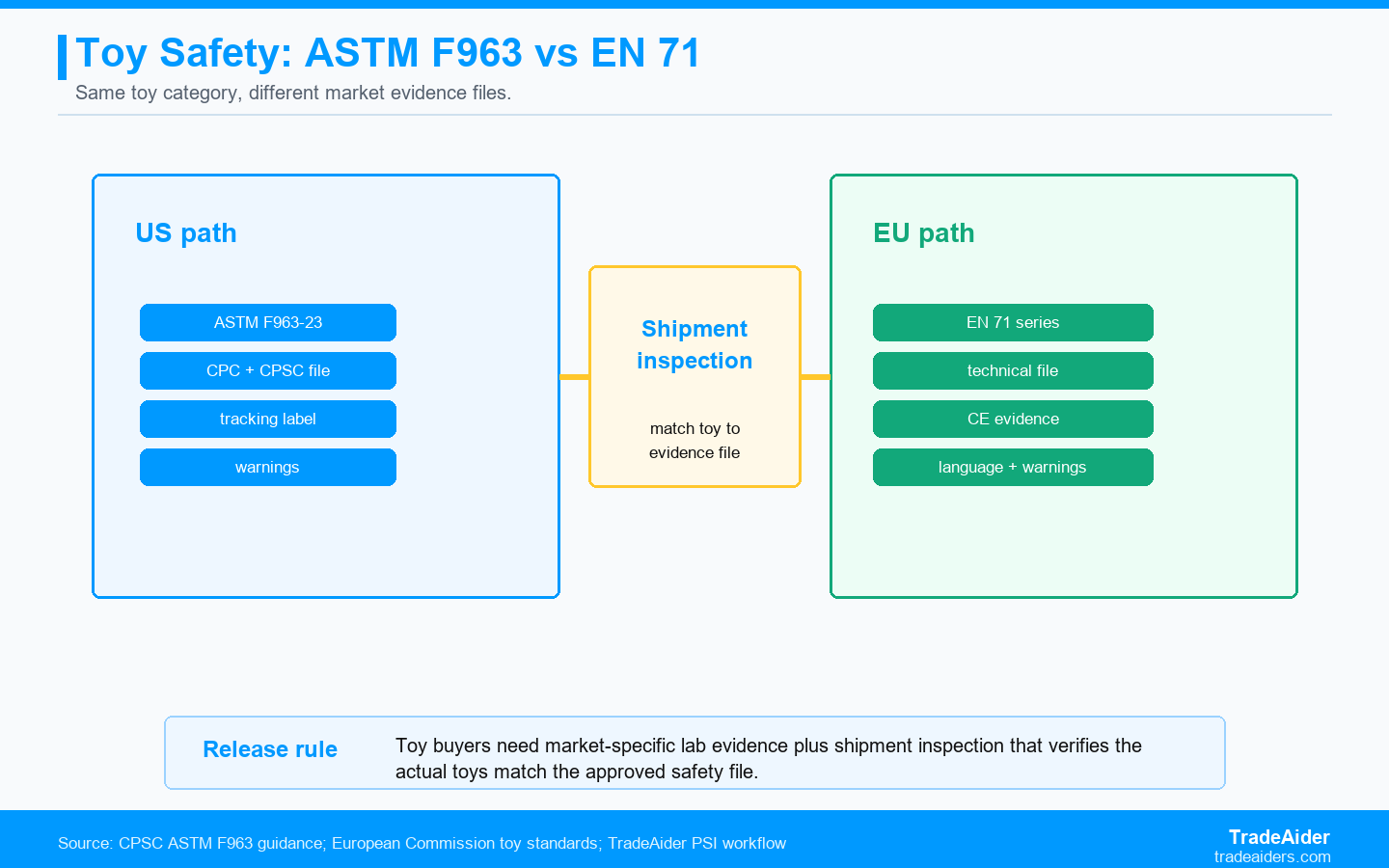
Toy buyers need market-specific lab evidence plus shipment inspection that verifies the actual toys match the approved safety file.
What Buyers Must Check For The US Path
The US path starts with product classification, applicable sections, testing, certification, and traceability.
For US sales, the buyer should confirm whether the product is a toy, whether it is intended for children under 14, whether it is intended primarily for children 12 or younger, and whether children's product testing and certification requirements apply. The seller or importer must understand the obligations rather than relying only on supplier statements.
The compliance file should match the exact toy. Check product name, model, factory, applicant, material, age grade, test date, report photos, ASTM F963 version, applicable sections, CPSIA requirements, tracking label, warning text, and CPC details where required. If the toy uses batteries, magnets, projectiles, sound, cords, elastics, plush materials, coatings, or small components, review the relevant risk areas carefully.
On-site inspection should verify product identity and visible safety elements. Inspectors can check small parts appearance, sharp edges, sharp points, loose components, battery compartment access, warning labels, tracking labels, packaging, barcode, carton marks, and whether the shipped toy matches the tested sample. Inspection cannot replace lab testing, but it can catch shipment mismatch.
What Buyers Must Check For The EU Path
The EU path starts with CE-related responsibility, technical documentation, and applicable harmonised standards.
For EU sales, the buyer should confirm whether the toy falls under EU toy safety rules, what EN 71 parts apply, whether other standards such as electrical toy standards are relevant, whether CE marking is supported, and whether technical documentation, declaration, labels, warnings, language requirements, importer information, and traceability are complete.
EN 71 is a series, not one universal test. EN 71-1 covers mechanical and physical properties; EN 71-2 covers flammability; EN 71-3 covers migration of certain elements; other parts address specific toy categories and risks. The buyer should confirm which parts are relevant and whether the cited versions are harmonised for the destination context.
On-site inspection should verify CE mark placement where applicable, age warnings, language, importer or responsible-party information, model, batch, packaging, instruction leaflet, small parts warnings, and visible product conformity. If the EU version differs from the US version, cartons and labels should clearly separate the market inventory.
Common China Toy Inspection Failures
Many toy problems are not missing reports; they are mismatch between reports and real goods.
Common failures include supplier reports for old models, wrong age grade, missing warning label, missing tracking label, CE mark without supporting file, wrong language, loose small parts, weak stitching on plush toys, sharp plastic flash, exposed metal burrs, battery compartment screws missing, magnet count mismatch, paint or coating change, and packaging that differs from tested samples.
Another common issue is mixed production. A supplier may pack older and newer versions together, use old retail boxes after a label update, or switch accessories. Toy buyers should inspect cartons across the lot, not only one prepared sample. If a toy has multiple colors or characters, each variation should be represented in the sample plan.
Toy buyers should also treat supplier change control as compliance control. A material substitution, paint change, battery component change, magnet change, cord length change, or new packaging vendor can affect safety evidence. The buyer should require approval before changes and decide whether retesting or stronger inspection is needed.
Where TradeAider Fits In Toy Safety Inspection
TradeAider fits by checking whether the shipped toys match the buyer's ASTM or EN 71 evidence file.
TradeAider can use Pre-Shipment Inspection to verify toy model, age label, warning text, packaging, visible construction, accessories, tracking label, CE-related label elements, carton marks, and shipment identity against the approved files.
For toys with production-change risk, During Production Inspection can check materials, components, labels, packaging, and workmanship before the whole lot is packed. If a toy supplier has repeated compliance or process failures, factory audit service can review supplier controls.
The business fit is evidence alignment. TradeAider does not replace a CPSC-accepted lab, notified body, legal counsel, or formal compliance process. It helps the buyer verify that the physical shipment still matches the approved ASTM F963 or EN 71 file.
SPAR Scenario: The Toy Report Was For The Wrong Version
The supplier had a test report, but the shipment had changed.
Situation: A buyer sources a battery-operated toy from China for US and EU sales. The supplier provides ASTM F963 and EN 71 reports from a previous production run.
Problem: During PSI, TradeAider finds that the retail box uses a new warning layout, the battery compartment screw differs from the tested sample, and the EU cartons include English-only instructions. One color variation also has loose plastic flash near a child-handled edge.
Action: The buyer holds shipment, asks the compliance consultant and lab to review whether the change affects testing, requires corrected instructions and warning labels, and asks the supplier to sort the affected color variation.
Result: The buyer learns that toy compliance is not a one-time report. Each shipment must match the approved market file before release.
Action Card: Toy Safety Inspection Checklist
Build one checklist for lab evidence and one checklist for the physical shipment.
- Confirm destination market, age grade, toy classification, and applicable ASTM F963 or EN 71 path.
- Match every test report to product name, model, material, factory, photos, version, and test date.
- Verify warnings, tracking labels, CE-related labels, instructions, language, and importer information where applicable.
- Inspect visible hazards: small parts risk, sharp points, sharp edges, loose components, magnets, cords, battery compartments, and poor stitching.
- Check packaging, barcode, carton marks, variation mix, accessories, and whether all colors or styles are represented.
- Control supplier changes and decide whether retesting, DPI, PSI, or reinspection is needed.
The buyer should not ask the factory whether the toy is compliant in general. The better question is whether this exact toy version, made by this factory, with these materials and labels, for this destination market, has current evidence and matches the shipment. That question is harder to avoid.
For US and EU dual-market toys, maintain separate evidence files even when the product is physically similar. The US file may focus on ASTM F963, CPC, tracking labels, and CPSC-related requirements. The EU file may focus on EN 71, CE documentation, declaration, language, importer details, and technical file. Inspection connects each file to the actual cartons.
Toy safety failures can damage children, customers, marketplace accounts, retailer relationships, and brand trust. The buyer should therefore schedule testing and inspection early enough to correct problems before the shipment leaves the factory.
If you are sourcing toys from China, send TradeAider the toy photos, age grade, destination market, test reports, label files, packaging, and shipment plan. The next step is to ask TradeAider to inspect the toy shipment against the ASTM or EN 71 evidence file.
Frequently Asked Questions
Is ASTM F963 the same as EN 71?
No. ASTM F963 and EN 71 support different market systems. They may cover similar risk areas, but one does not automatically replace the other.
Is ASTM F963-23 current for US toys?
CPSC public guidance identifies ASTM F963-23 as the latest Commission-accepted mandatory toy standard under 16 CFR part 1250.
Can inspection replace toy lab testing?
No. Inspection verifies the shipment and visible conformity. Lab testing and compliance documentation are still needed where toy safety rules require them.
What is the biggest toy compliance mistake?
Using a supplier report that does not match the exact toy version, age grade, material, factory, label, or destination market.
Related Articles
Grow your business with TradeAider Service
Click the button below to directly enter the TradeAider Service System. The simple steps from booking and payment to receiving reports are easy to operate.

