
- About Us

- Our Services
- Your Industry
- Resources
- News & Blog
A US textile PFAS plan should start with the state where the product will be sold, the product category, and the rule date—not with a generic supplier test report. PFAS are a broad group of chemicals often used to create water, stain, oil, or soil resistance. For an importer, the practical release question is whether the sales-state decision, the finished SKU and finish, the supporting records, and the packed lot all describe the same goods. A factory-side inspection can help compare those records with observable goods, but it does not decide legal applicability or certify chemical compliance.
Map the States Before You Request Evidence
A textile PFAS release plan should begin with the states, product category, date, and sale channel in scope; a supplier test alone cannot turn different state rules into one uniform US answer. That is especially important when one SKU is a standard shirt in one product review but a water-resistant outer layer, juvenile product, furnishing, or severe-wet-condition item in another.
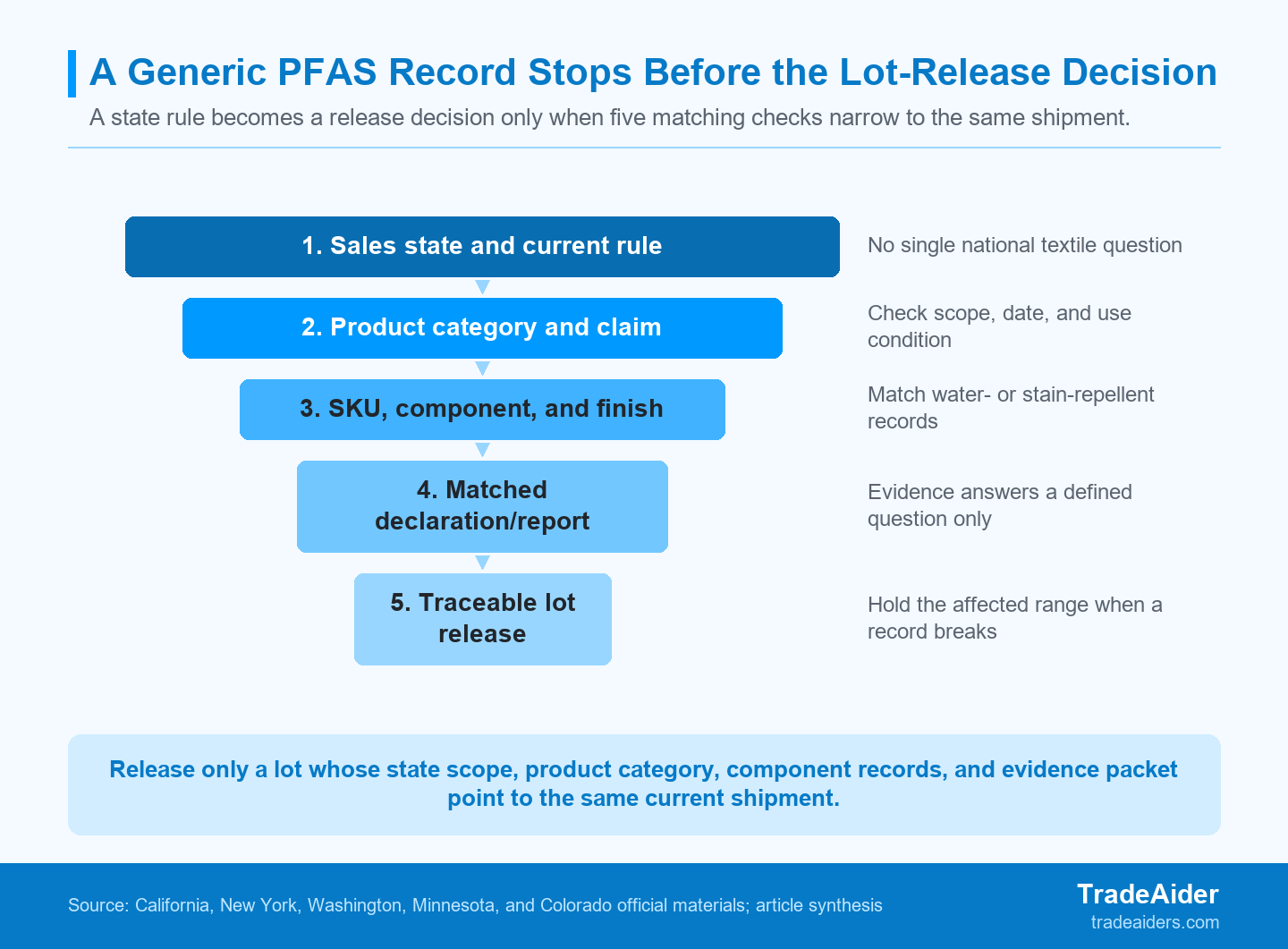
A textile PFAS release decision narrows from the sales state to one identifiable lot and its matching evidence packet.
California's textile-article rule is a product-level control with a manufacturer certificate obligation, so the evidence packet needs both product identity and a signed declaration path. The California Legislature's AB 1817 text sets the January 1, 2025 starting point for new textile articles containing regulated PFAS, subject to its definitions and exceptions.
New York's apparel rule focuses on intentionally added PFAS and separates severe-wet-conditions outdoor apparel into a later phase, so product use claims and category boundaries matter before shipment. The New York State Department of Environmental Conservation guidance states that the regular-apparel restriction begins January 1, 2025 and that the severe-wet-conditions outdoor-apparel restriction begins January 1, 2028.
Washington's restriction date for PFAS in apparel and accessories is January 1, 2027, while the state's textile-furnishing requirements use a different category and date. Its official compliance table is a useful reminder that a state map must name the exact category, not merely “textiles.”
- Map the sales states, exact product category, and effective date before requesting supplier evidence.
- Trace any water-, stain-, oil-, or soil-repellent finish from component to finished SKU.
- Release only an identifiable lot whose records match the product and cartons being checked.
| State | Planning cue | Evidence question before release |
|---|---|---|
| California | Textile articles; statute has a certificate mechanism | Does the SKU and its components match the declaration and applicable statutory definition? |
| New York | Apparel; special severe-wet-condition path | What is the product's intended use and does the manufacturer record match it? |
| Washington | Apparel and accessories have their own restriction date | Is the sales plan using the right Washington category and current timing? |
| Minnesota | Named textile-adjacent categories are phased | Is the SKU a fabric treatment, juvenile product, furnishing, or another covered category? |
| Colorado | Textile and severe-wet-condition pathways are phased | Do the function and use claim change the category review? |
Beginning January 1, 2025, Minnesota's first PFAS prohibitions name 11 specific product categories, including fabric treatments, juvenile products, and textile furnishings, rather than a single all-apparel category. The Minnesota Pollution Control Agency's 2025 prohibition guidance should prompt a category review before a team assumes that a clothing label alone answers the question.
Colorado's 2024 SB24-081 measure uses a phased approach that distinguishes textile articles from severe-wet-conditions outdoor apparel, so a waterproof-use claim needs an explicit category review rather than a generic textile declaration. The Colorado General Assembly's SB24-081 summary provides the current legislative pathway; confirm the enacted rules and SKU-specific scope before making a sale decision.
Put this map into the purchase specification before bulk material is committed. If water resistance, stain release, or other performance treatment is part of the product promise, the buyer should be able to name the fabric, finish, supplier, intended sales states, and what record must accompany that configuration. That is the point where TradeAider can help an importer set finish and material controls before bulk production instead of trying to reconstruct the evidence after cartons are sealed.
Separate Intentional Use From Threshold Evidence
California's statutory definition shows why the evidence question cannot be reduced to one laboratory result: it includes both intentionally added PFAS and specified total-organic-fluorine thresholds that change from 100 ppm in 2025 to 50 ppm in 2027. The statutory definition applies that measurement term to California's rule; it is not a universal US test method or a shortcut for another state's product definition.
“Intentionally added PFAS” means PFAS deliberately included to perform a function in a product or component. “Total organic fluorine” is a measurement term used in California's statutory threshold definition. A buyer may need to review both a supplier's process declaration and a report that answers a defined component-level question. Neither document should be stretched beyond its sample, date, product configuration, and state scope.
Trace the Finish, Not Just the Finished Garment
Water- and stain-repellent claims should be traced from the named fabric and finish to the finished SKU before a team decides which state evidence question it must answer. New York's PFAS background identifies water-repellent clothing as one consumer-product use. That is why the finish claim belongs in the SKU record. Ask for the finished-goods bill of materials, the fabric construction, the finish or coating name, the material supplier, the SKU and colorway coverage, and the production range. A declaration that says only “PFAS-free” without showing which product configuration it covers leaves the release owner unable to match the document to the carton range.
A trace also keeps marketing copy in scope. “Water resistant,” “waterproof,” “stain resistant,” and “soil release” are not interchangeable operational notes. Capture the approved claim exactly as it will appear on the retail pack, listing, hangtag, or product sheet. If the claim changes after a supplier changes a finish, revise the state map and the declaration request before the updated configuration spreads across lots.
Review the Report Against the Exact Requirement
A laboratory report is usable only after its sample, component, method, reporting limit, date, and result are matched to the state requirement and current production range it is meant to support. The release owner should also confirm whether the report refers to the finished item, a fabric, a coating, a trim, or a different SKU. A report may be useful evidence, but it does not erase the need to determine which state's scope applies or whether a later material change has made the report stale.
Use a simple question on the release packet: “What exact rule or buyer requirement is this report intended to support?” If nobody can answer that question in one sentence, pause before treating it as a shipment clearance document. Escalate legal categorization and method selection to the appropriate compliance and laboratory advisers; keep the factory-side task limited to matching agreed references with the current product.
Build a State-Specific Evidence Packet
For each in-scope state, release evidence should connect the SKU and material components to the applicable category decision, supplier declaration, treatment record, test report where relevant, and lot or carton range. That is an evidence-management framework, not a legal compliance conclusion. It gives the importer a controlled way to see whether the record refers to the goods about to ship.
- Sales-state and category decision: record the state, the retail or online sales scope, the product category considered, the rule date, and the owner of any legal interpretation.
- SKU and component map: list the finished SKU, fabric, finish, coating, trim, performance claim, and supplier or mill reference that could change the decision.
- Evidence set: attach the controlled supplier declaration, any relevant report reference, and the rule or buyer requirement each document is meant to address.
- Lot-release control: name the production, carton, or packing-list range covered; state what mismatch causes a hold and who approves the recheck.
Keep one owner for the state map and one owner for the supplier record. They may be different people, but they must use one version-controlled packet. When a finish, supplier, or claim changes during bulk production, do not wait for the final visit to discover it. Use the change point to verify a finish change while production is still running, then update the component-to-lot map before the change reaches more cartons.
A signed record can be meaningful, but its value depends on scope. New York's guidance describes a manufacturer compliance certification that is signed by an authorized manufacturing-company official and kept available by sellers; it should not be treated as a blank form that solves other states' requirements. Minnesota's program also develops in stages, so a supplier declaration should have a date, product scope, and refresh trigger rather than an indefinite “all products” promise.
Use Inspection to Match Evidence to the Packed Shipment
A factory-side inspection can verify agreed product, label, treatment, packaging, and lot observations against a controlled evidence packet; it cannot determine state-law applicability or certify PFAS compliance. That boundary protects both the importer and the inspection team: legal scope, laboratory method selection, and record truthfulness remain with their appropriate owners.
For a Pre-Shipment Inspection—a final factory-side check of agreed observable goods and export packing before release—the order quantity should be 100% complete and at least 80% packed for export. The 80% threshold concerns packing readiness, not production completion. At that point, the inspector can compare selected units and cartons with the approved SKU, visible performance claims, retail packaging, carton markings, packing-list range, and any finish or declaration reference the buyer has included in the packet.
Ask the inspector to record observations, not to sign off on a legal conclusion. A useful brief says which labels to photograph, whether to match hangtag claims to approved artwork, which carton range represents the held lot, how to record a fabric or finish reference, and who receives a mismatch. For a release-stage physical comparison, an importer can scope a pre-shipment inspection around the release packet with TradeAider.
When the records and the physical lot agree, the inspection report adds reliable shipment context. When they disagree, the report should identify the affected SKU and range, preserve photos and counts, and trigger the packet's hold-and-recheck rule. It should not declare that a product is lawful, unlawful, or cleared for sale. That distinction is what makes the factory observation usable for the decision owner.
Illustrative Scenario: Two Lots Need Different Release Decisions
In the illustrative order, a missing finish declaration affects only the traceable jacket lot using the water-repellent finish, so that lot is held while the unaffected cotton tee lots proceed through their own release checks. This is not a TradeAider client case, a testing result, or a prediction of how an agency would treat the goods.
Hold the Identifiable Jacket Lot and Recheck Its Record
A US apparel importer plans sales in California, New York, Washington, and Minnesota. Its 4,800-unit order includes two 1,200-unit lots of water-resistant children's rain jackets and 2,400 untreated cotton tees. The goods are 100% complete and at least 80% packed for export. The product map names the jacket finish as the only component carrying a water-repellent claim. The factory can separate the jacket lots by carton range, but the current supplier declaration does not identify the finish used for the second 1,200-unit jacket lot. The tee lots have their own material declarations and no water- or stain-repellent claim. In the illustrative order, the missing declaration is contained to the identifiable 1,200-unit jacket lot while the separately documented tee lots move only through their own state-evidence checks.
In the illustrative order, the missing declaration is contained to the identifiable 1,200-unit jacket lot while the separately documented tee lots move only through their own state-evidence checks. The release owner holds the named jacket carton range, requests a controlled declaration that identifies the material supplier, finish, SKU coverage, and production range, and revises the state map if the configuration or sales scope has changed. After the record is refreshed, the recheck compares the updated document with the same jacket SKU, approved finish reference, label claim, and carton range. The scenario is an operational method only; state-law scope and laboratory questions go to the appropriate advisers.
This decision is narrower than “release the order” or “stop the order.” It uses traceability to contain the known gap and keeps the team from assuming that a document for a cotton tee validates a treated rain jacket. If the jacket lots could not be separated, the hold would need to widen because the buyer could not honestly tell which cartons the missing record covered.
Send a Decision-Ready Inspection Brief
The useful inspection brief names the state coverage decision, the specific product components and treatment records to compare, the shipment range, and the owner who can hold and recheck a mismatch. It turns a broad PFAS request into an observable factory-side task without asking an inspector to make a legal ruling.
- Attach the current sales-state and product-category map.
- Name every SKU, fabric, finish, component, and approved performance claim in scope.
- Provide the controlled declaration and any report reference, with its intended evidence question.
- Specify the production or carton range to observe and the photos or counts needed.
- Name the hold-and-recheck owner and the escalation contact for a state or laboratory question.
TradeAider can use that packet to scope observable checks against finished goods and export packing, while the importer keeps responsibility for the state decision and supplied evidence. If the state map, component list, and carton coverage are ready, send the state evidence packet to TradeAider for inspection scoping.
Frequently Asked Questions
Do all US states use the same textile PFAS rule?
US states do not use one textile PFAS rule; they can differ by product category, definition, effective date, evidence mechanism, and treatment of special outdoor or juvenile products. Build the sales-state map for the actual SKU, then identify the state source, scope boundary, and evidence owner. A declaration that is useful for one state's category should not be presented as a national clearance statement.
Does a PFAS test report prove every state requirement?
A PFAS test report does not prove every state requirement; it supports a defined question only when its sample, component, method, date, and result match the applicable state requirement and current product configuration. It does not determine the product category, make a sales-state decision, or automatically cover a later change in fabric, finish, supplier, or performance claim.
What can an inspection verify for PFAS planning?
An inspection can compare agreed physical product, label, finish-reference, carton, and lot observations with a controlled evidence packet, but it cannot determine legal applicability or certify compliance. Its value is the traceable record of what was observed on the identifiable shipment range, plus a clear escalation when the goods and packet do not match.
When should a supplier declaration be refreshed?
Refresh a declaration when the product, material, finish, supplier, sales-state scope, rule date, or production lot coverage changes in a way that could affect the evidence decision. New York's PFAS apparel guidance says a manufacturer compliance certification may be used to document compliance, is signed by an authorized manufacturing-company official, and should be maintained on-site by sellers. The NYSDEC guidance provides the state-specific source. Keep any such record tied to the current SKU and configuration rather than relying on an undated supplier statement.
Related Articles


Grow your business with TradeAider Service
Click the button below to directly enter the TradeAider Service System. The simple steps from booking and payment to receiving reports are easy to operate.

